A Feisty Farewell

No trip to Central Asia is complete without some yurt action, so naturally we had to check it out and see what it’s like to spend a night in a yurt. If you’ve read any of our other posts on Central Asia, you will probably not be surprised to know that getting to said yurt involved a pretty rough, long drive. The landscape was all desert, not so much sand dunes, but lots of patches of about 6-inch high plants and nothing else. We stopped in this one area that seemed to pop up out of nowhere, with just a few trees and tons of locals picnicking, which was completely random and really fascinating.

While here, we climbed up the slate rocks to check out some very old petroglyphs. Up top, a local guy showed us a scorpion he caught and somehow maneuvered into a water bottle. It’s probably for the best that we declined to share this piece of information with Linda until after the yurt stay was over.

When we finally arrived, we were smack in the middle of the hot hot desert. There wasn’t much around except for a handful of yurts and a few camels, though our yurt accommodation was surprisingly fancy – we got thick mats to sleep on, there was even a light and a power outlet in the room, and get this…flushing toilets on the premises! Living large, my friends.

Alan and Ron went off to explore Lake Aidarkul for a quick and refreshing swim. Meanwhile, Linda and I stuck around at the yurts for a camel ride. Our camel guy seemed to be mildly infatuated with me, and I was hesitant to include this on here because it makes me all bashful, but I got a kick out of the fact that in Alan’s notes from this day it reads “J and Linda do camel ride, guess guy loves J. Natch.” Aw, honey.

Dinner was a multi course meal amongst the other tourists in a bigger tent. We drank a little vodka, busted out the cards and played a little dhumbal, and then everyone headed outside to the campfire where a Kazakh (the yurt camp was near Kazakhstan and thus many local residents are ethnic Kazakhs) singer and guitar player serenaded us. The Americans headed to bed afterwards, but the Russian tourists stayed up late very passionately (read: loudly) singing some patriotic songs.

As a telling example of the monitoring and control the government does and has, know that tourists must “register” at every hotel they stay at. These little stubs we receive when we hand over our passports at each stop must be presented upon exiting the country as proof of where we’ve been. So, even at this yurt in the middle of the desert, we had to use our passports to get documentation to serve as proof of our whereabouts. I’m starting to get the feeling that the government likes knowing where we are!

On the drive out to the yurt we had stopped in Gijduvan for a demonstration of the pottery workshop. You know this guy is legit, because he met Hillary.

We also stopped briefly to see a fortress built by Alexander the Great (holy oldness!) and to see the holy water spring and holy fish (so much holy in this sentence!) at the base of the fortress. While Ron and Alan climbed up top for the view, Linda and I stayed down and chatted with Mansur. A very curious Uzbek tourist was intrigued, and, speaking no English (or anything for that matter), stood about three inches from my face and watched me as I spoke and listened. I tried to be polite but my personal space bubble was just bursting and I finally had to run away from her in the awkward, shamed way that us space-bubble activists do. By now we were quite used to being among very few tourists (meaning foreigners, as we saw tons of Uzbek tourists) and used to people saying hello, wanting to know where we’re from, etc. We joked with our guide that we should just wear a big sign that says “AMERICA,” since he was constantly fielding the same question from curious Uzbeks as to our origins. Luckily, all the Uzbeks we encountered responded with enthusiasm, or – at the very least – tolerance (sadly, this was not the case for all of our Central Asian visit).

We left the yurt early in a best efforts attempt to escape the desert heat before it was at its most oppressive. It was Samarkand or bust! By now, by the way, the views on our drives were becoming more and more incredible. Beautiful pastures backed by stunning snow-capped mountains. Every so often a boy riding a donkey, or a shepherd tending his herd of cattle. Or sheep. And then these fields of poppies. I can’t even stand how beautiful it was. These photos are not even properly taken. They’re car shots. From a moving van. You can see the reflection of the camera in the window. And the blur from the speed. And it’s still the most amazing pastoral scene.

And then, the pent-up excitement was killing us. We’d been teased by these mosques, these madrasas, these caravanserais, these architecturally and historically significant buildings. One after another of impressive, amazing, intricate, beautifully tiled, older-than-old things. But we knew the icing on the cake would be Samarkand. Oh, Samarkand, the holy grail of Silk Road destinations. And here it was, at our fingertips and ready for our incessant photo taking and endless stories of ancient Islamic tall tales. And this is what we arrived to:

Wouldn’t it be our luck that our trip to Central Asia coincided with a period of construction and renovation on perhaps the most noteworthy historical sight among all of the Silk Road’s sights. I can’t lie, after all the history we’d soaked up like a (partially functioning) sponge, we were not quite in the right state of mind to truly appreciate the awesomeness that is Samarkand’s Registan Square, but this construction really did us in. We could hardly appreciate the grandeur of these buildings. Their scale puts the ones we saw in Tashkent, Khiva and Bukhara to shame, but it is very difficult to appreciate from the side, with jackhammers screaming (as evidenced by my face in that lovely video). I think part of what detracted from our experience here as well was that there were so many souvenir shops in, and modernization evident on, the buildings – for example, plastered walls and lights installed in the rooms to create better gift shops. Restoration is one thing, but some of this felt more like alteration and enhancement. We did not realize that all three enormous buildings on Registan Square were built after Tamerlane’s rule. By the way, Tamerlane is the same guy as Amir Temur.

Our first afternoon in town we were on our own, so we wandered around a bit independently. We meandered down the walking street, which used to be lined with stalls and covered. There is a bit more of a regular city vibe here (short shorts sighting included – though jeans are still a rarity). It’s not too surprising given that it’s the second most populous city in Uzbekistan at about a half million people. While the walking street is lined with souvenir shops and feels quite sanitized, it is a very pleasant place to kill an afternoon.

We ventured into the Jewish quarter in a search for the synagogue. By chance, McLovin happened to find us and show us the way. Not kidding. This kid had the lisp and everything…is this not the Uzbek twin of McLovin?!

We escaped the heat with a soft-serve in the shade. When in Samarkand do as the Uzbeks do?

There is also a nice little market off the walking street.

Aside from Registan Square, we also visited the first mausoleum of Amir Temur, where he is buried among others. It’s decorated with marble, papier-mâché over brick, gold leaf adorning everywhere, and the tomb is black jade.

What still managed to impress us mightily after all the sightseeing we’d done by this point was Shah-i-Zinda, a narrow street lined with mausoleums so densely packed and intricate it’s hard to fully absorb what’s surrounding you. This was by far the most impressive tile work we saw on the trip.

The tile-making process is incredibly intricate. Check out these pictures that give you a little sense of how much work goes into each one.

Our next stop in Central Asia was Kyrgyzstan, and getting there was quite the ordeal. After a change in schedule made the Tashkent to Bishkek flight less appealing, we decided to drive from Tashkent and cross the border at Osh, Krygyzstan, followed by a domestic flight from Osh to Bishkek. This was probably a mistake. We will cover the Osh airport incident in a separate post, but even getting to that scene was not an easy process.

The drive was much longer than our travel agents (both local and foreign) said it would be (how neither organization, whose functions entail solely guiding tourists through these countries, could figure this out is beyond me), and thus we spent 6.5 hours in the car without time even to stop for toilets or water. There was some beautiful scenery, and, this is still Uzbekistan, so there were also some checkpoints. I mean, why would anyone think you can move around freely within a country? One checkpoint involved getting out of the car and waiting while watching our passports get tossed onto the hood of someone else’s (moving) car. But anyway, after 6.5 hours we arrive at the border for our final Uzbek exit, already frazzled about the timing mistakes (plural. Aside from driving time, neither travel agent realized there was a time change at the border, despite our efforts to confirm this given the time change in Bishkek) and potentially missing our flight and being stuck in a Kyrgyz city that some State Department equivalents recommend avoiding. The border officials know we are in a rush, and this appears to inspire them to be extra slow and spend extra time talking and joking about us while we stand there. And there is certainly no right to privacy here, or at least the border control folks have no concern violating it. This is evident as the bag searches begin. The situation came to a head when one guy made me take out my laptop, open my photos (I guess because you are not supposed to take photos of certain things and places, the authorities feel entitled to search your photo files upon exit) and then started going through not only the photos from our time in Uzbekistan, but proceeded to peruse my older photos, including a photo album I’d made for Alan after our first year of dating. At which point I, in the middle of this border control building and surrounded by about six employees doing nothing but helping themselves to a tour of my photos and belongings, barely able to contain the rage bubbling up inside of me, slapped his hand away and grabbed my computer back saying something along the lines of “enough, this is ridiculous…[mumble lots of swears].” Though he certainly wasn’t able to decipher what I was rapid-fire shaming him with, I told him in no uncertain terms that he had absolutely no right to be going through those photos. As Alan points out, it was a bit of a ballsy and risky move, but it was a highly effective one, because a few minutes later we were walking across to Kyrgyzstan. And this guy clearly knew he was doing something wrong, as that was the end of all the bag checks. Alan’s was cursory at most. Hopefully I succeeded in shaming him to some extent, though this was not the end of the authorities prodding out of some perverted curiosity with further questions. Can I just say that it’s never given me greater pleasure to look a man in the eye and say, “I’m a lawyer.” This series of events filled me with a lot of rage. In retrospect, what was I to have done? Not opened the computer? Told him I had no photos? To be at a border crossing, confronted by these men is to be in a place of no power. They hold all the cards. Power does strange things to people, doesn’t it?

To summarize our time in Uzbekistan, we spent cumulatively about 10 days there. I think we all agree that we may have bitten off slightly more than we could chew in the history and sight-seeing departments, even with cutting out a number of the other Silk Road cities. We generally prefer more culture or interaction or activity on our trips (and definitely less time spent driving). But overall, we found the experience in Uzbekistan to be fascinating and worth the headaches (e.g. even despite the immigration and customs headaches). Aside from the gems hired to work its borders, the people we met in Uzbekistan were wonderfully pleasant and friendly. And it’s a tough balance to figure out because, while the security presence and red tape bullshit in Uzbekistan got very tiring, very fast, we really did feel safe here. Contrast this with Kyrgyzstan where we didn’t need a visa (in fact we did not even fill out an immigration form), didn’t have to register at our hotels, weren’t subjected to arduous border crossing processes, and didn’t get pulled over at numerous checkpoints. That was lovely, but Kyrgyzstan has a higher crime rate, and we actually felt the least safe in Krygyzstan of any country we visited (again, more on that later). Uzbekistan was unusual in many ways, and very much a different experience from most of our prior Asian travels (and really all of our travels, ever). From small, interesting nuances like the fact that drivers already in the rotary do not have the right of way, to the Soviet style checkpoints, form checking and border control, it was a place unlike any other we’ve been. There is so much of interest to see here, we feel it would benefit the country much to fix some of the issues that inhibit tourism here (e.g. making visas easier to obtain and fixing the currency issues we detailed in prior posts).

Practical Info

Transportation: We took a high-speed train back to Tashkent. There is a cafe and a couple stalls selling snacks at the station. We boarded at 4:20 pm (our guide said you should board early, he may have been just trying to go home) and the train departed (exactly on time) at 5 pm. It was incredibly nice with spacious seats that reclined. I guess we were in business class, not sure if they sell lower classed seats or what those would be like. They served complimentary tea and these tasty little burrito-like things, plus a wide selection for purchase. We arrived in Tashkent a little after 7 pm.

Accommodation: In Samarkand, we stayed at Hotel Malika Classic (not to be confused with Malika Prime). WiFi worked reasonably well, and it we paid 3k UZS for access for the whole family on unlimited devices. The hotel was quite nice and the staff was friendly and helpful, but it seemed a little removed from the action. That said, I’m not sure where the action is.

Food: My dad and I had dinner at Venezia where we got pizza, which was fine and a welcome change. With two beers and water and tip it cost 35k UZS. Lunches were at Sayor Cafe (right next to Karambek which gets good reviews, and I think the same owner), which was good, and at the Choyxona (aka tea house) by the bazaar near Bibi-Khanym Mosque, where we had manti and bread and yogurt and cucumber and tomato with dill and soup.

Activities: We covered most of this above, but I’ll add some more detail and/or repeat here. Our travel agent arranged the trip to Lake Aidarkul and the yurt stay, but we saw tourist offices advertising a similar overnight trip from Samarkand and likely other places. While I enjoyed the scenery and overall experience, it is pretty out of the way and thus if you have limited time then I would say this is skippable.

In Samarkand, while exploring on our own the first day, we walked through some back alleys and saw the Mubarak Mosque and nearby synagogue. On our full day tour, we visited the Amir Temur Mausoleum; Registan Square; Bibi-Khanym Mosque; Siab Bazaar; Shah-i-Zinda; and Ulugbek’s Observatory.

May 4-7, 2014 (Sunday-Wednesday)

Bukhara: The Living City

After another long Central Asian drive and even longer Central Asian border crossing we were back in Uzbekistan, this time bound for Bukhara. We freshened up quickly at our hotel (necessary after the mile-long walk through no man’s land in the desert heat between Turkmenistan and Uzbekistan) before heading out for a night of Uzbek food, fashion, dancing and music. This dinner, at the madrasa Nodir Devon Begi at Lyabi Khauz complex, was a lovely welcome back, and we thoroughly enjoyed our dinner (including a surprisingly not horrible Uzbek wine) while being entertained by a show alternating between fashion and traditional dance. (Very dorky) fun fact: the “madrasa” was built to be a caravanserai, but the king misidentified it as a madrasa at its unveiling, and the poor guy who built it couldn’t correct the king of course. So this is why it’s an atypical structure for a madrasa, and why you can walk straight into the courtyard (unlike other madrasas where you must go right or left upon entrance). Maybe it was that Uzbek wine, but I got inspired to shop. I’m kind of digging the Uzbek style. So much so, in fact, that I caved and bought my first “real” souvenir of the trip: a lovely Uzbek jacket.

Walking back through the old city after dinner it was immediately apparent that Bukhara is not the museum relic that Khiva is, but a living city. People are out and about everywhere, dining, drinking, shopping, laughing. It’s far more vibrant. Also more western and touristy, but overall a nice mix of activity. And we aren’t complaining about access to some of those “touristy” things we’d been missing, like ice (Alan loves his iced coffee). So enamored were we that we returned the following night to Lyabi Khauz, a plaza built around a pool shaded by some seriously old mulberry trees, for dinner at a nice restaurant on the water.

Bukhara is one of the seven holy cities of Islam because the religion developed so much here. Real religion or history buffs can have an absolute field day here, visiting as many of the 997 historic monuments as they can fit in. It’s all the more impressive when you realize that many of the buildings in Bukhara were destroyed when the Mongols invaded in 1220, and again when the (Russian) Red Army attacked and bombed the city in 1920. We had neither the time nor the attention span to see all of these, but we did get a good sampling, starting at the first building in Central Asia built of fired brick (the Ismail Samani Mausoleum) and which served as the prototype for India’s famed Taj Mahal.

The Bolo Khauz mosque, built in 1713, with an ayvan built in 1917, was particularly stunning, and we sat there on a Friday morning observing a group of old men waiting for the Friday services.

Alan and Ron got in touch with their roots for a change when we stumbled upon an old synagogue, which is home to the handful of remaining Bukhari Jews. (If you are interested in learning more, check out this New York Times article on the community in Queens.)

The gigantic fortress was impressive. It was here, of all places and all things, that bowling began when guards used to roll giant rock balls down the entrance to defend it! But what we enjoyed most was the impromptu flash mob of Uzbek ladies. (Funny enough, these are the same ladies from Fergana valley who we laughed with as the two groups of us stood around photographing each other).

Check out the video:

We executed our first black market money exchange here in Bukhara and you really feel like you’re doing something illicit when a guy your guide knows through a guy shows up with a black bag full of bills, crouches down all shady to count it out and then makes the exchange. I half expected to find a couple packets of smack in that bag. Just to be clear, this was the first black market exchange that we personally conducted. Earlier that same day, the driver who gathered us from the border crossing pulled over by what appeared to be a broken down car. Perhaps he was just a good Samaritan who received a five-gallon jug of petrol as a thank you, but the bag of cash suggested otherwise.

Perhaps the most impressive view is in the square surrounded by the Kalon Minaret, the huge Kalon Mosque and the prestigious Mir-i-Arab Madrassa. The minaret was likely the tallest building in Central Asia when it was built in the 12th Century. Genghis Khan was so impressed that he declined to destroy the minaret even as he razed everything else. By the way, I never knew that many spell Genghis as Chinggis or Jenghiz and pronounce it differently than we were taught.

This mosque (the oldest one, now home to a carpet museum) isn’t too shabby either.

Just outside the old city are even more historical sights. We checked out Chor Minor, which is a unique madrasa with four minarets. As Mansur drilled into our brains, building a madrasa kills two rabbits with one bullet 😉 : it satisfies the builder’s obligation to give charitably, while at the same time bringing him fame. This guy killed three rabbits, because the four minarets were a symbol to the world that his four daughters were, ahem, single.

Check out these doors with the double knockers – they each create a different sound so the people inside knew if a man or a woman was knocking and whether the woman answering the knock could show her face when she opened the door. Neat, eh?

Next stop was at a Sufi mausoleum. I learned that Sufism has something to do with silent meditation…something about all dervishes are Sufi but not all Sufi are dervishes…but mostly I kind of tuned out this stuff and thought about how we call my cat, Safari, Sufi for short. I know. Probably not the ideal candidate for this much historical immersion. I apologize to all our readers who were waiting patiently for my notes on Sufism.

Last stop on the tour was a visit to the Emir’s Summer Palace (the last emir, Alim Khan), an extremely pretty and intricately designed home with a lot of Russian influence. Our guide often asked us questions to keep us guessing and engaged in the course of our tours. At the summer palace he asked us to guess how the builders knew that this area would be cooler than the old city (hence the putting of the summer palace here). Our three or four guesses were dismissed before he finally gave us the answer. Linda smartly pointed out how hilarious it was that he let us keep guessing on this one like we might actually get there. The right answer? They cut a slaughtered sheep into four pieces and hung each on the four corners of the old city, waiting to see which direction spoiled the slowest, and then assumed that such direction was the coolest.

We learned a little bit, too, about Suzani embroidery. Apparently they are kind of like resumes of the girl making them, and she chooses figures that symbolize aspects of her personality. For example, the turtle symbolizes patience, the pomegranate means fertility, and the scorpion: tough. We opined on what we might sew on our own Suzanis to court each other, and we agreed neither of us would be needling any turtles. Dogs? Yes, definitely some of those. Loyal, cuddly, and super happy to see you at the end of every day. Sorry, total corn balls.

Mansur took us to his favorite spot for lamb, Chor Bakir, which was just outside of the city and certainly not touristy. The baked lamb was solid, if not incredible. But the special bread took the spotlight. It was like a super thick, flaky, buttery pie crust. Delicious.

For a little relaxation we decided to visit the Hammam. Now, being half Turkish and having visited Turkey several times you might think that I’d experienced a Turkish bath before, but no. I’d somehow avoided this experience until Uzbekistan. And it will most certainly be my last time. I’d say that it was one of the least comfortable experiences I’ve ever had. Not so much the vigorous scrubbing or the weird body contortions or the intense heat that was amplified by the ginger they rub on you, but the fact that it was a young man and I was, well, naked. Why couldn’t I get a fat old lady with a really big mole on her face? No, who am I kidding, I’d still be incredibly uncomfortable in that situation. The baths are not for me.

On the way out of town we happened upon a bird market and popped out of the van to explore. I’ve never seen so many birds in one place! My friend Jaimie has pretty severe ornithophobia, and I kept thinking this would be her nightmare.

Over on the prepared foods side of the market we picked up fixings for another picnic lunch. We ate so many dried fruits and nuts on this trip! I was able to fuel the fire that is my obsession with yellow raisins, and we even discovered a tasty new treat: apricot kernels.

Practical Info

You can walk to visit all the attractions in and around the old city, but you will need motorized transport to visit the Emir’s Summer Palace and/or the Bakhautdin Naqshband Mausoleum. If you like shopping, there are little domed bazaars at the crossroads of various streets and pedestrian paths. Today these seem pretty touristy, but markets have existed in this fashion for centuries. We saw many vendors with beautiful pottery near the Kalon Minaret and elsewhere.

Accommodation: We stayed at Karavan Hotel. The location seems pretty good, as it is right in between the different “old town” sites. There is free WiFi in the lobby, and they did our laundry for a reasonable price. That said, since Bukhara was the most lively and fun city we visited, I might prefer to stay closer to Lyabi Khauz. Which would put you further away from Bolo Khauz and the Mausoleum of Ismail Samani etc., but more in the middle of a fun little evening scene. A couple spots I noticed there were Hotel ASL and Hotel Asia.

Food: Our first night we went to the 6 pm dinner, folklore, music and fashion show at Madrasa Nodir Devon Begi (at Lyabi Khauz complex). It cost 230k UZS including a bottle of wine, i.e. not cheap but it was enjoyable and worth it. Another night we ate near the same place, right on the little water square at Lyabi Khauz. It was quite good and lively.

For lunches, we enjoyed Bolo Khauz Cafe (near the eponymous mosque), which had a nice mix of locals and some tourists. After our day trip to the Sufi shrine and Summer Palace, we had lunch at Chor Bakir, a non-touristy lamb spot outside the city. The baked lamb was solid if not incredible. The “special” bread we waited for out of the oven was incredible.

I finally got my iced coffee fix at Minor Coffee House. Well, actually it was a strange mix of espresso and Pepsi, but it had ice so I didn’t complain. Cafe Wishbone had a delicious iced coffee that was more like a frappuccino.

On our way out of town we stopped at the large market for picnic supplies. The variety and quantity of nuts and dried fruits are impressive (with combos like walnut-stuffed apricots). We bought outstanding apricot kernels…our guide said that Bukhara apricots are special which is why these kernels are better than most. They also sell chicken legs, apparently purchased from the US for their unnatural immensity. These are called Bush legs, no joke.

Activities: We covered most of this above, but I’ll list it out here. On our full day city tour we visited the Ismail Samani Mausoleum; the Chashma-Ayub Mausoleum; Bolo Khauz Mosque; the Ark Fortress (similar to Kunya Ark in Khiva, this was the royal town within a town), within which is the reception and coronation court, another mosque and some small museums; Kalon Minaret and Mosque; Mir-i-Arab Madrassa; an old Jewish synagogue near Lyabi Khauz; and the oldest mosque (I forget the name) which is now a carpet museum.

The hammam that Jenni so enjoyed is called Bozori Kord. I did not experience quite the discomfort that she did, but I would drop it in the category of an experience rather than a supremely enjoyable experience. My dad and I suffered in the uber hot room for about 15 minutes too long before being doused and roughly massaged with our faces pressed against a marble slab. All while I’m fearing that the man contorting me isn’t quite as focused on my herniated discs as I am. And that ginger scrub combined with lying down on hot stones honestly made me feel like my back was on fire. It was astoundingly hot, relieved only somewhat after they threw buckets of cold water on us. The fee for this hour of bliss is a mere 60k UZS.

On our day trip outside the city, we visited the Bakhautdin Naqshband Mausoleum (the memorial complex of the Sufi saint Naqshbandi) and the Emir’s Summer Palace.

May 1-4, 2014 (Thursday-Sunday)

And It Burns, Burns, Burns

You start to feel like you’re out there when your guide uses Afghanistan as a directional point of reference. “Afghanistan is just that a-way.” “See those mountains over there? That’s Iran.” But then you really feel out there when you drive hours into the Turkmen desert in search of a giant gas crater that has been burning non-stop for more than forty years, and then camp right by it. But I’ll get to that shortly. Any doubt that we were off the usual tourist circuit was obliterated when we realized that the entire time we were in the country we saw only one other person we were certain was a foreign tourist! (And she was a deaf-mute Japanese girl… is your mind blown yet? Again, I’ll get to that in a minute). Lest doubt linger on, know this: the former president of Turkmenistan proposed renaming the months of the year. After things like his mother.

Our entry to Turkmenistan was an “out there” experience in its own right. It was our first overland border crossing in Central Asia, from Uzbekistan. The process of getting from the edge of Uzbekistan (coming from Khiva) to the start of Turkmenistan (at Dashoguz) was an ordeal that took the better part of two hours, and included no less than nine (yes we counted them) passport checks. Mind you there were no lines. The process is just. that. slow.

Let’s break it down, shall we? First, there is a briefing by the guide who drives you to the border that you are under no circumstances to take pictures at the border. (We sneakily took our one photo from the car, but then, unfortunately, we had to halt the documentation of this epic process). After our car dropped us a solider checked our passports before we were able to enter the building. We filled out some forms and passed through customs. Of course, a few more people are checking our passports through this process. Occasionally, they are checking our bags. For what, I don’t exactly know. Then we walk a little bit further to immigration where our passports are stamped. Then, a solider on the other side checks our passports once more. Then you walk across to the Turkmen soil where another couple of soldiers checked our passports and looked for our visas (we only had an invitation letter at this point). Here, we were told to wait, and eventually up came a minivan to shuttle us the maybe half mile or so across no-man’s land to begin the process of entering Turkmenistan. Never mind that we had no choice in the matter of whether to walk, we were charged $1 each for the convenience. Again we wait for a soldier to check our passports and invitation letter while he sits in a little glass cube for several minutes hand writing down information from our documents. Our hearts sank a little when we thought he said “bad news,” but he was really saying something in Turkmen that we can only assume means “wait here while I very slowly cut through some red tape.” Finally, our passports retrieved, we walk to the main building and hand our passports over to the next lemming. Thankfully, our guide met us here, and explained that we should have a seat because it could be a half hour or more before we got anywhere. He also assisted in the customs procedure by asking about three different ways whether we were transporting any drugs or souvenirs as they checked our bags (apparently there are very strict rules governing the export of certain items, and if we had bought things like these items in Uzbekistan and failed to document that then we might face trouble when we tried to leave Turkmenistan. For this same reason, we were advised to buy items like jewelry or carpets only at official stores that can provide official papers).

Talk about a nation (or nations) in their post-communist era independent infancy. There’s a whole lot of bureaucracy and red tape and rules that don’t make a whole lot of sense in these parts. At least to an outsider. And we tried, oh we tried, to understand. We asked ourselves why five people need to look at your passport in the course of 100 yards. Is it because the state is large and needs to find employment for its citizens? Is it because the powers that be do not trust the workers and soldiers to check things correctly? And if so, is this a manifestation of a general lack of trust? Is it because they want to create an atmosphere of authority and ensure you get the message that the state is powerful and knows everything you are doing? All of the above?

As mind boggling as this experience was, quite possibly the most amazing part of it was the one other person we saw crossing: a deaf-mute young woman from Japan. Talk about balls! I can’t even imagine traveling alone in this part of the world, let alone as a woman (not that it can’t be done, and we’ve met women who travel the world independently, I’m just saying they are infinitely braver than I), but a deaf-mute single woman for whom English is her second language?! We observed one of the soldiers trying to communicate with her and she wrote down (in perfect English and very neat handwriting) “can you write, please?” The man clearly couldn’t read English, and I wouldn’t be surprised if very few people in this part of the world can read and write English well enough to communicate effectively. So, kudos to this massively impressive girl. We keep meaning to Google her and see if maybe she’s writing a book or something. Our other theory is that she is a spy and the whole deaf-mute thing is a cover. In this case, she is probably also a ninja.

Having finally succeeded in crossing the border (which in its own right felt like an accomplishment of sorts), we were greeted by our animated guide Rustam, and two SUV’s packed and ready for camping. Our driver, Aman, was the coolest grandpa I’ve ever met. He rocked Ray-Bans and had a look you might expect of a guy driving you across the Sahara from North Africa. Already we began to notice differences from Uzbekistan. First, while the landscape hadn’t much changed, it already looked and felt more wealthy. I suppose this is not terribly surprising given Turkmenistan’s comparative wealth (they have a robust gas supply, in addition to a healthy textile industry and agricultural crops. In fact, the state provides 120L of petrol free per month, and thereafter it costs about $0.25 per liter! Our guide said you could run the utilities in your home non-stop for a year and pay something like $50.) We passed some fairly basic looking villages but then began driving through a small city lined with big, modern buildings, and we started seeing the roads dotted with Beemers and Lexuses.

It perhaps goes without saying that when you have a guided tour in a country your experience is somewhat colored by the opinions and personality of that guide. Our guide in Turkmenistan was young, spirited and lively, and we felt that extended somewhat to the country as well. Despite that Turkmenistan bans Facebook and Uzbekistan does not, we felt a noticeable increase in cheeriness (albeit alongside an increase in aggressiveness). First of all, crossing the border we immediately began to see more variation in the color of the cars, in stark contrast with Uzbekistan’s white vehicles (our guide had told us this is because of the oppressive summer heat). Like Uzbekistan, Turkmenistan is primarily Muslim, but it is not an Islamic state, and again our guide felt inclined to point out that they are not fundamentalist Muslims (his words: they pray outside the mosque, like beer and pork and do not kill people). A rather blunt statement, but I guess they are sensitive to the fact that many ignorant people have a difficult time grasping the concept that there are Muslim-majority nations that are neither Islamic states nor infected by fundamentalism. The guides believe that many Americans fear this region and/or that we are told not to come here, which is at least partly true. But to make a long story short, we had only one very unpleasant and uncomfortable experience while in Central Asia (which we’ll mention when we cover Kyrgyzstan), and it did have to do with our being American but had nothing to do with religion.

On the way to the desert we stopped briefly to visit a produce market and picked up some local cognac and wine. Our guide raved about the cheap and delicious Turkmen cognac (20 Manat for a decent sized bottle), but I think we were mostly excited to pay for something without counting through a thick wad of cash (unlike Uzbekistan, here the exchange rate is closer to 3:1 and large bills are in circulation). We tried desperately to photograph some of these women with the epic teeth bling, but to no avail. They smile and flash these golden chompers, but the minute you hold the camera up the smiles turn tight lipped. We also tried to snap a shot of the adorable school girls in their green uniforms and long pigtail braids (which we learned were a required part of the uniform. If you haven’t got the hair you must get the extensions). The boys, somewhat less cute, wore little suits and taqiyahs (traditional Turkmen caps). This is the best shot we got:

Our final stop pre-crater awesomeness was our brief intro to Turkmenistan’s ancient Silk Road history (having gotten more than our fair share of old buildings and history in Uzbekistan we opted to skip most of the more prominent Silk Road attractions in Turkmenistan). Nonetheless we made the not-so-quick excursion to Konye-Urgench for a very quick tour. These sites were not as restored or excavated as the ones we viewed in Uzbekistan, but they were very much in the middle of nowhere, so you got to feel somewhat the experience of what it might have been like to pull up at one of these desert oases in your caravan (way) back in the day. We snapped the obligatory mausoleum photos and got accosted by a group of locals eager to photograph us. I was intrigued to learn that there is a hill (called Kyrk Molla) women roll down in the hopes it will make them more fertile (lots of Turkmen folks come here on pilgrimage). I just hope none of them are doing this while already pregnant.

And alas, onto the crater, which is essentially the reason we made this entire foray into the fascinating nation of Turkmenistan. After leaving Konye-Urgench and passing back through Dashoguz, we still had another four hours or so driving through the middle of nowhere. Literally. There was nothing for miles in any direction for large chunks of this drive. I would be lying if I told you the thought never crossed my mind that these guys could be taking us to some secret cult headquarters. The roads were in quite the state of disrepair, and this resulted in some serious swerving. It didn’t help that keeping right was more of a suggestion than a rule, and cars would occasionally just begin driving on the wrong side of the “highway” because there were fewer potholes. We were also intrigued by the sporadic arrangements of straw boxes placed roadside; these apparently help keep the sand from blowing across and clogging the roads.

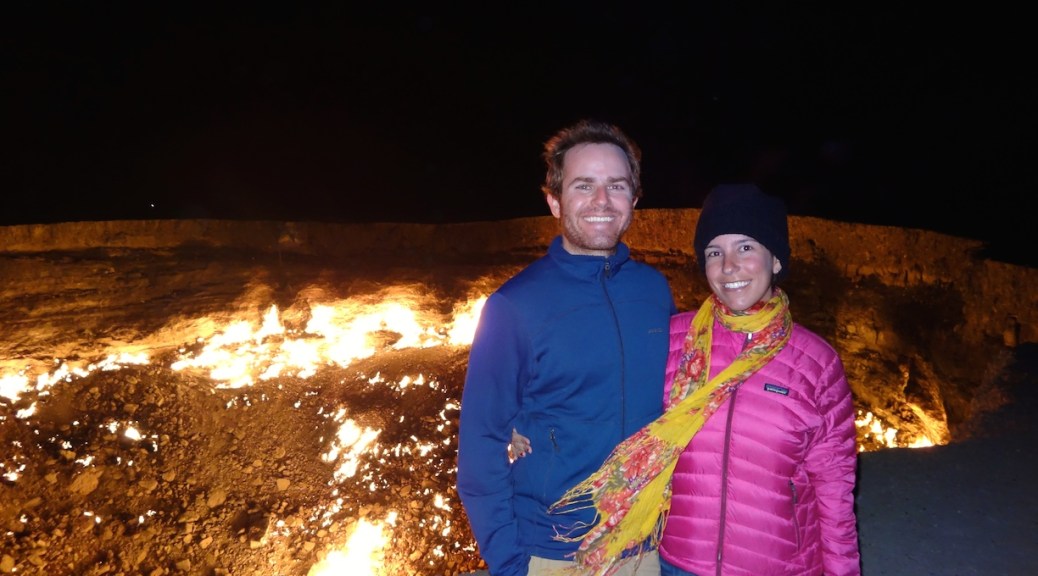
The day turned into night and eventually we reached a turnoff, leaving the “highway” for what was essentially off-roading (which didn’t feel that different from highway driving), in the dark of night, in the middle of the Karakum Desert. All alone. Aside from our two vehicles, there was no source of light. Until, that is, we began to see this gigantic red glow ahead in the darkness. And then suddenly, there it was. A gigantic (70 meters across) hole in the middle of the desert, burning.

Both the crater and the fire were caused by man, which cheapens it in a way. I thought it was all natural. But nonetheless one of the most surreal things I’ve experienced. While the exact history of this phenomenon is uncertain, Wikipedia says the Soviets were drilling for natural gas here in 1971 and the ground collapsed beneath the drilling rig. To avoid poisonous gas discharge, geologists decided to light it on fire and thought it would burn a few days. It’s been burning ever since: more than 40 years! The whole thing is not one giant flame, however, but various areas (I assume pockets of gas) are alight while others just look like rock. For this reason, some spots are 200º Celsius while others are only 30º.

We stared in awe at this oversized campfire (I remarked at the time that I felt like I was in Honey I Shrunk The Kids: The Camping Edition). We were the only people there except for bumping into the deaf-mute girl and her guide. That guide saw us ogling the crater and noted there are three things capable of making people stand and stare: waterfalls, fire, and other people working.

I know it seems strange that we’re wearing winter jackets and hats beside Paul Bunyan’s camp fire, but it was actually quite cold and windy out here in the desert. When the wind blew one way, it was cold. When it blew the other you got blasted in the face with a serious heat wave. To escape this wind we camped behind a little hill.

Check out this little video clip to get a better sense of this thing:

Alan, Ron, Linda, Rustam and the drivers enjoyed a nice barbecued chicken dinner by our normal-person sized fire. Meanwhile, I ran in circles trying to escape the insane number of desert spiders creepy-crawling about. The cool grandpa taught us the trick of chilling a bottle of wine by wrapping it in a wet cloth.

In the morning we checked out the crater by daylight, which made us appreciate having arrived so late at night, so that we saw it for the first time in all its glowing glory. It’s still pretty incredible by day, but the night is the time to see it!

On the drive out we stopped to see two other craters of note: one with a bubbling mud base and another filled with a beautiful green water.

We also stopped for the obligatory desert sand jumping. Remind anyone of our visit to White Sand National Monument in New Mexico?

And then we had our first camel jam of our trip. (On the highway.) Too funny.

On our way to Ashgabat we stopped in the small village of Bokurdak for lunch and a little glimpse into Turkmen village life. I was of course enticed by the dogs (Turkmen dogs are typically shepherd dogs called Alabai, and large hounds called Tazy, which are often used in conjunction with a falcon for a Turkmen hunting tri-fecta). Their Alabai was only five months old and already quite large (and insanely energetic!). Apparently these things get enormous. I’m going to have to see about importing one of these guys. Our border crossing experiences tell me this is not going to be easy.

Lunch was preceded by a lovely introduction, including the reciting of a Turkmen poem by the homeowner’s youngest daughter, after which we sat down to a feast of lamb soup, lamb plov, these little “crackers” that are essentially small packets of dough fried in cottonseed oil, and our first taste of camel milk. (Yes, really.) Think soupy, salty yogurt. Though they put out a whole pitcher, we did not make a big dent (but propers to Ron for finishing his serving). We found it amusing too that the baby camel (which, by the way, how cute is he?!) is kept tethered away from it’s momma so he doesn’t hog all the camel milk. On our brief tour we learned that these villagers live on subsistence farming, felt-making and cattle breeding. They had an SUV and some kind of washing machine, but the toilet was still a wooden shed with a hole in the ground. After seeing the camel pen and being schooled on the useful properties of saxaul, we got a little demonstration of how she makes yarn from the camel’s wool and then we were on our way to the capital city.

We didn’t have much time in Turkmenistan’s capital city of Ashgabat, so we can’t opine all that much on the place. It is known for an abundance of white marble buildings and garish sights. I’m not sure what remains, but I know the former President Niyazov had erected a gold statue of himself, which revolved to follow the sun throughout the day. Anyway, black to Planet Earth. In the little time we did have, we went out to the Russian Bazaar via what I will call paid hitchhiking. Apparently illegal taxi-cab drivers abound in these parts, and we procured a ride from a non-English speaking older Turkmen guy smoking a cigarette and blasting “Barbie Girl.” Needless to say this brought me great pleasure. The Russian Bazaar/Altyn Asyr was a mix of a mall with cotton wares and an outdoor food market, which is organized and refrigerated. After a guy told Alan he was not allowed to take pictures (this is a market, not a military building?!), we bought provisions for a little picnic and ate dinner back at the hotel. Aside from this brief excursion, what I can tell you about Ashgabat is that there is a lovely, if smoggy, view of the mountains (on the other side of which lies Iran).

Practical Info

We booked most of our Silk Road trip through Jim O. at Tailor-made Adventures (somehow affiliated with Dragoman and Imaginative Traveller). For reasons we won’t get into here, we would not enthusiastically recommend his services. Though the team he organized in Turkmenistan was great. It would be extremely difficult, if not impossible, to visit Turkmenistan independently. I think the government pretty much requires you to travel with a licensed operator. Anyway, English is not widely spoken and there are many nuances and formalities that would be tough to negotiate on your own.

I do not recall whether my dad and Linda could have obtained visas in advance since they were coming from home, but in any event we all arrived with an invitation letter that the travel agency had obtained for us. At the border, we paid $66 each (comprised of something like $55 for the visa, $10 for immigration, and a $1 bank fee), and they were much less fussy about the bills than the class act at immigration in Uzbekistan. Though we may have just gotten a lucky teller that day.

We covered our land-entry in depth above. We departed by land, as well, at the Farab crossing from near Turkmenabat (Turkmenistan) towards Bukhara (Uzbekistan). Our experience was similar in terms of time commitment and absurdity. Except this time we took a short van ride for 1 Manat each, and then we had to walk about a mile through no-man’s land with all our bags. Fortunately it wasn’t the middle of the summer, when the temperature could be 120º+ (nor the freezing cold winter).

By the way, what’s the deal with the no-man’s land in between countries? Is it actually part of one country? What if Jenni just couldn’t take it any more and beat me silly? Would she have committed a crime? According to whose laws?

The exchange rate was 1USD = 2.85 Turkmenistan Manat. It was much easier to exchange money here than Uzbekistan…we did this at the market when we bought liquor, and we didn’t have to show our passport or fill out forms!

Transportation: Ashgabat is the capital city and where your international flight would likely (definitely?) land. We were met by SUVs at the border by Dashoguz and traveled in these the whole time, until we flew from Ashgabat to Turkmenabat. Domestic flights are only on Turkmenistan Airlines. We flew a new Boeing 717 and it was fine. Though we paid for almost everything as part of our tour package, we did see the receipt for our domestic flight: $26/ticket, including all fees etc. From the airport in Turkmenabat, we took two more SUVs for the ~1 hour drive to the border crossing at Farab.

As in Uzbekistan, it seems “illegal” taxis are ubiquitous. We took these both ways between our Ashgabat hotel and the Russian Bazaar, and paid 6 Manat total each way.

Accommodation: In Ashgabat we stayed at Ak Altyn. It was fine, though a bit dated and our room kind of smelled like cigarettes. WiFi was available for $5/hour, but we did not try it. There is a Sofitel that gets good reviews. And someone told us he prefers the location of the Grand Hotel, which is closer to some sights (while Ak Altyn is in a quieter area).

Our only other night in the country was camping at the Darvaza gas crater, which was awesome.

Food: We had lunch after the border crossing at Hotel Uzboy in Dashoguz. The lentil soup was outstanding. Our only other meal aside from our time camping and at the village in Bokurdak was a picnic dinner with supplies purchased at the Russian Bazaar in Ashgabat. There was a lot to choose from, and there is some prepared food there, too. Cognac is very inexpensive.

Activities: It was interesting to see Konye-Urgench, but the drive from Dashoguz was about 1.5 hours each way, and you could skip it if you’re visiting a lot of other Silk Road sites. Because we are not history buffs and we did so much of this in Uzbekistan, we skipped places like Merv, Nissa, Gonur, etc. Our guide was adamant about the party scene on the Caspian Sea, but I’m not sure it would be as fun for a (non-Russian speaking) visitor.

For activities in or closer to Ashgabat, another guide we met mentioned horse farms you can visit, the National Musuem, and Kow Ata Underground Lake.

April 29 – May 1, 2014 (Tuesday-Thursday)