Cape Town

Cape Town gets a lot of hype. At least it felt like everyone we know (and all of their mothers) jocked Cape Town, hard. So, I was a little worried it would be one of those places that couldn’t live up to its preceding reputation. Not so. Cape Town deserves a lot of hype. It is stunning.

Case in point, the view from our hotel in Camps Bay. (I will have you know by the way, that for the longest time I thought this area was called Camp Spay, and when I first saw it written down, I was flabbergasted).

The property at our guesthouse was just awesome. You could hear the waves from below (a quick walk from the beach) and look up from the patio to Table Mountain soaring 3,000 feet straight up behind us.

Hard as it was to not park ourselves in front of that pool and delicious view, we got out the door and headed up to hike what is likely Cape Town’s most famous attraction: Table Mountain.

Pro tip: do not begin hiking Table Mountain at high noon on a cloudless 90°+ day. Be smart. Don’t be like us. The route we took was only about 3km but on that short walk you ascend something like 2,000 feet, so you get a workout, for sure. Oh my goodness, so overheated and way too much sun exposure. But damn if it wasn’t spectacularly beautiful.

Also, the people hiking were super friendly, which kind of was an early indicator of our overall experience in South Africa. Good people! This was especially comforting to me given that there are apparently issues with people getting mugged on this hike. Can you imagine?! In general I feel like we either had really good luck/avoided the sketchier areas, or crime is not such a big issue in Cape Town. Probably a bit of both.

Scorched and exhausted, we opted to take the tram down (even though this meant we had to walk a mile from the base of the tram back to our car). While the tram was a little scary for me given the heights, the views were terrific.

It’s a good thing we fit in the Table Mountain hike early, because by the day we got around to hiking Lion’s Head, the weather was not in our favor. We started our walk with a bit of fog, but by the time we neared the top, the visibility was horrible, and the rocky trail was damp from the moisture-laden air. As a result, we sadly never did get to enjoy the views from the peak of Lion’s Head, but I did conquer my fear of heights a bit with the portion of the hike that requires the use of metal ladders and chains.

Part of what makes Cape Town so special is the proximity of all these amazing amenities. The hiking is phenomenal, the beaches are beautiful, and to top it off, there is even wine! We stopped at Groot Constantia vineyard for lunch one day, and savored some duck liver parfait and a divine peri peri chicken dish while sampling the local wines.

The downtown area, on the other side of Lion’s Head from Camps Bay, was nice, though we definitely felt we made the right decision in choosing to stay where we did. The waterfront is pretty much a very nice mall with an outdoor promenade type of area with lots of shops and restaurants. It is enjoyable, but we probably would not deem it a must-see.

The colorful houses in Bo-Kaap were beautiful, but some of the streets around here were noticeably grittier and I doubt I’d want to be walking around there at night.

Greenmarket Square had a nice collection of craft stalls, and the nearby buildings were very New Orleans feeling with their wrought iron balconies and second floor bars.

We loved Company’s Garden with its funky swings, great old trees, and rose garden, all benefiting from the backdrop of Table Mountain behind it.

We didn’t explore too much of the dining scene downtown, but we did fit in a dinner at 95 Keerom. They seemed to think we were on our honeymoon, giving us the prime table and bringing out a free meringue at the end of our meal. We didn’t set the record straight and it wasn’t un-fun 😉 Hey, this could be considered a really long honeymoon, right?

Nearby Hout Bay was also very fun. The coastline is again amazing, and the Bay Harbour Market had a hip, young vibe with its crafty art and clothing vendors and the eclectic food court boasting everything from BBQ and sushi to Mexican and Tunisian, to German sausages and craft beer. It had an Austin-esque feel.

We spent the better part of a day driving the peninsula. This is an absolutely breathtaking drive. In a lot of ways, the scenery here reminded me of Australia, and things reminding me of Australia are generally pretty awesome.

The views of Hout Bay were superb.

Noordhoek Beach, with its wide sandy expanse and gorgeous turquoise water was hard to leave.

We walked up to the old lighthouse at Cape Point. The views were great, but it was so windy that we opted to skip the other walks and beaches.

Wildlife made some appearances along the way, as we drove by a few ostrich farms and saw loads of baboons in the roads.

We even pulled over so that Alan could save a turtle that was in dire risk of getting run over trying to cross the road.

And we may or may not have made a little bit of a rookie mistake when it came to the baboons. We had been so careful, so nervous about the baboons that we even stopped before the Cape Point parking lot to get our snacks and cover our food, but then, in a moment of lapsed judgment, we opened the trunk of our car in the popular tourist parking lot to grab the snacks. We were so oblivious that I even joked to Alan, “careful there’s a baboon behind you,” when, suddenly, there was a baboon behind him. While Alan smartly backed away, the baboon hopped up into the trunk, rifled through our backpack and helped himself to a granola bar. I, the aggressive-under-pressure person that I’m discovering myself to be, started waving my hands (FULL OF SNACKS) at the baboon to scare him out of the car. By some sheer stroke of luck, the baboon did not attack me, but crossed the parking lot to enjoy his healthy bar while we slammed the trunk shut, jumped in the car and locked the doors. I should also mention that in this time a large group of tourists had somehow collected around us and several children were laughing hysterically as I screamed and waved my arms at this furry beast.

Heading back north we stopped to visit the penguins at Boulders Beach. How cute!?

Lastly, we enjoyed lunch at Live Bait in Kalk Bay and then hopped out of the car to catch a glimpse of the brightly colored beach huts at St. James before setting back for Camps Bay.

On our last day in town we paid a visit to the Imizamo Yethu township. After a bit of confusion trying to find a legit guide and a safe place to park, we were able to join a group for a short, informative tour. It is really amazing to see the conditions these people are still living in, despite the fact that apartheid ended 20 years ago. The contrast between the primarily white neighborhood of Camps Bay and the conditions in Imizamo Yethu is striking.

We were, however, pleased to see the bright, shiny, beautiful faces of the local kids at the community school.

Practical Info

Cape Town’s latitude of ~33º is nearly the same as Los Angeles, Sydney and Buenos Aires. The central area is known as the City Bowl, bound by Table Bay in the Atlantic Ocean and backed by Table Mountain, Devil’s Peak, Signal Hill, etc. The Cape Peninsula is a mountainous spine running south to Cape Point. Table Mountain is both a mountain, and the name of the national park that encompasses many more mountains. This map may get you more comfortable with the layout: http://www.mappery.com/map-of/Cape-Town-Birds-Eye-View-Map (thanks to Barbra for sharing this map and lots of helpful tips!).

It is a strikingly beautiful and diverse area. Just a short drive from a major metropolis you’ll find excellent hiking, several wineries, and many upscale and/or funky beachside communities. Crime is a hot topic for South Africa. We generally felt safe in and around Cape Town, but we spent minimal time in the city after dark. It is nice to keep some small bills and/or change handy as all over South Africa there are often “guards” who will watch your car and expect a tip. Also, the plug adapter sets we own do not have adapters that work in Africa. You need a triangle three-prong where the prongs are circular and thick.

The currency is the South African Rand, aka ZAR but we’ll just use “R.” At time of travel, 1 USD = R11. We bought a SIM card on arrival at Johannesburg airport. Word is that Vodacom has the best coverage, and MTN is the other major. The SIM cost R115 + R149 for 1GB of data + R220 for ~100 minutes calling in South Africa (or fewer minutes if calling internationally).

Transportation: We arrived on an Air Namibia flight from Windhoek. Most international flights go through Johannesburg. We rented a car with Hertz, which is located on-site along with several other brands. The drive to Camps Bay took ~half an hour. Having a car is nice, especially if you’re not staying downtown. Otherwise, e.g. to see the peninsula you’d have to join a tour or hire a car and driver for the day.

The City Sightseeing (aka Hop On Hop Off) buses are very popular. There are routes covering the city and/or the less urban attractions. We took a MyCiti bus one day, which is very inexpensive. The manager of our guesthouse loaned us her MyCiti cards, and I think it cost R7 from Camps Bay to the V&A Waterfront. But at many times the bus only runs twice/hour and transfers are usually required, so it is not that efficient. Taxis are cheap and easy. When you see the meter clicking up at hyper-speed, fear not. Those are effectively penny increments. Getting from 95 Keerom to Camps Bay cost R100 with a generous tip. Unicab comes recommended, and they have an app where you can request pick-up. Uber is here, and we did not use it but a friend said it’s as great as you’d expect. There are some trains, but I don’t know much about these.

Accommodation: We stayed at Bay Atlantic Guest House in Camps Bay, which is southwest of the City Bowl. It was perfect for us. Note they offer a 10% discount if you pay the balance in cash, and I believe a free bottle of wine if you stay three or more nights.

Camps Bay is a wealthy beach community only ~10-15 minutes from downtown. There are many bars and restaurants on the beachfront Victoria Road, though these tend to be pricier and some feel sort of like South Beach in Cape Town. Camps Bay is very convenient for hiking Table Mountain and Lion’s Head, and also for visiting the Atlantic side of the peninsula.

If you plan to visit many museums and/or focus more on nightlife and the urban experience in general, then you might prefer staying in the City Bowl. I read a Forbes article in which the writer raves about One & Only at the V&A Waterfront, and also about Reuben’s restaurant there. Ellerman House is another well-reviewed high-end property, which I think is closer to the action than Camps Bay but maybe farther than the Waterfront.

Food and Drinks: Dinner at Blues in Camps Bay was good. We found the pasta at 95 Keerom so-so but the lamb chops and chocolate fondant were excellent. Lunch at Sevruga at the V&A Waterfront was uninspiring. Live Bait in Kalk Bay was solid. We also had lunch at Simon’s at Groot Constantia. The salad was so-so, the peri peri chicken was phenomenal. The food court (and overall scene) at Bay Harbour Market in Hout Bay was on point. We got pizza delivered from Col’Cacchio, and it did not disappoint.

In general, we have been impressed by the seafood in South Africa, and by the value of the food and wine. There are endless dining options in and around Cape Town, I’ll just mention a smattering that folks recommended: high tea at Mount Nelson Hotel; La Colombe; Fork (on Long Street); The Roundhouse; Carne (same owner as 95 Keerom); Bizerca; The Codfather; The Test Kitchen.

Activities: We spent only one day exploring the city proper, when we visited the V&A Waterfront, Bo-Kaap, Long Street, Greenmarket Square and Company’s Garden. Most of the rest of our time was some combo of the peninsula and/or hiking.

Table Mountain is the flagship attraction, certainly for the outdoors. We hiked up the most common route, which is Platteklip Gorge. It is very steep (I think the trail is less than 2 miles and ascends more than 2k feet). The views for much of the hike and from the top are fantastic. We took the tram down to save time and knees. It costs R115 each to descend. Note that if you park at the trailhead and take the tram down, you have to walk about a mile back to your car (which you will have parked about a mile past the tram station when driving up Tafelberg Road). Apparently there have been some muggings on the mountain and thus folks advise joining up with others (unless your group is already 3+ I guess), but there were so many other hikers during our visit that this was irrelevant. There are lots of other routes on Table Mountain, including India Venster, some options from Constantia (I think), and even a five-day trek on the Hoerikwaggo Trail.

We hiked Lion’s Head another day. It is much easier and often includes stunning views of Camps Bay, Clifton, the City Bowl, etc. So we’re told. It was entirely covered in fog for us. The round-trip took us about 1 hour 45 minutes. There is a metal ladder and some narrow, exposed parts on the upper reaches. There is also a near-vertical stretch with chains and holds, but you can circumvent this if you want…both ways are marked.

A full-day tour of the peninsula is highly recommended. We went counter-clockwise, from Camps Bay to Hout Bay; taking the Chapman’s Peak Drive toll road over to Noordhoek, which has a beautiful long beach and we stopped at Noordhoek Farm Village; continuing to Kommetjie and then all the way down to Cape Point; then back up the eastern side to Simon’s Town and the penguins at Boulders Beach; through Fish Hoek to a very late lunch at Live Bait in Kalk Bay; snapping a couple pics of the colorful beach shacks at St. James; then breezing through Muizenberg and back around Table Mountain to Camps Bay.

Some more detail on some of these places on the peninsula drive: in Hout Bay, see if the Bay Harbour Market will be open as it’s quite cool, and you can also take a boat from Hout Bay to visit a seal colony; the toll for Chapman’s Peak was R38; entry to Cape of Good Hope costs R105/adult…there are many things to see/do there, but it was windy and we had a lot of ground to cover so we only walked up the dirt path alongside the Flying Dutchman Funicular to the original lighthouse at Cape Point (it was too high and often covered in fog, the newer one is lower); entry to the penguins at Boulders Beach costs R55/adult; we didn’t take it, but Boyes Drive (aka M75) is an elevated and perhaps more scenic route between Kalk Bay and Muizenberg. Beware the baboons! We tried to prepare by reorganizing our food and backpack, but as we were leaving the Cape Point parking area we had a momentary lapse in focus and a baboon climbed into our trunk and thankfully took only a granola bar.

We did an informal township tour of Imizamo Yethu, which is by Hout Bay. We simply joined a local woman who was leading some other tourists, and this included some info and visiting a couple houses/shacks and the community center etc. for R70 each. Afrika Moni is a known guide for Imizamo Yethu, so you might look him up. Other popular places for township tours include Khayelitsha, Gugulethu and Langa.

There are many activities and attractions we considered but didn’t get to. Top of that list would probably be Kirstenbosch Botanical Gardens as well as Robben Island. You might also consider District Six Museum (and various Iziko Museums), Two Oceans Aquarium, various crafts markets, etc.

October 25-30, 2014 (Saturday-Thursday)
Okonjima

Our last stop in Namibia was Okonjima, home to The AfriCat Foundation. We only spent one night here, but we sincerely wished we had two (or more!). It was a fantastic and extraordinarily interactive wildlife experience. This property is different than most safari camps in that many of the animals living there are semi-wild, since The AfriCat Foundation works to rehabilitate wild cats (and wild dogs). Because the leopards, cheetahs, and dogs in the park are tagged, sightings are more or less guaranteed. The guides carry tracking devices that beep when in close proximity to the receptor on the animals’ collar.

And the smaller game living right on the campgrounds are much more accustomed to human contact. They even permit (and encourage) feeding of the birds and warthogs, by providing a jar of seeds in your room to share with them. Fair warning though, there is no wall, window or screen separating your room from the great outdoors. Well, there can be, but the canvas siding is rolled up for your arrival. Also, it is a flap of canvas, so… And hence your first impression is that of no separation between you and the animals.

While (somewhat surprisingly) no animals tried to come through the gigantic open walkway into our room, we did have one hornbill that scared the bejeebies out of me by repeatedly jumping into our actual glass window, and Alan came dangerously close to getting head-butted by a warthog that grew jealous of Alan’s feeding his rivals.

We had the opportunity to go out on two game drives during our stay at Okonjima. Because you go out with a tracker device to try and spot one of the specific monitored animals, each game drive is focused on one of those four species: leopards, cheetahs, hyenas or wild dogs. On our first drive, we chose to search for the leopards. We saw several in Botswana, but they are so beautiful one can never really tire of admiring these precious cats. In not too long we spotted one and followed her down the dry riverbed for a ways. Maybe the most exquisite animal, I think.

We said goodbye to the leopard and headed to a beautiful spot for sundowners. En route we spotted several baboons, a hare, some giraffes, and warthogs. Cats and dogs aren’t the only game to be seen!

We were treated to a stunning sunset as we sipped our G&T’s, and as we imbibed we even spotted a dassie rat (a very rare sighting) that chose to join us for happy hour!

The drive closed with a bang as we passed the most adorable baby jackals on our way home! Oh god, the urge to cuddle was almost irresistible. Of course, we knew the mother had to be somewhere near, so snuggling was not an option.

At night, after dinner, we went out for a second excursion to visit what Okonjima calls the night hide. The jeep takes you back through the Jurassic Park-style gates (the lodging is outside the massive fenced area where the predators live) and then you hop out and walk a bit with your flashlights into this little protective enclosure with a small opening for viewing. On the other side, the guide drops a bunch of food scraps and lo and behold, out come these badass little animals: porcupines and honey badgers! Things are seriously hard-core. And honey badgers, as anyone with internet access knows, just don’t care. We were even lucky enough to spot a brown hyena on the drive home when our headlights caught the glow of its eyes. Too dark for pictures though, and bummer because it was our first and only brown hyena sighting on the trip.

And here’s a little video showing the porcupine putting those quills to action.

For our final drive the next morning, we went out in search of the cheetahs. It was starting to look futile as we neared the end of the property with no beeps from the tracking device. But soon enough, we parked the jeep, and WALKED off in the direction of some identified cheetah activity. Crazy right? I mean, they are only semi-wild cheetahs, but they are still wild enough to require that Rohan (the fantastic resident guide) pack a 9mm and Jimmy (our Namibia guide) carry this big old stick in case of attack. So the fear factor really does get your adrenaline going.

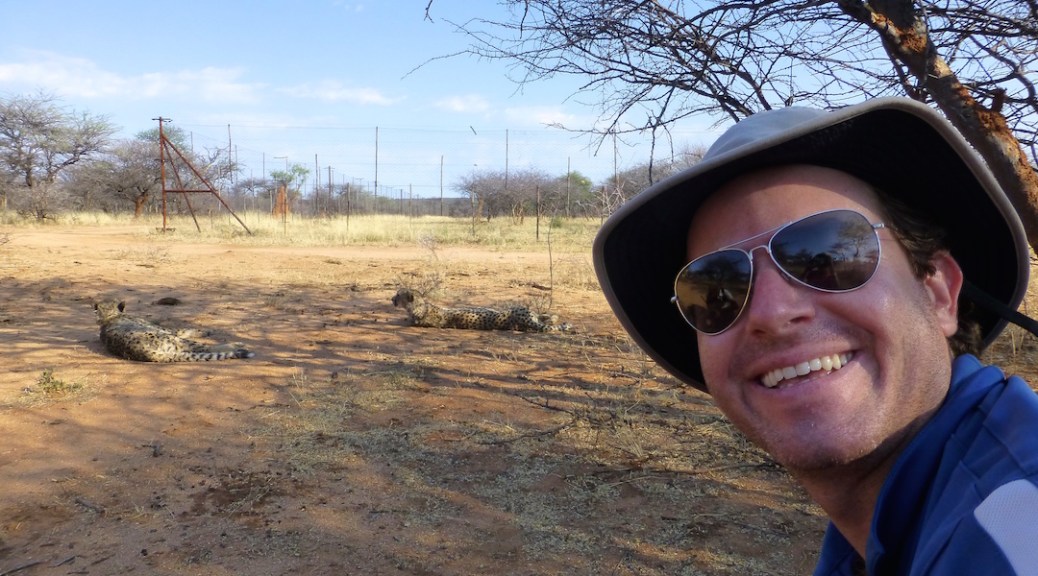
We were maybe 15 feet away from these beautiful creatures. I think we were most surprised by how long and slender they are. Their bodies are like slinkies.

Of course, the cats are not alone. There are many wild animals roaming the property, and we saw lots during the course of our stay. The variety of antelopes here was the greatest out of all our stops in Africa: eland, impala, kudu, oryx (including the tiniest baby oryx!), duiker, steenbok, and red hartebeest.

And just as we were grabbing our bags to leave, we spotted an elephant shrew hanging out in a termite mound just outside of our room! Some epic animal sightings here at Okonjima, that is for sure. We were sad to leave this camp and sad to say goodbye to Namibia, but ready for the final nation of our round-the-world voyage: South Africa!

Practical Info

Okonjima is a 55k acre private game reserve and home to The AfriCat Foundation, which rehabilitates cheetahs, wild dogs, hyenas and leopards.

To recap our Namibia itinerary: we spent a transit night in Windhoek; then we drove southwest to the Sossusvlei area and stayed two nights at Hoodia Desert Lodge; then we drove northwest to Swakopmund and stayed two nights at Organic Square Guesthouse; then we drove north to Damaraland and stayed two nights at Doro !Nawas; then we drove east to Okonjima where we stayed one night before departing the next day via Windhoek. With the benefit of hindsight we might have altered this slightly. Driving times may be long and traveling at night is not advised (mainly for the risk of hitting animals), so you may need to spend two nights somewhere to have just one day. That said, we would probably have spent one night in Swakopmund and two at Okonjima, and we might have visited Etosha National Park to top up our wild safari bucket.

Transportation: We drove from Doro !Nawas, I think passing Khorixas, Outjo and maybe Otjiwarongo. The road was dirt at times and paved at others. We departed for Windhoek and our international flights onward: Mom and Rich to Johannesburg, we to Cape Town.

Accommodation: Much like most places we’ve stayed in Botswana and Namibia, the setup here is a central “lodge” area that is covered and open-sided where you gather, eat meals, etc. A small but nice pool is there. Then there are several very spacious cabins set apart from each other. At least this is the case in the Bush Camp, where we stayed. One of the awesome things about this place is there are animals hanging out nearby. There were a couple warthogs right by the main area, and our cabin had rolled up front windows open to warthogs, guinea fowl and some others within a few feet of us. Plus, of course, the insane hornbill who kept jumping into our side glass window. There is no WiFi in the rooms, but it works quite well in the main area.

Food and Drinks: We ate all our meals at the lodge, and the food was very good. At least for our package, certain wine was included but generally alcohol was not.

Activities: We participated in three great activities. First was leopard tracking, and we got quite a bit of reasonably up close time with Shanti, a female leopard. After dinner that night, we visited the night hide. The guide laid out some food scraps and immediately three porcupines and two honey badgers joined us. Very cool. The next morning we did cheetah tracking, and for these somewhat smaller and less dangerous cats (vs. leopards or of course lions) we actually got out of the vehicle and walked over to them. We stood/kneeled about 15 feet away from Spud and Coco Chanel (bro and sis) plus their buddy Bones. Super neat.

We did not have enough time to try wild dog or hyena tracking, nor to visit The AfriCat Foundation education center.

October 24-25, 2014 (Friday-Saturday)

Doro !Nawas

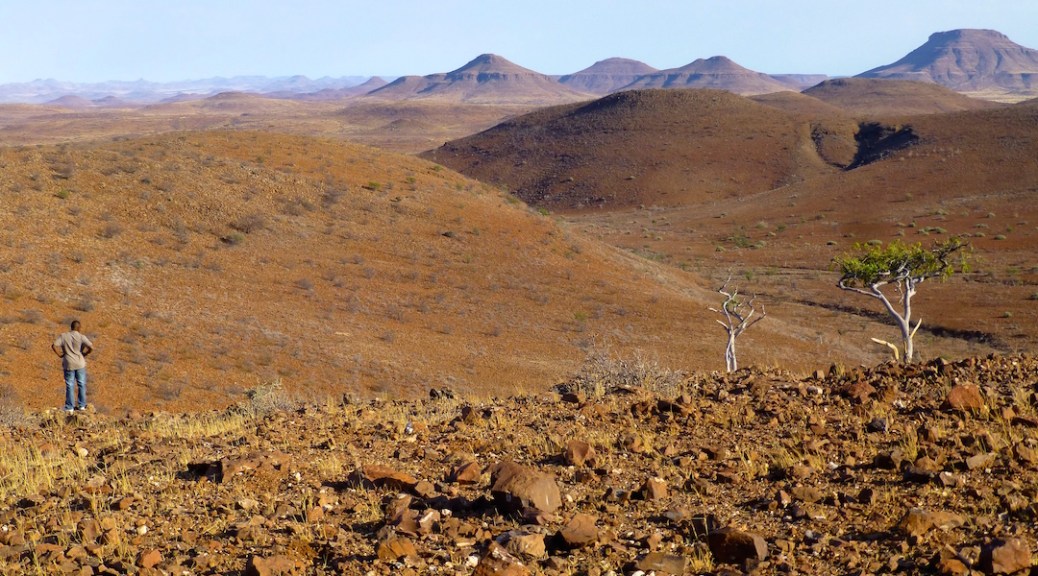
We left the dunes of Sossusvlei and Swakopmund, but we were still surrounded by a lot of sand, a lot of beauty, and it was still really dry. Doro !Nawas Camp in Damaraland is another middle-of-nowhere, stunning Namibian property.

The drive up took us through mile after mile of wide-open expanses. The only signs of human life were the tiny communities of huts constructed from what looks like the remains of the recycle bin: pieces of tin, stone, brick, wood, plastic, some combination of the above.

Doro !Nawas itself sits upon the dry Aba-Huab River Valley, within the Doro !Nawas Conservancy in central Damaraland. Its location affords stunning views of the mountains and red sandstone cliffs.

And you might notice the exclamation point in Dora !Nawas. It is, in fact, a click language. The staff at the camp would read the menu each night in English and in the local click language (I think it’s called Khoekhoe?) and it is seriously impressive. I wish I could make all those click sounds! Here’s a little video, if you’re interested:

And after dinner the staff would sing and dance. It was good fun. We were particularly fond of the Amarula dance (and the Amurula! – a delicious liqueur made from the marula fruit that grows in Africa).

A short drive from Doro !Nawas is Twyfelfontein, which translates to doubtful spring. This area is full of ancient petroglyphs. There are lots of animals depicted, and our guide explained that these were used for education (e.g. to teach the young about footprints of animals to hunt, and those to run away from).

There are also some beautiful rock formations, including these “Organ Pipes.”

But the highlight of this expedition was the epic sundowner spot. Our guide pulled out a veritable spread, complete with biltong, nuts, crackers and the obligatory G&T’s. So many beautiful sunsets in Africa. And because it gets very chilly there as the sun goes down, they have fleece-lined ponchos on hand! Fleece-lined ponchos! Keep your eyes open for fleece-lined ponchos as the next Snuggie. Calling it.

Also, I sincerely wish I had video or at least photos, but we finally saw springboks in action. It’s clear to us now how they got their name. They literally spring across fields – apparently in an effort to convince predators that they’re super fit and hard to catch or something. And the best part? This move is called pronking.

Alan and I woke early one morning to head out with Jimmy in search of the elusive rhinoceros. The 4:30 am wake up call was a little brutal, but when we turned off the road and a few minutes later saw a large group of desert-adapted elephants, we knew it had been worth it.

Our luck continued on the drive as we spotted some kudu, springboks, oryx, Hartmann’s mountain zebras, and steenbok.

Jimmy even made an epic spot of a spotted hyena in the distance.

And then some jackals! Not to mention the scrub hare we saw on the drive in.

And then we thought our luck was going to culminate in some really big sightings when Jimmy spotted lion prints, rhino poop and flattened euphorbia bushes – evidence that a rhino had trampled them recently. We traced the tracks for what felt like miles and certainly hours. We were impressed with Jimmy’s tracking skills, but the rhinos and the lion were sneaky that morning. Despite our best efforts, they eluded us. Though we did learn a fun fact about rhinos. You may have heard of black rhinos and white rhinos. These distinctions have nothing to do with their color. Rather, it is the shape of their mouths. The misleading “white” designation derives from the Afrikaans word “weid,” which describes the flat, wide lip of “white” rhinos which is better adapted to grazing vs. the pointed lip black rhinos use to pick fruit and leaves off branches and twigs.

In the hopes we might spot some, we kept driving on, deeper into the wilderness, and on a seriously bumpy road. The landscape was absolutely spectacular, and the geodes lying all around sparkled beautifully in the sun.

To make up for the lack of a rhino sighting, some giraffes appeared on the side of the road as we began heading back to camp. All in all a solid day of game viewing in an area not that geared towards safaris.

Practical Info

Damaraland is best known for the collection of San rock engravings at Twyfelfontein. The region’s scenery is gorgeous and reminiscent of the Southwestern US. Other attractions include desert-adapted elephants, possible black rhino sightings, assorted other wildlife and terrific stargazing.

Note that we were booked at Doro !Nawas on a dinner, bed and breakfast basis. If you book on a fully inclusive basis, then alcoholic beverages and laundry service would be included.

Transportation: We drove from Swakopmund, which took at least a few hours and was largely on unpaved roads. We departed for Okonjima.

Accommodation: We stayed at Doro !Nawas, which is a Wilderness Safaris property. The setting is beautiful, offering vast views of the landscape and epic stargazing. The main building has cozy lounge spaces and all meals are taken there (including lunch on the deck). The infinity pool is small but refreshing. The thatched roof cabins are enormous and nicely appointed. There is no WiFi, though there is a computer in the lodge area that works fine for email.

Food and Drinks: We ate all our meals at the lodge. The food was fine, but not quite as good as many other places we’ve stayed thus far in Africa. The after dinner singing and dancing, however, was delightful.

Activities: A visit to Twyfelfontein is pretty much mandatory. We also stopped to observe the Organ Pipes and Burnt Mountain, which frankly were a bit underwhelming. I think there are some hikes in the area. It was neat to see desert-adapted elephants and other animals.

October 22-24, 2014 (Wednesday-Friday)

Swakopmund

Our next stop in Namibia had us driving through even more barren land towards the coast. The landscape got downright otherworldly at points.

We spotted the occasional wildlife, including desert zebras in the distance, some ostriches and a cool hawk-like bird.

Among the strange things encountered on our drives in and out of Swakopmund was a shipwreck…

…and weirder still, the Free Republic of Wlotzkasbaken, a cluster of homes not connected to government systems. Thus, their water is supplied by personal water tanks on the roofs, and their power from generators. Our guide thinks it might be entirely inhabited by white people. What a weird little commune.

And our drive in even took us across the Tropic of Capricorn!

The town of Swakopmund itself is maybe not as exciting as the drives in and out, though it did provide a lovely place for us to do some souvenir shopping and enjoy some fresh seafood (who knew we’d be eating delicious raw oysters in Namibia?). Also, it was much, much cooler – an extremely welcome respite from the heat we’d been enduring so far in Africa.

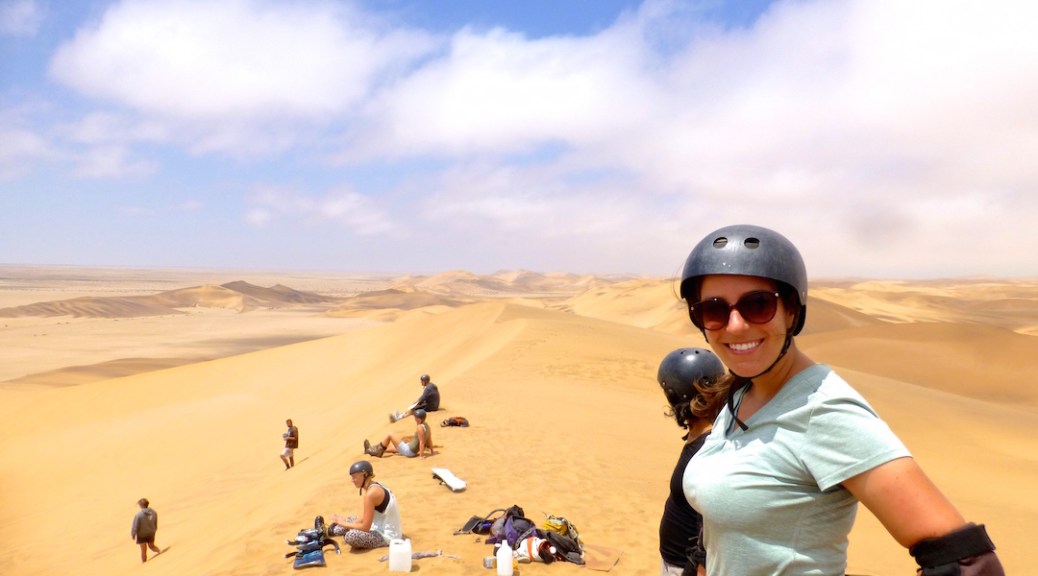
But the big attraction in Swakopmund seems to be the adventure sports. So, naturally, we set off to check them out. (Alan and I, that is, while Ronnie and Rich enjoyed a more tame boat cruise.) First up was some fun in the sand dunes. Not that adventurous, and figuring our skiing skills might not translate so easily to sand boarding, we opted for the lie down boarding, which is pretty much like sledding, but instead of quickly going down a snowy hill, you fly down a giant sand dune at speeds of up to 72 km/h. (!!!!!!!!!) I know, because they whipped out a speed gun (like the ones that cops use) and tested our speeds and that was Alan’s fastest. That is fast, people. Very fast. Even with the “brakes” (read: dragging my feet in the sand in a semi-futile attempt to control my velocity), I reached a max of 54 km/h. To which our guide responded, “dude, why did you go so slow?” Ha! I may be adventurous, but I am still afraid of nearly everything in the world, so I have my limits.

The boards are pretty much just a piece of laminate board, super smooth on one side. You lie down on it, lift up the front, and WHEEEE! SO MUCH FUN! Not to mention the view of the landscape up there is awesome. Plus, you get a nice workout from climbing up the dunes in between runs.

To top off our day of desert adventure, we tried sand quad-biking. Um, horrible. Maybe I’m scarred from the memory of the time my brother and I rode a quad into a tree as little kids in Virginia, but I could not do it. I totally freaked out. One of the guides stayed behind with me to try to help me figure it out, but I got stuck going up hills that were maybe two feet high, despite his constant encouragement that “it’s so easy, it’s so easy. You just, go…” I wound up ditching my bike in the middle of the desert and riding on the back of his, and it wasn’t that much better. On the bright side, Alan loved it! He tore up those dunes like a sand badass.

Practical Info

Swakopmund is a coastal town with a fair amount of German colonial architecture and many German-speaking residents and visitors. It is the adventure capital of Namibia. There is skydiving, sand-boarding, quad-biking, surfing and more. Plus tamer options like boat trips to view dolphins, birds, a seal colony, etc.

Transportation: We drove from Hoodia Desert Lodge/Sossusvlei via Kuiseb Pass, and we stopped to view Kuiseb Canyon where our guide told us about the two German geologists who hid here during World War II. There is a book and a film called The Sheltering Desert that tells their story. We continued towards the coast and stopped for lunch in Walvis Bay before arriving in Swakopmund. You would not need a car to get around the central part of town, and I believe many of the activity vendors offer free pick-up and drop-off. There is also an airport and a train line. We departed for Doro Nawas/Damaraland, stopping at a shipwreck and for petrol in Uis.

Accommodation: We stayed at Organic Square Guesthouse, which is a few blocks outside the center of town. Decor is modern with concrete floors and such. Breakfast was fine though mostly cold options.

Food and Drinks: We had nice dinners at Tug (in town) and The Wreck (outside town), and we preferred the latter. Thus began our streak of being impressed by the seafood in Namibia (and later South Africa). Calamari and oysters were consistently excellent, and I enjoyed kingklip many times. We did not venture out for nightlife, but a friend mentioned Napolitana.

Activities: Jenni and I did a combo day of sand-boarding and quad-biking. I believe the name of the sand-boarding operation is Alter-Action. Quad-biking was at Desert Explorers. The cost for the package was NAD650/person, which included sand-boarding, a video thereof, an hour on the quad bikes, transportation and lunch. I found this to be excellent value.

My mom and Rich enjoyed their boat trip, which I think included onboard champagne and oysters. The town has plenty of craft shops, cafes, etc. and is nice to walk around. There is an outdoor, informal craft market by the beach. Skydiving is popular here. The aquarium in town is said to be nice. There is also Kristall Galerie, which holds some special crystal formations.

October 20-22, 2014 (Monday-Wednesday)

Sossusvlei

After a rather indirect travel day from Camp Okavango in Botswana via South Africa and into Namibia (including a semi-lost, but later found, piece of luggage (Rich’s) for the first and only time on our year and a half of travels!) we found ourselves in Windhoek preparing to drive to the dunes of Sossusvlei.

The ride from the capital was beautiful. Just a few miles outside of the city we began to see baboons on the roadside, and we eventually made it to the Spreetshoogte Pass, which offered spectacular views of the Namib Desert. Apparently for those adventurous enough, you can camp here. I’d recommend it for one seeking extreme desert isolation.

To my delight, there were also kitschy roadside attractions on the way to Sossusvlei, and we stopped for lunch in the town of Solitaire (population: tiny). This itty-bitty metropolis features a gas station, restaurant, bakery and general store – and the only ones of those for many, many miles around. We stopped for all of the above amenities, including an oryx burger and a slice of their famous apple pie.

We also noticed a few massive sociable weaver nests on the acacia trees. These nests hold up to 300 birds! Sociable is right.

Our final stop on our way into the region was a quick visit to the Sesriem Canyon for a walk around the composite rocks striated from the impact of a long-gone river.

When we finally made it to Hoodia Desert Lodge, we were elated to see how beautiful it was. And the best part – it had air conditioning! But seriously, this is an incredibly gorgeous property with a cozy indoor common area full of leather couches, stunning views of the surrounding mountains and the (then dry) Tsauchab River, and the rooms are luxurious with great outdoor showers.

A quick drive from the lodge brings you to the Sesriem Gate, entrance to Namib-Naukluft National Park and its world famous red sand-dunes of Sossusvlei. We arrived early, as the sun was rising, and the views were incredible.

As you make your way down the long road towards the dunes you see hot air balloon riders floating above the red sands.

We also spotted a bit of wildlife, including some wild ostrich and oryx, Namibia’s national animal, with its huge straight horns.

The dunes, though, take center stage here. They are just spectacular.

Dune 45 is supposedly the most photographed, and it’s easy to see why. This magnificent dune catches the shadows in an artful way.

Bid Daddy, perhaps not surprisingly given the name, is the tallest, stretching up to 325 meters and dwarfing the surrounding dunes. We climbed up to the top of it. It’s a hot, grueling, two-steps-forward-one-step-back walk.

But the reward at the top…

360° views of nothin’ but sand, and down below you can see Deadvlei where we headed afterwards.

This video helps to give some perspective. Look for the people at the bottom of Deadvlei when the camera zooms in below.

But the best part of the trek: going down! While it took over an hour to hike up, we flew down in about 10 minutes. And wee!

Deadvlei is a dried riverbed made of clay, surrounded by Big Daddy and other dunes, and dotted with a forest of old, dead trees.

They have been stagnant for years, decomposition halted because the air is so dry. Deadvlei has not seen rain in a long time.

On our way out we saw a black-backed jackal wandering around the parking lot and walking right up to people eating. Scavengers have it easy when humans come along I suppose.

Practical Info

We traveled in Namibia with my mom and Rich on a private guided tour with Ultimate Safaris. Some folks travel independently to Namibia. We considered a self-drive trip, which means a travel agent would have made all the bookings and provided us with detailed maps and information and a 4WD rental. This does seem manageable, but I am happy we went with a guide. Our itinerary required a lot of driving on bumpy roads, we got a flat tire, and it was nice not to have to worry about getting around and booking activities etc. Later, Jenni and I traveled around South Africa on our own in a rental car, and that was very easy and pleasant.

Our guide Jimmy was very knowledgable on his country’s history, culture, wildlife and geography. Namibia is famed for its vast desert landscapes, sand dunes, animals, starry skies and more.

Perhaps most famous of those desert landscapes and sand dunes is Sossusvlei, which is the name of a specific salt and clay pan but often refers more generally to the Namib-Naukluft National Park and its characteristic large red dunes.

The currency is the Namibian Dollar, and at time of travel the exchange rate was ~ 1 USD = 11 NAD. South African Rand are accepted throughout Namibia (the rate is identical), but not vice versa.

Transportation: We arrived to Windhoek on a South African Airways flight from Johannesburg (having come from Camp Okavango in Botswana earlier in the day). The drive from the airport into the city takes 30-45 minutes. Jimmy was our guide and driver. Our vehicle was a Toyota Land Cruiser. Some ways are paved, but mostly in Namibia we were on reasonably smooth dirt roads. Pretty much everyone has a jeep or pickup truck or the like in this country.

We drove from Windhoek to Sossusvlei via the Spreetshoogte Pass, stopping in Solitaire and visiting Sesriem Canyon before arriving at our lodge. It was a fairly short drive (maybe 15-20 minutes) from the lodge to Sesriem Gate, and from there the paved road runs 60 km toward Sossusvlei (the pan). Where the pavement ends, one may either take a shuttle or drive the remaining 5 km through deep sand if one has the proper vehicle.

Accommodation: In Sossusvlei we stayed at Hoodia Desert Lodge. The property is stunning with stylish decor befitting owner Thomas’ prior profession as an interior designer. There are 11 stand-alone thatched chalets with air conditioning. The common area features a gorgeous lounge and dining room, a spacious deck with views and a small pool. While we have no hesitation recommending this place, we must note that the only way to really see the dunes at sunrise and beat the crowds is to stay inside the park gates.

In Windhoek, we stayed at the Hilton, and it was very nice. Our only complaint is that the free WiFi works only in the lobby, i.e. WiFi in your room is an extra charge.

Food and Drinks: We enjoyed lunch in Solitaire, and yes the apple pie is delicious. Other meals in the area were generally had at Hoodia Desert Lodge, where the food was great. Similar to our experience in South Africa, hotels tend not to gouge you on alcohol, which is delightful as you can enjoy perfectly fine bottles of South African wine for ~$15 even at a high-end property.

Dinner at the Hilton in Windhoek was quite good; the breakfast buffet was outstanding.

Activities: The highlight of the area is clearly visiting the red sand dunes and white pans of Namib-Naukluft National Park. The park gates open at sunrise, and there was a queue well in advance. Jenni and I hiked to the top of Big Daddy, the tallest sand dune around. We took the shorter route and needed an hour for the ascent. The views are glorious. We ran down the dune in about 10 minutes to Deadvlei, which is the white dry clay pan with dead trees you see in National Geographic photos. We never actually explored the pan of Sossusvlei itself, because after the exercise and especially the sun exposure we’d had enough. Note that some protection for your camera is advised as sand gets into everything.

We’re told that Dune 45 (so named because it is 45 km on the road past the Sesriem Gate) is the most photographed dune in the world. You could also hike that, or Big Mama, or probably various others.

On our way into the region on the first day, we stopped for about an hour at Sesriem Canyon. It is neat to see, but I would not be devastated to miss it. Hot air balloon rides are understandably popular around Sossusvlei.

October 17-20, 2014 (Friday-Monday)

Okavango

For the benefit of anyone reading this for advice on planning your own Botswana safari, let me start off by saying that we would not recommend Camp Okavango. While the experience was fine – lovely even – it’s less of a classic safari experience and more of one geared towards “relaxation.” For the amount of money it costs to “relax” here, you could do any one of hundreds of truly relaxing activities. My two cents: spend that money relaxing in Tahiti. My idea of relaxation is not waking up at 5 am for a boat ride or a game viewing walk, nor sleeping in a non-air conditioned semi permanent structure (nice as it is) in the sweltering heat. It is by no means an unpleasant experience, just not the one I envisioned for my six short nights on safari in Botswana.

So what does Camp Okavango offer? Remoteness, for starters. The landing strip here is not even a dirt patch; it’s so infrequently trodden it is still largely covered in grass. Don’t worry, there is a unionized group of red lechwe that graze/mow for maintenance. And you don’t ever set foot in a car/truck/jeep here – even from the airport…you walk to camp. That’s pretty cool. Before we had even dropped our bags, we saw some baboons!

And unlike most safari lodges, you do not sit in a jeep for game viewing activities. Most such activities are water based. And with the water based activities you are not so much focused on game viewing as you are on maybe bird watching, spotting the occasional croc, and relaxing.

Our first night we partook in a fishing trip. It was certainly relaxing to hang out in this place of sublime beauty, knocking back a number of cold ones while we tried (largely in vain) to catch some supper. Alan won the prize of first catch of the day, and what a catch it was!

Rich then stepped in to show him how it’s done, with little improvement.

Then the pro showed up. Who has two thumbs and caught the only keeper among us? This girl. Not to toot my own horn or anything. 😉

Despite the poor performance on the actual fishing part, we enjoyed the spectacular sunset while we chased our afternoon brews with a G&T.

The next day we tried out another type of boating activity: a trip in the mokoro. These are traditional canoe-like vessels commonly used in the Okavango Delta. We floated along peacefully, admiring the millions of birds ranging from slate egrets, to spare wing geese, to malachite kingfishers and practically everything in between.

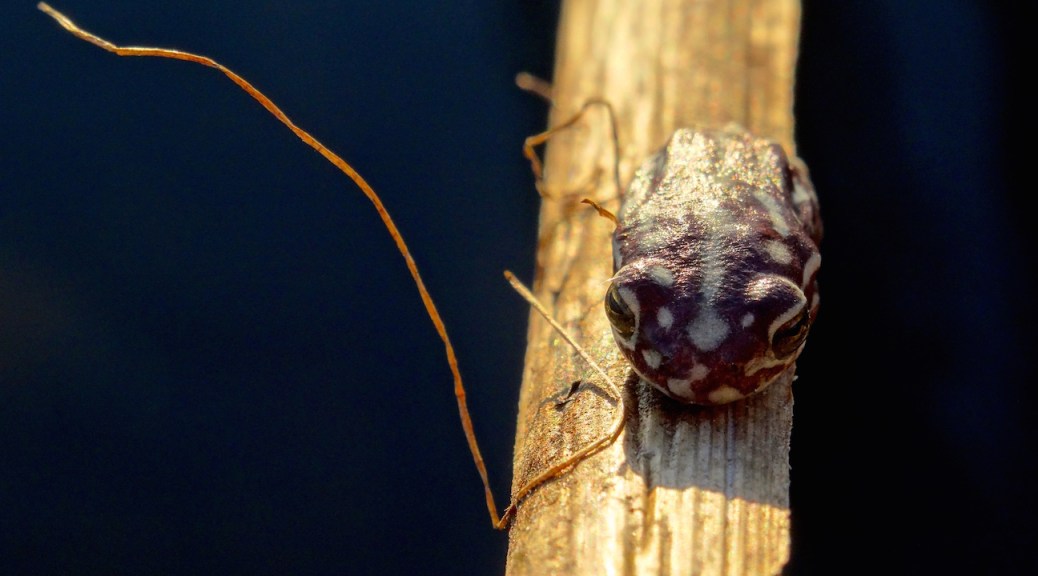
We particularly enjoyed these tiny reed frogs that change colors like a chameleon.

Our guide, Stagga, enjoyed them in a different way: as a snack. Just kidding, no frogs were harmed in the making of this post.

On our walk back to camp we were lucky to spot a few giraffes. They are even more graceful and impressive when viewed on foot from a distance of a few meters.

When not enjoying the water based activities, there are safari walks to be taken. Our first one was maybe a little underwhelming, kind of more akin to a glorified nature walk, but it was interesting to learn about some of the flora that tends to get ignored when you’re in the jeep searching for big cats. While you (hopefully) do not get as close to the fauna while on foot, the animals are not all that far away. We saw lots of red lechwe, even more birds, impala, baboons, some buffalo and elephants. We also happened upon a lot of warthogs. Fun fact: warthogs’ tails stick straight up in the air when they run. It’s adorable.

We ventured out a bit farther on our second walk in search of the hippo pool. Worth the distance, for sure. We saw a handful of hippos hanging out, and a humongous croc sliding in and out of the water to hang with the fatties.

From there we boarded our last of the tiny planes to fly back to Maun en route to Namibia!

Practical Info

Camp Okavango is in the heart of the Okavango Delta. There are no game drives here, just walking safaris and water based activities like fishing, motorboat rides and mokoro rides. This means that while the camp is relaxing and the staff are friendly, this is not the place to come if you’re after optimal big-game viewing. Please see our post on Savute Safari Lodge for more general info.

Transportation: We arrived on a seven-seat single-engine Cessna from Camp Moremi. The flight took about 15 minutes and we landed on a grass strip. It is a short walk from the landing strip into Camp Okavango.

We departed on an 11-seat Cessna for the half hour flight to Maun. From there, we took a much larger Air Botswana turbo-prop for the ~2 hour flight to Johannesburg, where we nearly missed our connecting flight on South African Airways to Windhoek, Namibia. There is a direct flight from Maun to Windhoek that left much later in the day. I’m not sure why we didn’t take that flight. It could’ve been sold out by the time we finalized our itinerary, or…

Accommodation: There are spacious permanent tents with en-suite facilities. As at Camp Moremi, each tent is on a raised teak platform and has canvas sides, a comfortable bed, etc. There is electricity (from a generator) in each tent during the day, but only battery power at night to provide enough light. So don’t forget to charge those camera batteries during your siesta break!

The property has a grassy lawn with a small pool. All meals are served in a thatch-roofed, open air dining space.

Food and Drinks: Hunger was not an issue. Breakfast is served at 6 am and is mainly cold fare, such as cereal, fruit, yogurt, excellent bread, juices, coffee, etc. Perhaps pancakes or crepes would be added. Brunch is around 11 am, and this includes a lunch buffet plus eggs cooked to order. Afternoon tea is at 3:30 pm, and there are always snacks. During the afternoon water excursion, sundowners are de rigeur. These take place around 6 pm (seasonally variable, I presume), where you imbibe a gin & tonic (or perhaps wine or beer) and have more snacks. Things like biltong (local jerky), cookies, chicken wings, whatever. Back at the lodge, pre-dinner cocktails with snacks are up around 7:30 pm. Dinner is at 8 pm, and this entails a plated appetizer plus a buffet and a plated dessert. In general, the breads were excellent and the food was very good. It was here that we first tasted the genius of Amarula, a cream liqueur made from the fruit of the marula tree.

Activities: You can choose among (1) walking safaris on a nearby island, which are almost always done in the morning to avoid the afternoon heat; (2) motorboat rides where you see birds and possibly crocodiles, hippos, etc.; (3) mokoro rides which are punted and very peaceful; or (4) fishing. We did two walking safaris, one mokoro ride and one fishing trip. On the fishing trip, I got nothing to keep while Jenni caught a 6-8” bream that we enjoyed at dinner.

October 15-17, 2014 (Wednesday-Friday)

Moremi

Our next safari stop was Camp Moremi in the Moremi Game Reserve. This time we had to board a seriously small airplane. Six seats. Including the pilot! Our luggage barely fit, not to mention our bodies. I can’t say this leg was as pleasant as the one to Savute. My motion sickness did not jive with the world’s tiniest plane. I suppose our luck on the flight in was somewhat foretelling, as our game viewing at Moremi got off to a very slow start.

Case in point: we were maybe fifteen minutes into our first game drive when Grass, our guide, received a call on his radio from another guide that there was a leopard nearby. We turned around and the search was on. We got the teeniest tiniest glimpse of her, and Grass started maneuvering the jeep trying to get closer.

That’s when we got stuck. In an open-sided jeep, in a giant mud puddle, in the wilderness, with a leopard nearby. And maybe five minutes after we got stuck, another jeep from our camp got stuck just a few feet away from us! We had to wait for another, bigger jeep to come and drag us out of our respective ditches. I was really skeptical it was going to work, but by some miracle we all got out of there! And unmarred by leopards, no less. It wasn’t as scary as it all might sound, though I was legitimately fearful that we were going to miss the chance to spot a wild dog or a cheetah. Anyway, it made for a funny story and only took maybe a half an hour out of our game drive.

From there, however, the game viewing kind of dried up. Our guide supposed our bad luck was likely due to the strange weather we’d been having. Maybe so, because on the next couple of game drives we had hardly any big game sightings. A bit of a bummer, but that said, it gave us lots of time to slow down and really appreciate the scenery and some of the less “glamorous” animals.

There were, of course, the usuals like water buck, wildebeest and impala…

…elephants…

…those beautiful zebras…

…and loads of birds. All sorts like storks, ibises, egrets, herons, geese, ducks, bee-eaters, kingfishers, lilac-breasted rollers, hammerkops, hornbills, guinea fowl, African fish eagle, vultures, owls…

We even spotted an owl with a baby in her nest, and a mama vulture and baby in nest!

Plus, there were a lot of new animals in this area that don’t live near Savute, and thus were first time sightings for us. The biggest: hippos! We never got to see one fully exposed because they kept hiding in the water (again with our luck!), but you can get a sense for how rotund those bodacious babes are.

And the scariest: a big ‘ole crocodile!

One evening, while Ronnie and Rich went on a boat ride, Alan and I wound up getting a jeep all to ourselves and taking a private game drive. It was super relaxing, and – dare I say – maybe even a little romantic. Since there weren’t any cat sightings we saw basically no other humans nor jeeps the entire time we were out. And while the game wasn’t terribly exciting, we did see some kudu, elephants, loads of birds, red lechwe and a number of monitor lizards.

And one thing I haven’t mentioned yet, on all the evening game drives there is a stop near the end where you post up to have a cocktail and some snacks. Having one such sundowner just the two (OK three, including Grass) of us was really lovely. It helped to have a spectacular sunset with red lechwes and elephants roaming around us in the distance. I still find myself craving gin and tonics around sunset each night.

Bonus – there were elephants on the runway when we drove home that night!

Our luck felt like it was going to turn on one of our morning drives. After a really slow start where we saw hardly anything at all, we caught a couple of spotted hyenas quite close to the “road.” These were so much cuter than I expected! They look like dogs!! (Everyone else says these are ugly, but I just can’t see it?!)

While we were stopped taking pictures and admiring the hyenas, we got a call that another jeep had spotted a pair of cheetahs. It was a ways away, and in the opposite direction of camp (where we were headed back for brunch), but we went for it given the disappointment of our first two drives. Talk about a wild-goose chase. We drove around in circles for over an hour trying to find those suckers, but they were nowhere to be seen! It was not for lack of trying. Grass was a bona fide safari detective out there, monitoring the vultures, examining the impala corpses, checking for footprints, and using the binoculars to search for camouflaged cheetahs in the bushes. I like to think we drove by them ten times as they snickered at us from their hideaway in the underbrush.

All in, this ended up being a six and a half hour game drive (not super comfortable on those bumpy jeep rides and in the sweltering heat), but I suppose it worked out for the best because on our (long) drive back to camp we finally spotted some other new animals: baboons and vervet monkeys! And every camper is a happy camper when they get to watch monkeys run around, am I right? Or am I right? (I’m right.)

P.S. If you’re wondering just how bumpy the rides can be, take for example the quality of some of the “bridges.”

Those baboons were way smaller than we expected, and they are much smaller than the baboons we saw in Namibia and South Africa (and stay tuned for those, because we have quite a crazy baboon story from SA!).

Fun fact, you have to hide any food and your medicines in a cupboard at Camp Moremi. The baboons think these are baboon candy, and they’ve learned how to break into the rooms to get them! Crazy, right? We lived in perpetual fear of a baboon in the room.

The monkeys are the best, though. I don’t think anyone can watch monkeys and not feel some sort of human connection. It’s hard not to think of the similarities between us and them as they stare off into the distance or care for their young.

Alan and I were even lucky enough to walk by a group of monkeys at camp as we were headed to leave the next day. We watched a teeny tiny baby monkey (bonkey!) learning to take his first steps. He was so small the blades of grass knocked him over! It was beautiful. I could barely tear myself away in time to catch our flight.

The camp, by the way, was home to a lot of animals. In addition to the monkeys (and the occasional intruding baboon) there are resident bushbucks, and they look just like miniature Bambis with their white spots. They roam around the rooms and pool area and are just too cute.

But the real highlight of our stay at Moremi came at the very end of our very last drive. We found three adult lions. One male, napping in the shade, and nearby, a male and a female lion doing the pre-sexy time dance. Bow chicka-bow wow. We watched for a while as the male checked out the female, sniffing around and making his intentions known.

Apparently, the Mrs. had a bit of a headache and was none too impressed. There was some back and forth roaring, until finally they plopped down for a nap. Solid way to close out our stay at Moremi!

Practical Info

Camp Moremi is in the Xakanaxa area of the Moremi Game Reserve. It offers both game drives and water-based activities. For more general information and background, please see our post on Savute Safari Lodge.

Transportation: We arrived from Savute Safari Lodge on a six-seat single-prop Cessna 206 for the half hour flight to Xakanaka Airstrip. From there, it’s a 10-15 minute drive to Camp Moremi.

Accommodation: There are spacious permanent tents with attached facilities. Each tent is on a raised teak platform and has canvas sides, a comfortable bed, etc. There is electricity (from a generator) in each tent during the day, but only battery power at night to provide enough light to find your way to the bathroom. So don’t forget to charge those camera batteries during your siesta break!

The property has a grassy lawn with a small pool. Breakfast, lunch and tea are served in the boma, while dinner and cocktails are served upstairs in a rather sumptuous space.

Food and Drinks: Hunger was not an issue. Breakfast is served at 6 am and is mainly cold fare, such as cereal, fruit, yogurt, excellent bread, juices, coffee, etc. Perhaps pancakes or crepes would be added. Then the morning game drive often includes a tea break with a light snack. Brunch is around 11 am, and this includes a lunch buffet plus eggs cooked to order. Afternoon tea is at 3:30 pm, and there are always snacks. During the afternoon game drive, sundowners are de rigeur. These take place around 6 pm (seasonally variable, I presume), where you imbibe a gin & tonic (or perhaps wine or beer) and have more snacks. Things like biltong (local jerky), cookies, chicken wings, whatever. Back at the lodge, pre-dinner cocktails with snacks are up around 7:30 pm. Dinner is at 8 pm, and this entails a plated appetizer plus a buffet and a plated dessert. In general, the breads were excellent and the food was very good.

Activities: The primary activity is a game drive, which takes place in the morning (~6:30-11 am) and again in the afternoon (~4-7 pm). Camp Moremi also offers motorboat rides to the nearby lagoon. Game drives are in open-sided Toyota Land Cruisers, and each guest gets a “window” seat.

October 13-15, 2014 (Monday-Wednesday)

Savute

We’re back with Africa posts! Brace yourselves, this is going to be a long one, and loaded with pictures. We had 1400+ photos from the first two days alone. Needless to say, editing and sorting through the 100s of shots of the same animal took us a while! Anyway, let’s get to those animals, shall we?!

Africa. Our final continent (of five visited) on this trip around the world, and the last non-Antarctic continent left for Jenni to cross off her bucket list (Alan had already been to Africa, but none of the countries we visited this time). And something tells me this won’t be our last time on this incredible continent.

After a not-so-quick layover in Johannesburg where we met up with Alan’s mom and Rich who accompanied us on our visit to Botswana and Namibia, we were ready and amped up for some game viewing. To Savute Safari Lodge we went. And wow, did Savute come through with a phenomenal first couple days on safari! (Which, by the way, was my (though not Alan’s) first ever safari, and I walked away after two days saying, “even if that’s all the safari I ever do, I am happy!” Luckily there was even more to come on this trip, and I’m hoping more in my life down the road!!!)

It’s worth noting that just getting to these places is an adventure. After flying to South Africa we had to spend a night in Jo-burg in order to catch the early morning flight up to Maun, Botswana. From there we moved to the tiny planes (too close for missiles, switching to guns). This one was small for sure, but the 11-seater was just getting us prepared for the truly microscopic planes yet to come. Once I got over the initial fear on that tiny plane, I felt like a little kid. I might have had more fun on the plane than I did on the actual game drives. (Not really, but…) You guys, you see ANIMALS FROM THE AIR. It was one of the coolest things ever. As we were nearing the “airport” (read: strip of land with fewer trees and animals) I was yelling out almost every few seconds exclamations like, “Holy shit, an elephant!” “Oh my god oh my god it’s a giraffe!” “Alan! ALAN! That’s a ZEBRA! Do you see that ZEBRA?” The pure, unadulterated, uncontainable excitement of a three year old. And I’m not the least bit ashamed.

Also, the non-animal views were pretty spectacular themselves.

The airport, and I truly use that word lightly, was rustic. No chic to this shabby, folks. Though the animals quite liked it. There were a couple of hornbills to welcome us, hanging out alongside the runway as we unpacked our luggage. We spared no time getting out there to see the animals. Having arrived a bit late due to a delayed flight, we were transferred to a game drive jeep before even visiting the camp, and headed off for our first (land-based) game viewing.

We saw tons of game! Elephants, zebras, giraffes, antelopes, warthogs, galore!

But why hold out any longer. You guys, we saw lions. EATING an ELEPHANT. TONS OF THEM. AND BABY CUBS. Oh my god, if you’ve ever seen me turn into a non-communicative animal-obsessed being around puppies, you can kind of imagine how fixated I was. Granted I had to keep pretty quiet and not, you know, jump out of the jeep and run to cuddle these adorable little fluff ball killing machines, so it was restrained, but oh, was it joyful.

There was a whole family there. Lots of mamas, and a whole litter of oversized kittens.

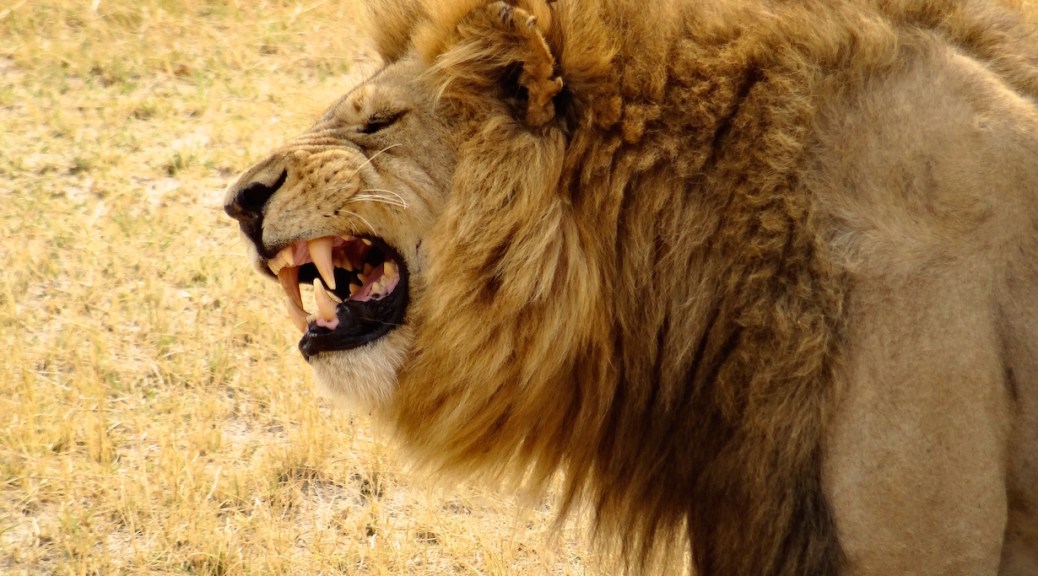
And then there was papa. And he was a looker. He kind of hung out away from the rest of the family. And when he stood up and walked around it was just breathtaking.

We watched in awe as he downed some water and immediately peed it all out (ha!), and then just ogled him in his royal, powerful presence.

And they are all so unfazed by the presence of humans and these big ole jeeps coming right up to them. They barely bat an eye when the jeeps turn on. Though at one point a mama cat stood up from her catnap and started walking straight towards me, eyes locked. I’m not going to lie; I panicked a little and maybe started to maneuver in my seat so that I could hide behind Alan.

And can we talk about how insanely cool it is that we saw the one documented pride of lions in the world that stalks, kills and eats elephants?! Some of you may have even seen the film coverage (NatGeo or Animal Planet or something?). Well, that was shot here. We even saw a guy who films documentaries on these cats.

Of course lions weren’t the only highlight. We saw tons of elephants, the majestic beasts that they are. Good golly are they big in person.

And everything about them is huge. Sorry to be crude. But their man bits literally drag in the water as the cross!

One of the pleasant surprises was how many bird species we saw. This is the only type of animal I could not even remotely name with confidence or identify when we saw any. There are so many! I clearly don’t have the memory capacity required of a safari guide. So, there goes my back up plan of leaving the world of law for the Serengeti.

Of course, Pumbaa and his cousins showed up. Warthogs are cool little things. Never realized they get down on their elbows (do warthogs have elbows? If they did, that’s what they’d be leaning on) to eat.

Also, how cute are these mongoose? Adorbs.

I adored the giraffes. They may have been my favorite. Because they are weirdly at once graceful and awkward. They’ve got these gangly old limbs and crazy necks, requiring them to spread their front legs open in order to reach down and drink water, but when they run it’s stunning. It’s like watching movement in slow motion. They remind me of ballerinas. You just watch how they move and you have to stop to admire it.

But I also loved the zebras (too hard to really pick a favorite I guess). They are so beautiful and they look fake. It’s hard to believe you’re not looking at a hologram of a mythical creature, and that a rainbow colored unicorn is not going to pop up right next to them. Right? God, they are just beautiful, beautiful creatures.

But nobody is going to disagree that the leopard sightings were a MAJOR highlight. We thought we were lucky when we spotted the first one, off in the distance and lying down, camouflaged by the grasses around him. And when he stood up and walked toward the jeep I was kind of jumping up and down (in my heart, so as not to spook the guy). This was my first leopard sighting in the wild and I was blown away.

But it kept getting better. Later, we saw a leopard – super close up – stalking some guinea fowl! He never did make the move, but it was still neat to see, and the real-life suspense can’t be beat. The leopard even used one of the jeeps to hide behind as he crept up on his prey.

We followed him around for a while as he made his way through the wilderness. Though a freak 10-15 minute hailstorm (seriously!) eventually made us lose him. That was strange. One minute you’re dripping sweat in the 90°+ heat, and the next you’re shivering, struggling to get a poncho on as you’re being pelted by big cold pebbles being flung into your head at a 45-degree angle.

One of the things I hadn’t appreciated about African game is the number and types of antelope. There are practically millions. Impala are ubiquitous. The guides joke that they are McDonald’s for leopards since they are a quick meal and they’ve got an “M” pattern in white on their bums.

Wildebeest also abound. (Apparently one of the “ugly” five, but I argue they’re kinda cute!)

Waterbuck showed up occasionally as well. I thought these were neat because they have big white circles on the fur on their bum, which helps them to follow each other in a herd at night, given their poor eyesight, especially in the dark.

We also saw the tsessebe, known as the Desert Ferrari due to its speed. I thought their faces looked like leather. I know, I know. Leather is animal hide, but it looked like a piece of a leather jacket sewed onto their faces.

The littlest antelope we saw at Savute were definitely the steenbok. These minuscule little creatures would barely come up to a tall person’s knee. Alan and I joked that these are the prostitutes of the antelopes because it looks like they are wearing too much makeup. Look at those eyes!

One evening we saw an enormous herd of Cape buffalo walking in a line that seemed to stretch for miles and miles (farther than the eye can see). There were hundreds, maybe thousands of them, making their way back to a safer place to sleep for the evening.

But my favorite of the antelope was the kudu. These guys are beautiful with their lovely white fur patterns, and especially the males, with the curlicue antlers.

The lodge itself…Damn you guys. I’m writing this from the other side. From the real world side, where I now pay rent on an apartment and am facing the prospect of working a real Monday to Friday job again. And this seems like a distant memory already. Oh, that lodge felt like a honeymoon suite. Except for the combo of the lack of aircon and the sweltering heat. Oh, and the spiders the size of pancakes that seemed to like to pay me a surprise visit every time I used the shower. Ok, small pancakes. But big and terrifying to an arachnophobe like myself, all right? Anyway, I suppose nature is where it is. And it was worth it for the incredible experience amongst the animals. From our room we could see elephants coming to the water, and I woke up one morning to a view of Cape buffalo from the bed. Do I feel spoiled? I do.

And the dinner setting was unreal. There is a water hole formed from a borehole on the property, and the water in it is a bit salty so the elephants are really drawn to it. And they show up just as dinner is being served. From your table as you feast (on specialties like springbok carpaccio and impala pie!), the elephants come strolling through by the dozens to drink up from their watering hole.

Practical Info

Deciding where to go on safari can be quite a daunting task. Even once we chose Botswana, the options seemed overwhelming. There are several regions, and within these are various concessions and countless camps and lodges. And the nomenclature gets confusing because folks will talk about names as though they’re entirely separate, even if one lies within the other…such as the Moremi Game Reserve and the Okavango Delta. Some safari destinations vary greatly with the seasons while others are more consistent year-round. October tends to be the end of Botswana’s high season, and it is also the hottest month of the year.

Safaris are usually pricy, and Botswana usually falls on the very pricy end of that spectrum. Part of what you pay for is access, since Botswana’s safari areas tend to be less crowded and more remote than most others. In addition to the high costs of the lodging itself, you can expect to pay a bit for internal flights on bush planes.

We chose a six-night package with Desert & Delta, which allowed us to pick and choose from their several properties. We spent two nights each at Savute Safari Lodge, Camp Moremi and Camp Okavango. I would classify Desert & Delta as midrange, for Botswana. Which means it’s massively expensive (each night is the equivalent of an overwater bungalow in Tahiti or the Maldives at a nice resort), yet there are plenty of options that cost double and more. Our package included accommodation, all food and drinks (except premium brands, but e.g. Glenfiddich whisky was included so it wasn’t exactly well drinks), two activities per day (typically game drives), laundry, etc. It was all very comfortable and well done.

We picked these three properties because we thought it would be nice to see different areas. Wildlife and landscape can vary quite dramatically. Savute Safari Lodge is in Chobe National Park. Camp Moremi is in the Moremi Game Reserve. Camp Okavango is in the Okavango Delta. With the benefit of hindsight, we would say that Savute was amazing, Camp Moremi was good and could be great with better luck, and we would advise skipping Camp Okavango. I did not realize there were no game drives at Camp Okavango, but only walks or boat rides. Nor that it seems most water-based game viewing does not offer nearly the same prospects for big-game viewing. If your goal on safari is to see as much big game as possible, definitely do not go to Camp Okavango.

The game viewing at Savute was by far the best, and the river/watering hole adjacent to the lodge drew a steady stream of elephants and sometimes Cape buffalo.

Transportation: We flew from Paris (Orly) to Heathrow and then took a redeye to Johannesburg on an A380. Quite a plane, that is. In Johannesburg, we stayed at a hotel right by the airport (the Intercontinental is at the airport and a lot pricier) and just took the hotel’s free shuttle both ways. The Gautrain is well-regarded if you want to explore some of Johannesburg.

We departed from JNB for the ~2 hour flight to Maun, Botswana on a turbo-prop Air Botswana flight, which had four seats per row. There we went through immigration, and we were met by a representative of Desert & Delta Safaris and then transferred to an 11-seat Cessna for the 45 minute flight to Savute. From the Savute airstrip, it is perhaps a 20 minute drive to Savute Safari Lodge.

We departed Savute on a six-seat, single-engine Cessna 206 for the half hour flight to Xakanaka Airstrip to stay at Camp Moremi. This was a tiny plane!

Accommodation: Savute Safari Lodge may be called a “lodge,” but it felt more like a camp. Perhaps if the cabins are all wood/glass rather than permanent tent structures then one calls this a lodge? Anyway, each couple gets a very spacious cabin with en-suite facilities. Our room #6 was closest to the common areas, where there is a building with a bar and lounge, a small pool, and an outdoor covered area for lunch and dinner. There is electricity (from a generator) in each cabin during the day, but only battery power at night to provide enough light. So don’t forget to charge those camera batteries during your siesta break! Note that there is no air conditioning, and the fan only works while the generator is on.

In Johannesburg, we stayed at the Premier Hotel O.R. Tambo, which is very near the airport and has a free shuttle.

Food and Drinks: Hunger was not an issue. Breakfast is served at 6 am and is mainly cold fare, such as cereal, fruit, yogurt, excellent bread, juices, coffee, etc. Perhaps pancakes or crepes would be added. Then the morning game drive often includes a tea break with a light snack. Brunch is around 11 am, and this includes a lunch buffet plus eggs cooked to order. Afternoon tea is at 3:30 pm, and there are always snacks. During the afternoon game drive, sundowners are de rigeur. These take place around 6 pm (seasonally variable, I presume), where you imbibe a gin & tonic (or perhaps wine or beer) and have more snacks. Things like biltong (local jerky), cookies, chicken wings, whatever. Back at the lodge, pre-dinner cocktails with snacks are up around 7:30 pm. Dinner is at 8 pm, and this entails a plated appetizer plus a buffet and a plated dessert. In general, the breads were excellent and the food was very good.

Activities: At Savute Safari Lodge, everyone does a morning game drive (~6:30-11 am) and an afternoon game drive (~4-7 pm). At certain other properties, including our next stops, there could be game walks and/or water-based activities. Game drives are in open-sided Toyota Land Cruisers, and each guest gets a “window” seat.

October 11-13, 2014 (Saturday-Monday)

À Bientôt, l’Europe!

Oh, Paris. You just might be my favorite city in Europe. How anyone could not love the City of Light is beyond me. It just oozes beauty, art and style. I could wander those streets covered in pretty Parisian architecture, and (were it not for the smokers) I could sit outside at those fantastic cafes, watching the black and grey clad locals walk by with their impossibly cute dogs, whilst sipping on Bourgogne and nibbling on some rillettes and cornichons (and macarons to finish, but of course!).

Upon the advice of a handful of friends, we stayed in the Marais (3rd arrondissement) and we really loved it. There are loads of cafes, restaurants and cute boutiques, and there tend to be fewer tourists than some of the other arrondissements. It seemed the shops right near our flat were segregated by block. E.g. we were staying on the luggage and handbag street, nearby was a strip of (high end) cosmetic stores, and then a street of nothing but wholesale jewelry, and so on. I have to say I appreciate that organization.

One of our favorite finds in our little neighborhood was the Marché des Enfants Rouge (supposedly the oldest covered market in the city). It kind of became our go to spot, for quick meals, meats and cheese, and even flowers.

Of course, we had to pay a visit to my dear friend Jen’s old home on Rue des Rosiers, where she lived while studying in Paris. It being the Jewish quarter and our visit coinciding with the Friday afternoon of the Jewish High Holidays, it was sort of dead. And, most important, L’As du Fallafel was closed. So we came back another day to sample this legendary falafel, and we ate it standing outside Jen’s old door. If you want an indication of how much Alan liked his falafel, consider this. A kind Orthodox man came over and wrapped a Tefillin around Alan while we chatted for a bit, and the entire time Alan did not stop eating his food.

Now Paris is the only place we went on this trip that we’d both been to already. But our last visits were something like 15 years ago, when Alan was a college student with mono, and I was a middle schooler focused largely on shopping at Kookai. Thus, on this trip we hit up a number of the popular tourist sights, and we felt a bit better about skipping a few we’d  done previously.

That said, we did some serious exploring this time around. We really felt like (especially with a week-long visit) we were getting to know the city, and able to maneuver our way around. The metro system is remarkably easy to navigate, and super efficient. Of course, those iconic metro entry signs add some beauty to the experience, too.

Of our touristing; first things first: cheesy romantic-ness. We obviously picnicked in front of the Eiffel Tower. (I am a romantic + first time in Paris with my lovah = wine and cheese by the Tour Eiffel). We picked up supplies at the Marché des Enfants Rouge and headed over for a lovely afternoon soaking up the sun. I was dismayed only by the fact that I was outdone by not one, but TWO women (English speaking and likely American) who had our same idea but out cheesed us by wearing berets. The gall.

Oh, and side note: speaking of cheese, we picked up a couple cheeses we’d discovered at dinner the night before: a creamy and stinky Pont-l’Évêque, and a nutty parm-y/cheddar-y Mimolette. I’m really glad Alan didn’t tell me until afterwards, but apparently Mimolette is (or was, or this was all urban legend?) banned by the FDA because mites are used in the cheese making process. I can’t decide if I’m more grossed out about this, or all the weird things we ate in Asia.

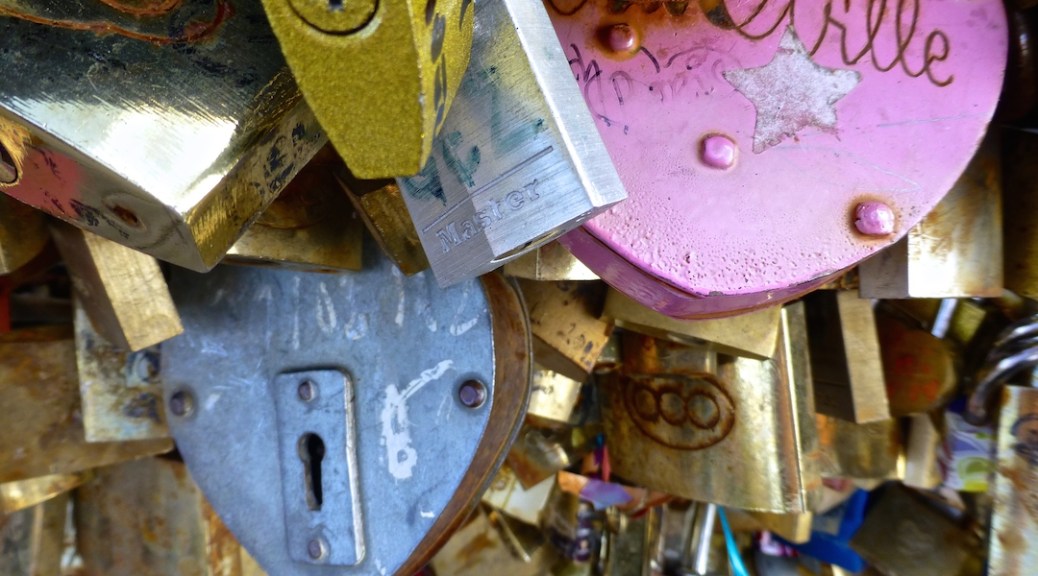
Alan was a total sport and indulged me in some even more uber-cheesy Parisian romance (slash a silly tourist trap): we placed a lock on Pont des Arts (the love lock bridge) and threw the key in the River Seine. It is truly insane how many locks are fitted onto that little bridge. And there are entire sections that are clipped and covered with wood so you can’t attach more. I’ve read that they regularly clip the locks as they get put up, and it looks like it must happen often since most of the dated locks had looked like they were from no earlier than August of this year. People go all out, too. Our €2, purchased a half block away from the bridge, standard lock was certainly outdone by some of the personally engraved, heart shaped masterpieces up there.

Of course, we visited a number of the other big sights. After our Eiffel Tower picnic we walked over to L’Arc de Triomphe. Way bigger and more impressive than I remembered. (Kind of a theme with Paris, for me.)

We walked by the Louvre to take the obligatory selfie in front of the pyramid (again, was more impressive and bigger than I recall). While we didn’t really have any intention of going inside the museum, I would have enjoyed taking our time and walking through the Jardin des Tuileries. Unfortunately, we had so-so weather by the time we made it over here.

We did check out the Jardin des Plantes one day, and despite the chilly weather, we enjoyed admiring the flowers and practicing our French by reading informational bits about medicinal plants and herbs. Loving the green spaces in this city.

We visited the Centre Georges Pompidou, though not the museum, just the sixth floor roof with its awesome views of practically all of Paris (Eiffel Tower and Sacré-Cœur included). I learned that this inside out building was designed by the same guy (Renzo Piano) who did the wind tunnel at the Ferrari factory we saw outside Bologna.

And you guys, we pulled it together for our last stop in Europe and we did it. We went to a museum. And we damn near went to two, but the line for the Musée d’Orsay on a free entrance day around noon is a special kind of torture nobody should voluntarily subject themselves to. Anyhow, I’m calling it a success. We had a bit of a stretch there where we couldn’t bear to do museums (ahem, London). But the Rodin Museum captured our attentions long enough for us to get a wee bit of culture. The grounds of this former mansion are lovely. And Rodin’s sculptures certainly don’t make bad lawn ornaments.

We really enjoyed wandering Île Saint-Louis (definitely check it out, no “major” sights per se, but incredibly charming little neighborhood full of tempting fromageries, boulangeries, and boucheries) on our way back from visiting Notre Dame and Sainte-Chapelle.

Alan is officially obsessed with photographing Notre Dame, he couldn’t stop.

Sainte-Chapelle is the somewhat lesser known, but in my opinion more beautiful (at least on the inside) stained glass loaded church. Look at the detail in there.

Alan loved Rue Mouffetard. It’s a gourmand’s paradise, full of your choice of cheese, meat, foie, pâtés, pastries, seafood, rotisserie, chocolate, wine…

One evening we went over to Montmartre and met the parents of Alan’s best friend from law school (his father is from Paris and they have a flat they happened to be visiting at the same time as we were there!). Our lovely hosts walked us around the area, showing us the last vineyard in Paris (!): Clos Montmartre (who knew?), the adorable and buzzing square atop the hill, and the Sacré-Cœur all lit up at night with the amazing views down below. We shared a fantastic dinner (and wine!) at Le Coq Rico.

Those who know me well know I am borderline obsessed with macarons. So naturally I sampled several. On Champs-Élysées we picked up a handful of Pierre Hermé’s treats. Alan really enjoyed the olive oil vanilla (but my favorite ever just might be a classic vanilla bean flavor, so I was not as into this one). The jasmine flavor, however, was out of this world. I was lucky to grab a few from Ladurée in Orly Airport on our way out. Their vanilla and rose were the bomb.com. And you know I jumped on the opportunity to try a macaron ice cream sandwich (oh yes). That bad boy from Berthillon was a salted butter caramel ice cream surrounded by big almond macaron cookies. And it was sinful (if not a bit cloying).

We’re not much of shoppers on this trip given the whole one suitcase for months at a time thing, but we did explore a bit of the wares on offer. We wandered Champs-Élysées after walking to L’Arc de Triomphe. Though to be honest, we didn’t even really window-shop anything more than the macarons. It’s a pretty, wide boulevard and of course there are nice shops, but we found it quite touristy (e.g. there was a line out to the street for Häagen-Dazs, what?).

But I did very much enjoy going to Saint-Ouen for the Marché Aux Puces, supposedly the world’s largest flea market. If I had a home to ship stuff to, or current income, I would probably have purchased some furniture. There are some beautiful pieces there. We also found it très Parisian and très adorable that all the proprietors were eating their lunch with baguette and wine all fancy at their tables, with real silverware. How civilized.

All in all, Paris was a fantastic way to wrap up our nearly three months in Europe. We’re off to Africa for the next and final continent on this crazy trip of ours!

Practical Info

Paris lives up to its hype of being a beautiful and romantic city. The lovely buildings with wrought iron balconies covered in flowers abound. As do the ample squares, cobblestone streets and peaceful gardens. The Seine is most attractive, adorned by several bridges and some quaint islands.

Generally speaking, I was a little disappointed with the food vs. very high expectations. And the wine was pricier than I expected. I could not but help compare each of these categories to Italy, which I felt clearly had the upper hand in terms of value. I was pleasantly surprised by the friendliness of the locals and ease of communication and transport. Many assert the French can seem snooty or unfriendly, and we did not experience this at all. Perhaps because we can speak some French and made the effort, nearly everyone we interacted with was kind and willing to speak English, especially if theirs was better than our French.

We bought a SIM card at Orange (SFR was out) for €40 which includes 2 hours of international calls, 1GB data, etc. This was much pricier than we’re used to, but we needed it. In the unlikely event you need to ship something, the folks we interacted with at two post offices were exceptionally friendly and helpful. It costs €50 to ship 7kg in a smallish box to the US.

Transportation: We arrived to Charles de Gaulle Airport (CDG) on a flight from Prague. We took the RER B train (€9.75 each, self-service machines with English) to Châtelet – Les Halles and walked from there to our apartment. Paris is quite large, and the public transit system is good. You can buy a carnet of 10 metro tickets for €13.70 (basically break even at 8 rides), and you can divvy up the tickets however you want (unlike, say, London’s Oyster Card where each person needs his own card).

Velib’ is the public bike sharing program. Autolib’ is an electric car sharing service.

We departed on a flight from Orly Airport to Johannesburg via London Heathrow. Taxis G7 has an English language number and they picked us up on time. It cost ~€40 and took half an hour from our apartment to Orly Airport.

Accommodation: We stayed at an Airbnb place on Rue des Vertus in the 3rd arrondissement, in/next to Le Marais. This is a great area if you want to be walking distance to cafes, boutiques, bars, etc. and don’t mind a touch of grittiness. Proximity to metro stations is important. I am by no means an expert on Paris and museums are not a big priority for us, but from what I’ve seen I’d probably stay in the 3rd, 4th, 5th or 6th.

Food and Drinks: Dinner at Bistrot Paul Bert (not to be confused with his other establishments) was very good. The fixed price menu is available in English and costs €38. It was getting late as we finished, so for my cheese course the waiter dropped off enough for five people and said I should take whatever I want. This is when we learned about Mimolette, which looks like (orange) cheddar and to me tasted sort of like a cheddar mixed with a Parmesan, as it is somewhat nutty and tangy. I’m not sure the current status, but I read that it’s banned in the US because it is deliberately exposed to mites. A pity, if true.

Le Coq Rico is a renowned volaille (poultry) restaurant in the 18th. We had a great meal there with the Streiffs. N.B. they are opening a branch in NY at Park Ave and 20th. The €21 two-course lunch at L’AOC was solid value. Our meal was good and the service was excellent.

Few even argue that L’As du Fallafel is not the best falafel in Paris. It is delicious and hearty at €6; there is a separate line for take away; get the hot sauce, it’s not very spicy. Also on Rue des Rosiers are a handful of competitors.

Marché des Enfants Rouges is a small covered market with meats, cheeses, fish, veggies, flowers, etc. and also stalls selling prepared food like Moroccan, Italian, Lebanese, Japanese…It is cool. Caractère de Cochon is a nearby shrine to the pig. Jean-Paul Gardil looked like a great butcher on Rue Saint-Louis en l’Île.

Ice cream at Berthillon on the same street was great and reasonably priced. I am not a big macaron fan, but Jenni, a self-proclaimed macaron aficionado, assures that those from Pierre Hermé are superb. Ditto those from Ladurée, which I’m pretty sure has some NY locations.

Rue Mouffetard (in the 5th) is a gourmand’s delight. There are several shops with cheese, meat, foie gras, pâtés, pastries, seafood, rotisserie, chocolate, wine, etc. The young man at wine shop Le Repaire de Bacchus was very helpful and steered us nicely to a Pic Saint-Loup.

We did not visit any of these in Montmartre, but Chez Plumeau is in a quieter part just off Place du Tertre; Le Tire Bouchon is a piano bar; Au Lapin Agile is a cabaret bar.

Though Paris is rightly famous for its sidewalk cafes, beware that you’ll likely be enveloped in cigarette smoke when you sit outside. I read that one should order steak “a point” for medium rare, which might be to the rare side given French preferences. Saignant is rare (at least for beef). If you want food to take away, the word is “emporter.”

Activities: There are endless famous museums, monuments, shopping areas, markets, gardens, specialty stores, etc. Most of the major museums are free on the first Sunday of each month, and some offer discounted rates for late visits on other days. Even if you don’t enter the Louvre, it’s worth passing by for the impressive building and iconic glass pyramid.

The Musée Rodin holds many pieces within its 18th century mansion and also its spacious and peaceful gardens. Musée d’Orsay eluded me yet again. The Eiffel Tower is an obligatory stop, at least for first-timers. We picnicked in a grassy area east of the Tower but did not ascend to any of the “floors.”

The Marché aux Puces de Saint-Ouen is generally considered the largest flea market in the world. TimeOut has a good description here.

Montmartre is like a cobblestone-street village atop a hill (butte) overlooking the city. Its most famous attraction is the Basilica of Sacré-Cœur; its central square the Place du Tertre. We visited at night and it was loaded with tourists and souvenir shops, but it’s easy to see the appeal. Once you get away from Place du Tertre, it is a lot calmer. Clos Montmartre is the only working vineyard in Paris, and each year there is a harvest festival (always early October?).

Île Saint-Louis is a charming place for a stroll. A friend did a Fat Tire bike tour and liked it. We wanted to do a cruise on Canal Saint-Martin, but the weather did not cooperate our last couple days. We did not go this time, but Versailles makes a lovely day trip.

October 2-9, 2014 (Thursday-Thursday)

Praha

Did someone replace Prague with Disneyland while I was asleep at the wheel? We arrived in the late afternoon and made it over to Charles Bridge that evening for our first view of the Prague Castle in all its glistening nighttime glory. That scene is straight out of a Disney movie. It is unreal and utterly romantic. I literally swooned.

The whole city kind of feels like a movie set to me. I mean, look at the town square.

It even has an astronomical clock. That sounds as movie-set-esque as possible, until you’re told that every hour on the hour it turns into a gigantic cuckoo clock. Are teacups and candlesticks going to start singing and dancing as well?

The incredible buildings don’t stop at the bridge and the town square; they are all over the city. And we know, because we took a (nerd alert!) Segway tour around the whole place!

I’m not going to lie, I was kind of nervous about riding the Segway at first. I got over the whole being embarrassed thing, because um, it’s actually insanely cool to ride this ingenious device. But, since (as is well documented on this blog) I am afraid of everything, I was afraid of hitting pedestrians and/or falling off this mysterious vehicle and onto the street thereby ending up with a cobblestone patterned face. But it was my lucky day, we were the only ones to show up for the tour and so we got a little private lesson on how not to injure oneself or others on a Segway, and guess what? I didn’t! Hooray! Also, it is so amazing to experience the world as a tall person for a day. The things you can see up there! 😉

Our mad Segway skills did not stop us, however, from wearing our helmets the entire time we were on the tour. Even when we parked the Segways to walk around. Bonus to sightseeing with helmets on: you can always find your partner in a crowd! We’re special, I know.

Our tour took us through most of Prague’s highlights. It was sort of the perfect way to explore a city for people like us who have a very short attention span when it comes to museums and churches and such. You just get there (fast), check it out, learn a tiny bit about it, and move on. I also highly recommend doing a Segway tour your first day in town. That way, you get your bearings and anything you really like and want to learn more about you can go back to and visit again.

One of the perks of doing the touristy stuff on Segway was cheating on the “walk” up to the castle. While we didn’t have much time to explore, we quickly went in to look at the church up close.

And the views from up there, and the nearby orchard/park, are wonderful.

Post-Segway tour we made it back to Malá Strana and entered the St. Nicholas church to check out the inside, and for good reason. Some ornate, pink and green marble Baroque-ness going on in there. Europe has got some seriously beautiful churches, does it not? I’ve been to church more in the last two months than my entire life before!

We also stopped to visit the Wallenstein Gardens, where the Czech Senate does its thing. They have a nice little spot there, loaded with bronze statues, a pond full of fish and surrounded by peacocks, all flanked by a view of the castle behind.

My favorite spot in Praha has to be the Lennon Wall. It is just so colorful and happy, and while I’m not sure if this is always the case or not, there was a guy playing covers of Beatles classics while we snapped our photos. And this little girl dancing along was maybe the cutest thing ever.

I really enjoyed reading a bunch of the notes people have left on the wall. There are all sorts of medium stuck up on there, often affixed by a band-aid.

The music scene in Prague is said to be legit so we spent a couple nights checking out a mix of the local concert offerings. One night we visited Reduta Jazz Club, where Billy Clinton himself once got up on stage and wailed on the sax. Juwana Jenkins sang some soul/rock and she was definitely an entertainer. Though we were really wowed by the fantastic harmonica player, Charlie Slavik.

To switch it up, we saw some classical music (organ/piano player, a violinist and two singers) the next night. We felt classy as hell ( 😉 ), and the venue was really lovely.

On the whole, I was a little un-into the Czech food, but I think this is largely because we’d been eating this hearty, meaty type of fare for so long by this point (German food and beer, then Prague for beef goulash, pork, bread dumplings, and more beer). That said, we did sample the trdelnik one evening. This is kind of like a heavy fried dough made on a burning hot rolling pin and then smeared with nutella. It’s as good as it sounds, and one is enough for a meal. Also, as our waiter not so subtly suggested the first evening, Pilsner Urquell may just be the best beer in the world. Ok, maybe that’s a stretch, but it’s really good.

Practical Info 

Prague has a huge and fun Old Town and sports some very impressive buildings and views (such as Prague Castle from Charles Bridge). History, beer and music are top draws. I did not realize before visiting that Prague was once the capital of the Holy Roman Empire (under Charles IV). Nor that “New Town” was built in the 14th century.

If you have enough time for a day-trip or more, Český Krumlov comes highly recommended.

Czech’s currency is the koruna (aka crown), though you will often see prices quoted in Euros. At time of travel, 1 USD = 21.6 CZK.

Transportation: We arrived on a train from Berlin, disembarking at Prague’s main train station (Praha hlavní nádraží). Much of the ride offers charming countryside scenery, as the tracks run right along a river. We walked (or took a Segway) everywhere within the city. The public transit system has a good reputation and is not that expensive.

We departed on a Smart Wings flight to Paris. Our hotel charged CZK690 (a cab may be slightly cheaper, and one may take public transport) for the 20-30 minute drive to Vaclav Havel Airport, which is nice and has free WiFi. The plane said Czech Airlines on it, and it was a pleasant voyage.

Accommodation: We stayed at Hotel U Červené židle (aka Red Chair Hotel). The location is superb, very near to Old Town Square and the Charles Bridge. Our room was spacious and the staff were very helpful. It seems to me that you probably want to stay in Old Town or Lesser Town.

If you are looking for something more upscale, my Dad and Linda recently stayed at Mamaison Riverside and my in-laws stayed at The Emblem. The Four Seasons is near Charles Bridge with a view of Prague Castle, and the Mandarin Oriental is in Lesser Town.

Food and Drinks: The Czech Republic is famous for its beer, but we did not really bring our A-game. Our excuse is that we came from Oktoberfest plus a week with Jack, aka the beer pusher. There are the classic old brewers, plus allegedly a robust craft beer scene. I can say that we much prefer the Pilsner Urquell to the Budweiser Budvar. We found the food generally good, but not great. There is a lot of goulash, roast pork, cabbage, bread or potato dumplings, etc. In general, stews, roast meats and hearty food prevail. If you have a sweet tooth, the ubiquitous trdelnik (a cylindrical pastry) makes a nice snack or dessert.

Dinner at U Parlamentu was good, and a half liter of Pilsner is only CZK38. Lunch at Cafe Savoy was also good, and the interior is lovely. Pad thai at Siam Orchid was not cheap (CZK190), but it was large and tasty. Dinner at U Medvidku was disappointing. The service was lousy, it was smoky, they were out of Jenni’s top choice, and I thought it was a craft brewery but somehow at dinner I could order only Budweiser Budvar.

Some other places that were recommended include K The Two Brothers (Indian); Pivovarský Dům; Cafe Louvre.

Activities: The City Tour with Prague Segway Tours (CZK1490 each, three hours) was a nice way to get an overview of the major tourist attractions. We weren’t so impressed by our guide, but riding a Segway was fun and it was worthwhile. We saw a blues/rock show at Reduta Jazz Club (CZK320/ticket, purchased in advance at their ticket window). Juwana Jenkins was good, but Charlie Slavik on the harmonica was the highlight. We considered JazzDock or Jazz Boat for shows.

“Mozart in Old Prague” at the Klementinum Mirror Chapel was nice (CZK550/ticket, somehow arranged at the front desk of Eurostars Thalia). We would’ve liked to hear the Czech Philharmonic at the Rudolfinum, but opening night was the day we departed. The National Theatre and Smetana Hall at Municipal House are but two of the many other venues for classical, opera, etc. There are also regular performances in various churches.

We saw Prague Castle and St. Vitus Cathedral up close, but we never entered. We did enter Our Lady of Victory Church (not that special unless you’re really into the baby Jesus statue) and St. Nicholas (CZK70), which is an impressive baroque construction. Wallenstein Garden is free and peaceful with nice views. Just don’t ingest hallucinogens before visiting or the dripstone wall may get you. But the peacocks might be neat.

Old Town Square is a must, with the Astronomical Clock, gothic Church of Our Lady before Týn, etc. Nearby is the Powder Tower, Republic Square (there was a small farmer’s market when we passed through on Wednesday) and the Municipal House (with an attractive Art Nouveau cafe and restaurant). The main square of New Town is Wenceslas Square.

The Lennon Wall made for an enjoyable quick stop. The old Jewish Quarter (Josefov) is a top attraction, though we just cruised through and did not make it to the museum. Our Segway guide said there is a pedestrian area with bars etc. along the Vltava River, I think it’s called Novoměstská náplavka or something like that.

September 28 – October 2, 2014 (Sunday-Thursday)