Category Archives: Central Asia

Khiva

Leaving Tashkent we flew to Urgench and then traveled by car to the desert fortresses (covered in our prior post) before arriving in Khiva. This was the first of many long drives across the ‘Stans. Looking back I think we greatly underestimated the amount of time we would be spending in cars during these three weeks, and while it often got tiring and I occasionally suffered from some bad-road-induced car sickness, we really enjoyed these chances to observe the less-seen nooks and crannies of Uzbekistan and its neighbors. While there is a whole lot of nothing, there is also a whole lot that’s interesting. The box-like houses that sporadically line the streets are all connected by exposed pipes carrying natural gas (a major natural resource of Uzbekistan). In general, we were struck by how much more prevalent colors like brown and grey (in the landscape and man-made structures) are here compared to supremely colorful places we visited like India and Sri Lanka. But in spurts, the red and yellow government subsidized houses dot the landscape like Ronald McDonald outposts. In sparser areas there are miles and miles of cotton and wheat fields and lining the streets is often a row of the silk worms’ favorite: mulberry trees. And of course, there are those donkey-pulled carts.

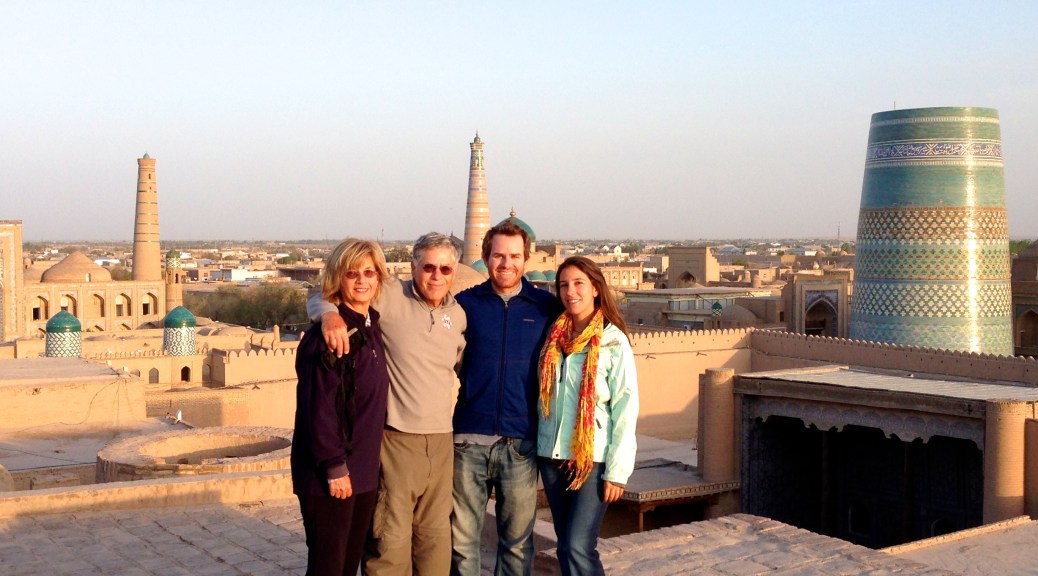
Khiva was the first major Silk Road city we visited. Among the Silk Road destinations in Uzbekistan, Khiva has a reputation for feeling more like a museum than Bukhara or Samarkand. The old city has been beautifully restored, but some fret it is now so polished and touristic that it has lost some of its living vibrancy. We can understand this sentiment, for when you enter through one of the four gates into the walled inner city (Itchan-Kala), the ancient mosques, madrasas, and caravanserais are all full and buzzing with shopkeepers and souvenir sellers (including some folks selling these incredible traditional Uzbek hats for the men, and lovely fur hats for the ladies. Alan and Ron look like 80s rock stars, no?), but at night it seems more of a ghost town.

In addition to the beautiful restoration, the sense that you’re in a museum is perhaps because the tightly compacted inner city means all these architectural gems and amazing sights are conveniently located a quick walk around, as though you are passing through a large, outdoor exhibit.

Our first night in town we walked up to a great vantage point atop the city walls to watch the sunset and get spectacular views of the blue and white tiles with a stunning evening light.

After sunset we had another hearty meal (hearty is a good word to describe every Uzbek meal), preceded by a medicinal vodka shot. Our guide informed us that taking a shot of vodka pre-meal helps the stomach to deal with any pesky digestion issues. Fact or fiction? We’re not sure.

The area in which Khiva is located is called Khorezm. Back in the day, people were named after where they came from, and so one man from this area, known as Al-Khawrizmi went on to become a pretty great mathematician. And it is from his name that we got the word for algorithm, and his book titled Kitab al-Jebr is where the word algebra derived from. Crazy, huh?

Among the other fascinating facts about the way life was in Khiva’s heyday, men sentenced to death were killed by impaling. And the punishment for adulterous women? They were placed in a sack with wild, giant Uzbek hornets that would sting them to death. What a way to go, eh? We were skeptical at first too, until we saw Uzbek hornets with our own eyes. They are enormous!

Within the Itchan Kala, the Kunya Ark is the old palace and a smaller fortress within the fortress. It was neat to learn some of the engineering and architectural intricacies, necessitated in part by the region’s extreme weather. Temperatures in Uzbekistan often plummet well below zero in the winter, and summers are scorching with readings of 120º and higher. So, for example, the ayvan of the Khan’s court faces north and tops out above the city walls, so it stays cooler in the summer by avoiding the sun and catching the breeze. We also learned that Uzbekistan generally has a high water table and high salinity, so drainage and irrigation were and are a common theme in land use and planning.

Apart from the scientific-leaning tidbits of knowledge, we heard many a tall tale. Legends and mythical heroes are commonplace in Central Asia. Thus when we visited the Mausoleum of Pakhlavan Mahmoud, a fur maker and undefeated wrestler, our guide explained not only the various parts of the building but regaled us with a 10-minute story about how the wrestler was summoned to India because a rajah wanted to see him battle a local strongman and this local’s mother begged Pakhlavan Mahmoud to let her son win so he would not be punished in defeat and Pakhlavan Mahmoud did this but then got in trouble because the rajah knew he threw the fight but then in a dramatic turn of events…We must have heard 30 stories like this during our time in Central Asia.

Khiva was only stop number one of the Silk Road for us, and I have to be honest, we aren’t the biggest history buffs in the world, so there was definitely a bit of mosque/fact/history overload. Even this early on. One way to help us break up the long stretches and let us digest the information was to break for elevensies. Um, how had I never heard this term before?! Elevensies, tensies, twelvsies! You stop in the morning for a cuppa and a quick bite! Obsessed. I was told by Mansur that there is no such thing as threesies, but you can bet every time I snack break, be it ninesies or midnightsies I’m adding a “sies.” This also makes me terribly excited to go to London. Just so I can have elevensies (with scones and clotted cream!). And I can also try out the new expression we learned…Instead of saying, “kill two birds with one stone,” I can use the Uzbek twist on this phrase and say “kill two rabbits with one bullet.” Like, “Dear, we’re a bit knackered and hungry, aren’t we? Why don’t we break for foursies and we’ll kill two rabbits with one bullet? Right, then, cheerio.” Anyways, I digress.

A trip to the Silk Road would be incomplete without learning about the silk making process, and when we stopped at a small demonstration and educational facility it was practically impossible to pull Ron and Alan away from a book detailing the complexities of the silk dying and carpet weaving process. A very quick explanation: silkworms eat the leaves of the mulberry trees and grow tons and spin a cocoon maybe one-third the size of a chicken egg. When you unwind the cocoon they’ve spun you can have up to a kilometer of silk ready to be softened and died. The actual weaving process takes lots of time and is incredibly detailed. We were very impressed by these hard-working ladies.

On our last evening in Khiva and feeling a bit done with the touristy museum kinda thing, we requested Mansur help us find a non-touristy restaurant. He happily obliged, but even he had to say it as we sat practically alone in a big open room and were served a whole, cold chicken slathered in ketchup and mayonnaise, that maybe we picked the wrong city to try and get off the tourist track. I was also amused walking back to our hotel that night that despite the many very modern streetlamps, not a single light was on. When I asked Mansur why, he said “what for? They use them when officials are in town.”

Practical Info 

Accommodation: We stayed at Malika Khorezm Hotel. It is located outside the old city walls, but within easy walking distance. Our room was huge and spartan but nice. The WiFi worked only in the lobby. We saw several options located inside the old city which might be a little more atmospheric, though everywhere felt like a ghost town at night.

Food: We dined at Hotel Kheivak in the old city. The hearty soup with rice and beef plus dill, and the pasta with meat and yogurt etc., came with vodka shots. Our second night we asked for a non-touristy place. Perhaps we picked the wrong city for this. There was hardly anyone else in the large room. There was no menu. Our whole chicken arrived half cold and slathered in ketchup and mayo. Actually, it was not bad. The vodka came in a small water glass, and our guide calls it medicine.

Activities: Our first evening in town we entered the Itchan Kala (the walled inner town of the city of Khiva) through the gates of Ata Darvaza (there are four gates, this is the west gate), and we walked up some stairs inside the Kunya Ark (the palace) for a vantage point with great views (especially at sunset). We paid 4k UZS each to enter. I’m not sure exactly how to find this place, but maybe if you ask for the sunset view place inside Kunya Ark then someone could point it out.

We had a full day sightseeing inside the Itchan Kala. We saw the Kunya Ark, the Mausoleum of Pakhlavan Mahmoud, the Juma Masjid (with its 213 wooden columns), some minarets and madrasas, and a great little silk making place with a book describing the process. A silk worm’s cocoon might be one kilometer long when unwound! Our guide handled everything but I think you may need a ticket to enter the Itchan Kala and then also for specific buildings, though I’m not certain.

April 27-29, 2014 (Sunday-Tuesday)
Welcome to Uzbekistan

Yup, you read that right. So began our travels to the peculiar and perplexing place that is Central Asia. Also colloquially known as the ‘Stans. Uzbekistan was the first stop on our trip along the Silk Road (we also ventured into Turkmenistan, Kyrgyzstan and Western China on this foray into the land of magic carpets). If you’re scratching your head and asking yourself “why in the world would one go to Uzbekistan?” well, you’re not alone. The response we received from many was, “where?” followed quickly by “why?” (or more frequently than I might have thought, “is that a country?”). So I suppose I’ll start with a very brief introduction to Uzbekistan and why/how we ended up here.

Uzbekistan is the most populous of the five nations typically considered to make up Central Asia (Uzbekistan, Kazakhstan, Tajikistan, Kyrgyzstan, and Turkmenistan), home to arguably the grandest of the Silk Road’s cities (Samarkand, Bukhara and Khiva). Given its central location, Uzbekistan was a required stop for the multitude of trading caravans shopping their silken (and other) wares. This region of the world has largely been home to nomadic peoples and served as a crossroads for the movement of not only goods, but people, cultures, ethnicities and ideas to and from Europe and Asia. It’s a historically fascinating place, full of architecturally stunning ancient mosques, caravanserais, and madrasas. It’s also home to many Turkic descendants, and to our surprise, a substantial number of Turkish speakers.

Uzbekistan is also a former member of the USSR, and this Soviet influence is palpable in many ways, the most obvious probably the red tape you fight through crossing its borders. We’ll cover our two Uzbek overland border crossings separately (and do stay tuned because they were two of the strangest and most infuriating days of our lives. A truly unique travel experience that may not be rivaled outside this part of the world). And that alone almost sums up what we sought out of this visit: an experience unlike others. A chance to visit a part of the world rarely seen by people in our hometowns, and a place not so well understood. We learned an incredible amount while in these countries, largely because we knew so little about them beforehand, and in part because we had very informative tour guides unlike much of our independent travels. I should also mention that we were joined here by Alan’s father, Ron, and his wife Linda. We were also accompanied for the majority of this trip by local guides, as we booked this trip through a travel agent and decided (wisely) that these countries would be too difficult (if not impossible and at times prohibited) to visit independently.

With the exception of the characters we met at Uzbekistan’s borders, we generally found the people in this nation to be pleasant and friendly, and we were touched by their genuine curiosity and excitement to see us. This mutual fascination was so poignantly displayed one day while we were touring some of the mosques alongside a group of women from rural Uzbekistan. I’m not sure who started photographing whom, but we all stood there looking at each other through the lens of our cameras and laughing.

The people of Uzbekistan are predominantly Muslim, but it is not an Islamic state. In fact, the government suppresses religious expression by banning full-face veils and long beards. Our guides here and in Turkmenistan were adamant about how the people are Muslim but not fundamentalist and still like alcohol etc., which gave us a somewhat modern and progressive impression of the country. But in many ways, it feels like Uzbekistan is a nation stuck in time. What time I’m not exactly sure. The Soviet Era? It was certainly a time before smoking was banned in public establishments and hotel rooms. The stale smell of cigarette smoke lingering in old fabrics permeates the air of most establishments, including all of our hotel rooms. In fact, the first time we got an option for a non-smoking room was weeks later in Kyrgyzstan, and the non-smoking floor was one of ten plus floors in the massive hotel. And while there are a lot of the modern conveniences that you tend to associate with developed countries, there is a distinctly quaint, pastoral even, quality to the place. So, for example, while you will see modern roads and pedestrian crossing lights, there are also donkey-drawn carts on those roads (and cows and sheep and horses).

One of the first things visitors to Uzbekistan learn is that the money situation is absurd. What do I mean by this? Well, credit cards are accepted at approximately zero locations throughout the country. Cash is obtainable via ATMs, which are conveniently located at approximately two locations in the nation. In the capital city of Tashkent, only. And these ATMs dispense only USD, which you will then need to take to the bank (or the streets, as black market money exchanges are common) to exchange them for Uzbekistan Sum (UZS). And bring your biggest purse/suitcase/trashbag because the largest bills you are likely to find are 1,000s (and, on the rare occasion, 5,000s). Ladies and gents, let me break this down for you. 1,000 UZS = $0.43 USD. That’s 43 CENTS. That means when you exchange one US$100 bill you receive about 230 UZS bills! We quickly learned that a skill unique to the Uzbek is the ability to count legal tender in rapid-fire succession. Our guide, Mansur, did his best to teach us. On multiple occasions. But there is no rivaling one with a lifetime’s experience of counting out a three-inch thick stack of bills to pay for his borscht. I suppose it goes without saying that I was forced on multiple occasions to fight the urge to make it rain UZS. Among the next things you will learn about money in this nation: it must be reported. You must declare on arrival the exact amount of cash (USD, UZS or otherwise) you are carrying into the country. And then you must declare exactly how much you are taking out of the country upon your exit. And if that number somehow gets bigger, be prepared to explain. Never mind that there are ATMs, you will need proof. Oh, one last fun fact about currency in Uzbekistan. USD is often accepted, sometimes appreciated. But not just any old American dollars. The Uzbek have a policy on USD, which is to say that if it has even the most minuscule tear or even a smidgen of writing, you might as well consider it toilet paper. No, my friends, the Uzbek will have none of your shitty, dirty, written on or torn USD. You will need pristine bills. Not even kidding, that we held up the line at the airport for a good ten minutes as the man in charge of processing our visa on arrival sat there and rejected bill after bill after bill of the same United States dollars that every single US establishment will gladly accept. And don’t expect this same quality in your stacks of Uzbek cash, the rules may as well be opposite.

After sorting out our money, we were finally ready to get out and see what Uzbekistan was all about. Armed with pockets full of (not so valuable) cash, we set out for a tour of Tashkent, the capital city. Our accommodation, Hotel Uzbekistan, stands in a prime location, overlooking a large square centered by the statue of Amir Temur, the national hero. In fact, much of the city is covered by big, beautiful, green squares and parks, well-manicured gardens surrounding statues, monuments and buildings. The manicuring extends to the buildings, the streets, even the subways and the meat market – it’s an impressively clean city. And that subway. Let me tell you, it is just stunningly beautiful. Each station is decorated differently and my particular favorite was very art deco, with marble walls and columns and super in-right-now brass fixtures. Unfortunately, as with many sights in Uzbekistan, the taking of pictures in the subway is strictly prohibited (hellooooo nonsensical Soviet era rules and hyper paranoia!).

We checked out a local market where Alan and Ron indulged in their first taste of horse meat. Again, you heard correctly. Horse meat is a popular treat here, and according to Alan, it’s quite tasty when spiced up and served with noodles. Linda and I stuck to the bread on this occasion. There’s just something about eating a horse…it’s not quite a dog, but…I couldn’t bring myself to do it.

Which brings me to Uzbek cuisine, and really Central Asian food in general. This is what the header of the Uzbek visa application should read: vegetarians need not apply. The options are typically meat, meat or meat. A typical meal is bread, a soup made with meat, potatoes in the soup and perhaps elsewhere, and then one of plov (made with rice and either lamb or beef), kebabs (again, beef or lamb), or manti (like a meat filled ravioli). We became all too familiar with these dishes as the variation of food all across the ‘Stans was close to non-existent. In fact, none of the ‘Stans we visited have any Western chains! We realized at this point how unusual it is that a significant chunk of our time over the course of this trip was spent in countries (and cities) with no McDonald’s. At first, this is an amusing, even impressive fact. After three weeks of plov and instant coffee, the lack of Starbucks seems a devastating flaw.

We were surprised by how clean, refrigerated and orderly the markets are. These are not your typical developing country markets with potent odors and abundant hazards for those sporting flip-flops. It was here in this market that we also got our first glimpse of the redonkulous junk-in-the-trunk sheep butts. (I’m not even ashamed to use the word redonkulous. You should see these lamb bums in action. They swing back and forth when they walk. It is ALL. FAT. In fact, every time a fat-tailed sheep walks by an angel starts singing Sir Mix-a-Lot’s classic.) And the Uzbeks love that ish. Sheep bum is everywhere.

The old town was our first chance to glimpse the beautiful blue and white decorated architecture that is so characteristic of the Silk Road. It’s pretty incredible to see the contrast of these old, intricate and colorful buildings next to the stark, cold Soviet architecture throughout much of the city. We were also fascinated to see the old neighboring homes made of mud and straw and with no windows to the street (so as to allow the ladies to be able to walk around uncovered without risk of being seen, back in the day). We also scoped out the world’s oldest Quran (printed on deer skin!) and a madrasa (Muslim school) before heading back to our nice-in-a-dated-way hotel to recover from jetlag.

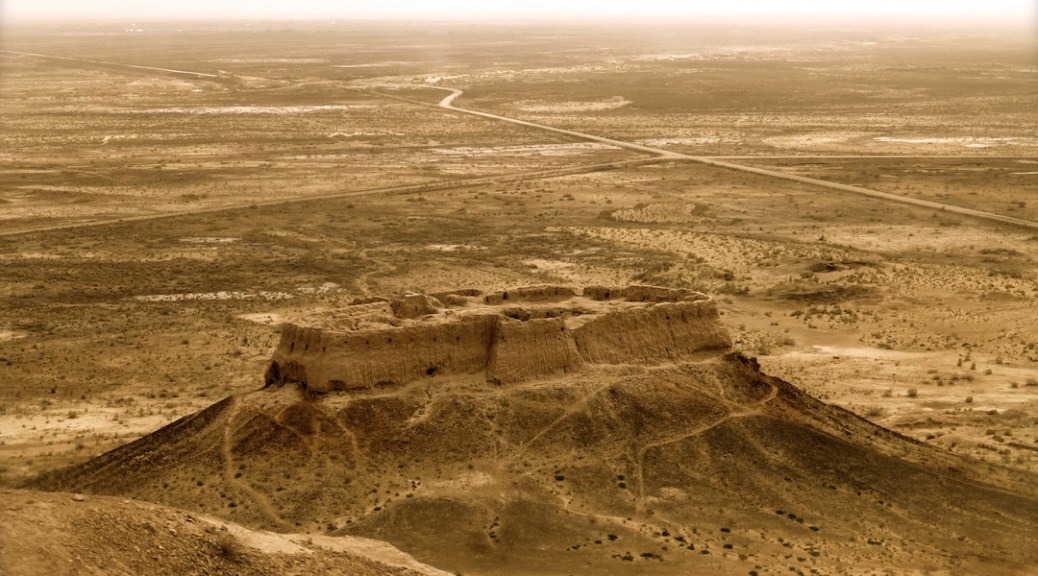
From Tashkent we flew to Urgench and first visited some ancient fortresses before settling in Khiva for two nights. This area holds many fortresses in varied states of preservation, and we stopped to see Ayaz-Kala and Tuprak-Kala. These mud and clay structures are still standing after many hundreds of years. We really appreciated visiting these because they are so remote. Standing on top of these, looking out at the miles and miles of desert nothingness, you can start to get a sense of what it must have been like to travel on camel for weeks, waiting for signs of life and civilization as you make your way through the unforgiving heat and miles of endless terrain.

Practical Info

We booked most of our Silk Road trip through Jim O. at Tailor-made Adventures (somehow affiliated with Dragoman and Imaginative Traveller). I think you could visit Uzbekistan independently if you have a really tight budget and/or you are very adventurous, but I probably would not recommend it. English is not widely spoken and there are many nuances and formalities that would be tough to negotiate on your own. Besides, the history is arguably the main draw, and a good guide can explain it all and make the sights more interesting.

I am not sure if US citizens need an invitation letter to visit Uzbekistan. We were unable to obtain visas prior to leaving for Asia, and Jim was able to get us an official invitation letter from the proper Uzbekistan ministry such that we got a visa on arrival in Tashkent (after a bit of paperwork beforehand and $160 per visa on arrival). They were absurdly strict regarding the quality of the USD bills they would accept. If there was a 1mm tear or the slightest marking, forget it. It is almost entirely a cash-based country, so be sure the USD (or Euros, perhaps) you bring are pristine and ample. The official exchange rate was 1 USD = ~2270 Uzbekistan Sum (UZS), but the black market rate was more like 1 USD = 2750 UZS. We never tried to use an ATM. There was one in our hotel in Tashkent, but the guide said it dispenses USD so you would still have to exchange foreign cash for local cash.

Note that there may be several variations of how certain words are spelled (e.g. Khauz, Hauz, Xauz or Haus), so be patient and creative if you Google things and don’t get exact results.

Transportation: Our agent arranged everything. We had a private car for most of the trip, and we also flew from Tashkent to Urgench (on Uzbekistan Airlines, which was perfectly fine on an A320…Urgench is the nearest airport to Khiva) and took an amazingly nice high-speed train from Samarkand back to Tashkent. The roads were generally very bad, though it was smoother driving from Tashkent to the Kyrgyz border (at Osh, Kyrgyzstan) than it was driving in the western part of the country.

I love the taxi situation in Uzbekistan (and Turkmenistan). In most places (Samarkand had more official taxis), everyone uses “illegal” cabs. Which are just guys who give you a ride for a negotiated price. What you pay depends on how many passengers you are, which makes sense because they usually try to fill their car. It ends up being incredibly cheap (like $1-4 total to go most places intra-city), and since there is no meter you do not have to worry about getting the drive-around.

The subway in Tashkent has some beautiful stations (no photos allowed), and a token costs only 800 UZS.

Accommodation: In Tashkent we stayed at Hotel Uzbekistan. It is large and a bit dated, but kind of an experience. There is a barber shop on the top floor. The WiFi is free and works fairly well. The breakfast spread was quite a bit more substantial than other places we stayed. Our last night we had dinner across from the International Hotel (the old Intercontinental), and this seemed to be the more business-oriented area.

Food: We had dinner at Yolki Palki, a Russian chain. It was not bad, and the staff spoke English (107k UZS). Our last night we had dinner at Siesta. I think this is also a chain, but it did not feel like one. We spent 135k UZS for food and a bottle of lousy local wine. We were the only ones in the joint, but the service was great.

Much more exciting was the hot food section at/near Chorsu Bazaar loaded with manti, breads, grilled meats and noodles with ground horse meat. Which my dad and I ate, and it was delicious. The halva was tasty and very cheap at 6000 UZS/kg.

Activities: One day in Tashkent is all we had, and that’s probably all you need (well you don’t really need any, but it’s pleasant enough as part of your transit). We walked around Amir Temur Square (in front of our hotel) and Independence Square before taking the subway to Chorsu Bazaar. The bazaar was enjoyable. We strolled through the old town where the homes have walls made of mud and straw and there are no windows onto the street. Next we visited a large square (fairly certain this was the Khast Imam complex) where there is a mosque, a converted madrasa housing craft shops (we soon learned this is very common in Uzbekistan), and a small building that holds the world’s oldest Quran.

I believe there are mountains within a 1-2 hour drive from Tashkent where you can ski in the winter.

April 26-27 + May 6-7, 2014 (Saturday-Sunday + Tuesday-Wednesday)