Category Archives: Asia

Great Sights, Crappy City

If you come to India, chances are very high that you will visit Agra.  The Taj Mahal is one of the most famous attractions in the world, and deservedly so.  There is also Agra Fort plus a couple smaller local sights, and Fatehpur Sikri is about an hour away.

By all means, do come to Agra.  But get out quickly, or stay at one of the nicer hotels outside the Taj Ganj area.

I think 15 nights of independent travel in India and some marginal accommodation started to catch up with us, because the “h” word was uttered quite a few times during our stay in Agra.  If I had to summarize my non-sightseeing impression of this place, I would say Night of the Living Dead with zombies coming at me from obscured positions.  Other than that, it was awesome.

We arrived on New Year’s Eve and wandered around the alleys briefly, peeping some camels and a rat and endless touts.  Where are you going?  Um, I don’t know, but do you want my social security number, too?

We considered one of the rooftop buffets/parties but it was way colder than we realized (in the 40s, so do not pay extra for an air conditioned room this time of year!) and they didn’t look so great.  Instead we had delicious shahi paneer and an amazing banana lassi at Shankara Vegis restaurant, where we would end up spending most of our non-sightseeing time in Agra.

It was a sensationally undignified close to a momentous 2013 for us.  The highlight was that our room had a TV, and I found Predator.  Things deteriorated quickly though when I heard our neighbors grunting and dropping turds in the middle of the night since our lovely hotel room has a bathroom with a large square near the ceiling open to the next bathroom.  I would’ve complained to the manager, but by now I know it wouldn’t have done any good.  Like when you show up and the WiFi is out of service, there is no apology or recompense.

You are probably thinking what the #$@ am I doing staying in places like this?  And I am wondering that, too!  I think for most of the rest of the trip we’ll find better places.  We also could afford to spend more, but we set a budget and we’re trying to stick to it.  So it would be nice to make a few bucks while we travel and expand the expense-side guilt free.  If you have any consulting gigs let me know!

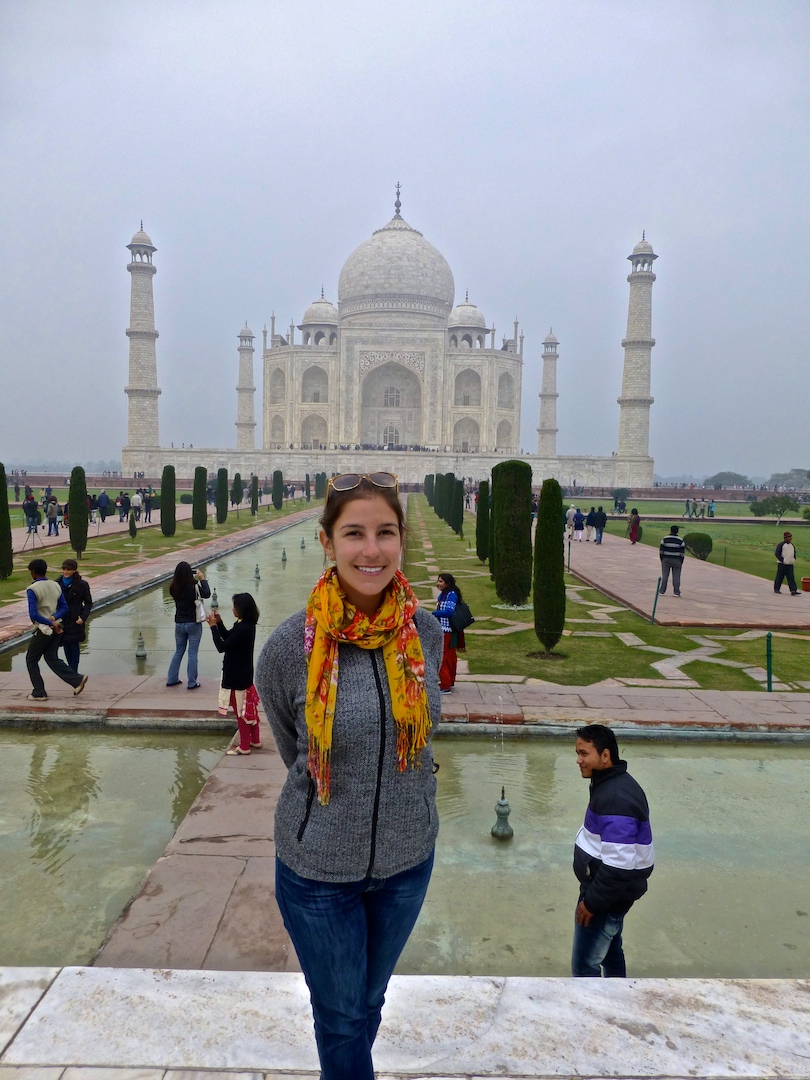
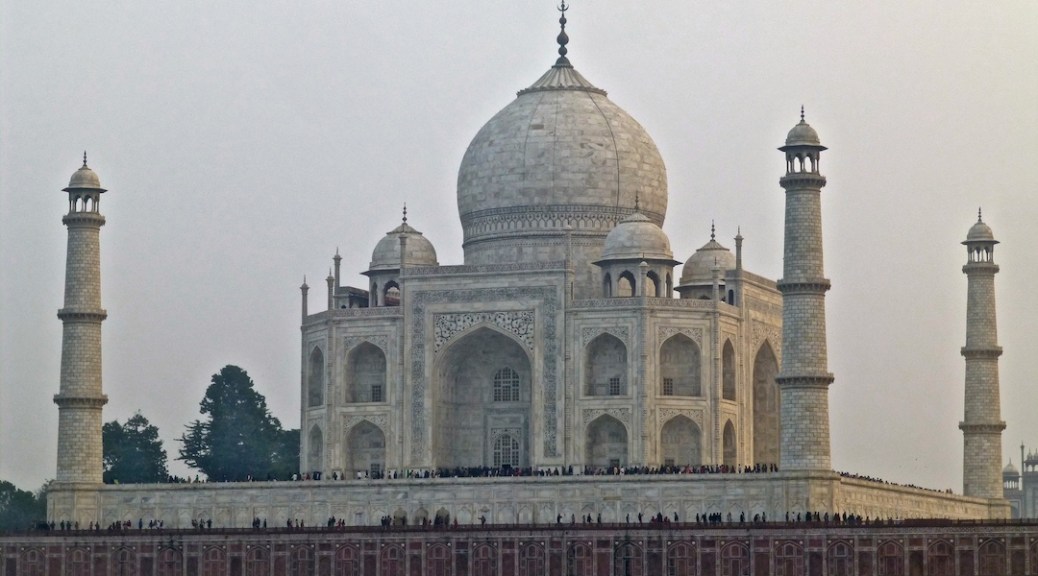
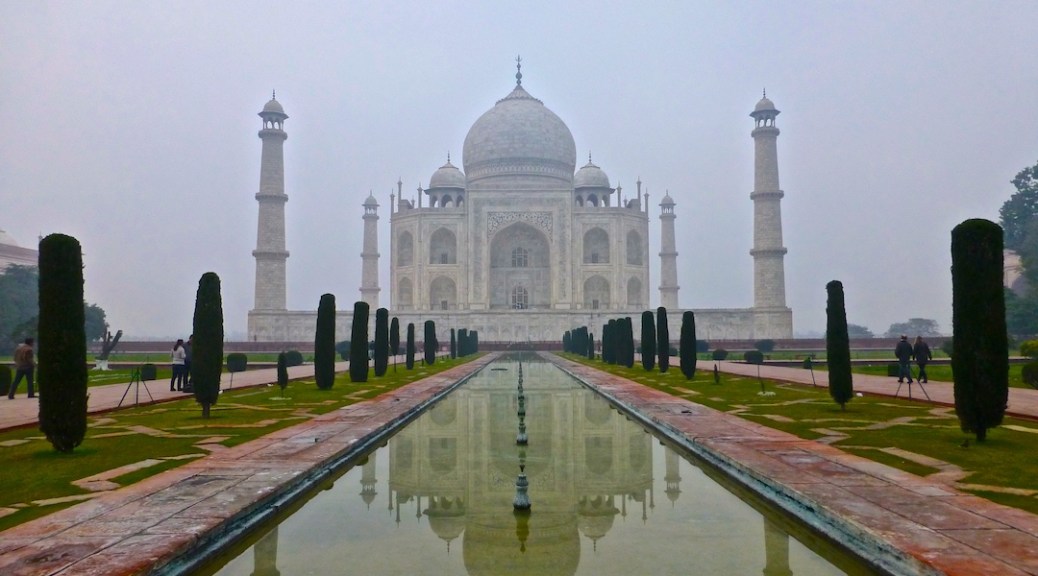
New Year’s Day was quite a lot better as we visited the Taj Mahal.  We woke early and were in line for the open.  Apparently the weather is frequently foggy this time of year, and we encountered some of that.  Travelers we met in Mumbai said they couldn’t even see the Taj until around 11 am.  We could see it fine the whole time, it just wasn’t sunny.  Hence all the flat light photos.  Nonetheless, it was definitely worthwhile to arrive first thing in the morning because it was not crowded and many times more visitors were there when we left around 10:15 am.

After clearing security we emerged into the Chowk-i-Jilo Khana which itself leads to the stunning main entrance to the gardens and Taj.  Once through the gateway you see the Taj at the end of the gardens, and if you come before the fountains start (around 10 am when we visited) and at the right time of year (?) you should see its reflection in the waterways.  Magnificent from afar, one does not appreciate the scale nor detail until much closer.  It really is an exquisite monument.

We admired it a while and then visited the onsite museum for several minutes.  Nearby is a tree loaded with lovely green birds with long tails.  The sun never did emerge and we left a few hours later.

Do you know about gulab jamun?  It is so freakin good.  It is basically a fried ball of dough soaked in rose water syrup.  We had one with our thali lunch at…Shankara Vegis.

Then we hit Agra Fort for a couple hours.  It features gorgeous carving and inlay work and some views of the Taj and river, plus a few more green birds.  At both the Taj and the Fort, Indian tourists greatly outnumbered foreigners.

From the Fort, we took a rickshaw across the river for sunset views of the Taj.  Good call, Kenny.  Ask to be taken to Mehtab Bagh, but you do not need to pay to enter the gardens if you just want to enjoy the view.  Instead, walk right past that entrance and down to the river.  The only discernible difference I noticed was that the free view comes without eye-level barbed wire.

This is a great vantage point not only for the view but the relative calm and silence.  You see thousands of tourists marching like ants around the mausoleum, but hear only birds and music.  Perhaps the water level was unusually low for our visit as we did not see the reflection that Kenny mentioned.

I also enjoyed the calmer and friendlier feel to this side of the river.  Much more peaceful, and of course additional goats wearing sweaters.

Instead of massive log-droppings and grunts, Thursday we were woken by some man incessantly making a karate kid “haayyaaaa” sound followed by loud banging.  I thought of Miyagi, of course, then Robin Williams in Good Morning, Vietnam.

The sun came out and we enjoyed marvelous views of the Taj during breakfast on hotel Kamal’s rooftop.  And we saw more monkeys.  And an Indian man working on his roof who ran inside when he saw the monkeys running along the rooftops his way and shrieking.

Most people here seem fazed by nothing, but this man was terrified.  Which made us uneasy about these aggressive monkeys all around.  We escaped unscathed.  Oh, and Jenni named baby monkeys “bonkeys.”  That makes so much more sense than wasting two syllables.

In the afternoon we drove about an hour to Fatehpur Sikri, the former imperial capital (briefly) of the Mughal emperor Akbar.  As our cabbie from the airport said, seat belts are not allowed in Agra.  We think he meant required, but the effect is the same.

It is funny how often drivers do things like stop on the way to pick up a personal item, or just get out of the car to use the bathroom without saying a word.  And today’s guy sucked just like our Sri Lanka driver.  More on his dishonesty in Practical Info.

Fatehpur Sikri, though, was quite lovely.  The palace has some alluring sandstone buildings with splendid carvings.  Apparently Akbar was religiously tolerant but he sounds like quite a dirty bird.  Rumor has it he used to play pachisi in the courtyard with slave girls in costumes for live pieces.  And his harem was legendary.  We’re talking Wilt numbers.  He had a super wide bed raised about 7 feet off the ground with no attached stairs, i.e. his servants had to bring the stairs as necessary.  Yeah.

The palace contains three different areas, one each for his Turkish wife, his Christian wife (?) and the Hindu wife who bore his first child as prophesied by Sheikh Salim Chishti, which sheikh got a white marble tomb inside the Jama Masjid that we visited right after the palace.  Jenni beamed with Turkish pride at the fact that such wife did not care about a big house but got the finest carvings, gems and art work.

The Jama Masjid (mosque) might have been even more impressive than the palace.  We initially entered the square a different way, but the Buland Darwaza (great gate) is breathtaking.  The square itself is bustling with activity.  The prayer hall facing Mecca has its own grand gateway and Sheik Salim’s white tomb marks a brilliant contrast against its sandstone surroundings.

Inside the tomb there is a steady stream of visitors making wishes and tying cloth around the lattice marble screen window.  Check out the insane bee clusters on the gateway ceiling in one of the photos below.

We were hustled a while by this adorable kid who said he spoke five languages, and his introductory Francais, Deutsch and Espanol were solid.  Another of those kids who might be a star in the US, as I mentioned in my Mumbai post.

Back in Taj Ganj we had dinner at Joney’s but I was hit with something like a 24-hour virus so I could barely eat and spent the rest of the night shivering.  And we watched Wild Things 2 which only made it worse.

Practical Info

Transportation: A pre-paid taxi from the airport cost Rs 400 but it could be 600 depending on your destination.  A rickshaw from Taj Ganj to Agra Fort cost Rs 100.  From Agra Fort to Mehtab Bagh and back to Taj Ganj we paid Rs 250 in a rickshaw.  Our return trip by car to Fatehpur Sikri cost Rs 1100.

Accommodation: We stayed at Hotel Siddhartha near the West Gate of the Taj Mahal.  It is conveniently located for Taj visits and some of the cheap food options on Chowk Kagzi, and at least slightly removed from the noise and hassle of Chowk Kagzi.  I could almost have recommended it as a budget option, but hearing so clearly your neighbor shitting is an offense I cannot forgive.

There are a bunch of other budget options in the Taj Ganj area and some nicer places outside.  Being in Taj Ganj was not a fraction as appealing as I thought it would be, so if you can afford it I would probably stay elsewhere.  Unless there is some home stay with excellent reviews.  If you stay in Taj Ganj, I cannot speak to any other qualities but Kamal’s rooftop has amazing views of the Taj.  While many multiples of our budget on this trip, I hear the Oberoi Amarvilas is worth a splurge.

Food: A number of the restaurants recommended in my guidebook are outside Taj Ganj, and it was generally just not that nice around Agra and dealing with the touts was unpleasant so we did not venture out.  Shankara Vegis on Chowk Kagzi was tasty and cozy with nice owners and reasonably good WiFi.  We also ate at Joney’s one night and it is very cheap and good, but I was sick that night so I can’t fully judge it.  Jenni didn’t love the malai kafta which is one of their signature dishes, but the banana and honey paratha was mighty tasty.  We had breakfast at The Stuff Maker atop Kamal (hotel) and the food was OK but the views of the Taj are stupendous.  The best rooftop views we saw.

Sights: The Taj Mahal opens at sunrise and closes at sunset, I believe.  It is CLOSED ON FRIDAYS.  Someone told us it opened at 6 am, so we showed up around 6:40 am but in fact they didn’t let in anyone until sunrise.  Perhaps it is the ticket window that opens at 6 am.  Foreigners pay Rs 750 and you get a 0.5 liter water bottle and some shoe covers to use when in/around the actual mausoleum.  Keep your ticket stub as it will give you a Rs 50 discount on admission to Agra Fort the same day, and I think some other same-day sights/discounts.  There are separate lines for men and women and for Indians and foreigners.  They will pat you down and search bags, but the rules for what you can bring were not clear to me.  We were told that neither phones nor guidebooks are allowed, but we saw plenty of each.  I did see someone forced to get rid of their cigarettes and lighter to enter.  The museum opens at 9 am.

Agra Fort is the second most famous attraction in the area.  We spent a couple hours there and I recommend you do the same.  Admission is Rs 300, or 250 with a same-day Taj ticket stub.  There is a sound and light show after sunset.

Fatehpur Sikri is about an hour’s drive from Agra.  Beware the guide scam.  Our driver brought us to a parking lot where guides produced official department of tourism I.D. cards and insisted we must pay Rs 600 for a guide and that cars are not allowed any farther etc.  In fact, official guides are available at the entrance to the palace (we used the Diwan-i-Am entrance) for Rs 250 and cars are allowed to continue a little farther.  It is true that cars are not allowed to drive up to the entrance, so you can either walk from the car park as we did or take a CNG bus for Rs 5/each.  If you walk, either retrace and take the paved road up or continue down the same road and opposite the UPTDC Gulistan Tourist Complex turn right up a dirt path.  Entry tickets cost Rs 260.  Visiting the Jama Masjid is free though you are expected to tip the shoe guard and can expect pitches on buying cloth and flowers for an offering at the Tomb of Islam Khan.

December 31, 2013 – Jaunary 3, 2014 (Tuesday-Friday)
Agra

I’ll start with the positive because this post is going to get a little graphic. You were warned.

The good: the Taj Mahal! It really is incredible. I had my doubts. Can it live up to the hype? Can it really be that impressive? Yeah, it’s pretty awe-inspiring. Can you imagine someone building something like this today? Let alone in the 1600s without the benefit of modern machinery? Wow. And to be able to start 2014 at such an iconic and remarkable site, I felt really lucky. Much of the rest of our time in Agra, we weren’t feeling quite as lucky.

We stayed at Hotel Siddhartha, which is a moderate improvement over Hotel Padmam (as you’ll recall reading about in my Madurai post). Here we were provided no toilet paper or soap, but we were provided one towel. For the two of us. But again, it’s an ask-only policy. If requested, they’ll provide you with the world’s smallest TP roll. I don’t understand this. Do most people not ask and this is how they save money? Is toilet paper really that expensive? (No, it’s not. We went out and bought our own supply). It is such a strange policy. The toilet again leaked, though this time I was more certain than not that it was not sewage (hooray!). And it was freezing cold in Agra! I had not realized or anticipated just how cold it would be, and while we were provided a sheet and a gnarly looking blanket, it was cold enough that we slept in fleece jackets, hats and socks. Also, the promised wifi was non-existent and no apology or accommodation was offered in this respect.

But the true downside of this hotel did not hit me until 2014. Do you know what my very first experience of 2014 was? Waking up at 4am to the devastating realization that you can hear in full stereo all the noises from the neighbor’s bathroom. You don’t know disappointment until you’ve listened to a man do his business and realize that that was just a courtesy flush. Does this mean 2014 is going to be a shitty year?

I learned my lesson and wore earplugs the last two nights. Which is not to say I was immune from hearing the plethora of other strange and loud noises. Oh, India and your hodgepodge of sound.

I don’t really understand the relative value of things in India. I’m constantly surprised by how cheap certain items/services are versus others. Our hotel in Delhi is no five-star, but in India’s capital city and at $30 a night it has crown molding, room service and a built in fish tank (that hasn’t been cleaned since probably 1982, but still, it’s a fish tank with a few living fish). In Agra, a city that offers little other than the Taj and a handful of other sites, we spent $20 a night for a complete shit hole.

We arrived in Agra in the early evening of New Years Eve. First impressions: it’s cold here! Holy winter hats batman. (So don’t be foolish like we were and pay extra for the room with A/C. Although I don’t think the non-A/C rooms had hot water. Not that it mattered; I couldn’t bring myself to shower at that place.) It would be really nice to have ever entered a building with heat. At least I could put down my now greyed white linen pants for a few days as I jaunted around in jeans, a fleece and scarf. After checking into our hotel, we wandered around Agra and checked out a few of the rooftop bars and restaurants where music was blaring, lights were strung, and buffets were set up in anticipation of the New Years Eve festivities. Some looked promising, but tired, weary and cold, we opted for the ground floor enclosed restaurant of Shankara Vegis, which practically became our second home for our stay in Agra. We ordered the Shahi Paneer with paratha and it was divine. In fact, we ordered it again the next day! Also, their banana lassis are top notch. And it’s all super cheap. Highly recommend this place – the owners are friendly and nice, it’s cheap and delicious, and it’s just about the only place in Taj Ganj where you can access wifi from a restaurant indoors (we found one other place that had wifi but only on the roof). What’s not to love?

After dinner we shared a chocolate bar at the hotel and fell asleep before midnight to crappy (I should be careful with this word now..) movies on TV. Not the best New Years Eve of my life, but I got to wake up and see the Taj Mahal first thing in 2014 (well, second after hearing a man strenuously pass stool). Here, forget I said that and look at this picture of me at the Taj enjoying the less jarring noises of India:

P1040616

The intensity level in Agra is high. We stayed in the Taj Ganj area, adjacent to the Taj. Here the streets are quite narrow and also crowded, which means lots of narrowly missed accidents. It’s also full of hawkers, cows, dogs, monkeys (though mostly they stay on the rooftops) and rats. As we were paying for a bottle of water and a chocolate bar on New Years Eve we noticed a rat at the shop owner’s foot. My biggest pet peeve was that you have to walk single file to even attempt to not get hit by bikes, motorbikes, tuk-tuks, cars, cows, dogs, push carts, people etc, and so I’d follow behind Alan and someone would cut me off to have some version of the following conversation with Alan: “where you going? You need tuk-tuk? Money exchange? Battery?” [Alan walks away after saying no thank you the first time and then ignoring him] “Yes? OK” Meanwhile I have to pass around the guy, which is not an easy task on those roads. It got serious. I may have been throwing some ‘bows to block these guys out by the end of our time in Agra.

On New Years Day, after the traumatic events of 4am, we dragged ourselves out of bed to get to the Taj at sunrise. While we’d read that it opens at 6am, I think that refers only to the ticket counter, because they didn’t open the doors to start passing people through security until a little bit after 7am. Note that there are separate lines for Indians and foreigners (though they call it the high-value ticket holders line, because we pay about 10 times as much), and each is separated by sex. The Indian men’s line was by far the longest, so you wouldn’t want to get stuck in there and miss the good views before it gets super crowded. It’s one of India’s pricier attractions, but for good reason, and it’s still quite cheap (around $12 a person, and you are provided a bottle of water and shoe covers). There are also a bunch of rules about what you can and can’t take in, guidebooks and mobile phones being among the things you’re not supposed to have. So being the good, square rule-followers that we are, we left these things behind and of course saw tons of people carrying them around and using them. Also, you’re not supposed to take pictures inside the mausoleum, but I saw a handful of people doing just that with no consequence.

The sunrise itself was not worth coming early for as it was quite foggy and the lighting was sadly not the best, but it was definitely worth it to see the Taj before the crowds really amass. There is quite a big difference in the number of people there at 7am versus 10am. We stuck around for about three hours hoping the sun would come out and we’d get some shots in better light, but it didn’t change all that much. Still, it was really enjoyable to walk around the grounds, explore the museum for a little bit, and watch these beautiful green birds darting in and out of the trees.

After a late breakfast, which then turned into lunch at Shankara Vegis we ventured out to see Agra Fort. We’d asked our friends at Shankara how much a tuk-tuk should cost, and they said Rs 50. Getting a tuk-tuk driver to negotiate on price or come below Rs 100, however, was an impossible feat. It’s a bit weird that people don’t even counter; they’ll just drive off. While the case is not so extreme when its Rs 100 vs. 50, it has become a constant theme in our attempts to obtain transport. So many drivers just try to blatantly rip you off. Even when it’s clear you know how much it should cost they don’t try to save face. They don’t need the money that bad? Think they can find someone else to make it worth their while? Highly doubt it. Another thing that confuses me about India. Also, when you finally find a driver, they surprisingly often stop to do things of their own accord while you’re paying for their service. We’ve had numerous drivers pull over with no explanation, until we deduce that they’ve stopped to use a loo (OK on that one, I get it), or pick up a painting from a shop, or go out of the way to get gas on a short ride, or – the best – stop to wash you car! With a bottle of water and a rag! While we sat in the car looking confused for twenty minutes. I will never understand why this struck him as the appropriate time to do such a task.

Anyway, I digress. The Agra Fort was pretty cool to see. The carvings are intricate and beautiful, and you get to see the inlaid precious stone work up close, which is rather difficult to do at the Taj, so I really appreciated that aspect. (Most of the inlaid work at the Taj is inside the Mausoleum which is not well-lit (though maybe if you visit later in the day/on a sunny day).

After the Fort we hired a tuk-tuk to take us to the river to watch the sunset from behind the Taj. Seeing the visitors at the Taj move in opposite directions of the two levels around the Taj was pretty neat. They looked like swift currents of ants from our vantage point. The sunset itself was not super exciting, again because of the fog (there is a lot of fog in the area this time of year, so maybe plan your visit to the Taj sometime when it’s warmer and clearer out!). But we did discover this metallic green version of a ladybug. The drive into this area was fun too. Lots of monkeys, a cool little village, and lots of goats in sweaters. I’m so obsessed. The goats wear nicer sweaters than many of the people here! So sweet. I wish I could have captured a snapshot of some of the goats in knit Cosby-type sweaters. Alas, these were the best shots we got. You still get the idea.

Guess where we went for dinner? Shankara vegis! 🙂 But we did switch it up for breakfast the next morning. We checked out “Stuff-Maker” (yes, that’s the name of the restaurant) on the rooftop of Hotel Kamal. The Taj had been completely socked in when we checked out the rooftops on New Years Eve, so it was a very pleasant surprise to see the stunning views on a clear morning. Plus, you get to watch the monkeys run and jump around the rooftops while you eat. These are some badass monkeys though. I’ve seen a lot of Indian people get nearly hit by moving vehicles, yet I’d never seen an Indian person express fear. Until today. When I saw a man run in absolute terror down the stairs from his roof at the sight of two of those monkeys shrieking and running towards him. Oh and guys, can we all agree that baby monkeys should be called bonkeys?

Later we arranged a car to take us to Fatehpur Sikri (about an hour away from Agra). Of course, rather than taking us to the entrance, our driver took us to a tour guide place where they show us their “official government ID cards” and proceed to try and charge us more than twice the rate of the actual official government tour guides. After arguing with them and the driver for a minute, we walked ourselves up to the entrance and hired a proper guide. I know there’s a lot of venting in this post, but seriously it gets so tiring. Everything is more difficult than it needs to be! Why can’t anyone just be honest and not solely interested in getting a commission off of us? Why can’t anything just work as expected!? Gah. Three weeks of trying to navigate our way through India has started to take its toll on us. (I know, I know, call the WAHmbulance. But I’m giving it to you real, guys… the good, the bad and the ugly. Lord knows we hit all three on this stop.)

The place itself is awesome. The first part – Fatehpur Sikri – is a palace where the king and his three wives lived. The Turk in me was pretty stoked to see the Turkish wife’s palace in comparison to the others. It may have been the smallest, but it was closest to the King’s, and the most expensive and beautiful – full of jewels in its heyday. You go girl. The Christian wife’s was mid-sized and the Hindu wife who bore him a child was massive. All three, and the common areas, had impressive carvings. There was also a giant Chinese Checkers board that the King used to play with naked women as the playing pieces. This guy was a character.

Not far away is Jama Masjid, which is an impressive mosque with some really extraordinary gates, and an all white marble tomb where people give tapestries and tie a string to the walls while making three wishes. Cute. But be forewarned that they’ll try to sell you tapestries for a “charitable donation” of Rs 500-1500. It was after we refused this and the other tchotchkes for sale that we noticed our guide’s service declined and our tour quickly wrapped up.

The drive to and from Fatehpur Sikri is long, but I think worth it. Mostly because of the site itself, but also party because you get to see a lot of peacocks and really cute piglets on the way (I find it amusing how pigs really do flock to piles of trash). You also see lots of men peeing. But this is true all over Agra.  I saw more men peeing in Agra than I ever thought I’d see in a lifetime.

Back in Taj Ganj we checked out Joney’s for dinner, which is highly reviewed on TripAdvisor, and tourists seem to love it, as evidenced by the guest book they place in front of you when you wait for your food. Their star dishes are the malai kofta and banana lassis, both of which underwhelmed me (and Shankara’s banana lassis are way better!). The banana and honey paratha though? Mmmm, dessert paratha. Need I say more?

Overall, I’d say Agra is worth it because the Taj Mahal is so spectacular, and it’s nice to go see the fort and Fatehpur Sikri as well, but the city itself is most certainly not a highlight and I wouldn’t stay more than two nights. I’d also suggest paying up for a driver so you don’t have to negotiate constantly with tuk-tuk drivers or tourist agencies (which are essentially men with storefronts, a mobile phone and a few friends who drive cars).

Whatever its name, it’s big

Mumbai (or Bombay, depending on who you ask) is huge, both in terms of population and area.  It could overpower you, at least if you try to cover a broad section of its geography.  There are some interesting sights and countless nice restaurants and nooks for quietude.  The weather was great with warm days and cool nights, like Los Angeles.

This was our first time in a really big Indian city, and we actually found it less overwhelming than some of the smaller cities.  I think this is because it has that rhythm of a major metropolis with nice, more Western escape zones and the anonymity that comes with being two of 20 million.  I felt safe here, and our friends in Delhi opined that Mumbai is a good bit safer than Delhi.

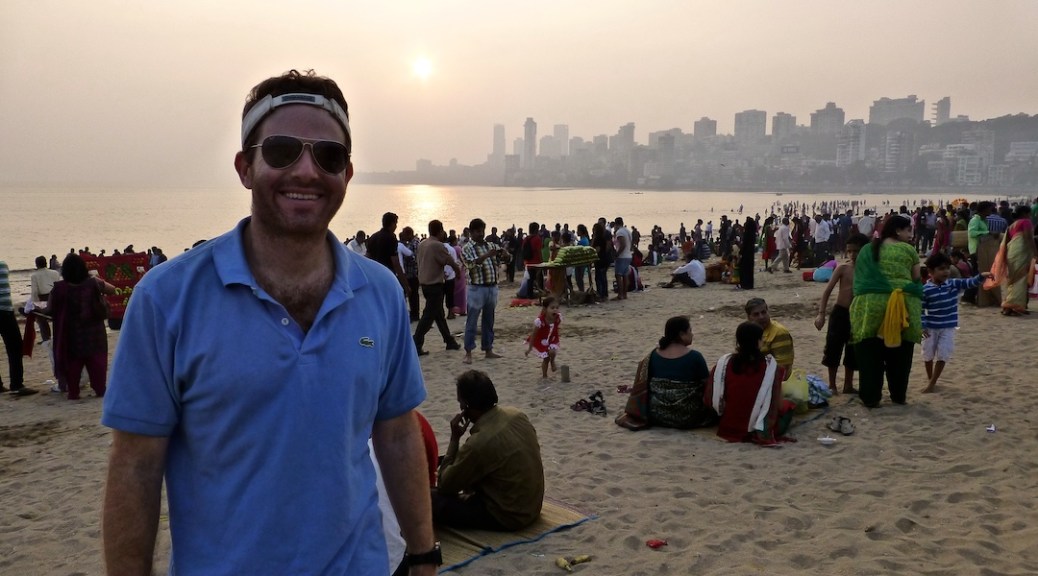
Highlights included Chowpatty Beach on a Sunday afternoon, wandering some alleys off the Colaba Causeway and the Dharavi slum tour.

We got our first taste of trying to cross a Mumbai street while walking to a delicious dinner at Khyber on Friday night.  It is not easy.  There are multiple lanes of traffic in each direction and green seems to mean go while red is maybe I’ll go or maybe I’ll stop.  But if I tell you that’d be cheating.  It can help to follow a local whose body doesn’t display obvious motor vehicle-inflicted damage.

So crossing the street is challenging, but then you might find a nice, wide sidewalk with only humans using it.  A major change from somewhere like Madurai or Agra.  And again this felt less challenging to me, perhaps because I am more accustomed to busy streets and aggressive drivers (a la New York) than to dodging mopeds, touts, cows, goats, monkeys and piles of feces.

Saturday we had our first masala dosas for breakfast and a cappuccino!  On the list of things I miss, good (and usually iced) coffee features prominently.  We wandered around and passed a little park with Ghandi’s statue before realizing we took a circuitous path to end up back at the Oval Maidan, quite near our hotel.

The Oval Maidan is a large green space surrounded by 19th century Gothic buildings on one side and 1930s Art Deco on the other.  There were several cricket games being played and some of the teams had uniforms.  By luck we stumbled upon the Jewish synagogue and I snapped a shot of this gorgeous robin’s egg blue structure before being told that no photos are allowed.

After a generally peaceful stroll we arrived at the Gateway of India and thrust ourselves into its madness.  It is beautiful but so crowded and hectic, and I did not want to buy a photo of us printed on the spot nor an enormous balloon.

Then we continued to Colaba Causeway which was slightly calmer and decided to eat lunch at Olympia Coffee House.  It is an Irani cafe where the waiters all don Peshawari caps and only men are allowed on the ground floor with the mezzanine for women and their families.

We split a “mutton masala spicy” and this was our only meal of the trip so far where the heat made me pull back towards the end.  I’ve been impressed with Jenni’s consumption strength.  They brought fennel seeds with the bill, which is common here.  We were only the white folks in a packed place; it must not be in Lonely Planet.  And with a generous tip it cost $4.

We continued south and wandered east onto some side streets (near the “Pasta” lanes, if you’re looking) with no other tourists but plenty of fruits, veggies and goats.  Then we crossed back west to a slum by the ocean with an intense fish smell and much harsher odors by the bathrooms.  Real strong stuff.

There are a lot of government and administrative buildings and generally a stronger security presence than I anticipated.  One of my least favorite things is the abundance of stands with a rifle propped facing outwards near head level.  But I guess everything works flawlessly in India so what could possibly go wrong?

Dinner was our first real break from local ethnic cuisine and half a night out.  We had a corner window table at Pizza by the Bay with great views of Marine Drive and the Queen’s Necklace.  After this we had drinks at Dome on the roof of the Intercontinental hotel around the corner.

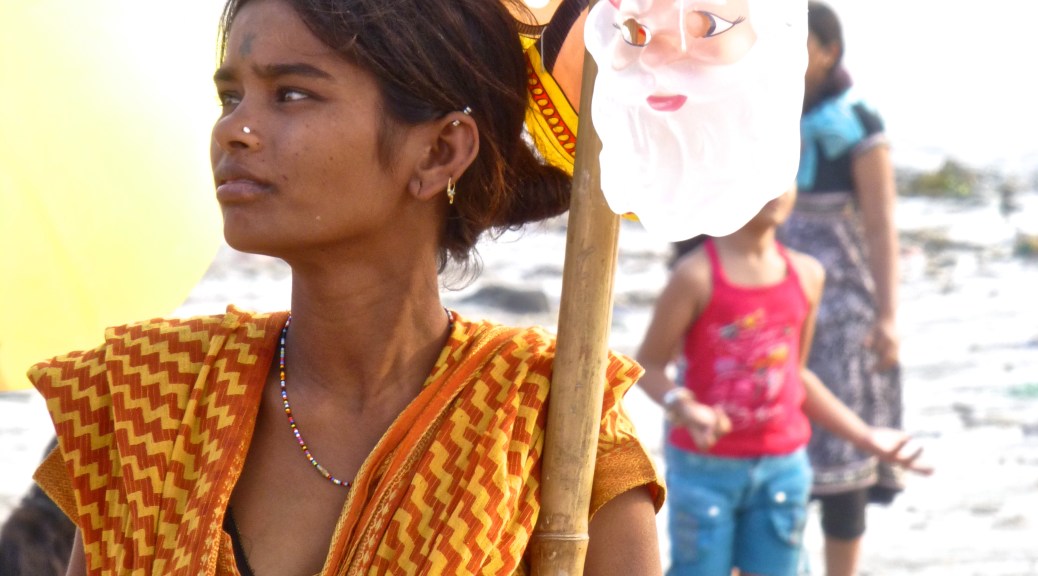
A little girl selling flowers relentlessly pitched us the whole way.  Some of the kids hawking here are so cute and personable.  If they were in the US they might be child stars, or at least have the most profitable lemonade stand on the block…instead of hustling for their next meal.

To enter the Intercontinental you get the metal detector wand scan.  It is a pretty swanky place and the roof bar was very nice with great views, albeit about $20/drink.  Oh, when you see that Oban single malt for only $13, don’t get excited.  That’s for a 30ml pour, so double it for a drink you’d accept in the US.  It felt nice to have a taste of our former lives hanging out with fancy people.

Sunday we walked around the Fort area and markets but you should do so on a different day because a lot of it was closed.  There were so many people sleeping on the street or some kind of stand today, I think more than usual because it was Sunday.  It was fun watching kids play cricket in the streets.

Mumbai is probably India’s most cosmopolitan city and there is some real wealth here.  It is fascinating to see some of this alongside cows on the road and guys sharpening knives with a bicycle-powered wheel.

The post office occupies an impressive building just by Victoria Terminus (now called Chhatrapati Shivaji Terminus but most still refer to it as Victoria or V.T.), a beautiful and lively structure.  You can’t enter the main part of the station as you typically would in Europe, but it’s worth seeing.  Plus you can grab an Indian guava with chili salt.

Crawford Market was a shadow of its regular self but we found some spicy cashews and candied fennel and there were still lots of puppies, birds, fruits, veggies and men sleeping.  As I write this from Delhi, those spicy cashews are the chief suspect in the moderate stomach problem case.

We walked a long way and had a hard time finding a cab, so we were quite pleased to reach Marine Drive and catch the sea breeze.  A little bit farther and we hit the sand at Chowpatty Beach.

What a great scene on a Sunday afternoon!  The area is known for street food and snacks, we were wusses and just got some ice cream bars.  There is a small section on the south end with permanent F&B structures and then a big beach packed with families and people grilling up corn and making Indian snacks.  Guys rent little mats (and get pretty territorial with each other) and others have these pimped out big-wheels for kids that play electronic music.

I had a delicious channa bhatura for dinner at Cream Centre across the street.  It’s like a puffed up piece of fried dough that you puncture and then eat with a spicy mixture of chickpeas, potatoes and onions.  My meal came with a view of the Chowpatty crowds and lots of guys looking in through the window to watch cricket on the restaurant wall’s HDTV.

A block or two down is Bachelorr’s, famous for its fresh fruit juices and creams.  We got chocolate milkshakes because that always sounds right, but they were so-so and I’d go for the fruit drinks.  Speaking of drinks, when you walk around Mumbai all day, it is hard to figure out the right balance of staying hydrated but not having to pee.  Because good luck finding a bathroom that’s not the sidewalk.

Monday we met our Reality Tours & Travel guide at the Churchgate station for the ride up to Dharavi.  They were pretty alarmist about how hard it would be to get off the train at the right stop, but it was easier than the New York subway (though more on this in Practical Info).  The slum tour was very neat and I recommend doing one.  They strongly request you do not take any pictures once the tour begins, so the ones I have included are from their own library (which you can access after taking the tour).

This is one of many slums in Mumbai, but perhaps the most famous due to its size and Slumdog Millionaire.  There is a heavy industry section and a residential section where they also have enterprises making things like soap, leather, pottery and papadum.  The heavy industry section is dedicated largely to recycling, mostly plastic with some aluminum.  The working conditions are pretty rough with some closed spaces and toxic gases.  The population density is astronomical.

Dharavi functions like its own city.  There are schools and some stores and an economy estimated at several hundred million dollars.  It is estimated that 1,500 people might share one public toilet.  I haven’t researched it extensively and the workings are complex, so I won’t try to get into all the details of life in the slums and the “law”  and controversy surrounding them and forcible eviction that takes place from time to time etc.

Behind the Beautiful Forevers won the National Book Award and I mention it on my Books post.  It takes place in a different slum but the tales of corruption are so mind-boggling and heinous.  Our tour makes an effort to focus on the happiness of the residents.  It is true that we saw a lot of kids smiling and in general the feel was not of desperation and horror but rather contentedness. My guess is the truth lies somewhere in the middle.  That the lives of most are not as dreadful as the main characters of Katherine Boo’s book but that there is extensive crime and corruption that Reality Tours omits from the story.

Interestingly, Reality Tours is itself quite the operation.  There must have been 30+ people in small groups that day, and the tour operates every day.  They give 80% of the profits to their sister-NGO…but I wonder what even 20% of those profits amounts to?!  I don’t mean to suggest they’re doing anything wrong, but it’s an interesting new business.  I actually just came upon this article from yesterday, quite timely.

We met some nice fellow travelers, including an Aussie couple on a six-week trip with three young kids.  Nice to get a little inspiration in advance 🙂

We stopped by the Dhobi Ghat on the way home.  The one we visited in Kochi offered a more up-close view and was more quaint, but this was another interesting juxtaposition of an old tradition in the middle of a mega-city with big buildings in the background.

Trishna is a famous seafood restaurant and dinner that night was a moderate splurge.  It was good but I can’t say I was blown away.  I was more excited to find this Indian kid wearing a “that’s what she said” t-shirt.

Getting to the airport on Tuesday was a bit of a fiasco but alas we made it with plenty of time for our flight to Agra.  And I got some more inspiration for a planned post on some of the things that make India incredible yet also infuriating!

Practical Info

Transportation: A prepaid taxi from the airport to our hotel in Churchgate cost Rs 480.  If you take the Sea Link bridge, the toll is an additional Rs 55.  Traffic is usually bad, so plan for 60-90 minutes.  To return to the airport, our hotel called a taxi and insisted he use the meter so the trip was less than Rs 400.

We walked around much of the city and this may suffice for Colaba, Fort, Marine Drive, etc.  But not if you want to visit areas further afield.  Taxis and auto-rickshaws are reluctant to use the meter, but your hotel or a guide may be able to convince them.  The amounts are pretty small so it hardly matters, but e.g. we paid Rs 100 to go the same distance as a trip four times as far would have cost on the meter.

Our only experience with the train was the day we did the Dharavi slum tour, when we met the guide inside Churchgate station and he purchased return tickets.  Since we traveled counter to the daily commute (i.e. we were heading north around 9:30 am when most commuters were coming from the north to Churchgate and surrounding areas), the train was not that crowded and it was pretty simple.  Same for our ride back on the train from the Dhobi Ghat to Churchgate.  And since Churchgate is the end of the line, it removes some of the stress that would be present if the train were crowded and you tried to enter or exit during the handful of seconds the train rests at the platform.

Make sure you know which airport you need.  I won’t get into the details here, but we had an unpleasant experience sorting out where to go for our departing flight to Agra.

Accommodation: Many tourists stay in the Colaba area (this is where the famous Taj Mahal Palace hotel and Gateway of India sight are located, among others), and this seemed like a fine option.  We stayed at Hotel Astoria in Churchgate.  The room was spacious with good AC for just over $100/night.  Breakfast with fresh omelets was included.  WiFi is available free in the lobby but in the room you pay Rs 107/215 for 12/24 hours, and this is per device.

The location was very good.  One long block from Marine Drive, right at an entrance to Churchgate train station, a 10 minute walk to the Fort area, etc.  The Intercontinental and its popular Dome rooftop bar are a five minute walk.  I do not know where Churchgate ends and Nariman Point begins, but the Oberoi is also in this general area.

Activities: We spent a couple days just wandering Colaba, Fort and some markets.  We did not realize that the Mangaldas cloth market and Zaveri Bazaar jewelry markets are closed on Sunday, and I think Crawford Market was a fraction of its normal self.

Chowpatty Beach on Sunday afternoon was a highlight, covered above.  We also thought our Dharavi slum tour with Reality Tours and Travel was a neat experience, covered above.  This cost Rs 750 each (or Rs 700 if you meet there instead of at Churchgate).  Reality offers slightly different versions of this tour as well as market, street food and other tours.  Chhatrapati Shivaji Terminus (still referred to by most as Victoria Terminus or V.T.) is worth a visit for its beautiful building, though you cannot enter the main area as you would in a typical European train station.

I might not go far out of my way, but if you are nearby then viewing the Mahalakshmi Dhobi Ghat is kind of neat.  I think you can descend and get closer to the action, but most seem to observe from the road bridge above.

Some popular activities we missed include visiting the island tomb of Haji Ali, and Elephanta Island.

Food: We had some good meals in Mumbai.  I’ll cover the dinners first…

Khyber (Fort) is somewhat romantic with marble floors and rough wooden beams, and our mutton rara was excellent.  I was offended by Rs 315 for plain rice, but enjoyed my cocktail and the waiters speak English well.  BEWARE: many nicer restaurants do not include taxes in the prices shown on the menu, and these can add up to 25% without even including a tip.  Also, if you want to drink non-Indian wine, be prepared to pay 5x mark ups.  We saw a bottle of Yellowtail on more than one menu priced around $50.  Someone should import two-buck Chuck and sell it for $25.

Pizza by the Bay (Churchgate/Marine Drive) serves quite good pizza (certainly by Indian standards) and has other Italian and American standards.  Our corner window table on a Saturday night included a lovely breeze and Queen’s Necklace views.

Creamy Centre (Chowpatty Beach) is clean and bright and one of those places with a touristy feel but mostly Indian clientele.  My channa bhatura was very filling and delicious.  It is a chain with other locations in India and even one in Dubai.  After we got milkshakes at Bachelorr’s a couple blocks south.  These were nothing special, perhaps the fruit juices for which it is more famous are better.

Trishna (Fort) is a legendary seafood restaurant that filled up quickly after we sat at 7:45 pm on a Monday.  We split a large portion of the signature butter pepper garlic crab (out of the shell) as well as squid with chili and garlic and some garlic naan.  I used a chit for Jenni to forego paratha as the bread of choice.  The kesar pista kulfi dessert is like a cross between regular and astronaut ice cream and comes as a disc cut into triangles.  Minimal points for atmosphere.  The meal was very good, though frankly if you put a lot of butter and garlic on just about anything it’s tasty.

We really had only one proper lunch, as Sunday we snacked on spicy cashews at Crawford Market before some ice cream at Chowpatty and an early dinner, and Monday was a late margarita pizza at Markiv’s (a clean and corporate type place with mediocre pizza) next to our hotel.  But that one proper lunch at Olympia Coffee House was a highlight, which I covered above.  It cost Rs 250 with a generous tip.

Drink: We have been going out very little on this trip, but did enjoy a brief reminder of the high life at Dome (Intercontinental, Marine Drive) on Saturday night.  Aer at The Four Seasons is well-reviewed.  I believe there are some pubs and of course hotel bars in Colaba, and I read that many of the hipper/edgier venues are north of the main tourist neighborhoods.  Time Out covers Mumbai and might be a good resource.

December 27-31, 2013 (Friday-Tuesday)

Dosas and Mimosas: Bombay

Mumbai/Bombay (whatever you call it) was my first experience in what I would previously refer to as “a really big crazy Indian city.” (We’d been to Bangalore, Udaipur and Jodhpur on our honeymoon; Cochin and Madurai were the biggest cities we hit before Mumbai on this trip). Now, I have a whole new view of Indian intensity in big cities vs. small ones. I actually think Mumbai is much less overwhelming than smaller cities we’ve seen (e.g. Madurai, now Agra). (P.S. I’ve by now also been to Delhi. It’s pretty intense here, so maybe Mumbai is the exception. Details to come in my Delhi post).

That said, it’s still quite an experience. And there are certainly intense experiences.

If you do nothing else, just come to Mumbai, get in a prepaid taxi from the airport, and drive to your hotel. That alone is an experience you will get few other places in the world. Holy intenseness, crazy crazy madness, overwhelming happeningness, and poverty of mammoth proportion. You pass slums leaving the airport, and we hit some pretty serious traffic. You don’t know traffic til you’ve seen Indian city traffic. Every last square inch is crammed with vehicles going every which way. I think our driver’s attempt to skirt the traffic contributed to the craziness of the drive, as we were on smaller side roads for much of it. Kids come knocking on the windows, some begging for money, others trying to sell you things. I spent the hour trying to soak in as much of the scene around me as possible, and crossing my fingers that our luggage tied to the roof of the car wouldn’t go flying off once we hit the expressway.

It’s always a little challenging getting into a new place in the evening when you can’t get your bearings. So starting Mumbai in the dark was a little confusing. Crossing the street is epicly difficult. Despite that there are traffic lights and pedestrian crossing lights at the crosswalks (or zebra crossings), it seems that cars occasionally consider red lights optional. And while traffic keeps left, as with most things in India, consider it a generality. Like our mothers taught us all when we were young, “look left right left, then cross…” Modify this slightly in India, look right left right, RUN RUN RUN. Actually, I think it best to find a group of locals that appear to know what they’re doing and follow (closely!) behind them.

There are lots of people out and about in Mumbai, though pretty much throughout the city (at least the areas we frequented) it’s not the overwhelming in-your-face-ness of say Agra, Madurai or Delhi (except maybe at India Gate). I’m starting to notice that men far outnumber the women in many parts of India, and I find it somewhat surprising that in a modern city like Bombay where many women work that we can walk two or three crowded blocks and pass not a single other female.

Just walking out from the hotel to grab some dinner, we were thrown off passing guards with loaded guns pointed out at street so you have to walk right by it. I’m still not sure what building they were protecting, but it must be an important one. Looking like lost tourists in search of street signs, we wound up getting escorted to our restaurant, Kyber, by a friendly man carrying a laptop in shopping bag. I was skeptical; he was kind. And Kyber was delicious. It was here I tried mutton (goat) for the first time. We ordered the mutton rara: mutton pieces in an almond cream and red masala sauce. Fantastic, but the highlight was most definitely the mint paratha! I am so obsessed with paratha it’s scary, and I didn’t realize it could be improved upon (I’ve tried it aloo (potato), paneer (cheese), garlic, you name it), but mint! Who would’ve thunk it. Oh. Em. Gee. Solid meal. Though the city price tag was a shock after all the cheap and delicious eats we’ve had so far – about Rs 2,000 plus 22% VAT/service charges for what was actually only one main dish. Also they charged Rs 325 for rice (we’ve had huge meals of curry and unlimited rice for less than Rs 100!).

We stayed at a hotel in Churchgate called Astoria. The area is fantastic. Nearby to Colaba, which is probably the most popular tourist area, but a little bit less crowded, and lots of good stuff to see/eat/do nearby. We were also right next door to the Churchgate metro station, which proved to be very convenient for getting to our slum tour. The hotel itself was mediocre, and pricier by far than most of what we stayed in in India (about $100 a night, internet access extra). I guess Bombay is a pricey city. The most redeeming thing about our hotel was definitely the impressive breakfast spread. They had a guy who cooked up omelettes and dosas to order. I think I ordered a Masala dosa every morning. Definitely try the banana shakes as well. Also, they provide scented talc as a complimentary toiletry, random and awesome.

Our first day in town we set out to walk around and explore. We stopped to watch boys playing cricket on the Oval Maidan. It’s a large park with a handful of games going on at all times it appears. And the architecture surrounding the park (as well as all around this city!) is beautiful – art deco, gothic, very European. Next we walked up to India Gate, which was hugely crowded with tourists and hawkers. You have to wait in line to go through some security, but I find it more disconcerting than comforting when the bag check policy seems to be hit or miss. We saw Taj Palace from across the way. Despite the guidebooks intriguing mention of the awesome bathroom on the main floor, we skipped it. From there we walked up through Colaba market, again very touristy. I find it odd that there are super famous and popular places where food is not known to be great and their main claim to fame is showing tourists the bullet holes from the terrorist attacks. Not exactly my thing. Instead, we stopped at Olympia for a quick eat. While I was not enthused by the fact that we had to eat on the “Ladies Lounge” on the upper level, the cheap and tasty mutton masala spicy was worth the principle digression. We knew this spot was legit because it was the spiciest meal on the trip so far, and we were the only white people in the place.

We walked off lunch through some random and poorer areas. Given how many people live on the streets, you see a lot of people’s more intimate and mundane experiences. We saw numerous pick-up cricket games in the streets, lots of people sleeping (everywhere), even kids being bathed in the street.

That night we went to dinner at Pizza by the Bay for some good ole western food. It was super delicious – fried calamari and margarita pizza and a bottle of wine. Mix of locals and tourists, and a great location where you catch the breeze off the water through the open windows.

While there’s definitely a range of budgets accommodated by restaurants in Mumbai, the mid-range restaurants are much more expensive than elsewhere. Or is it just that there weren’t many/any mid-range restaurants elsewhere? Either way, the prices were a shock after our experiences eating cheap. Most shocking are the wine prices. They charge $50 for a bottle of Yellowtail. YELLOWTAIL! Oi. Not to mention there is like 25% extra with taxes and service charges (which you never see at the more casual spots). Indian wines are more reasonably priced, and as such we stuck to these. We had an amusing conversation with our waiter one night about the virtues of Indian wine. His argument was essentially that the conditions for wine in India are on par with those in respected wine producing regions, but the problem with Indian wines is just that their vines are too young. Interesting. His other argument is that Indian people “have the tongue” for it, and so they can taste how good it is. I’ll buy that argument vs. most westerners when it comes to spicy food, but wine? I ain’t buying it.

We walked over to the Intercontinental Hotel after dinner to grab a few cocktails. A girl followed us all the way from dinner to the bar, trying to sell us some flowers by fake crying, making weird faces, hanging off of Alan, and a host of other odd tactics. She seemed to speak decent English so I told her that pretending to have a seizure was probably not her best sales tactic. I guess we were the fools because by engaging with her she gave us her hardest sales pitch all the way to the bar, and then waited for us until we came outside probably over an hour later. That girl should be a Bollywood actress. There are a handful of beggars throughout the city who hold out their hands to you, and they seem to get progressively more aggressive at night, poking you or whacking you with their outstretched palms if you try to ignore them.

The rooftop bar at Intercontinental was très chic and expensive (think $20 cocktails). There were no other non-Indians while we were there. We were seated at a 4 seat high top and twice asked if it would be OK to seat people with us. Both times we said yes, but then the guests refused. No love for the tourists?? Anyway, we very much enjoyed the great views and popular American music. With the flashing Christmas lights it had a very clubby vibe. The drink I ordered was spectacular, I think some combination of kiwi and coconut water and vodka and some other stuff. Budget buster day, but if only for a night we felt like our old employed selves. 😉

The next day we did some more tourist exploring on foot. We checked out Horniman Circle, which was a peaceful little park with a playground inside. Next we walked through fort area.

The shops were not in full force, it being a Sunday, but there was still plenty of activity. Including this cow, waiting in line for a Xerox:

The Post Office building is the most impressive I’ve ever seen. Seriously, the buildings in Mumbai practically rival those in St. Petersburg for impressiveness. We went in to the Victoria train station, tried to figure out how to purchase tickets from Agra to Delhi later in the week, but as with most things in India, it was confusing and definitive answers were scarce. We left empty-handed as we hadn’t brought our passports with us.

Stopped outside to try a peroo (sp?), an Indian guava, with chili salt. Interesting, though I think we should try one with a pink interior. These were white and we saw vendors later selling ones with pink insides that looked maybe to be a bit more ripe.

Crawford market was fun, tons of stalls selling snacks and nuts and spices. We bought a little package of spicy cashews (which I believe gave me food poisoning in Delhi, ugh) and some candy covered fennel seeds (so good, and help digestion if eaten after a meal. They hand these out in lots of restaurants with your bill.) They also had lots of fresh fruits, and right next to it was a row of animal shops with adorable puppies sadly caged and birds of every type, from chicks to parakeets.

We walked by the Devi temple, which had a line of locals that wrapped round the block. We stopped to ask an official looking man if it was OK to go in with Alan wearing shorts, his response was to shove us in and cut the line. Felt bad, but nobody seemed to mind beyond the basic shoving whilst in line process.

Weary from the heat, walking and little food we finally arrived at Chowpatty Beach. I think this is THE spot for Sundays, and it was bumping. There are vendors everywhere selling snacks, toys, rattan mats, and a host of other items. My favorite? Guys with tricked out power wheel cars and motorbikes blaring music that they would push kids around on for a few rupees. We were tempted by the snacks and sweets, though having read that this is a particularly hygienically risky area, we opted for pre-packaged ice cream bars. Fantastic – mine was fruit and nut and had yellow raisins and nuts in it. Which reminds me that so many countries outside the U.S. use the yellow raisins over the red ones. So much better, can we make this a thing in the states?

After chilling on the beach for a while we grabbed dinner at Cream Centre for some solid veg food. Alan got the regionally famous Channa Bhatura, which is a gigantic piece of fried dough that’s all puffed up with air. You pop it upon receipt and use it to spoon out the spicy chickpea curry that’s served alongside it. Pretty good. I enjoyed a paratha and some paneer curry. We stopped at renowned Bachelorr’s for shakes afterwards. Maybe try the fruit, we went with chocolate shakes and they were nothing special and pricey by Indian standards.

Our last day in Mumbai we went on a slum tour with Reality Tours. I was on the fence about the idea of a guided tour, but I’m glad we did it. We learned a lot, and you really could get lost inside those dark and narrow alleyways! We first saw the commercial area where they recycle aluminum and plastic. The non-toxic trades are in the residential area (fabrics, food, pottery, etc.). The lifespan of people working in the recycling shops is quite low given the fumes they inhale daily.

Note that taking photographs is not allowed on the tour, to preserve the privacy of the people. The below photos are professional photographs provided by Reality Tours.

Part of the mission of the tour group is to portray a more “realistic” image than the media does of the slums, and how happy it is here. True, there were a lot of happy kids and adults here. I imagine the picture isn’t quite as rosy as they paint it to be, but it does give you an appreciation of the sense of community that’s created here. 80% of profits go to programs in the area to provide education, the arts etc. The kids are as always adorable and smile and say hello. I’m sorry if this sounds crass, but I feel like this had to be one of the “nicer” slums. They have public pay toilets that are cleaned seven times a day, and a number of the homes had color TVs and internet. I appreciate the mission of Reality, but I’m just not convinced it’s the full reality.

We took a cab to the Dobi Ghat (where they wash the laundry) afterwards with another couple. It was quite amusing when the tour guide tried to squeeze a family of 5, another couple and the driver in a five person car. Though I’ve probably seen more people than that in a tuk-tuk by now.

We braved the train back to Churchgate by ourselves. Trains were not as bad as we were warned, though I certainly could see how they might be at rush hour. The Reality Tours sent a guide to meet us all at Churchgate, and he’d give us three stops advance notice to prep us for getting off the train (apparently they stop only for seven seconds, and when crowded you kind of have to push and shove your way to the door in order to make it. Wasn’t really crowded at all when we rode though). We heard there are an average of 15 train related deaths a day (Alan thinks in Mumbai alone, can this really be possible?!).  The average must be skewed by a handful of bigger accidents, but it’s still incredibly high. I presume this is primarily because of the people who hang out the open doorways.

Our last night we had dinner at Trishna, trying their famous butter garlic pepper crab, out of the shell. Tasty and VERY buttery. We also ordered chili garlic squid and a bottle of viognier, and even splurged on some kesar pista kulfi for dessert (kind of pistachio ice cream dish.. meh. nothing special). All in the meal was around $80. We’re living large in Bombay, baby 😉

A few thoughts on cleanliness/hygiene in India… A lot of people in India chew paan, a reddish tobacco product, so you see people spitting it out constantly. You also see a lot of it on the ground as you walk around. Interestingly, we did not see a single trash can on the streets of Bombay. Trash, you see tons of. The litter is much much worse in Northern India. In Kerala you see signs about keeping the environment clean, not littering etc. It’s not yet part of the mentality outside of Southern India. My friend Aash pointed out that the literacy rate in Kerala is around 90%, as opposed to something closer to 50 or 60% up in Delhi, so that probably plays a big role. Still, even in Kerala you will see trash flying out of bus windows.

You can’t be a puss about dirt here, and you definitely need a healthy open-mindedness about eating at less than spotless restaurants. We’ve had our fair share of meals that would not pass a health inspection review back home (is a grade F even possible?). It’s best to just not think about it. I’m particularly cautious in India (e.g. limited street food) because so many people do get sick here (according to the CDC there’s about a 50% chance of getting sick on a two week visit in India. Multiply by two of us and 3.5 weeks and we were (writing this from Delhi, where our luck ran out) beating the odds. You know it’s not a particularly clean country when restaurants use “hygienic” as one of the three words on their signs to entice you in.

Toilets similarly range in hygiene. The smell of the public toilets (where there are any) as you walk by is enough to make you try to time your water consumption with access to western toilets. And it’s no easy task, let me tell you! That said, you don’t see anybody peeing on the streets where there are public toilets. Men pee everywhere in India, and to my delight, I didn’t see a single man peeing whilst in Bombay! Hooray! Stay tuned for Agra, where I probably saw more men peeing than not peeing.

Getting out of Mumbai was a trip. Our plane ticket said we depart from “BOM,” and when you look up that airport code you’ll see that it’s the Mumbai International Airport. However, we were flying domestic, to Agra. We asked our hotel and they said it would be the international airport then. So they put us in a cab, argued with the driver in Hindi for about 5 minutes and then said, OK no problem, you’ll pay the metered price (basically no cab drivers will agree to metered prices, they try to rip you off, and there’s really no hope getting a metered fare unless you have someone who speaks their language arrange it), it will be a few kilometers past the domestic airport. We get dropped off at the international airport, and then the security guys can’t figure out whether we should be here or the domestic airport. We find some Air India employees who tell us to go to domestic. They’re just different terminals. Really? A $100/night hotel in Mumbai that’s popular with business travelers doesn’t know this? Anyway, we tried to hire another cab or tuk-tuk, and they all tried to rip us off massively (charging more for the 11km ride than it did to take the hour long trip from Churchgate to the airport). We weren’t that crunched for time, and were so furious at this point we told them all to fly a kite. Unfortunately though, nobody was even willing to negotiate. Finally an airport employee saw us struggling and came in to assist, getting a tuk-tuk driver to agree to take us at the metered price. Even then, she says in no case to pay over Rs 50, though of course our driver gets lost and so it cost nearly 50% more than that (not a lot of money, but nobody ever seems to know what’s going on). Then we’re stopped by security that takes Alan’s phone to look at our flight info and says “no, you have to go back to international.” How is this so hard?!? Honestly. Luckily/unintentionally(?), the tuk-tuk driver who could not speak English just dropped us at the domestic airport, and for an additional Rs 75 we were finally the correct airport. If you could see me fuming at the incompetence of the people running the airport food joint, you would have laughed. It’s a love-hate relationship I have with India. Love-hate.

Madurai

I had started questioning myself after Cochin, the backwaters, and Munnar… is India really that intense? As crazy as everyone says it is? Am I misremembering our honeymoon and actually this is a very chill country? Well, Madurai quickly reminded us of the cacophony that so much of India provides. These parts of India offer near-constant sensorial stimulation: sights (colors, people, animals, things everywhere), sounds (essentially continuous honking along with the myriad of other city noises you hear), smells (yeah, lots of those… by the time you realize you smell sweet flowers and think to inhale deeply, it’s been replaced by some other foul smell and you regret taking that deep breath), touch (lots of people and stuff, not so much space), and tastes (obviously you know by now from reading my blog that I love me some paratha, and India has a hell of a lot to offer in the culinary department).

By now I’m used to not having the luxuries at our hotels (a top sheet, a shower separate from the toilet, a safe, air conditioning, a hairdryer, etc.). But Hotel Padmam took it to a new level: none of the above, and no soap, no towels, no toilet paper. Though they do provide the dirtiest looking walls you’ve ever seen. Oh and the toilet leaks and it rotates smelling like piss, vom, and I’ll let you guess the third scent. You can also hear your neighbors retching. Loveliest sounds to wake up to, I tell you. Alan tells me I’m overreacting; it’s not that bad. But hey, I didn’t make us move, I’m just venting about it and resolving to try and bring in a little income somehow so we can avoid the no-TP style hotels in the future. (To be fair, we asked (twice) for TP, soap and towels and we received. I guess it’s just an ask-and-ye-shall-receive only policy. Also, we bought a top sheet for a few dollars from a shop down the street. It helped me sleep, and the pink really brightened up the room). Oh, also for $20 a night they threw in breakfast. We tried the South Indian breakfast the first morning, definitely the worst food we’ve had to date in India. Also, I’m pretty sure they tried to give us a used plastic bottle that was refilled with tap water. (Must be careful of this some places in India.)  The next day we opted for the “continental breakfast” – three pieces of toast. It was much better at least.

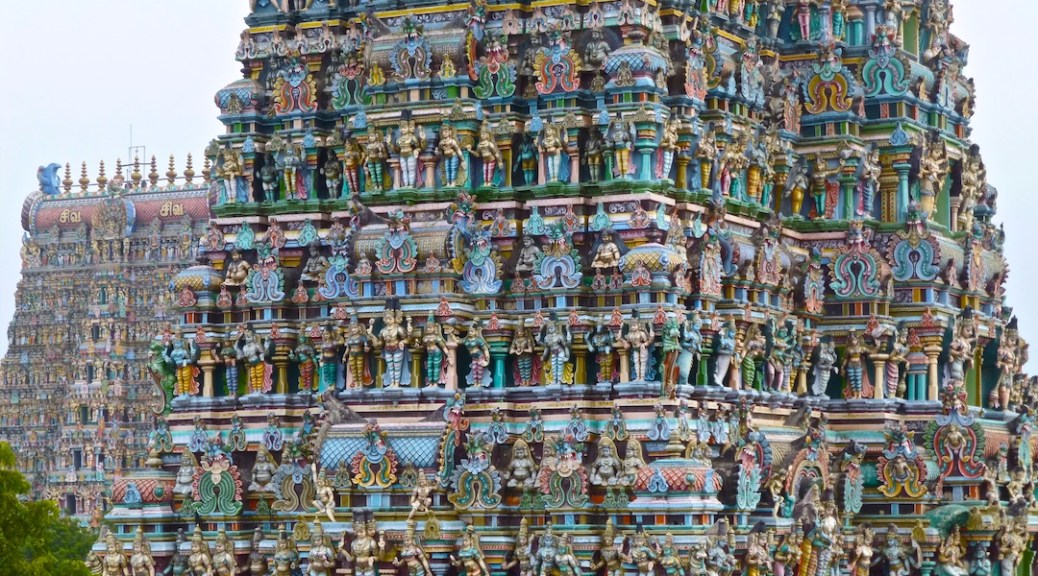
Alas, we didn’t come to Madurai for the magnificent lodging (though I think there are one or two nicer places, if you go, by all means, stay at those), we came for the same reason everyone comes: the Meenakshi Temple. And it is truly a stunning piece of work. By the temple the street is quieter and a little more relaxing. You can wander around and everyone tries to get you to go in their shops, which do, to their credit, offer nice rooftop views of the temple. They of course want you to buy things from their stores though. Luckily, we met a not overly pushy guy who made us cinnamon cardamom tea and let us enjoy the views without too much of a sales pitch, provided we tell our friends to go there. So friends, go to Miya’s store and buy some elephants statues, or jewelry, or textiles.

The temple itself is really quite impressive. A bit confusing getting in – but to sum it up for you: full pants required, no hats, no shoes, no cameras, but mobile cameras are fine so long as you pay Rs 50. (Don’t ask me why… one of the stranger rules we’ve come across so far. Also, I just have to say that while so much of what India has to offer is beautiful and cheap to see, it’s a total bummer that you aren’t allowed to photograph a lot of it.) Foreigners must pay Rs 50 each to get in, and there are a handful of places that only Hindus are allowed within the temple itself (and the lines for these are impressively long). There is also an art museum within the temple and the entrance fee is covered by the Rs 50 paid to enter the building. Quite a bargain – for less than a dollar a person you get a full day’s access to this impressive site.

We watched for a while an elephant who would take money from patrons using his trunk, then bop them on the head and pass the buck back to his owner. Pretty neat.

After wandering and soaking in the place for a few hours, we enjoyed sitting and people watching. Alan lay down on the floor for a bit to gaze up at the temple towers and the sky and people thought this was quite amusing. That or just that we were white. (Also, one woman thought he was sleeping, which is apparently offensive, and so he got yelled at). One boy pointed and laughed at us and his Mom told him to come over and say hello. Next thing I knew I was shaking hands with 10 kids who liked to say “Hello! Hello!” It’s cute how much they like to shake hands and talk to us white-folk. (There are certainly other non-Indian tourists, but not all that many. Still, I’m surprised how often we get stared at in India. I would have thought people would be more used to seeing tourists by now.) We also ran into a few kids outside the temple who wanted “one pen, please” and loved seeing photos of themselves. These kids are hilarious and adorable.

Food in Madurai started out underwhelming: an undercooked chicken dish (Alan pointed out that you would think they could have cooked the chicken all the way through in the hour it took to provide it to us) at Chettanoor’s roof-top restaurant, and then a questionable South Indian breakfast at our hotel. Luckily the tali lunch at Arrathy was phenomenal. They give you about ten little dishes of curries and sauces, a bunch of papadum, and then they pile on a ton of rice, cover it with some golden powder and then drizzle hot liquid ghee over top of it. You aren’t provided silverware (except serving spoons). I attempted to use my fingers as the locals did, mixing the rice, powder and ghee together, but I am just incapable of eating saucy curries and rice with my fingers, so I used my serving spoon to assist. Learning to eat Indian food with your fingers is harder than mastering chopsticks! One of my favorite of the dishes was a sweet rose water and cashew concoction. Still trying to figure out what it was called so that I can order it elsewhere! Do tell if you know 🙂

My general impression of Madurai is that it ain’t that awesome. The food options (that you’d be able to eat at and not get sick from) are not very plentiful or amazing (the tali lunch was great, but other places that come highly recommended… not so much), and it’s just not that cool here. I’m writing this now from Mumbai, which I’d heard mixed reviews on, and it is so much better here. Weirdly, we’ve moved to one of the biggest cities in the world, with incredible population density and insane poverty, yet I saw several people peeing on the side of the road in Madurai and none here. I actually feel much safer walking around Mumbai than I did in Madurai, which is surprising to me. And if there are nice, chill spots with some ambience, we didn’t find them. So I would recommend one night max in Madurai. It’s pretty neat to see the temple, but I wouldn’t waste much time in the city itself.

Each time I’m blown away by the roads we travel to get to our next destination. The drive from Munnar to Madurai was no exception. Coming down the mountain we descended a terrifying series of switchbacks where the road would occasionally be blocked by rocks and/or road work with no warning.

::the road to Madurai::

Temple and Thali

Madurai is an ancient south Indian city whose main attraction is the massive and bustling Meenakshi temple.  We drove here from Munnar to spend a day and a half and two nights.  If you are considering staying longer, please reconsider.  The temple is remarkable but otherwise the city has little to commend it.  Except for the thali lunch at Aarathy.

Check out the temple gopuras (towers) from a distance for some perspective and then the up close shots to appreciate the detail of each gopura.

We stayed at Hotel Padmam which sports a fine location but I don’t recommend it.  We had to ask twice to get toilet paper, soap and towels (at all, not like refills or anything), and if you want a top sheet walk down the street and buy one for a few bucks.  There is no WiFi in the room and the manager told us it takes 40 minutes to complete the 15 minute trip to the airport and charged us Rs 450 (paid to him not the driver, who he probably paid half that at most) which is nearly the same as the hour and a half journey from the Mumbai airport to our Mumbai hotel costs.  Even for $23/night I expected more.  Like a bathroom that didn’t smell like vomit.  We decided this is slightly below the accommodation level we’re aiming for.

Lunch at Emperor on the roof of Hotel Chentoor was so-so but there is a nice view of the temple gopuras.  Afterwards we walked around the temple to enjoy up-close views and the constant buzz of activity encircling this holy site.  There are women selling jewelry, busy food stands, kids asking for pens and carts packed with dates and large blocks of some jelly-like substance.

In this area you will be approached repeatedly by men suggesting you can go to the top of some building for a view and do not need to buy anything.

While clearly a commission pitch, we figured we had nothing to lose.  So we entered The Museum Company on the west side of the temple, marched straight to the top and then had a peaceful view where Miya offered us some tea with cardamom and cinnamon.

He proffered a long view of business, i.e. it didn’t matter if we bought anything but we could come back someday or tell our friends.  He was soft-spoken and true to his word, granting us leave with minimal earful.  Our true story of “sorry, you have lovely stuff but we have no room in our luggage and no home” has convinced many.

The rooftop rest was welcome.  Our first nine days in India were uber relaxing and Madurai marked a sharp contrast.  This is the kind of place you need to pay attention or you’ll get hit by a moped or goat.  Jenni was carrying a water bottle that took a moto-handlebar beating.  Nobody covers their mouth to cough and we saw multiple men urinating on the side of the road.

And the noise.  Constant.  Auto-rickshaw motors, horns, the rhythmic hand-pumping of water, chanting, negotiation.  If I were a music producer I think I would spend a little time in India for inspiration.

Surprisingly another calm corner in Madurai was this little vegetable alleyway which also had some birds located by the southeast corner of the square where our hotel sits.  We ate dinner at Dhivya Mahal where my aloo mutter masala was quite tasty.  Guess what Jenni got?  Paratha!

Thursday we visited the temple.  It took some effort to figure out the rules and setup (more in Practical Info but NOTE only mobile phone cameras are allowed inside, so if you can tell a difference in the photos that’s why), but alas we entered and the sensorial stimulation did not disappoint.  Aside from the prodigious and intricate gopuras, inside the temple there are vivid paintings, statues of deities, carved columns, tiered candle stands and a whole mess of humanity.  Offerings here, clink-clanking of donated change there, folks prostrating themselves or whispering in the ear of stone creatures.  Only Hindus are allowed in to the shrines, and these all had very long lines.

One section is dedicated to an art museum from where we viewed an elephant in the area between the inner and outer temple walls.  The elephant was trained to extend his trunk and take money, then tap the giver on the noggin and pass the cash back to its master.

On our way out we rested in the shade a bit and I lay down gazing up at clouds drifting over a gopura, listening to Indian music and watching the birds circle.  It is always nice to find moments of serenity amidst the madness.  A little boy walking past pointed at Jenni and laughed, then his mother told him to go say hello.  Which opened the floodgate and soon she had a little greeting line.

By the way, unrelated to Madurai but while I’m writing this Jenni just got a message from an Indian friend she studied with in Melbourne.  He recommends the kite festival in Ahmedabad in mid-January.  We will be in Thailand or Laos but…

After visiting the temple we were hungry, and more so after a long search for Aarathy.  When you approach on the side street and it looks like a dump, do not be alarmed.  Push onward, for the reward is a superb, all you can eat thali veg lunch.  Our man doles out the rice then ghee-ifies it with some powder and liquid butter.  Plus there are ten different bowls of yumminess, papadum, etc.  All for Rs 100.

Madurai is on the south India itinerary of many well-known tour companies.  If you visit alone, my advice is spend one day, do not stay at Hotel Padmam and do have lunch at Aarathy.

Practical Info

Accommodation: We stayed at Hotel Padmam which I pretty much covered above.  It seems the city is somewhat divided between the old town south of the river where the temple and action are, and the less exciting but likely nicer area north of the river.  I believe there are a couple nicer hotels there, and since being in the action in Madurai isn’t that great and you really just need to visit the temple, you might want to stay in one of those nicer hotels.

Temple: Modest dress is required.  Full pants for men, no hats.  You cannot wear shoes but can check them for free at each entrance.  There is an outside wall where you would check shoes, etc. and then you can enter the space in between for free.  To enter the actual temple, foreigners have to pay Rs 100.  You may not bring a camera inside.  However, you can bring a mobile phone inside, and for Rs 50 you can take pictures with your phone.  This all seems odd and is contrary to what I had thought, so you might double check for yourself even though we asked several people.  When you see the really long line of Indians waiting to enter the temple, walk around it, pay the Rs 100 and walk right in.  Unless you are Hindu, then maybe that line is where the shrine line begins.

Shopping: We went to the roof at The Museum Company at #26, West Chitrai Street, Ph: 0452 2346043, fortroyalmadurai@yahoo.com and our man was Gowhar aka Miya.  I cannot speak to the quality of the product nor how it compares to other stores, but it appeared to have nice wooden art and jewelry.  And he said we could leave our footwear there when we visited the temple.

December 25-27, 2013 (Wednesday-Friday)

Tea with Celine Dion

After Kerala’s backwaters we headed east for the hill country.  Munnar is set in the mountains surrounded by waterfalls and tea and cardamom plantations with cool, fresh air.  It was most pleasant and turned out to be a perfect place to spend Christmas in India.

Munnar is a small town in Kerala, though the surrounding area is generally all referred to as Munnar.  After nearly five hours of driving from the backwaters, much of it rather jarring, we checked into Casa del Fauno, our home for the next four nights.  I have included pictures below and details on the property in the Practical Info section.

Sidebar: near Kochi there was a cop going up to every driver with a little brown box and asking them to blow into it.  Random, low-tech breathalyzer, at 9:15 am.

As I write this we have already visited Madurai and I am now in Mumbai, thus confirming how comparatively relaxing were our first nine nights in India!  In Munnar, we did two half-day activities and spent the rest of the time reading (I finished 4-Hour Workweek and put a nice dent in The Kite Runner), writing, mellowing out and listening to Christmas carols.

Sunday morning we were picked up by a jeep for a half-day tour up to the Kolukkumalai tea estate.  The scenery was gorgeous but the ride was brutal.  Bring Advil, and I think Jenni would advise doubling up on bras.  We rode in a Mahindra, Land-Cruiser style jeep up into the mountains on some path that was a mix of dirt and large stones.  You could not drive this route without a jeep or truck.

Our driver was from the area and knew everybody.  While most conversations I have observed seem to take three times as long as I’d expect, with our man it was the opposite.  He would just quickly shout things out at pretty much every person we passed.  And he LOVED the camera.  He would offer to take a picture of us and then take five more of our surroundings, fidgeting always with the zoom.  He was about making things happen, and I liked him.

After climbing more than an hour, we arrived at a ridge with views across the cloud-covered valleys below.  It looked like we were in an airplane, or Jurassic Park.  Just beyond here is the aptly named Echo Point.  The simple pleasure of a great echo is ageless.

We passed by a few women working the tea plantation seated on the roadside for a food break, and they pointed out a couple nilgiri tahr at the top of the hill above us.  The nilgiri tahr is a rare mountain goat found in these parts (see more in Practical Info, below).  A sprinkling of back damage and touch of sore bum later, and we arrived at the tea factory.

Kolukkumalai claims the title of the highest organic tea estate in the world.  We took a tour of the small factory where the process still involves much manual work supplementing English-built machines dating back 50-100+ years.  Converting tea leaves to tea is a seven-step process.  I won’t bore you with all the details, but these steps are withering, rolling, sieving, fermenting (oxidation), drying, fibre extraction and grading.  The withering takes place in long troughs upstairs where hot and cool air blows the leaves alternatively, after which they are fed into chutes and the remaining steps occur downstairs.

On the way home we stopped for lunch for our umpteenth paratha (I’m sure you’ll read “paratha” many more times) and a little curry sauce.  This cost Rs 75 for two!

The whole tour we did not see any other white folks.  Munnar is a popular destination for middle class Indians looking to escape the heat and enjoy the hills.

After we returned it came up that Jenni and I had each taken a liking to this song but hadn’t said anything because we didn’t think the other would understand.  Jenni did a little internet sleuthing and found a link.  Kind of corny but so soothing…enjoy!  Jenni was ecstatic playing this over and over that afternoon.

That night we made new friends (a man from Thrivandrum living in Beijing, and two of his friends) and a group of locals regaled us with Christmas carols, Indian style.  I knew that Kerala had more Christians than most of the country, but I did not appreciate the extent.  On our backwaters boats were pictures of Jesus, ditto the jeep’s mirror ornament and we have seen many churches.  Casa del Fauno constructed a manger for Christmas Eve.

We also heard “So This is Christmas” by Celine Dion the first few times on Casa’s stereo.  Casa had maybe eight different holiday songs that they kept playing, but none more so than Celine.

Monday we walked the cardamom plantation with Anoop, the kind and soft-spoken property manager.  Cardamom grows in bunches of plants which themselves produce bunches of pods close to the ground.  After harvest the pods are dried before being sold at wholesale.  The property and surrounding area also include bananas, mangos, coconuts, hibiscus, jackfruit, coffee and several flowers.  It is most lush and beautiful.

While on the tour we also saw their lily-graced reservoir, Anoop pointed out a recent elephant footprint that was about the size of four basketballs, and we met some ladies breaking for food who were so warm and friendly.

Anoop told us the workers get paid Rs 250/day plus food, accommodation and school for the children.

We continued down the road and passed a man with his goats speaking on his mobile.  Then we left the pavement and crossed a hillside with ancient pygmy rock houses before ascending some steep rocks to reconnect with a different road.

A handful of smiling kids and kittens later, we returned to the Casa and later enjoyed a perfect sunset over the hills.

I enjoyed the food at our hotel and fell in love with this spicy pickled mango sauce.  Also, there was an endless supply of crisp papadums each lunch and dinner.

Tuesday we relaxed and had a bottle of mediocre Four Seasons shiraz before/with our Christmas Eve dinner.  We met a fun family from England and the mood was jovial with a warm fire (wood and a coconut shell towards the end) and many fireworks.  One of the staff threw those loud poppers until the whole bag was gone.  Jenni had the honor of cutting the fruit cake, and the stars were excellent.

But the highlight was definitely good ole Celine.  After Anoop had played So This is Christmas twice in the span of three or four songs, we eyed him going back to fiddle with the stereo.  I gave Jenni the fist clenched, elbow tucked “yessssss!!!!!” sign and he saw me, then proceeded to play Celine again.  Caught red-handed he came over and smiled and said sheepishly “I like this song very much.”  It was adorable and we had perhaps our best laugh of the trip.

We departed on Christmas and the staff insisted on taking pictures with us.  The drive down to Madurai was beautiful and spirited, on a rough mountain road with many hairpin turns and areas where landslides had covered half the road with rock or simply made half the road disappear.  Plus, an elephant crossing sign.

Munnar was beautiful, lush and relaxing.  Often I had to remind myself I was in India.  If you are looking for a stereotypical Indian cultural experience this is probably not the place, but to see a calm and peaceful side of this amazing country it is a good choice.

Practical Info

Transport: From our backwaters stay a bit south of Kochi, it took four hours by car to reach the town of Munnar and another 45 minutes to Casa del Fauno.  We paid Rs 3,400.  The last 1/3+ of the drive is on winding and often rough roads.  There are buses to Munnar but I do not think a train, and you will need private transportation to get around the area.  As all over India, your hotel or guesthouse can likely arrange tours and local and onward transport.  If given the option, it might be worth having your destination arrange the transport as that increases the likelihood your driver can find the place.

Accommodation: Your first key decision is whether to stay in the town of Munnar or the surrounding areas.  Munnar itself did not appear particularly charming but may have more budget options and offer a convenient base for exploration.  If you want more attractive environs, I recommend staying outside of Munnar.

We stayed at Casa del Fauno which is about 25 km beyond Munnar (coming from Kochi), closer to the town of Chinnakanal.  It was a (modest) splurge as we wanted a comfortable, peaceful environment for the holiday.  Casa del Fauno is a restored bungalow on the Peak Gardens cardamom plantation.  There are three rooms in the main house and some cottages just downhill.  The main house is lovely and cozy with nice hardwood floors and high wood ceilings and a wood-burning fireplace.  It felt like being in a friend’s home.  Our first three nights we stayed in the Deluxe Room in the main house which was spacious and opened to a common patio overlooking the small lawn and valley and mountains beyond.  This had already been booked for our fourth night and we were promised the Elegant Room also in the house but instead (for the same price) we got the honeymoon bungalow.  This was similar to our Deluxe Room but slightly larger, more private and with a large terrace overlooking the hills.  WiFi is only available in the main house, and may only work effectively in the Deluxe Room which is next to the router.  Breakfast is included and freshly made tea or coffee is available throughout the day.  Tasty Keralan lunch is served for Rs 250 and dinner costs Rs 500.  If you want alcohol you need to request it in advance and someone will go to the store to purchase it.  Casa del Fauno does not take credit cards.

We also considered staying at Windermere Estate, Anearangal Camp at Suryanelli, Siena Village and British County (run by the Tourist Desk with offices in Kochi).  Siena Village is well-reviewed though we passed the property and it is more in a town vs. Casa del Fauno which was really set in the forest.  Nearby our hotel are The Wind and Spice Tree.  Our driver also mentioned Club Mahindra.  Stanley Wilson (tour operator out of Kochi who booked our backwaters trip) runs a 3 day / 2 night tour for Rs 11,000 that might be a good option if you want to be efficient and economical with your time.

Activities: Popular activities include tea and spice plantation visits, the tea museum in town, scenic tours (e.g. to Top Station), trekking and visiting one or more of the region’s national parks and wildlife sanctuaries.  The famed Neelakurunji plant grows on the mountainside here and flowers once every 12 years.  My book says that late 2018 is the next bloom.

Our jeep tour to Kolukkumalai cost Rs 1700.  We had the jeep to ourselves and it could have seated more, though I do not know if the price would differ.  We had to pay Rs 100 for a road maintenance fee on the way, and one can only imagine what the “roads” would be like without maintenance.  At Kolukkumalai, it costs Rs 100 each to tour the factory.

Eravikulam National Park is considered the place to see the nilgiri tahr.  Chinnar Wildlife Sanctuary is also in the area.  We read and heard that Periyar Wildlife Sanctuary may be disappointing.  Attukad Waterfalls look impressive, though I think pictures you will see were probably taken in the rainy season.

Munnar

Driving in India is generally not a whole lot of fun (traffic, bad roads, general lack of order/following of traffic laws, etc.). Driving from the backwaters to Munnar was no exception. We hit heavy traffic near Cochin, including at one point waiting at a traffic stop while everyone was breathalyzed. At 9:15am mind you. Thankfully, our driver passed, though it was questionable given his driving skills. He was probably the worst driver we’ve had yet. Though he did introduce me to the Cham Cham song, which I’m now obsessed with. Listen to it a few times and tell me you don’t find yourself singing “Cham Cham” hours later…

Anyway, all was nothing but nice from there. Our hotel in Munnar (Casa del Fauno) was a wonderful and cozy little abode tucked away in the hills where we could relax, explore and enjoy Christmas. We spent a lot of time here (most afternoons) hanging out on the porch or in the common room or our very spacious bedroom drinking milk tea and enjoying the peacefulness of hill country. It didn’t hurt that they were big on the Christmas decorations. The festiveness, paired with the much cooler weather up in the hills made it Christmas cozy.

The food was pretty amazing too. We ate all but one of our meals at Casa del Fauno, and while you aren’t provided much (anything) in the way of options, you are presented with an incredible array of curries, rice, various Indian breads, and papadum at each lunch and dinner (and tasty Masala omelets at breakfast). And of course, tea. Lots and lots of milk tea was drunk.

One morning we took a Jeep out to the hills to see the tea plantations and tour a tea factory (highest organic tea plantation in the world apparently). The Jeep is very necessary. And it is a bumpy ride. How bumpy? Ladies, wear a supportive bra (or two). That is one hell of a ride. I never thought it possible to be so battered by a drive in which the airbags have not been deployed. Worth it though! Spectacular scenery up there. And there is an epic echo spot where your yells bounce around the hills maybe four or five times. We did not see any other non-Indian tourists, though we did pass several other Jeep goers. We’d read that Munnar is an up and coming tourist destination for middle class Indians looking to escape the heat, and this seems to be very true. At our hotel as well, there was a mix of Indian and European visitors, though curiously everyone seemed to stay only one night, while we kept still for four. I suppose there isn’t too much in the way of things to do up there – see the tea plantations, visit the top station, maybe a visit to Eravikulam (the national park where you supposedly can see elephants and (very rarely) tigers). We stayed long and did little as we were trying to enjoy a low-key Christmas and add calmness and tranquility to our zen bank before the next two weeks of intense-India.

Our driver loved taking pictures of us and for us. I think he took more pictures than we did (often of really uninteresting things haha. He fancies himself a photographer I suppose). His taste in music was fun though, I’ll hand him that. We were untz-untzing it all through those hills. And the man knows how to handle a Jeep on some brutal roads. Please note that the little green handle you see there is the closest you get to a door or seat belt! I think I got my (right) arm workout in just gripping for dear life. 😉

P1040147

The tea plantation was pretty neat. All the machinery there is 100 years old, and still functioning. Where most tea plantations have moved onto to better and faster technology, this one is still all done manually.

On the way back we grabbed lunch at a local restaurant. We were a little nervous this village resto could be the spot to break our streak of not getting sick, but luckily some parathas and mystery veggie curry didn’t do us in. Didn’t hurt that the lunch cost about $1.25 for the two of us, plus I got a dessert for Rs 1 (approximately 2 cents)! It was a packaged cookie thing and nothing special, except that it cost one rupee! (This of course excited me even more than a $1 meal.)

The next morning Anoop, the property manager, took us out for a walk around the grounds. The hotel sits on 85 acres of a cardamom plantation. It’s really lovely here. Beautiful flowers of every color everywhere you turn, and lots and lots of cardamom. He showed us what all the plants are, an impressive array of banana, jackfruit, mango, oranges, coffee, mulberry and hibiscus (to name a few). He taught us how to suck the honey out of the hibiscus, yum. We even saw tracks from where a wild elephant had come through and trampled the cardamom plants. Those were some BIG footprints. Very glad we didn’t encounter that elephant up close. Can you even imagine? We also stopped to meet some of the ladies who work on the plantation, picking cardamom pods. They were super sweet. I loved their earrings, with the chain that wraps around the upper part of the ear.

Afterwards we took a little hike further down the road and back up a big rocky hill where we saw 500 year old rock homes used by the pygmies. On the return back we saw even more adorable Indian kids, and I nearly peed my pants when I realized one of them was holding a pile of kittens. A PILE of them. Cuteness overload. They couldn’t be more than a few weeks old.

There is a large Christian population in Munnar, and they are big on Christmas here, especially at our hotel. We were treated with Christmas carolers one night. A group of 15 or so men singing and drumming backed up the two dancing santas in front. Check out a video here. We also had fires in the evenings and Christmas fruit cake! The decorations seemed to multiply by the day, culminating with baby Jesus in a manger out front on Christmas Eve.

Christmas Eve was pleasant. We had a lowkey day, not doing terribly much of anything. Anoop ran to the liquor store and picked up a bottle of red wine for us, and we enjoyed this by the fire while we made friends with a lovely British/Welsh family visiting. All the hotel guests (really only us, the British family and one other couple) and staff gathered around to cut the Christmas fruitcake. I was bestowed the honor of making the first cut, probably because I had a Santa hat to don. Alan and I were cracking up when Anoop restarted Celine Dion’s “So This Is Christmas” for maybe the 20th time. He sheepishly said, “I like very much this song.” We noticed, Anoop, we did. I had told him the first night that I loved the Christmas carols, and he ensured us that he had 7 CDs worth of carols. We never got to hear those other 6, nor probably the whole of the first, as Anoop was so so into Celine. After dinner the guys lit some fireworks and sparklers in the yard. Anoop even invited us to midnight mass, but we politely declined. It was a Christmas to remember, for sure, but we were of course missing our family, the tree, stockings, presents, the ham, etc. etc…

I was sad leaving Munnar. We spent so long there it was starting to feel like home. And we spent a lot of time with Anoop and crew, they were our makeshift Christmas family. I think they liked us too, as they all came outside to bid us farewell and we took turns passing around cameras to get a picture of us all together.

On the drive out I saw signs for elephant crossing. I’ve seen signs for a lot of random animal crossings by now on this journey, but this was the first elephant crossing sign I’ve ever come across.

Merry Christmas!

Merry Christmas! Happy Holidays! Happy New Year!

With love from Jenni & Alan

We’re in Munnar, India, enjoying Christmas with some Malalayam carolers, a roaring fire, and some Christmas fruit cake 🙂 While it doesn’t come close to my mom’s Christmas ham, biscuits and deviled eggs, we’ll be enjoying some spicy Indian curry and a bottle of (sort of) fine Indian wine tonight for our Christmas Eve dinner. We’re missing you all this holiday season!