Category Archives: Europe

Operation EurAfro

Oh, hey there. Remember that time we quit our jobs, traveled for 15 months, blogged about it, then came home and didn’t manage to finish the blog posts for another 5 months? Oopsie. Well, since we now have an idea as to what kinds of questions our followers have been eager to ask… here’s our last leg of the journey (Europe and Africa) in a nutshell…

This slideshow requires JavaScript.

Here are the stats:

Time Away: 3 months 17 days.

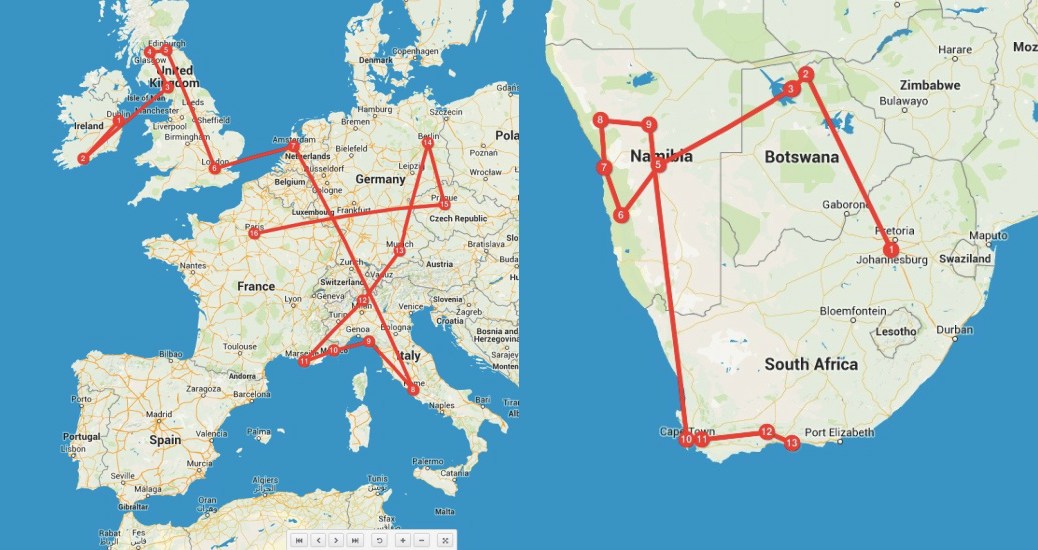
Countries Visited: 13 (Ireland, England, Scotland, Netherlands, Italy, Vatican City, France, Monaco, Germany, Czech Republic, South Africa, Botswana, Namibia).

Number of Border Crossings: 16 (re-entered a few countries like Italy (2 times), France (2 times) and South Africa (2 times)).

Number of Flights Taken: 20.

Miles Flown: 28,201.

Most Remote Airport: The Okavango landing strip, a patch of grass mowed by red lechwe and frequented by baboons and giraffes alike.

Number of Boat Rides Taken: 12.

Longest Amount of Time Spent in One Country: Tie between Scotland and Italy with 16 nights in each.

Shortest Amount of Time Spent in One Country: 2 hours in Monaco.

Number of Cities/Towns/Villages Stayed In: 38 (Dublin, Galway, Dingle, Kenmare, Kinsale, Borrowdale, Glasgow, Glencoe, Skye, Ullapool, Dufftown, Edinburgh, London, Amsterdam, Rome, Montepulciano, Bologna, Vernazza, Cassis, Bellagio, Munich, Bautzen, Berlin, Prague, Paris, Johannesburg, Savute, Moremi, Okavango, Windhoek, Sossusvlei, Swakopmund, Damaraland, Okonjima, Cape Town, Franschhoek, Oudtshoorn, Plettenberg Bay).

Number of Countries Rented/Drove Car In: 7 (Ireland, England, Scotland, Italy, France, Germany, South Africa).

Number of Tickets Received: 2. (And counting! Depends how many more notices my parents find in the mail from the Polizia Municipale Firenze. They take their road rules seriously over there!)

Scariest Roads: Ireland. Dude, so narrow, so windy.

Largest Country Visited: By Population: Germany; By Size: South Africa.

Smallest Country Visited: By Population: Vatican City; By Size: Vatican City (smallest in the world!).

Richest Country Visited (Highest GDP Per Capita): Monaco. (per World Bank and CIA, though it is not included on the IMF list. Per the IMF it’d be the Netherlands.)

Poorest Country Visited (Lowest GDP Per Capita): Namibia.

Countries With No McDonald’s Visited: Vatican City, Namibia, and Botswana.

Visas Obtained in Advance: 0! Hooray for easier traveling 🙂

Award for Overall Most Frustrating Travel Experience: Honestly, the travel was so much easier throughout Europe and Africa. If pressed, we’d probably say Namibia just given how much driving we had to do to get around, and the typically poor quality of the roads. But compared to say, Kyrgyzstan? Easy. Peasy.

Best Public Transportation System: Glasgow probably takes the cake for easiest since it’s a big circle that goes both directions.

Best View from a Room: Watching wild elephants from your room is tough to beat. But the view of Table Mountain at our place in Cape Town? I don’t know. Tough call.

Craziest Critters Sharing our Spaces: A big old frog that hitchhiked with us from England to Scotland, obscene spiders in Africa (that somehow always managed to hang out in the shower when Jenni was there), and the warthogs, guinea fowl and hornbill that basically hung out in our room in Okonjima, Namibia.

Favorite Beach Location: Probably Cinque Terre. Though in hindsight, there was a serious lack of ocean swimming on this last leg of our journey!

Most Appropriate Experience Accommodation: Hazel Bank! As if we haven’t gushed about this place enough already… We stayed in some fabulous places this round, but there was something so special, so appropriate for the locale, about Hazel Bank in England’s Lake District. In a word, heavenly. What I would do to be sipping a G&T on that lawn right now…

Number of Times Used AirBnB: 10 (Dublin, Galway, Glasgow, Edinburgh, Amsterdam, Rome, Bologna, Bellagio, Berlin, Paris).

Times Jenni Faced Her Fears: Let’s see, shall we? SPIDERS IN AFRICA. Bird “attack” in Okonjima. “Scorpion” attack in Okonjima. (Definitely used the emergency phone one too many times at Okonjima). Drinking scotch (neat!) in Scotland. Learning to drive(?) a segway in Prague. Sand sledding in Swakopmund, Namibia. Getting an ostrich neck massage (and riding an ostrich!) in Oudtshoorn, South Africa. City biking in Dublin.

Strangest Experience: Discovering a frog had hitchhiked with us from England to Scotland. Happening upon the nudie section at the park in Munich. Being offered lines of crushed breath mints at Oktoberfest. Getting stuck in the wilderness while a wild leopard roamed about around us.

Best Sunsets: Namibian sunsets for the win! (See: Okonjima, !Doro Nawas.)

Place Where Alan Most Fit In (physically): The land of the brethren redhead, of course! See also: Only Place Alan Fit In (physically).

Number of Beers Imbibed: Ugh, too many. Still working on those Euro-acquired beer bellies.

Place with the Weirdest Name: Dingle, Ireland, or Humansdorp, South Africa.

Best Spot for a Pint: The Bulman (Kinsale, Ireland).

Best Spot for a Cuppa: Ceiteag’s (Glendale, Scotland). Though for a fancier tea, London’s Athanaeum does the trick.

Most Appropriately Dressed Locals: The ladies at the Galway Races!

Family Members That Visited Us: 3. Alan’s brother, Kenny, met us in Italy, and later Alan’s mother Ronnie and her boyfriend Rich met us in Africa.

Friends Visited (e.g. people we knew before the trip): A whole bunch. It helped that we had friends in London, met up with folks in Germany and Amsterdam, and saw a whole lot of old friends at a wedding in Cassis. Lesson learned: it’s easier to convince your friends to visit you on your travels in Europe than it is to convince them to come to Asia.

Most Outlandish Character Met: The former pro-boxer trainer gypsy in Kinsale, Ireland. Joergen, the mustache tickler at Oktoberfest.

Place Where We Felt the Least Safe: Nowhere really… If we had to pick: Cape Town, but not really. We were more confused as to whether we should feel unsafe (e.g. with the warnings about muggings on the hikes).

Scariest Experience: Jenni fighting a baboon out of the car, with SNACKS in HAND(s).

Countries Visited That Drive on the Left: 6 (Ireland, England, Scotland, South Africa, Namibia, Botswana).

Coolest Sounding Language: Click languages in Damaraland, Namibia.

Craziest Party: Oktoberfest, of course.

Most Fairytale-esque Place (possibly in the world): Prague!

Favorite Night: First night of Oktoberfest, or maybe the second night of Oktoberfest. We had a lot of fun at Oktoberfest 🙂

Place We Partied the Least Relative to Its Fame as a Party Place: Berlin. Much to Jack’s dismay.

Favorite Day: Um, probably the day we pet baby cheetahs.

Favorite New Song Discovered: Just My Type.

Best Local Radio: Dingle, Ireland! Or really all over Ireland. I freaking LOVE their talk radio. Makes me want to fly to Ireland, just to get in the car and drive.

Best Music Performances: The show we caught in Ullapool gave me chills.

Best Entertainment, Overall: The Fringe Festival in Edinburgh, Scotland.

Best Street Art: Berlin, Germany.

Favorite European City Visited: Rome or Amsterdam.

Favorite European Country Visited: Italy. Even confirmed on our re-entry.

Most Beautiful Spot in Europe: Isle of Skye, Scotland.

Memorable Dishes/Meals: Meal we cooked as well as Alan’s birthday dinner in Tuscany, Pizza shared on the canal in Amsterdam. Oysters with a view (and a special appearance by hundreds of dolphins).

Strangest Foods Consumed: Kudu, springbok, impala, ostrich. Thank you Africa, for expanding my meat palate.

Country With Overall Best Eats: ITALY. HANDS DOWN. (duh.) See Emilia-Romagna, Roma, and Toscano for the culinary highlights.

Most Cheese Consumed In: Paris. See also: Most Macarons Consumed.

Best Value Wine: South Africa! Get to Franschhoek and get your wine fix, y’all. Note I did not say best wine. But value all the way. Best quality wines were had in Paris and Tuscany (love us some Montepulciano).

Best Hiking: Isle of Skye, Scotland and the sand dunes in Sossusvlei, Namibia.

Wettest Hiking: Glen Coe, Scotland.

Best Animal Sighting: I mean, this is impossible. EVERYTHING in Africa?! Highlights would include the lions eating an elephant in Savute, Botswana, lions in a pre-mating ritual at Moremi, Botswana, stunning leopards in Savute. Can’t say we didn’t enjoy camping out to watch wild meerkats start their day. Seeing cheetahs on foot wasn’t half bad either.

Stay tuned for a final-final summary post with the stats from our entire 15 months. At the rate we’re going, it’ll be published by 2016! 😉 Anything we missed? Factoids and favorites you’re dying to know? Just ask!
À Bientôt, l’Europe!

Oh, Paris. You just might be my favorite city in Europe. How anyone could not love the City of Light is beyond me. It just oozes beauty, art and style. I could wander those streets covered in pretty Parisian architecture, and (were it not for the smokers) I could sit outside at those fantastic cafes, watching the black and grey clad locals walk by with their impossibly cute dogs, whilst sipping on Bourgogne and nibbling on some rillettes and cornichons (and macarons to finish, but of course!).

Upon the advice of a handful of friends, we stayed in the Marais (3rd arrondissement) and we really loved it. There are loads of cafes, restaurants and cute boutiques, and there tend to be fewer tourists than some of the other arrondissements. It seemed the shops right near our flat were segregated by block. E.g. we were staying on the luggage and handbag street, nearby was a strip of (high end) cosmetic stores, and then a street of nothing but wholesale jewelry, and so on. I have to say I appreciate that organization.

One of our favorite finds in our little neighborhood was the Marché des Enfants Rouge (supposedly the oldest covered market in the city). It kind of became our go to spot, for quick meals, meats and cheese, and even flowers.

Of course, we had to pay a visit to my dear friend Jen’s old home on Rue des Rosiers, where she lived while studying in Paris. It being the Jewish quarter and our visit coinciding with the Friday afternoon of the Jewish High Holidays, it was sort of dead. And, most important, L’As du Fallafel was closed. So we came back another day to sample this legendary falafel, and we ate it standing outside Jen’s old door. If you want an indication of how much Alan liked his falafel, consider this. A kind Orthodox man came over and wrapped a Tefillin around Alan while we chatted for a bit, and the entire time Alan did not stop eating his food.

Now Paris is the only place we went on this trip that we’d both been to already. But our last visits were something like 15 years ago, when Alan was a college student with mono, and I was a middle schooler focused largely on shopping at Kookai. Thus, on this trip we hit up a number of the popular tourist sights, and we felt a bit better about skipping a few we’d  done previously.

That said, we did some serious exploring this time around. We really felt like (especially with a week-long visit) we were getting to know the city, and able to maneuver our way around. The metro system is remarkably easy to navigate, and super efficient. Of course, those iconic metro entry signs add some beauty to the experience, too.

Of our touristing; first things first: cheesy romantic-ness. We obviously picnicked in front of the Eiffel Tower. (I am a romantic + first time in Paris with my lovah = wine and cheese by the Tour Eiffel). We picked up supplies at the Marché des Enfants Rouge and headed over for a lovely afternoon soaking up the sun. I was dismayed only by the fact that I was outdone by not one, but TWO women (English speaking and likely American) who had our same idea but out cheesed us by wearing berets. The gall.

Oh, and side note: speaking of cheese, we picked up a couple cheeses we’d discovered at dinner the night before: a creamy and stinky Pont-l’Évêque, and a nutty parm-y/cheddar-y Mimolette. I’m really glad Alan didn’t tell me until afterwards, but apparently Mimolette is (or was, or this was all urban legend?) banned by the FDA because mites are used in the cheese making process. I can’t decide if I’m more grossed out about this, or all the weird things we ate in Asia.

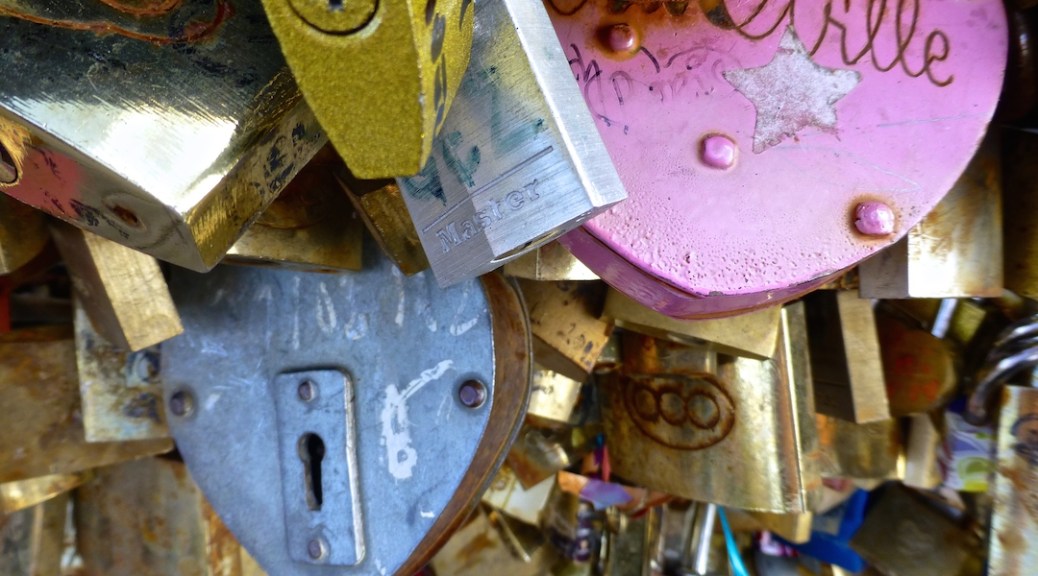
Alan was a total sport and indulged me in some even more uber-cheesy Parisian romance (slash a silly tourist trap): we placed a lock on Pont des Arts (the love lock bridge) and threw the key in the River Seine. It is truly insane how many locks are fitted onto that little bridge. And there are entire sections that are clipped and covered with wood so you can’t attach more. I’ve read that they regularly clip the locks as they get put up, and it looks like it must happen often since most of the dated locks had looked like they were from no earlier than August of this year. People go all out, too. Our €2, purchased a half block away from the bridge, standard lock was certainly outdone by some of the personally engraved, heart shaped masterpieces up there.

Of course, we visited a number of the other big sights. After our Eiffel Tower picnic we walked over to L’Arc de Triomphe. Way bigger and more impressive than I remembered. (Kind of a theme with Paris, for me.)

We walked by the Louvre to take the obligatory selfie in front of the pyramid (again, was more impressive and bigger than I recall). While we didn’t really have any intention of going inside the museum, I would have enjoyed taking our time and walking through the Jardin des Tuileries. Unfortunately, we had so-so weather by the time we made it over here.

We did check out the Jardin des Plantes one day, and despite the chilly weather, we enjoyed admiring the flowers and practicing our French by reading informational bits about medicinal plants and herbs. Loving the green spaces in this city.

We visited the Centre Georges Pompidou, though not the museum, just the sixth floor roof with its awesome views of practically all of Paris (Eiffel Tower and Sacré-Cœur included). I learned that this inside out building was designed by the same guy (Renzo Piano) who did the wind tunnel at the Ferrari factory we saw outside Bologna.

And you guys, we pulled it together for our last stop in Europe and we did it. We went to a museum. And we damn near went to two, but the line for the Musée d’Orsay on a free entrance day around noon is a special kind of torture nobody should voluntarily subject themselves to. Anyhow, I’m calling it a success. We had a bit of a stretch there where we couldn’t bear to do museums (ahem, London). But the Rodin Museum captured our attentions long enough for us to get a wee bit of culture. The grounds of this former mansion are lovely. And Rodin’s sculptures certainly don’t make bad lawn ornaments.

We really enjoyed wandering Île Saint-Louis (definitely check it out, no “major” sights per se, but incredibly charming little neighborhood full of tempting fromageries, boulangeries, and boucheries) on our way back from visiting Notre Dame and Sainte-Chapelle.

Alan is officially obsessed with photographing Notre Dame, he couldn’t stop.

Sainte-Chapelle is the somewhat lesser known, but in my opinion more beautiful (at least on the inside) stained glass loaded church. Look at the detail in there.

Alan loved Rue Mouffetard. It’s a gourmand’s paradise, full of your choice of cheese, meat, foie, pâtés, pastries, seafood, rotisserie, chocolate, wine…

One evening we went over to Montmartre and met the parents of Alan’s best friend from law school (his father is from Paris and they have a flat they happened to be visiting at the same time as we were there!). Our lovely hosts walked us around the area, showing us the last vineyard in Paris (!): Clos Montmartre (who knew?), the adorable and buzzing square atop the hill, and the Sacré-Cœur all lit up at night with the amazing views down below. We shared a fantastic dinner (and wine!) at Le Coq Rico.

Those who know me well know I am borderline obsessed with macarons. So naturally I sampled several. On Champs-Élysées we picked up a handful of Pierre Hermé’s treats. Alan really enjoyed the olive oil vanilla (but my favorite ever just might be a classic vanilla bean flavor, so I was not as into this one). The jasmine flavor, however, was out of this world. I was lucky to grab a few from Ladurée in Orly Airport on our way out. Their vanilla and rose were the bomb.com. And you know I jumped on the opportunity to try a macaron ice cream sandwich (oh yes). That bad boy from Berthillon was a salted butter caramel ice cream surrounded by big almond macaron cookies. And it was sinful (if not a bit cloying).

We’re not much of shoppers on this trip given the whole one suitcase for months at a time thing, but we did explore a bit of the wares on offer. We wandered Champs-Élysées after walking to L’Arc de Triomphe. Though to be honest, we didn’t even really window-shop anything more than the macarons. It’s a pretty, wide boulevard and of course there are nice shops, but we found it quite touristy (e.g. there was a line out to the street for Häagen-Dazs, what?).

But I did very much enjoy going to Saint-Ouen for the Marché Aux Puces, supposedly the world’s largest flea market. If I had a home to ship stuff to, or current income, I would probably have purchased some furniture. There are some beautiful pieces there. We also found it très Parisian and très adorable that all the proprietors were eating their lunch with baguette and wine all fancy at their tables, with real silverware. How civilized.

All in all, Paris was a fantastic way to wrap up our nearly three months in Europe. We’re off to Africa for the next and final continent on this crazy trip of ours!

Practical Info

Paris lives up to its hype of being a beautiful and romantic city. The lovely buildings with wrought iron balconies covered in flowers abound. As do the ample squares, cobblestone streets and peaceful gardens. The Seine is most attractive, adorned by several bridges and some quaint islands.

Generally speaking, I was a little disappointed with the food vs. very high expectations. And the wine was pricier than I expected. I could not but help compare each of these categories to Italy, which I felt clearly had the upper hand in terms of value. I was pleasantly surprised by the friendliness of the locals and ease of communication and transport. Many assert the French can seem snooty or unfriendly, and we did not experience this at all. Perhaps because we can speak some French and made the effort, nearly everyone we interacted with was kind and willing to speak English, especially if theirs was better than our French.

We bought a SIM card at Orange (SFR was out) for €40 which includes 2 hours of international calls, 1GB data, etc. This was much pricier than we’re used to, but we needed it. In the unlikely event you need to ship something, the folks we interacted with at two post offices were exceptionally friendly and helpful. It costs €50 to ship 7kg in a smallish box to the US.

Transportation: We arrived to Charles de Gaulle Airport (CDG) on a flight from Prague. We took the RER B train (€9.75 each, self-service machines with English) to Châtelet – Les Halles and walked from there to our apartment. Paris is quite large, and the public transit system is good. You can buy a carnet of 10 metro tickets for €13.70 (basically break even at 8 rides), and you can divvy up the tickets however you want (unlike, say, London’s Oyster Card where each person needs his own card).

Velib’ is the public bike sharing program. Autolib’ is an electric car sharing service.

We departed on a flight from Orly Airport to Johannesburg via London Heathrow. Taxis G7 has an English language number and they picked us up on time. It cost ~€40 and took half an hour from our apartment to Orly Airport.

Accommodation: We stayed at an Airbnb place on Rue des Vertus in the 3rd arrondissement, in/next to Le Marais. This is a great area if you want to be walking distance to cafes, boutiques, bars, etc. and don’t mind a touch of grittiness. Proximity to metro stations is important. I am by no means an expert on Paris and museums are not a big priority for us, but from what I’ve seen I’d probably stay in the 3rd, 4th, 5th or 6th.

Food and Drinks: Dinner at Bistrot Paul Bert (not to be confused with his other establishments) was very good. The fixed price menu is available in English and costs €38. It was getting late as we finished, so for my cheese course the waiter dropped off enough for five people and said I should take whatever I want. This is when we learned about Mimolette, which looks like (orange) cheddar and to me tasted sort of like a cheddar mixed with a Parmesan, as it is somewhat nutty and tangy. I’m not sure the current status, but I read that it’s banned in the US because it is deliberately exposed to mites. A pity, if true.

Le Coq Rico is a renowned volaille (poultry) restaurant in the 18th. We had a great meal there with the Streiffs. N.B. they are opening a branch in NY at Park Ave and 20th. The €21 two-course lunch at L’AOC was solid value. Our meal was good and the service was excellent.

Few even argue that L’As du Fallafel is not the best falafel in Paris. It is delicious and hearty at €6; there is a separate line for take away; get the hot sauce, it’s not very spicy. Also on Rue des Rosiers are a handful of competitors.

Marché des Enfants Rouges is a small covered market with meats, cheeses, fish, veggies, flowers, etc. and also stalls selling prepared food like Moroccan, Italian, Lebanese, Japanese…It is cool. Caractère de Cochon is a nearby shrine to the pig. Jean-Paul Gardil looked like a great butcher on Rue Saint-Louis en l’Île.

Ice cream at Berthillon on the same street was great and reasonably priced. I am not a big macaron fan, but Jenni, a self-proclaimed macaron aficionado, assures that those from Pierre Hermé are superb. Ditto those from Ladurée, which I’m pretty sure has some NY locations.

Rue Mouffetard (in the 5th) is a gourmand’s delight. There are several shops with cheese, meat, foie gras, pâtés, pastries, seafood, rotisserie, chocolate, wine, etc. The young man at wine shop Le Repaire de Bacchus was very helpful and steered us nicely to a Pic Saint-Loup.

We did not visit any of these in Montmartre, but Chez Plumeau is in a quieter part just off Place du Tertre; Le Tire Bouchon is a piano bar; Au Lapin Agile is a cabaret bar.

Though Paris is rightly famous for its sidewalk cafes, beware that you’ll likely be enveloped in cigarette smoke when you sit outside. I read that one should order steak “a point” for medium rare, which might be to the rare side given French preferences. Saignant is rare (at least for beef). If you want food to take away, the word is “emporter.”

Activities: There are endless famous museums, monuments, shopping areas, markets, gardens, specialty stores, etc. Most of the major museums are free on the first Sunday of each month, and some offer discounted rates for late visits on other days. Even if you don’t enter the Louvre, it’s worth passing by for the impressive building and iconic glass pyramid.

The Musée Rodin holds many pieces within its 18th century mansion and also its spacious and peaceful gardens. Musée d’Orsay eluded me yet again. The Eiffel Tower is an obligatory stop, at least for first-timers. We picnicked in a grassy area east of the Tower but did not ascend to any of the “floors.”

The Marché aux Puces de Saint-Ouen is generally considered the largest flea market in the world. TimeOut has a good description here.

Montmartre is like a cobblestone-street village atop a hill (butte) overlooking the city. Its most famous attraction is the Basilica of Sacré-Cœur; its central square the Place du Tertre. We visited at night and it was loaded with tourists and souvenir shops, but it’s easy to see the appeal. Once you get away from Place du Tertre, it is a lot calmer. Clos Montmartre is the only working vineyard in Paris, and each year there is a harvest festival (always early October?).

Île Saint-Louis is a charming place for a stroll. A friend did a Fat Tire bike tour and liked it. We wanted to do a cruise on Canal Saint-Martin, but the weather did not cooperate our last couple days. We did not go this time, but Versailles makes a lovely day trip.

October 2-9, 2014 (Thursday-Thursday)

Praha

Did someone replace Prague with Disneyland while I was asleep at the wheel? We arrived in the late afternoon and made it over to Charles Bridge that evening for our first view of the Prague Castle in all its glistening nighttime glory. That scene is straight out of a Disney movie. It is unreal and utterly romantic. I literally swooned.

The whole city kind of feels like a movie set to me. I mean, look at the town square.

It even has an astronomical clock. That sounds as movie-set-esque as possible, until you’re told that every hour on the hour it turns into a gigantic cuckoo clock. Are teacups and candlesticks going to start singing and dancing as well?

The incredible buildings don’t stop at the bridge and the town square; they are all over the city. And we know, because we took a (nerd alert!) Segway tour around the whole place!

I’m not going to lie, I was kind of nervous about riding the Segway at first. I got over the whole being embarrassed thing, because um, it’s actually insanely cool to ride this ingenious device. But, since (as is well documented on this blog) I am afraid of everything, I was afraid of hitting pedestrians and/or falling off this mysterious vehicle and onto the street thereby ending up with a cobblestone patterned face. But it was my lucky day, we were the only ones to show up for the tour and so we got a little private lesson on how not to injure oneself or others on a Segway, and guess what? I didn’t! Hooray! Also, it is so amazing to experience the world as a tall person for a day. The things you can see up there! 😉

Our mad Segway skills did not stop us, however, from wearing our helmets the entire time we were on the tour. Even when we parked the Segways to walk around. Bonus to sightseeing with helmets on: you can always find your partner in a crowd! We’re special, I know.

Our tour took us through most of Prague’s highlights. It was sort of the perfect way to explore a city for people like us who have a very short attention span when it comes to museums and churches and such. You just get there (fast), check it out, learn a tiny bit about it, and move on. I also highly recommend doing a Segway tour your first day in town. That way, you get your bearings and anything you really like and want to learn more about you can go back to and visit again.

One of the perks of doing the touristy stuff on Segway was cheating on the “walk” up to the castle. While we didn’t have much time to explore, we quickly went in to look at the church up close.

And the views from up there, and the nearby orchard/park, are wonderful.

Post-Segway tour we made it back to Malá Strana and entered the St. Nicholas church to check out the inside, and for good reason. Some ornate, pink and green marble Baroque-ness going on in there. Europe has got some seriously beautiful churches, does it not? I’ve been to church more in the last two months than my entire life before!

We also stopped to visit the Wallenstein Gardens, where the Czech Senate does its thing. They have a nice little spot there, loaded with bronze statues, a pond full of fish and surrounded by peacocks, all flanked by a view of the castle behind.

My favorite spot in Praha has to be the Lennon Wall. It is just so colorful and happy, and while I’m not sure if this is always the case or not, there was a guy playing covers of Beatles classics while we snapped our photos. And this little girl dancing along was maybe the cutest thing ever.

I really enjoyed reading a bunch of the notes people have left on the wall. There are all sorts of medium stuck up on there, often affixed by a band-aid.

The music scene in Prague is said to be legit so we spent a couple nights checking out a mix of the local concert offerings. One night we visited Reduta Jazz Club, where Billy Clinton himself once got up on stage and wailed on the sax. Juwana Jenkins sang some soul/rock and she was definitely an entertainer. Though we were really wowed by the fantastic harmonica player, Charlie Slavik.

To switch it up, we saw some classical music (organ/piano player, a violinist and two singers) the next night. We felt classy as hell ( 😉 ), and the venue was really lovely.

On the whole, I was a little un-into the Czech food, but I think this is largely because we’d been eating this hearty, meaty type of fare for so long by this point (German food and beer, then Prague for beef goulash, pork, bread dumplings, and more beer). That said, we did sample the trdelnik one evening. This is kind of like a heavy fried dough made on a burning hot rolling pin and then smeared with nutella. It’s as good as it sounds, and one is enough for a meal. Also, as our waiter not so subtly suggested the first evening, Pilsner Urquell may just be the best beer in the world. Ok, maybe that’s a stretch, but it’s really good.

Practical Info 

Prague has a huge and fun Old Town and sports some very impressive buildings and views (such as Prague Castle from Charles Bridge). History, beer and music are top draws. I did not realize before visiting that Prague was once the capital of the Holy Roman Empire (under Charles IV). Nor that “New Town” was built in the 14th century.

If you have enough time for a day-trip or more, Český Krumlov comes highly recommended.

Czech’s currency is the koruna (aka crown), though you will often see prices quoted in Euros. At time of travel, 1 USD = 21.6 CZK.

Transportation: We arrived on a train from Berlin, disembarking at Prague’s main train station (Praha hlavní nádraží). Much of the ride offers charming countryside scenery, as the tracks run right along a river. We walked (or took a Segway) everywhere within the city. The public transit system has a good reputation and is not that expensive.

We departed on a Smart Wings flight to Paris. Our hotel charged CZK690 (a cab may be slightly cheaper, and one may take public transport) for the 20-30 minute drive to Vaclav Havel Airport, which is nice and has free WiFi. The plane said Czech Airlines on it, and it was a pleasant voyage.

Accommodation: We stayed at Hotel U Červené židle (aka Red Chair Hotel). The location is superb, very near to Old Town Square and the Charles Bridge. Our room was spacious and the staff were very helpful. It seems to me that you probably want to stay in Old Town or Lesser Town.

If you are looking for something more upscale, my Dad and Linda recently stayed at Mamaison Riverside and my in-laws stayed at The Emblem. The Four Seasons is near Charles Bridge with a view of Prague Castle, and the Mandarin Oriental is in Lesser Town.

Food and Drinks: The Czech Republic is famous for its beer, but we did not really bring our A-game. Our excuse is that we came from Oktoberfest plus a week with Jack, aka the beer pusher. There are the classic old brewers, plus allegedly a robust craft beer scene. I can say that we much prefer the Pilsner Urquell to the Budweiser Budvar. We found the food generally good, but not great. There is a lot of goulash, roast pork, cabbage, bread or potato dumplings, etc. In general, stews, roast meats and hearty food prevail. If you have a sweet tooth, the ubiquitous trdelnik (a cylindrical pastry) makes a nice snack or dessert.

Dinner at U Parlamentu was good, and a half liter of Pilsner is only CZK38. Lunch at Cafe Savoy was also good, and the interior is lovely. Pad thai at Siam Orchid was not cheap (CZK190), but it was large and tasty. Dinner at U Medvidku was disappointing. The service was lousy, it was smoky, they were out of Jenni’s top choice, and I thought it was a craft brewery but somehow at dinner I could order only Budweiser Budvar.

Some other places that were recommended include K The Two Brothers (Indian); Pivovarský Dům; Cafe Louvre.

Activities: The City Tour with Prague Segway Tours (CZK1490 each, three hours) was a nice way to get an overview of the major tourist attractions. We weren’t so impressed by our guide, but riding a Segway was fun and it was worthwhile. We saw a blues/rock show at Reduta Jazz Club (CZK320/ticket, purchased in advance at their ticket window). Juwana Jenkins was good, but Charlie Slavik on the harmonica was the highlight. We considered JazzDock or Jazz Boat for shows.

“Mozart in Old Prague” at the Klementinum Mirror Chapel was nice (CZK550/ticket, somehow arranged at the front desk of Eurostars Thalia). We would’ve liked to hear the Czech Philharmonic at the Rudolfinum, but opening night was the day we departed. The National Theatre and Smetana Hall at Municipal House are but two of the many other venues for classical, opera, etc. There are also regular performances in various churches.

We saw Prague Castle and St. Vitus Cathedral up close, but we never entered. We did enter Our Lady of Victory Church (not that special unless you’re really into the baby Jesus statue) and St. Nicholas (CZK70), which is an impressive baroque construction. Wallenstein Garden is free and peaceful with nice views. Just don’t ingest hallucinogens before visiting or the dripstone wall may get you. But the peacocks might be neat.

Old Town Square is a must, with the Astronomical Clock, gothic Church of Our Lady before Týn, etc. Nearby is the Powder Tower, Republic Square (there was a small farmer’s market when we passed through on Wednesday) and the Municipal House (with an attractive Art Nouveau cafe and restaurant). The main square of New Town is Wenceslas Square.

The Lennon Wall made for an enjoyable quick stop. The old Jewish Quarter (Josefov) is a top attraction, though we just cruised through and did not make it to the museum. Our Segway guide said there is a pedestrian area with bars etc. along the Vltava River, I think it’s called Novoměstská náplavka or something like that.

September 28 – October 2, 2014 (Sunday-Thursday)

To the Wall

In recovery mode from Oktoberfest, we hit the open road (and more specifically, the Autobahn!) in seek of a place to relax for a night in between Munich and Berlin. Bautzen fit the bill. This charming medieval town was lovely, what with its many towers and cobblestone streets and all. Though it was extremely quiet. Like, we walked out of dinner (at our practically empty restaurant) around 10pm on a Thursday and all the shops were closed, all the streets deserted. Despite having the place practically to ourselves, we enjoyed dinner at Mönchshof, a fun restaurant where all the waiters are dressed as monks. We tried the local beverage specialties: a red beer, a wine and honey concoction (meh), and beer with banana juice. I had to taste the latter, knowing it could be one of those things that sounds utterly disgusting, but somehow is this amazing thing you suddenly realize you can’t live without. It was neither, but it was surprisingly tasty. Kind of like a beer based piña colada.

Our next and final stop in Germany was Berlin. Despite arriving on a misty, cold afternoon, we put in an impressive (and long!) walk around some of the city’s major highlights.

We walked from the train station past the gorgeous Reichstag building and on to the Brandenburg Gate.

While we didn’t actually go inside any museums, we walked over Museum Island to admire the intricate buildings.

We didn’t get to very much of the war/Jewish/Holocaust stuff, but we did see the impressive Neue Synagogue. It’s quite beautiful, and I actually thought it was a mosque when I saw its blue and gold dome from Museum Island. Probably because of its “splendid eastern Moorish style and resemblance to the Alhambra,” per Wikipedia.

Hackescher Markt was a nice square filled with restaurants, though it was somewhat dead given the spotty weather. And in further proof I am as easily entertained as a dog, I took approximately twenty pictures of the city amidst a street performer blowing giant bubbles.

But cooler yet was Hackesche Höfe, a super funky courtyard covered in artful graffiti. There’s also apparently a monster tour that originates here. I’m not entirely sure what this entails, but sounds interesting enough?

We eventually walked back through the Gendarmenmarkt, which is a splendid square with French and German cathedrals and the Konzerthaus (a concert house…see, German’s not so hard is it?).

I think Alan and Jack had the most fun at the Weber Grill store, which is part store, part shrine to barbecuing. I did not know that looking at grills could arouse so much enthusiasm. Now I know.

We ended the day of bang-out sightseeing with a visit to a must stop for tourists: Checkpoint Charlie. While there is little to actually see at this well-known historic wall crossing point, the display was very informative, and Jack took advantage of the photo op with the fake soldiers. Apparently, they’ll actually stamp your passport if you remember to bring it!

Overall we were wowed by the number of grand buildings throughout Berlin (I kind of pictured much more ugly, plain, communist era buildings), and the sheer number of cool galleries and cafes.

We stayed in the trendy neighborhood of Kreuzberg, rife with above-mentioned cafes. While one could argue that the whole city of Berlin is hipster, Kreuzberg is a mecca of hipsterdom, and it’s a really lovely area to hang out in.

Our one full day in town, the weather cooperated and we enjoyed a sunny day exploring Berlin. There was a super cute farmers market nearby our flat, I think on Südstern.

And there were tons of cobblestone streets with wide sidewalks, lined with beautiful big trees. Felt like a perfect fall day in the city walking through these parts.

Despite being a European country with one of the best reputations for efficiency, Germany is strangely anti-credit card. And getting by in English wasn’t always seamless. This is what happened when we tried to order eggs for breakfast in German:

And for my final exhibit of weird things that happen in Germany: as we were walking through a park later in the afternoon we were propositioned by the most forward and unabashed drug dealers I’ve ever encountered. And we’ve traveled to some avant-garde places. There is a little strip of the park in which no fewer than 20 men jumped up to ask us if we wanted any number of drugs they had on offer for us. And they followed us out the park, determined to make a sale. I don’t know if this happens to everyone or if we really looked like we could use a fix? I’m telling you, strange things go down in German parks: drugs, nudity and surfing, at a minimum.

Once we made it through the whack-a-mole of drug dealers, we enjoyed some Berliners at Freischwimmer in a happening waterfront bar area. This little alcove of bars and restaurants is the perfect place to laze away a sunny weekend afternoon.

Just in time for magic hour, we made it to the number one must-see of Berlin: the wall itself! The East Side Gallery is one of the few places where you can still see the original wall. I know it’s just a wall, and again like the Great Wall, I kind of tempered my expectations, but visiting the Berlin Wall was actually one of my favorite things we did here. It’s covered in graffiti, some of it politically driven, some of it beautiful and other parts just downright weird.

With only about a day and a half, we covered just a tiny part of this seriously big city, but of what we saw, we were big fans!

Practical Info 

Berlin is a huge city with fascinating history, some beautiful buildings, a diverse population and next-level hipster vibe. There is a large Turkish (and Middle Eastern) population, especially around Kreuzberg and Neukölln where kebab shops seem to outnumber traditional German places. Mitte seems to have a lot of the museums and upscale hotels, etc. There were many cafes and galleries around Auguststrasse and Rosenthaler Strasse.…Kreuzberg and Neukölln have lots of cafes, bars, cobblestone streets etc. We enjoyed walking around Bergmannstrasse, Kortestrasse, Dieffenbachstrasse, Falckensteinstrasse, etc. But again, this is a big city so do some research and be prepared to walk a while. It is harder to just show up and wander into the cute and lively areas.

An interesting note about Bautzen, where we stopped between Munich and Berlin: there is a community of Sorbs here, and per Wikipedia Sorbs “are a Western Slavic people of Central Europe living predominantly in Lusatia, a region on the territory of Germany and Poland.” Who knew?

Transportation: We drove from Bautzen, where we spent the night en route from Munich, and we dropped the car at Hertz at Hauptbahnhof (Central Station). We walked a lot in the city and took a taxi once, which was reasonable, but this city is very large. It would be a good idea to familiarize yourself with public transport, which I think is extensive. Renting bikes might be a good option, given the vastness and that bike lanes are ubiquitous.

We departed on a train for Prague, which takes ~4.5 hours. I purchased tickets on the bahn.de website (second class, €39 each), and we left from Berlin Südkreuz (instead of Hauptbahnhof) because it is closer to where we stayed. As it turned out, this meant we had to cross the Berlin Marathon route (so finding a taxi was tough and the circuitous route cost €20) and the train was quite crowded when we boarded. Had I realized the format of these trains, I probably would have paid the extra €4.50 each to reserve seats and maybe even the extra money for first class.

Accommodation: We stayed in an Airbnb apartment in Kreuzberg on Arndtstraße. The apartment was very large and not so expensive, and the location was good if you want to be close to Kreuzberg and somewhat close to Neukölln. Many of the tourist sights are in Mitte, so some might think it preferable to stay there. I don’t know much about Monbijou Hotel, but the location seemed quite good and the lobby/bar have a nice boutique feel. There were also a couple docked boats at the East Side Gallery (don’t think that’s in Mitte, but cool to be at the Wall) that seemed to be hostels.

In Bautzen, we stayed at Villa Antonia. It was a fairly easy walk to the old town area, the downstairs pub/restaurant looked nice, and the included breakfast was fairly good. Our attic room was huge, but WiFi didn’t work too well up there.

Food and Drinks: White Trash Fast Food is something of a compound with indoor and outdoor space, live music at times, a tattoo parlor, etc. The burgers were great, and the veal ribs were solid. Jack and I had sushi at Cube (near our apartment), which was very good and beyond reasonable. We had plenty of food plus some drinks for €40. Coffee at The Barn is good, and Kenny gave high marks to Pic Nic (a small Italian spot).

Sunny Saturday drinks at Freischwimmer (on a canal by the River Spree) was nice, and there was at least one other bar directly across the canal (closer to White Trash Fast Food).

Currywurst is a local specialty, and especially in the area we stayed (but also all over) there are countless kebab shops. Mustafa’s Gemuse Kebap is well-reviewed.

I would also note that Berlin is famous for its clubs and techno scene. Much to Jack’s chagrin, we never made it. But I think Berghain is one of the famous spots.

In Bautzen, we had dinner at Mönchshof, a medieval/monk themed spot in the old town. It has its own tasty beer (Rother Abt), an extensive menu and ample portions.

Activities: Being the museum-o-phobes we are, we mainly walked around the city. The first day we started at Hauptbahnhof, walking by the Reichstag, Brandenburg Gate, east on Unter den Linden (which was covered with construction as they are building a new train line), over Museum Island (worth seeing for the Berliner Dom and more, even if you never enter a building), past the Neue Synagogue, along Auguststrasse, and into the Hackesche Höfe complex. Then we headed towards home, passing through the gorgeous Gendarmenmarkt before spending a while at Checkpoint Charlie (but not the Wall museum there, which was closed).

Our second day we strolled more through Kreuzberg and Neukölln, visiting such charming streets as Bergmannstrasse, a strong little farmer’s market on Südstern, Kortestrasse, Dieffenbachstrasse, Pannierstrasse over a canal before crossing through Gorlitzer Park. I’ve never been offered drugs so repeatedly and openly as during this short passage. Then we had drinks at Freischwimmer, walked along Falckensteinstrasse and crossed the bridge to the East Side Gallery. This is one of the few places where you can still see the original Berlin Wall, and it was very cool. You get to see both sides and there are a couple bars there. We left too early on the prime day, but Kenny said Mauer Park on a Sunday was probably his favorite thing to do in Berlin.

There are lots of museums, war/Holocaust memorials, etc. in Berlin. Nearby Potsdam may also be worth visiting.

September 26-28, 2014 (Friday-Sunday)

Gemütlichkeit

It should come as no surprise that there is a really long German word for drinking lots of beer, cheers-ing constantly, and generally having the best time ever with your friends at Oktoberfest. That word is gemütlichkeit, and we learned it pretty quickly, given that the bands play the “Ein Prosit” song every ten minutes, day and night. For Oktoberfest virgins out there, it goes something along the lines of “ein prosit, ein prosit, gemütlichkeit.” This basically means (from what I recall): “A toast. A toast. That awesome feeling of drinking and having fun with your friends.” And though it doesn’t translate directly to English, we most definitely understood what gemütlichkeit meant while standing on our chairs, drinking German beer and dancing with the lederhosen clad locals.

I at once had high and tempered expectations for Oktoberfest. It is, after all, a festival dedicated largely to getting drunk off of beer. One would expect that to be fun, and maybe a little dirty. It far exceeded all of our expectations. I don’t know if it was stars aligning or the beer gods smiling down on us, but our first two nights experiencing Oktoberfest could not have been more perfect or more fun. It helped that our friend Jack met us in Munich to celebrate, and he is the ideal friend to help us get our drink on. ☺

Night one we entered the party with not the slightest clue as to how it all works. We wandered into a tent (Hacker-Pschorr) around five o’clock, when all the tables were already full. Not to be deterred, we stood in the space outside the tables and ordered a mass (a liter of beer) each from the first beerfrau who paid us mind. Perhaps it’s only because we drooled on the poor patrons sitting behind the wall from us, but a miraculous thing happened when a kind woman offered to let us order at her table, sit down and eat while she and her colleagues were waiting for the rest of their crew to arrive. We had our first tastes of the deliciousness that is Oktoberfest food, sampling the roast half chicken and a sausage with sauerkraut and mustard.

Satiated and yet still wanting more, we moved on to the Lowenbrau tent. By another pure stroke of luck, we squeezed into a table just as a man and his date were being escorted by security. By now, people were standing on their seats and dancing and singing along with the band. There are live bands in (I think) every tent. And most of them are fantastic, playing a range of classic songs and modern pop music, along with the Oktoberfest staples. At some point in the evening, we were joined by Jeurgen. (Sidenote, I’m 88% certain that everyone I met at Oktoberfest was named some variation of Jorg.) I’m sure I must have complimented him on his epic mustache because next thing I know, I was getting mustache tickles and he was dancing with Alan like they were old buddies. Best table-mate ever.

It was an evening of epic fun, singing and dancing, and cheers-ing non-stop. I mean, constantly. It helps that they play the “ein prosit” song every five minutes. Just in case you’d forgotten to drink. And people just slam their glasses into one another. It’s a wonder they don’t shatter. Also, for the record, those steins are heavy. I literally woke up with a swollen lump in between my right forefinger and thumb from holding those things. I had to go lefty the next night. And we realized just how impressive it is that beerfraus often carry five steins in each hand!

Some crazy stuff happens at Oktoberfest, but I was still pretty taken aback when the group next to us pulled out a small vial of white powder and began blowing lines of it, and even offered us a bump. Mind you this is on the outer row of tables, in clear view of security and staff! Turns out it was not an illicit substance, but menthol. They were basically blowing breath mints. And we saw a few other people doing it another day. The first of many strange things we discovered in Germany.

Also, how awesome are these whip guys?!

Outside the tents there is strangely little drinking. I hadn’t realized this beforehand. But it makes sense that nobody is carrying around a mass in a giant glass stein throughout the carnival that’s taking place outside. Anyway, it provides for a good break to play some carnival games. We never did try the rides, but if you’re into that sort of stuff, there are plenty to enjoy. There’s also tons of food. We picked up some nutella waffles one morning on the way in, delicious.

Somehow we managed to wake up early enough to get to the tents bright and early the next day. We sat at a table and began with our masses and our “ein prosit’s” and enjoying a merry old day the Oktoberfest way. The day scene is completely different, but totally awesome in a whole other way. People mostly sit down during the day, not quite drunk enough to stand on their chairs and sing, save for the occasional chap who would stand up and chug an entire mass to the cheers of the crowd. Apparently, if one fails at said task, they must pour the remaining beer on their head. Impressively, of all the chuggers we saw, not one was unable to finish. We were joined by a great German guy who, despite his limited English, told us all about his adventures traveling through the US, Africa and Europe in the 70s. He was fantastic company.

Also, in addition to the people walking around with baskets of pretzels for sale, there is a lady who sells pickles. Obviously we ordered a round. Did I mention how much I love this place?

Thanks to Alan’s relationships from his former work at a hedge fund, we were invited to the Kirkland & Ellis party our second night in town. We knew we had to step up our game, so Alan and I went off in search of some proper attire: dirndl and lederhosen!

I had known that Germany was home to lots of Turks, but I didn’t quite realize the extent of it. Parts of Germany (including the neighborhood we stayed in, just outside of the Oktoberfest area) are more Turkish than parts of Istanbul! To my shame, this was yet another place where a better knowledge of the Turkish language would have come in helpful. My very limited Turkish did, in fact, come in handy when I was able to ask “how much” at a shop selling lederhosen. Unfortunately, any rapport I gained by this translation was lost when the price he gave me was above the number I can count to (ten). Womp womp. Nevertheless, we succeeded in snagging a dirndl and some lederhosen elsewhere that really helped us fit in with the crowd. Jack, of course, stuck to his usual uniform of a white v-neck t-shirt and jeans. 😉

After confirming with the locals which side to tie my apron (left side means single, right side means taken and on the back means widowed), we headed out to the Kafer tent. Um, most fun I’ve ever had (and likely ever will) at a law firm hosted event. Amazeballs. The partners were super friendly and welcoming, and the event was all out. VIP tables in the upstairs section of the tent, food done right (I’m talking pretzel trees, a meat, cheese and pate spread, gigantic ox platter, potato balls, a ridiculous pancake dessert thing), drinks of course done right (unlimited masses, plus schnapps handed out late night), and we were right next to the band. The band, by the way, was out of this world awesome. They even came out and played amongst the crowd at points. We were dancing with the accordionist and violinist on our table. And somehow one of the lead singers and I started tickling each other. I don’t know. These things just happen at Oktoberfest. Overall, insanely fun party.

I also got a kick out of this guy who just laid down on the banister of the stairwell with his beer and watched the concert from there. Too funny.

And, if it’s a real feel for the festivities (chugging, yodeling, cheers-ing included) you’re after, check out this little montage of our Oktoberfest experience (thanks, Jack, for some great video footage!):

By day three we managed to pry ourselves from the tents for a few minutes to check out some of the non-Oktoberfest related highlights of Munich. We visited Marienpltaz, stopping for a ridiculous breakfast of schnitzel and whatever this meat/egg/potato concoction was at Tegernseer Tal Bräuhaus. We walked through the permanent Hofbräuhaus (cool, but at least during Oktoberfest, not as awesome as the event itself).

One of the coolest things we discovered was the Eisbach surfing. There is a permanent wave in the river that serious surfers hang out and ride all day long.

It’s wildly impressive. Feels like watching a pro-surfer movie, but live, and right up in the action. Do not miss this if you make it to Munich. Check out some video action:

From there we wandered through the park and another weird German thing happened to us. Everyone got naked. Well, not everyone, but there’s apparently a whole naked section of the park. Largely dudes, but there were a couple lady bits hanging out too.

We settled on a clothed section of the park and chilled out in the hammocks of a biergarten.

That night we went out for our last taste of Oktoberfest, and while the food did not disappoint, we were less impressed by the tents we checked out. We surmise it was a combination of things: I think as it gets later in the week the scene gets more crowded and more intense (e.g. lots of “bro-ey-ness” and aggressiveness… I got hit hard just trying to walk to the bathroom, and dodged a potentially developing fight as I came out), some tents are better than others (e.g. the band at Spaten just couldn’t compare), and we were far more sober than everyone around (never a good thing).

Practical Info

We visited Munich, but the trip was really all about Oktoberfest. Before coming, I did not realize that Oktoberfest is a Munich thing, not a Germany thing. Nor was I sure that it doesn’t really pervade the whole city, rather it is pretty much confined to the Theresienwiese, a huge concrete oval in the city.

The festival lasts ~16 days, beginning in late September and usually ending the first weekend in October. We visited during the first week, and likely on less-crowded days considering these were Monday-Wednesday. Vacation day issues aside, this seems like a good idea to me as it is plenty crazy and probably even more intense on the weekends.

Within the Theresienwiese are several enormous temporary beer tents. These take months to set up and typically hold upwards of 5k people each. Some of the major tents are Augustiner, Hacker-Pschorr, Lowenbrau, Paulaner, Spaten and Hofbrau. The tents get extremely crowded and finding a seat can be difficult. Many tables are reserved, and I’m not sure how one makes a reservation. If you show up very early, you can grab a table. Someone told us we had to show up at 9:30 am for a 10 am open, but we strolled into Augustiner on Tuesday at 11 am and it was pretty empty. I’m sure it’s different on the weekend, and maybe at other tents. If you are there when it’s packed, just hover and do your best. Not getting a seat can make it difficult to even buy beer, and I don’t think you could order proper food, though you could still buy giant pretzels and the like from vendors walking around with baskets. The standard beer order is a Mass (or Maß), which is one liter and always costs ~€10. Service is extremely prompt (at least after ordering), and you are expected to tip.

As far as I know, every tent has basically a full orchestra. They play a mix of traditional and pop music. The Ein Prosit tune will be stuck in your head for days, if not weeks. The Kafer tent had more of an interactive multi-piece band, and it was phenomenal.

A great many festival-goers are in traditional attire, which means a dirndl for women and lederhosen for men. We purchased ours at a shop on Landwehrstraße, on the north side between St. Paul’s Church and Hotel Demas City. It cost €30 for Jenni’s outfit and €50 for mine (just the leather, no shirt or shoes), which was half the best price we could negotiate a block or two closer to the festival. You might consider Amazon prior to travel.

We popped our Oktoberfest cherry at Hacker-Pschorr and then had loads of fun at Lowenbrau on the first night. On Tuesday we spent 11am – 3 pm at Augustiner, where the music began at noon. Then we rested up before the K&E party at the Kafer tent that night…which was amazing. Kafer is the celeb/VIP tent, and the party was truly top-notch. On Wednesday we did some touristy things before heading to the festival in the evening. We were a bit worn down and fairly sober, so perhaps we were harsher judges. We could only sit outside at Spaten, and the band seemed sub-par. The vibe at Hofbrau was by far the bro-iest and honestly a bit over the top and off-putting. We ended up at Augustiner where it was more mellow, this being a relative concept.

The biggest surprises for me were the variety and quality of food in the tents; how much music there was and how good most of it was; and how extensive the carnival area and rides are.

Transportation: We arrived on an Air Dolomiti flight from Milan, and we took the train from the airport to Hauptbahnhof (Central Station). I believe you can take the S-1 or S-8 train. It cost €10.40 each and took about 45 minutes. Our hotel and the festival are walking distance from the train station. Within the city, we walked everywhere.

We departed Munich in a rental car (Hertz, poor service) headed for Berlin, with a night on the way in Bautzen. The drive to Bautzen was ~5 hours, and we stopped for a late lunch in Hof. People do indeed drive very fast on the Autobahn. We routinely cruised at 160+ km/h. And in stark contrast with Italy and France, we never paid a single toll!

Accommodation: We stayed at Hotel Demas City. The immediate area is not particularly charming, but it is an easy walk to Oktoberfest and there was an ample supply of late-night doner shops, thus we were pleased with this pick. The room was pretty good-sized and water pressure was excellent. If it were not Oktoberfest, I would try to stay somewhere else. Maybe closer to Marienplatz.

Food and Drinks: The beer tents, of course. We were very impressed by the variety and quality of food there. The half roast chicken was consistently great (costs ~€10). Other staples include pork knuckle, sausage (maybe with saurekraut), various roast meats, spaetzle, and pretzels. Lunch at Tegernseer Tal Bräuhaus by Marienplatz was delicious. Our hotel was in the Turkish/Middle Eastern area, so there were lots of kebab shops.

Activities: Drinking and singing handily top all challengers. We covered the basics of Oktoberfest above. Jack did a city Segway tour before we arrived, and that sounded fun. One day we walked around the city, through Marienplatz and its surroundings where there are lively squares and beautiful architecture. Watching the surfers on the Eisbach was very neat. The Englischer Garten is a nice park, replete with nudists and a little biergarten with hammocks. The Residenz is high on the list of most tourists, and on a prior visit I think I hit the Deutsches Museum, which is a great science and technology museum.

September 22-25, 2014 (Monday-Thursday)

Lake Como: Our Cotton Anniversary

We returned to Italy after a brief foray into France, and it was everything we remembered it to be and more. In fact, over dinner one evening, I remarked that Italy might be the single most “lived up to its hype, and then some” country we’ve visited.

The drive from France was stunning. We took a different route than the one we’d driven in (along the coast), which led us through the mountains and some ski areas. The landscape was beautiful, including a few pretty turquoise lakes.

After deciding to spend our anniversary in Italy’s lake region, we chose to stay at the famed Lake Como, having heard it’s the most beautiful. And we settled on Bellagio as our town of choice since it is said to have the most spectacular views of said outstanding lake. It didn’t disappoint. Bellagio, “the pearl of the lake,” is set at the tip of the peninsula separating the two legs that make up part of the lake’s (upside down) “Y” shape. The resulting panorama includes the surrounding mountains and water with nearly 360° views.

We rented a flat a bit of a walk from town, but we were compensated with an incredibly spacious abode and a superb view. I mean, look at this:

We went out for dinner upon arrival, and the food was just as good as we remembered; the wine as cheap as we’d remembered. We’d heard rumors that Bellagio could be pricey and stuffy, but we found great value and exceptional service! So good that we actually tried to go back to the same restaurant the next night for our anniversary (but sadly all of the outdoor tables had been booked).

Though technically the day before our anniversary, we celebrated our nearly two years of wedded bliss on the 21st. We had perfect weather and so we walked into town, meandering along the steep side streets from the lakeside up the hill. We enjoyed lunch with a view on the tip of Punta Spartivento, where you get epic 180+° views of the lake.

Back at our flat we shared some pre-dinner drinks and watched our wedding video. Alan swears I’m the only person who actually watches her wedding video, but someone back me up here! Watching your own wedding video is like watching the best movie ever. And who doesn’t enjoy reliving the best day of their lives? (Side Note: I’m also weirdly fascinated by the yearly anniversary gifts thing, hence the title of this post. Does anyone actually give gifts like this? Both of our anniversary gifts to each other have been, well, traveling the world for a year, so we’re not exactly following tradition.) We finished the evening with the primo table at a lakefront hotel for our final taste of Italian food (for now at least). Goodbye Italy, we’ve adored you, and we will be back!

And just because it’s our anniversary and I wasn’t blogging when we got married, here are just a few of my favorite snaps from our big day.

Wedding photos by Kim Fox Photography.

Practical Info

Coming from a wedding in Cassis and about to meet Jack in Munich for Oktoberfest, we wanted a peaceful and romantic setting to celebrate our 2nd wedding anniversary. Lake Como certainly fit the bill, and Bellagio was wonderful. There are multiple lakes in this region, with Lake Como being the most famous. And Lake Como itself is very large with a great many lakeside communities. Bellagio is renowned for its elegance and wealthy residents, and we were concerned it might feel too snooty and restaurants would be way overpriced. In fact, it is adorable and quite approachable, and while the restaurants are pricier than certain other areas of Italy, we were pleasantly surprised by the value. It is very touristy, but the town manages to absorb the crowds better than e.g. Vernazza. I can see why Steve named his flagship Vegas casino after this place.

Transportation: We drove from Cassis, France, taking the inland route through Parc National des Ecrins, Briancon, Turin, Milan, etc. Much of the drive was through superb scenery, passing impressive sheer rock faces guarding over alpine villages. Italy further proved itself the country with far more tunnels than any I’ve visited. In Bellagio we walked everywhere; it is compact. There are water taxis and ferries for visiting other lake communities.

We departed on an Air Dolomiti flight out of Bergamo Orio al Serio (one of Milan’s airports, which took 1.5 hours to reach by car from Bellagio) direct to Munich for Oktoberfest!! There are some nice mountain views from the plane, I think sitting on the left (facing the front) is preferable.

Accommodation: We stayed in an Airbnb apartment on Via Aureggio, which is south of town on a hill with lovely views. We liked our spot, but it is ~15 minutes walking to town. There are a couple closer places for food. Many times in Europe we have opted for more space and less money, with the trade-off being a 10-20 minute walk from town. There are several options closer to the heart of Bellagio.

Food and Drinks: The food in Italy continued to impress us, and the regional variations are noteworthy. Good luck finding carbonara or cacio e pepe here. There is a lot of lake fish on most menus, at times sautéed or fried with butter and sage. There is generally more butter and cream, and there are also some richer cheese sauces for pasta, and dishes that reflect the proximity to Switzerland/Germany/Austria…such as melted cheese with smoked beef. House wine is less likely to be Sangiovese. We saw plenty of Tuscan wine, but also more from Piedmont, Lombardy, etc.

Dinner at Bilacus was great. The bresaola comes from the north part of the lake and was so red and fresh. That plus pasta, a mixed fish plate and a half liter of a solid cabernet blend house wine cost €48. Lunch at La Punta was most enjoyable, with an expansive view of the lake and tasty pasta. A mixed salad, two pastas and two glasses of wine cost €55. Dinner at Hotel Metropole was quite good, with a nice lakeside location (albeit some ferry traffic nearby).

Activities: We just walked around and enjoyed the scenery. Some take boat trips either to visit other lake towns or just for the views. I think there are some walks and hikes in the area. We considered visiting the Villa Melzi Gardens (costs €6.50), but alas…

September 20-22, 2014 (Saturday-Monday)

French Coast

So remember my oldest friend, the one who left us for Londontown and an awesome Irishman? Well, she and said Irishman tied the knot up in a chateau on the hills overlooking Cassis, France. And so Alan and I took a little road trip from Italy to France to see it happen!

Driving from Italy to France was an experience in its own right. The first road we needed to take out of Vernazza was closed due to the floods (three years ago), so we enlisted the help of a friendly Italian man to help us reroute. While his advice sounded on point, we soon found ourselves going up and down the cliffsides and taking narrow, winding roads through what was seemingly the least direct way out of Cinque Terre. At least it was stunningly beautiful. Once we finally found those autostrades, we were welcomed by some of the most insane tolls I have ever heard of. I had flashbacks to my shock at the tolls in New York, and I suddenly felt incredibly embarrassed to have ever complained about those. Europeans, you have it so bad when it comes to driving. We had one toll that was €26! That’s nearly $35! And in France there was one stretch where we had to stop (on the same highway) every 15 minutes to pay an exact change toll ranging from €2 to €14! Who knew we’d need to figure in hundreds of dollars extra for gas (it’s basically the equivalent of $9 a gallon) and tolls when we chose the rental car over the trains!

Alas, we perhaps made up for the budget hit by our seemingly impossible feat of visiting the country of Monaco and paying for NOTHING. The view of the country as you drive in is quite impressive. The huge yachts and the shining buildings stand in stark contrast to the stunning mountains behind. Down in the thick of it, we parked near the Casino, which was unfortunately closed when we arrived. What’s up with that by the way? Always thought casinos were 24 hours. So we took the obligatory Monte Carlo selfie and basically bounced. Though we first walked quickly through town to ogle the fancy stores, fancier cars, and even fancier yachts, and of course the ladies walking with their noses held high. So, if all the tolls we paid are going to France’s revenue and not Monaco’s, then Monaco wins the award of cheapest country we’ve ever visited! 😉

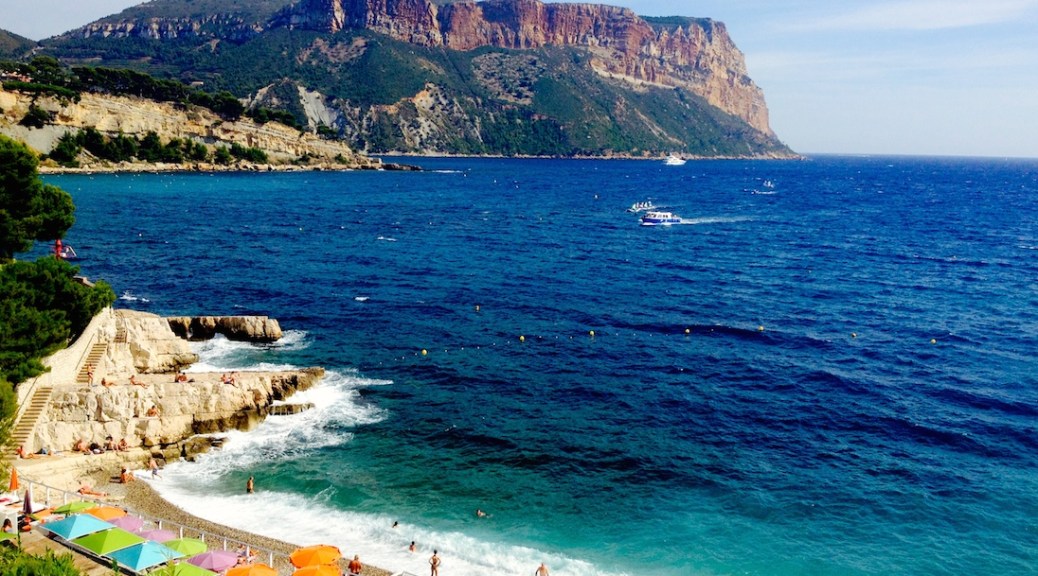
After a beautiful drive near the coast of the French Riviera we finally made it to our destination. The main town of Cassis is super cute, with a harbor full of boats and cafes full of people sipping rosé. We stayed at a hotel just a few minutes walk from this area, with a lovely view of a small beach just across the street. I’m embarrassed to say that I never even went in the ocean, but in my defense, we did not much luck out with the weather and it was exceptionally choppy. (Some on and off epic thunderstorms, which thankfully held off during the welcome party and the actual wedding, all outdoors! Though it did mean that the water was too rough for the boat cruise to go out, and I’m partially blaming that for the fact that we went to Cassis and never saw the Calanques! So embarrassing, but we place the rest of the blame on the rosé and champagne).

The wedding was held in a beautiful old chateau up the hill overlooking the town of Cassis. Not a bad view, eh? The bride was also stunning (shocker, I know), and it’s hard to say which was more beautiful. We had a great time dancing and clinking our champagne glasses and reuniting with friends and Kait’s family (since I practically lived at her house while I was in middle school!), and by 3:30 am I found myself in the pool (in my dress) alongside my newly married friend. Congratulations Mr. and Mrs. C!

Of the restaurants and attractions in Cassis, we can’t opine much since (as alluded to above) we spent much of our time at wedding related festivities or recovering from them. Most of our meals were taken at the panini shop next door to our hotel (and by our last day, the guy kind of knew us and maybe took a liking to us despite my very rusty French!?). The trois fromages panini was budget friendly and tasty with that Roquefort cheese! We had a few meals in the downtown area, but I would be hard pressed to remember the names. But do beware if you come to Cassis that many locals do not speak English and it is not always easy to communicate (even with my nearly ten years of studying the French language. Quel dommage)!

By the end of our visit to the French Riviera we were not operating at 100%, or as the groom would put it, we were paid a visit by the “bogeyman.” So it should not come as a surprise to Jaimie or Kait that we have now made a tradition of getting some post-wedding McNuggets, or, in this case, Le McNuggets. All your stories inspired us Matt & Jaim!

P.S. we’re not much good at photography when busy celebrating our friends’ weddings, so apologies for the few (and mostly low-quality iPhone) photos in this post!

Practical Info 

Cassis is a small town in the south of France, east of Marseilles in the Provence-Alpes-Côte d’Azur region. It is famous for the Calanques, which are steep-walled inlets on the Mediterranean. And also for rosé and white wine.

Transportation: We drove from Vernazza (Cinque Terre) and stopped in Monaco on the way. In Monaco, we parked at the public lot at the Casino de Monte-Carlo (first hour is free) and walked around a little. In Cassis, we parked at the hotel for €15/day. Right next door was a public lot offering hourly rates and charging more for 24 hour parking. It was a 5-10 minute walk from our hotel into town. Getting around on foot seemed pretty easy, especially if you take a boat tour (from the harbor) of the Calanques vs. walking to see them. Some friends either took a taxi or train to Cassis from Marseilles and did not have a car. We departed by car for Bellagio (Lake Como), opting for the inland route (through Briancon, Turin, Milan, etc.) since we had taken the coastal route from Cinque Terre. The inland route may be slightly longer (and more hilly and windy), but it was different and there is some great mountain scenery.

Accommodation: We stayed at Hotel de la Plage Mahogany, across the street from a small rocky beach and a 5-10 minute walk into the town/harbor. Our room was not that big but perfectly fine, and it had a balcony and gorgeous view of the ocean and cliffs across the way. Our friends stayed at Les Roches Blanches, which is a tad further from town but on the ocean with a cliffside infinity pool.

Food and Drinks: There are tons of restaurants lining the harbor. Seafood features prominently, and bouillabaisse is a specialty of the region. Closer to our hotel there was a panini stand we frequented, and the bacon cheeseburger with fries at Same Same Beach was hearty if quite pricy at €20. Local white wine and rosé are abundant.

Activities: We were in wedding mode, which combined with spotty weather meant minimal tourist activities. Aside from relaxing with walks around town or at the beach, I think the most popular activity must be visiting the Calanques. There are walking routes from the west side of town, or you can take a boat cruise departing from the town harbor. There are other scenic drives/walks in the area, and there are wineries that I assume one may visit.

We didn’t do much in Monaco as we had a long drive, but a few things that sounded interesting are visiting the Casino de Monte-Carlo (check dress code), Musée Océanographique, the Jardin Exotique district and the Palais Princier.

September 16-20, 2014 (Tuesday-Saturday)

Cinque Terre

Cinque Terre is a pretty snazzy handful of hamlets. These five towns are built (rather impressively) into the cliff sides of the Italian Riviera. Wine, beaches, ancient Italian villages, what’s not to love? It’s romantic (hence the visiting of Cinque Terre after Kenny’s departure), beautiful and relaxing.

We stayed in the town of Vernazza. This is touted as the poster child of Cinque Terre, and for good reason. It’s a tiny town with a main strip that’s barely more than one block. The main piazza is on the harbor and surrounded by restaurants with al fresco dining seats where you can watch the swimmers float about in the clear cerulean sea and the boats come in. The one downside to Vernazza: due to its tiny size, it cannot accommodate the number of tourists it receives during the day (at least during the peak month of September) and as such, it becomes overrun. Each time a train or a boat taxi arrives, there is a literal outpouring of people, and if you are trying to walk against the flow, it’s a mob scene. That said, I think it makes it an even better option for your home base while visiting Cinque Terre. That way you can escape the tourists (somewhat, there will still be loads everywhere) by visiting the other towns during the day, and returning to your more peaceful version of Vernazza for the mornings and evenings.

We spent our nights savoring some Italian food and wine, including a bottle of a beautiful Super Tuscan we’d bought in Tuscany, and even a bit of the Cinque Terre wines. Picnicking with some takeout pizza and pasta to enjoy with our wine was a fantastic way to watch the sunset. And we dined at a restaurant with an epic location up on the cliff one night. Had we had the place to ourselves, I might’ve thought I was on the Bachelorette.

I do have to state, however, that (quite disappointingly) the food is markedly less amazing here than in other parts of Italy we visited. With that said, we didn’t do tons of research or go to the most highly recommended restaurants. But on the other hand, you don’t really have to do that elsewhere in Italy to get amazing eats. It wasn’t bad, but don’t expect homemade fresh pasta to be de rigeur.

Perhaps one of the coolest things about Cinque Terre is the fact that the towns are all connected via hiking trails. Often visitors walk from one end to the other, opting to take a boat taxi or train at the end to cut some of the walk off. We were staying at the second or fourth town, depending on which direction you’re starting from. Since we’d heard lovely things about the two towns on either side of us (which are also the two longest distances between towns), we walked back and forth to each on either of our days in town.

Our first day we walked to Monterosso. We started a bit early to avoid the worst of the heat and crowds. It was pretty cool that the trail was literally outside the door of our hotel (they run through alleyways in the town and then become more rugged as you walk through undeveloped land). The views were spectacular, and it’s pretty incredible to be walking through vines of grapes and looking out at the vast ocean and steep landscape dotted with these colorful towns. Plus, it was really good to get some exercise in after all the consumption.

On arrival, we sucked it up and paid the exorbitant price for a pair of loungers and an umbrella, because this was our first time soaking up the sun in one of those picturesque umbrella-dotted Italian oases.

I was also kind of digging these pedal boats with water slides! Must try these somewhere. Monterosso itself was a bit bigger town, though it seemed to absorb the crowds a little better because of this. The beach is larger here, and you can rent the loungers, which isn’t an option over in Vernazza.

On the walk back we happened to arrive during what appeared to be an in-water concert. As in, the band was standing knee-deep in the water, and several tipsy beach goers were dancing alongside them. We watched from above and then hurried down to enjoy the last of the entertainment seaside.

Here’s a quick video, too:

On our last day we walked the opposite direction, to the town of Corniglia, which is set up on the hill and thus doesn’t offer direct beach access. It’s definitely less crowded than Vernazza and Monterosso, but I would probably not recommend this as a place for visitors to stay unless you really want to escape the tourists (at the expense of having direct water access).

Practical Info

Cinque Terre is a gorgeous section of the Italian Riviera, with five towns built on or into the mountains meeting the Ligurian Sea. The water is beautiful and clear, and the cliffs are steeply terraced. From south to north, the five towns are Riomaggiore, Manarola, Corniglia, Vernazza, and Monterosso. I think the two on the end are the largest, Corniglia may be the least visited, and Vernazza is the cover girl. Corniglia sits atop a cliff with no direct access to the sea. Vernazza has a natural harbor and tiny town beach.

We stayed in Vernazza and one day hiked to Monterosso and another day hiked to Corniglia. The whole area seems at once authentic and overrun with tourists. Folks have inhabited some of these towns since medieval times, and you will see no chain hotels and hardly a hotel or corporate sign anywhere. But it is firmly on travelers’ radar (especially Americans), and at its worst (like a Saturday afternoon in September) can feel uncomfortably crowded.

Transportation: We arrived by rental car from Bologna. Most of the drive was on highways, with the last several miles past La Spezia on extremely hilly, narrow and windy roads. There is official parking about 1km above town for €12/day, so I dropped off Jenni and the bags at the post office/Il Pirata restaurant, drove back up and then walked about 10 minutes down. There is a shuttle bus that I think costs €2. I’m not sure about the other towns, but in general the main town areas have no cars or only locals’ cars.

I believe most visitors arrive by train. Each of the five towns has its own station, and some trains stop only in certain towns. To get here, you would probably have to connect via Genoa/Sestri Levante (from the north/west) or La Spezia (from the south/east). The towns themselves are very small and walking is your only option, though some are quite vertical.

You have three main options for getting between the towns. Trains, boats and hiking. Many opt to hike one way and take a train or boat back. We did return hikes both times.

We departed by rental car for Cassis (via Monaco). One of the small roads was still closed from the 2011 flood, but the scenery made the detour more pleasant. Man, are tolls expensive in these parts. The highway from near Levanto to the French border cost >€26!

Accommodation: We stayed at Vernazza Rooms, right in the middle of town. The first two nights we had Roma 4, then we moved to Roma 1 (higher floor, has a terrace, WiFi doesn’t work as well up there). It is fairly basic, but the staff is helpful and it is convenient. You can hear the train often, but it’s not too bad with the windows closed.

There are not that many hotels in Cinque Terre, so a lot of the inventory is more like rooms in a house or quasi-B&B. Overall, we were surprised by how poor the options seemed. We considered staying at La Torretta in Manarola but didn’t want to spend the money. We walked past Hotel Porto Roca, which is on a cliff overlooking Monterosso and has a pool.

Food and Drinks: The specialties of the area are seafood (including anchovies), pesto and white wine. In general, we found the food here to be less good and more expensive than Rome, Tuscany or Bologna. There are several proper restaurants plus pizzerias/focaccerias, etc. Twice we got take out from Pizzeria Baia Saracena. The pasta was so-so but the pizza was good. Our one proper meal was dinner at Ristorante Belforte, which has a terrific setting perched above Vernazza’s square and harbor. The squid ink tagliolini was great, the rest of it was good. Portions are ample and the service was better than average. Gambero Rosso is well-reviewed.

Activities: There are very few sights here like museums or fountains. The main activities are relaxing, town-hopping, hiking and some water-based options. There are trails going higher up the mountains, but most tourists stick to the red and white marked trail that hugs the cliffside and connects all the five towns. We did the section from Vernazza to Monterosso one day and from Vernazza to Corniglia the next. I think these are the two longest stretches, and each took 60-90 minutes (one-way) and induced substantial sweating. One downer is that you have to pay to use the trails. It costs €7.50/person/day. There are options that encompass train and/or boat passes, too. I was a little put off by having to spend €30 to hike a few hours on two days.

We did not do much else except some swimming. The water is cool but comfortable and refreshing. Monterosso has the biggest beach, including a pay section where it costs €25/day for side-by-side loungers with an umbrella plus access to changing rooms and toilets.

September 13-16, 2014 (Saturday-Tuesday)

Good Eating in the E-R

One of the aspects of Italian food that I hadn’t really appreciated before coming to Italy is that the cuisine is very local. Such that the restaurants in each city have super similar menus, which vary slightly from the menus in the next area (which are also super similar to each other). For example, everywhere in Montepulciano there were truffles, bistecca fiorentina and pici (the local pasta shape). Everywhere in Rome there was pasta carbonara and cacio e pepe. And everywhere in Bologna there is tortellini and Bolognese (ragu).

We came to Bologna largely for the food. Emilia-Romagna, Bologna’s home region, is widely respected for its cuisine. A number of quintessential Italian staples hail from this region, and we took a wonderful tour to learn more about how they are made (and of course to taste them!).

Our tour took us first to Modena, where we visited a family of Parmigiano-Reggiano cheese makers (Nuova Martignana). The process is remarkably more involved than I’d realized. I also didn’t appreciate that Parmigiano-Reggiano is a controlled name, much in the way Champagne is a regulated term. So that “parmesan” cheese you’re used to eating, likely ain’t no Parmigiano-Reggiano, folks.

This cheese making process has been refined for 800 years, when it was first invented by Benedictine monks. It takes a whopping 1200 liters of milk to produce two wheels. Granted, these are some big cheese wheels, but that’s a lot of dairy. We got to see a lot of the steps in action. Most impressive, we watched them lift a really heavy (100kg!) hunk of cheese curd out of a giant copper vat of whey. We also marveled the “Hollywood movie set” of beautiful cheese in their aging room. I doubt I will ever see this much Parmigiano-Reggiano in one place again. Not so long ago, all these cheese wheels had to be flipped by hand weekly. Now there is a machine for that. It was tempting to stock up because the 30 month old cheese costs only €15/kg onsite, but there are too many meat and cheese shops everywhere.

Next stop was a 4th generation family run maker of balsamico tradizionale (named Boni). All of their balsamic vinegar is aged a minimum of 12 years (they have a family cask that is 144 years old). The process was somewhat confusing, since they use a multiple barrel system that involves transferring some of the aged grape juice from the larger barrels into the smaller ones each year. I was pretty surprised to learn that they use a white grape to make the stuff, and the color comes solely from the wood barrels. The variety of woods used was also surprising, i.e. different barrels are made of cherry, oak, chestnut, apple, etc. I was more impressed that it tasted so good atop ricotta cheese, Parmigiano-Reggiano, and gelato (separately, but all together probably works too!). Apparently, whenever a child is born in this region, the family starts a balsamic barrel so it’s ready at his/her wedding. The balsamico tradizionale is very expensive and intensely flavored, so this is the kind of stuff where you use a few drops, and it is very different from the balsamic vinegar you typically find in the States.

In between the food stops, our guide surprised us with a quick photo op outside the Ferrari factory where all the men drooled over the Renzo Piano-designed wind tunnel and the dozens of roaring cars being test driven around us. From there we went on to more food, and ate a full multi course lunch at La Ca Bianca. I kind of lost count, but I think we tried four different pastas. And then they came out with Acqua di Cedro (like limoncello) and a mascarpone and “chocolate sausage” for dessert. (Anyone who has been doubting how much we ate in Italy, take note.)

Our last stop had us landing at what appeared on the outside to be an apartment building. Upon entering, however, we discovered that it’s much more of a serial killer’s fantasy, which in a way, is what it is. A serial killer of pigs, who uses only the rear legs. Row after row after row of metal shelves held leg after leg after leg of prosciutto in various stages of the aging process. We had our final tasting of the day (with more Lambrusco…I neglected to mention above that Lambrusco, another Emilia-Romagna staple, accompanied each and every eating stop on this tour!) and promptly fell into a food coma/Lambrusco induced sleep on the drive home.

I was so disgusted with myself by the end of this day that I skipped dinner at the nice restaurant we had made a reservation for, because I knew that if I didn’t there was a serious chance I could eat enough to require medical attention. Alan and Kenny, however, ventured out. They passed through Piazza Verdi, which is filled with local university students drinking and mingling. In general, it was impressive how many people were hanging out and partying the whole walk to Piazza Maggiore. A never-ending stream of porticoed, cobblestone streets with abundant cafes and bars.

Our one free day in town we set off on foot to explore the city. Our neighborhood was a cool one, just a block away from Via dei Falegnami, where there were lots of lovely restaurants with outdoor seating and Bolognese dishes. We tried the Bolognese sauce at two, and they were not disappointing in the slightest. Though I should note there is much less tomato in the sauce than most of the Bolognese you are served in the States; here it’s almost pure meat. And it’s often served over a meat stuffed tortellini. I have to note that here (as well as in Rome, and I would presume Florence) there are often men walking around to al fresco diners trying to sell their wares by flashing green lasers on your table and showing you kitschy items like toilet shaped lighters. It was such a peculiar sight to us since the wares they peddled and the potential customers they targeted seemed so incongruous. Case in point: the guy that came by multiple times trying to sell a singing, dancing stuffed animal to a group of six women aged 50+. I have to wonder how many sales they successfully make.

Right by Trattoria dal Biassanot there is a very random and very cool “peep hole” with views to a hidden canal. Neato.

Just across the street from all this wonderful pasta is the Piazza VIII Agosto, which turned into a market for the days we were there. We did a little shopping and I caved and bought a pair of Italian shoes. Oh, and after a wine-y lunch the three of us bought matching sunnies from a street vendor. Tripletsies!

The main square, Piazza Maggiore, and the surrounding area was also lots of fun to walk around.

This city has a very young, liberal and “Occupy” vibe. There is a ton of graffiti, and even more college-aged people.

Though for some reason, all of the younger boys here look like Justin Bieber.

The boys climbed up the taller and straighter standing of the Two Towers of Bologna for some sweet views of the red rooftops, and we all shared a ridiculously good slice of pizza just outside.

I tried, I really tried to do my body some good and eat a salad one night, but you guys, this was what I got when I ordered the insalate:

To be fair, there was a sprig of parsley, so I did eat some greens while in Italy.

Practical Info

Bologna is the capital of Emilia-Romagna, a region many assert has Italy’s best cuisine. And certainly its finest motor-works. Among other things, this area is home to Parmigiano-Reggiano, Prosciutto di Parma, Balsamic Vinegar Tradizionale di Modena, Bolognese sauce (ragu), Lambrusco, Ducati, Maserati, Lamborghini, Pagani (maker of the $1.3MM Huayra) and Ferrari.

The city also holds Europe’s oldest university and is famous for its extensive porticoes. While Bologna can’t match Rome, Florence or Venice for big-name attractions, this also means that it’s far less touristy. The vibe is part professorial, part art student, part Occupy Wall Street and all epicurean delight. I have never seen more cured meat and cheese shops.

Transportation: We arrived by rental car from Florence, and getting out of there was a nightmare. Once here, we parked in the underground lot at Piazza VIII Agosto (€20/day) and didn’t touch our car until we departed for Cinque Terre. We walked around the city, and our day tour included transportation.

Accommodation: We stayed at an Airbnb apartment on Via Galliera near Piazza VIII Agosto. You might want to be closer to Piazza Maggiore, but if you don’t mind walking then our area is more than sufficient. There are more than enough bars and restaurants nearby, and every Friday and Saturday Piazza VIII Agosto is filled with a market.

Food and Drinks: The main reason we came to Bologna, and we were not disappointed. In addition to items mentioned above, Bologna is known for its stuffed pasta (mainly tortellini or tortelloni, sometimes in broth). Via Pescherie Vecchie and surrounding streets have a particularly high concentration of meat, cheese and wine shops.

We liked Trattoria dal Biassanot a lot, especially since it has an option to create your own plate with three different types of pasta. Lunch at Caffe/Trattoria del Rosso was very good. Pizzeria Due Torri has excellent slices. Dinner at Twinside was good though the pasta was maybe not as good as others. Its burger was delicious.

Kenny and I had a more high-end meal at Trattoria Battibecco, which was excellent. I had never heard of canocchie (the same as mantis shrimp?), but they sure imparted a rich shellfish flavor to the broth coating our rigatoni. It was nice to take a break from wine and enjoy a Laphroaig 15 year and Mortlach 10 year, both cask strength and from Wilson & Morgan (independent bottlers based in Italy). The meal was quite reasonable at €102, including fancy whisky, a foie gras starter, that canocchie pasta and some monkfish in bread crumbs with bacon.

Afterwards we bought a bottle of wine (only €12) at some bar on Vicolo Ranocchi and enjoyed it at a table outside. This little alley and many others hold plenty of revelers. There were also some places with outdoor live music in this central area.

A crepe filled with mascarpone, nutella and strawberries was about as good as street sweets get. Find it at Bombocrep. We tried to go to Ristorante Donatello for dinner but it was full; it looked like the place to be.

Activities: The highlight was definitely our all day Amazing Italy food tour (€120 each, covered above). In the city, we walked around and enjoyed the architecture, never-ending food shops, Via Zamboni (where the college kids hang), Piazza Maggiore, etc. Kenny and I climbed the 498 steps of the Tower of Asinelli (€3 each) for great views. The Portico of San Luca, leading up to the Madonna of San Luca Sanctuary, is reportedly one of the longest arcades in the world.

September 10-13, 2014 (Wednesday-Saturday)

Toscana

Ah, Tuscany. The place romantic dreams are made of. Sweet visions of holding hands and sipping Sangiovese. Or, more accurately for us, devouring pasta and gnawing on bistecca fiorentina bones.

Tuscany is full of picturesque hill towns to savor. On our drive from Rome we stopped in Orvieto (which is actually in Umbria), a quaint one for sure. Meandering around these quiet streets you would never expect to turn the corner and discover the incredibly intricate and beautiful Duomo that’s tucked into the town’s piazza. The colors on this façade are just stunning. Not to mention the optical illusion created by its construction, making it appear even larger than it is. I was very impressed with this church, more so even than St. Peter’s Basilica at the Vatican. To be fair, it’s much less crowded (practically empty even), and they were playing the most beautiful music while we were inside, which made it easier for me to experience the grandiose feelings that such buildings can elicit.

On the way out of Tuscany headed for Bologna, we took the scenic route, which allowed us to see a few more of these adorable old towns. We poked around Castellina and Greve, where we were able to sample lots of Chiantis. Not bad, but our verdict is that the Montepulciano terroir wins.

And we feel we can opine sufficiently on the quality of Montepulciano wines because the idyllic town we decided to settle down in for our five nights of Tuscan relaxation was none other than Montepulciano. It’s a looker, this one, sitting up atop a big ole’ hill. And it sure tastes good. We had many lovely meals here, tons of impressive house Montepulciano Rossos and Vino Nobiles, and loads of those (cheap!) Tuscan truffles. Our villa was situated on its own separate, smaller hill, just at the base of the town hill. This afforded us some pretty nice views of the San Biagio church and that beautiful Tuscan landscape.

We celebrated Alan’s birthday while in Montepulciano, and we spoiled him a bit. Kenny and I walked down to the local supermarket in the morning to pick up preparations for a special breakfast. The birthday boy was craving an American style brunch, so Kenny cooked him up a good ole’ egg, bacon and potato special, with a bit of an Italian twist. We used fresh buffalo mozzarella and some crazy pancetta. And we whipped up our take on a Tuscan mimosa: blood orange and prosecco, with a little umbrella on the side. Because nothing makes a party like drink umbrellas. We feasted on the spread outside, under the Tuscan sun. A great start to the day.

We explored the town more fully all afternoon. It’s situated atop a rather steep hill, and full of the classic Italian narrow roads and alleyways. We perused the tempting selections of Italian leather shoes and handbags, snacked on some café and dolcetti on Caffé Poliziano’s terrace (phenomenal views), and stopped in a few wine shops and cellars for some tastings of Montepulciano’s legendary Sangiovese wines.

In the evening of A’s day, we celebrated with some of the Lagavulin Distiller’s Edition Scotch whisky we’d bought him as an early birthday gift in Scotland, and I surprised him with a water dropper so he can appropriately open up the aromas and flavors. (It sounds like a weird and lame gift, but trust me, this made him very happy. If only you could see how excited he’s gotten about Scotch since our visit to Scotland!) We also surprised him with a smoky whisky cake I purchased on the sly in Scotland, which we filled with candles to serenade him with the birthday song.

Then we went up to dinner for the grand finale: bistecca fiorentina at Montepulciano’s most famous restaurant, Osteria Acquacheta. What an experience. It’s certainly not white tablecloths and snooty waiters. It’s family style seating, where Giulio, the chef and head of the house chops the steaks within view, comes over to show it to you before cooking, and then brings it back in all its sizzling beauty. (Bonus, they put it back on the grill for a few minutes mid-meal as it was starting to turn cold!) In true Italian family style, you are given only one glass, which you use for both water and wine. And our steak, oh, our steak. We were given a hunk of meat that weighed in at just under 2kg. For those of you not familiar with the metric system, that’s about 4.25 POUNDS of beef! Most impressive, though, is that I only ate one bite (was much too rare for me, plus I was all about the pasta we ordered on the “side”) and the two boys devoured all. of. it. Along with the meat, we had pici (a local pasta) al ragu, divine. So good I ordered my own serving after eating half of the first one. Perhaps the most shocking part of this meal, the whole thing cost €109 (for that hunka hunka steak, 2 pastas, liver pate, a truffle covered melty cheese, salad, 2 desserts, 1.5 liters of wine, 2 grappas (and when Alan spilled his, Giulio poured another gratis for Alan, Kenny and the guy sitting next to us). A steal for sure. And you can’t buy the good company. Check out this awesome Italian woman sitting next to Kenny who really enjoyed gnawing her bones as well. Awesome way to celebrate my husband and travel buddy extraordinaire.

While I savored some alone time at the villa the next day, Alan and Kenny paid a visit to the nearby town of Pienza. It happened to be the Fiera del Cacio, a celebration largely centered around pecorino cheese. There were award ceremonies and flag waiving parades, but naturally their focus was eye-boning the meats and cheeses and sampling a large selection. Lucky for me, they came home with a fantastic assortment (sopressata, lonza and coppa, and pecorino con tartufo, sheep’s milk blue, and two other award winning pecorinos) for our lunch the next day.

These fantastic meats and cheeses were thoroughly enjoyed, over many occasions. I also have to mention that the tomatoes here are positively delectable!

We didn’t just enjoy the fruits of everyone else’s labor, however. We tried our own hand at making some of this fine food. Our cooking class was a smashing success, if I do say so myself. We made a pecorino soufflé, followed by hand-rolled pici pasta with a pomodoro sauce for primi piatti, a pancetta wrapped herbed pork tenderloin for secondi piatti, and a pear and apricot tart for dessert. We’re still talking about how good our pici was!

Montepulciano had a couple cute animals, too. One night when we were up in town, we checked out the little church on the main piazza. I’m thinking I acquired some good karma, because I helped the church keeper lead a cat out of the church once he saw me sitting on the floor and petting it. Then I sat outside of the church with my cat.

Also, we stumbled upon these adorable little puppies in the park on the way up! OK, sorry I’ll stop talking about the animals and get back to the food and wine.

This being Tuscany, we of course did some proper wine tasting. We tasted at a few rooms in the town of Montepulciano and we also went out to two vineyards for wine tours and tasting. Dei was probably the fanciest wine cellar I’ve ever seen. The entire place is made of travertine marble. So all the aging casks are lined up in a beautifully done room of marble, the hallways are made of marble, the rooms housing the big vats and the bottling and labeling machine, all marble. I can’t help but wonder if the cost of all that marble is factored into the price you pay for the wines, but they do make a few nice ones. We really enjoyed the ‘08 Bossona Nobile Riserva and the Sancta Catharina ’09 Super Tuscan, and decided to buy a bottle of the latter. I’m maybe a broken recording of my dad, but really feeling the blends lately. Later in the day we checked out Avignonesi. While their more traditional Montepulcianos and Super Tuscan were lovely (and we got to sample a freshly fallen from the vine Sangiovese grape that was quite tasty), we were really wowed by their Vin Santo. This sweeter dessert wine made from dried grapes is done in a super special way here at Avignonesi. I won’t get into the details, but it’s aged extra long, and they call it liquid gold for good reason. We ponied up extra to taste the vin santo, and it was (per my tasting notes) “AMAZE BALLS.” Tastes kind of like maple syrup and burnt caramel, and it is so thick! We were given permission to stick our fingers in the glass and lick them to get the rest of that amazing pseudo-liquid. And so we did.

On the drive from Tuscany to Bologna we stopped in Florence. While most people would stay at least a few days, we had only a couple of hours in the city of Firenze. For this reason, we really only saw the tiniest bit of it, and what we did see was perhaps the most touristy bits. I’m generally not a fan of the most touristy bits of cities, and so it would be unfair for me to really pass judgment. With that said, we weren’t wowed with what we saw. It felt much more overridden with tourists than Rome did, but again, we also saw some much less touristy parts of Rome.

Anyhow, the Duomo is really pretty. I couldn’t go inside because my shorts were too skanky and my attempts to fashion a raincoat around my knees were futile, but from the pictures the boys took, I’m maintaining that it’s most impressive on the outside.

Mercato Centrale was a fun place to walk around. They have tons of vendors selling meat, cheeses, pasta, pizza, beer and wine, etc. Even an entire mozzarella section. The Italiano usual. Though it had a strong hipster vibe, oddly. I started thinking that it felt very Eataly-esque just as I noticed there actually is an Eataly inside.

We walked the main pedestrian way down through Piazza della Signoria (nice statues, fountains, souvenirs, tourists, yada yada yada) and onto Ponte Vecchio. This is basically a partly covered bridge lined with jewelry stores and absolutely laden with tourists trying to get their photographs. I had to make Alan and Kenny bend over the bridge to get a shot without any other people in it.

Also, driving in Firenze is heinous. I highly recommend not doing that. There is loads of traffic, the signs are weirdly confusing, and there are lots of restricted zones where you aren’t meant to drive unless you are a resident or something. I’m pretty sure they are monitored by camera and also that we will be seeing lots of unexpected charges when the rental car company catches wind of our transgressions. Whoopsie.

Practical Info

Tuscany is perhaps Italy’s most iconic region, with Florence the heavy-hitting Renaissance city and countless smaller cities and hill towns. It was difficult picking just one place to stay. We settled on Montepulciano based on some personal recs, ample wine and relative convenience to some other hill towns. We also considered places like Lucca, Siena, San Gimignano, Montalcino, etc. Not to mention various towns in Umbria.

In addition to picking a town/area, we struggled with whether we should stay at an agriturismo and, if not, should we stay in an old town area or just outside where we’d get more space and perhaps better views but sacrifice some walkability.

Transportation: We drove from Rome to Montepulciano, stopping in Orvieto for a few hours (where we drove up to the old town and parked right across from the funicular for a few Euros). It was easy getting out of Rome after picking up our rental car from Hertz on Via Sardegna. The A1 highway is fast, though tolls are pretty steep. I think we paid >€10 (which we later learned is small change for Italian tolls).

Our accommodation in Montepulciano was walking distance to the old town (see below), and it is easy to walk around the town if you don’t mind steep hills. There are probably some buses/shuttles between various hill towns in Tuscany, but having a car makes it much easier. It seems you can usually find a parking lot for ~€1.50/hr. Note that many towns do not allow cars within the historic center, so pay attention to signs.

We departed in our rental car headed for Bologna. We drove the scenic SR222 between Siena and Florence, taking in some of the classic Chianti views. In Florence, we parked underground at the main station. This is nice in the sense that you can walk from here to the major sights. The negative is that traffic was awful, and driving around here is confusing because there are lots of restricted roads. For this reason, most would suggest parking outside the city and taking public transport into the center. The drive from Florence to Bologna on the highway was quite scenic, if not the easiest driving. There are tons of large trucks, the road is pretty windy and hilly, and there are endless tunnels with fairly narrow lanes.

Accommodation: We stayed in the Sangallo 2BR apartment at Montorio, at the bottom of the hill on the western side of Montepulciano and very near the Madonna di San Biagio. Montorio represented a compromise in that we had a spacious apartment, some views, free parking, etc. but we could still walk to town. The catch being that the walk is 15 minutes up a steep hill. The WiFi was poor and the mosquitoes were a hindrance, but otherwise I’m a fan. Stefania is friendly and helpful, there is a free washing machine (and a dryer, which is a rarity, though it costs €2), the apartment is spacious and nicely decorated, and the location is convenient to many things.

Food and Drinks: Abundant consumption continued, as expected. My birthday dinner at Osteria dell’Acquacheta was quite an experience. This legendary steak spot does two family style seatings nightly, at 7:15 and then 9:15. We waited nearly an hour since we arrived early and were seated around 9:45, but I had the best seat in the house at the head of a table with a dead-on view of Giulio hacking away at the T-bone with his cleaver. He cut us a piece just under 2kg (it was 68 oz.!), brought it over raw for our approval, and our beef came back soon seared and rare. The steak was very good, perhaps great considering it was not drenched in butter and probably is grass-fed beef. We ate so much more than just steak, and the meal overall was extraordinarily good value. We had nearly 2kg of steak; a melted pecorino covered in shaved truffles; salad; liver pate; two pici with meat ragu; two desserts; water; two grappas; and 1.5 liters of red wine…for €109, all in. The steak alone, certainly with tax and tip, would have cost more in your typical nice US steakhouse. The pasta was amazing, they reheated the pieces of steak we hadn’t eaten late in the meal, and when I accidentally spilled my grappa Giulio poured another gratis for me, Kenny and our table-mate. At one point, Jenni told the girl across from her that she was so full she wanted to take her (own) pants off. Everyone leaves Acquacheta smiling.

Less of an event but other meals we enjoyed include Osteria del Conte, Osteria del Borgo and Pizzeria Linda. Many recommended La Grotta (by San Biagio church) for a nice meal.

Kenny and I spent an afternoon in Pienza that coincided with the annual Fiera del Cacio (cheese festival). I’m not sure if this is always the case (Pienza is famous for pecorino), but the tiny old town was loaded with stands selling and offering free tastes of cheeses and cured meats, plus porchetta everywhere. The soppressata here is loosely combined and so much better than at home. Coppa, lonza, truffle cheese…mmm.

Lunch in Orvieto at Trattoria La Grotta was quite good. Antica Macelleria Falorni is an impressive butcher/cured meat shop in Greve.

Activities: One day we hit a couple wineries. We visited Dei (~3km from Montepulciano, €10 tour and tasting), stopped for a quick look at Cortona (which seemed like quite a thriving hill town) and then visited Avignonesi (€15 tour and tasting, which included some pricy bottles, plus €10 extra to taste both Vin Santo varieties).

Our cooking class at Villa Poggiano (owned by the same family that owns Montorio and ~2km away) was a feast that included two bottles of wine, it was only the three of us, and it cost €90 each.

I won’t attempt to cover Florence in any detail here, except to mention that you can enter the Duomo for free but it costs to climb the dome itself, and you cannot enter if wearing short shorts or I think a tank-top. I believe you can reserve in advance to visit the Uffizi Gallery and avoid some of the wait.

September 5-10, 2014 (Friday-Wednesday)