Borneo’s Hairy Gymnasts

On our way out to the Iban longhouse we stopped at the Semenggoh (aka Semenggok) Orangutan Rehabilitation Center to try our luck at seeing some of these awesome creatures in the (semi) wild. Orangutans are another rare primate found in Borneo. You’ll recall from our Bako post that proboscis monkeys are endemic to this island, and orangutans are nearly so.  The only other place they may be found in the wild is the Indonesian island of Sumatra.  They are the largest tree living mammals in the world, and the alpha males have super wide cheeks with concave faces. Apparently these grow larger when they become the dominant male, crazy!

Semenggoh is Sarawak’s main orangutan rehabilitation center for those people of the forest (literal translation of organgutan) that have been injured, orphaned or previously kept as illegal pets. After initial rehabilitation in smaller centers they are brought here for re-introduction to the wild, while they are still monitored. Thus they are semi-wild, and since there is nothing like a cage or enclosure separating us from them, our introduction came complete with a number of warnings that incited just a touch of fear in addition to the suspense and excitement.

We were told not to carry food or even water bottles with us, and after hearing the stories about some of the bouts of violence from these mean lean hairy machines, I’m very glad we listened. Luckily for us, but sadly still, the most violent orangutan died recently. Hot Mama, as she was called, liked to start ish. But apparently she tried to start something with Ritchie, the alpha male weighing in at around 250 pounds, who took matters into his own hands and left Hot Mama for dead, dismembering three of her limbs in the process.

We lucked out and got to see three orangutans right away. A mama and baby plus another that was either a female or young male. This was a fantastic experience. These are such incredible and acrobatic creatures, swinging around on the ropes and trees. They jump around, do cartwheels upside down on the ropes, and hang from various limbs while they eat.  Their flexibility is extraordinary.  It’s like watching really hairy muscular people doing the parallel bars at the Olympics.

One of the rangers fed them from a platform, handing them bananas and coconuts. It was crazy to see an orangutan carry a coconut away in its foot while it scurried up a tree. I hadn’t realized their feet are basically like additional hands, shaped almost identically and with opposable thumbs/big toes. They’re smart, too, banging the coconuts against the tree to get the juice out.

Orangutans live quite long, up to about 40 years in the wild or into their 50s if in captivity, and we got to see Semenggoh’s first and only grandmother. She and her son were just hanging out in a tree above the parking area. Grandma was so mellow, and she blinked her eyes real slowly like a wise old grandma, not worried about missing anything. After ogling at her for a while, a ranger came by and gave her a turnip, which she shared with her boy orangutan, while everyone oohed and aahed.

As we were hustling to get back towards the parking lot when we heard Grandma was out, Alan had a near-miss with a Wagler’s pit viper that decided to chill out in the middle of the trail!!  Foot mid-way in the air he fortunately spotted it in time and so (thank our lucky stars) there was no trip to the hospital (if only we were so fortunate the rest of our trip!) and our guide Eric was able to stop and warn all the other tourists approaching from both sides.

We also saw some crocodiles in little cages. Aren’t they scary looking?! Those eyes… And we got our first peek at Borneo’s neat carnivorous pitcher plants.

Practical Info

Semenggoh is only about a half hour drive from Kuching.  We arrived for the 9 am feeding.  I think there are at least two feeding times most days and your chances of seeing an orangutan are much higher at these times.  Because all our Borneo activities were handled by a tour agent, we do not have many details on how to visit.  But this information should be widely available online and your hotel in Kuching can probably arrange a visit…or see e.g.: http://borneoadventure.com/tours/semenggoh-orangutans/.

February 21, 2014 (Friday)

Proboscises, Vipers and Muffin Eating Macaques, Oh My!

Our day trip to Borneo’s Bako National Park (also known as the day a macaque ate my muffin) was our first introduction to the spectacular wildlife Borneo has on offer. Our hilarious guide, Eric, informed us in advance that there are six animals we would search for and with a little bit of luck and a lot of Eric’s great wildlife spotting skills we got to see all six! (They are hard to spot on your own, so while it’s possible to visit the park without a guide, we would highly recommend you hire one! Plus they are great resources for information about the flora and fauna.)

The “big six” were pretty spectacular. First, the monkeys! There are three types of monkeys in the park, in ascending order of coolness: macaques (most common, you see these guys all around Asia), silver leaf langurs, and the jackpot: proboscis monkeys.

Proboscis monkeys are peculiar looking animals, readily identifiable by their epic schnozes. They also have long, thin, whitish tails and the alpha males especially have gigantic pot bellies. These facially phallic monkeys are some of the strangest looking creatures we have ever encountered. They are endemic to Borneo and you can bet we were thrilled and in awe to have the chance to observe these guys in the wild for a while. Apologies in advance to the Dutch, but these fellas are also called Dutchmen. Wikipedia says this is because “Indonesians remarked that the Dutch colonizers often had similarly large bellies and noses.”  I did not realize that the Dutch were known as such, but you learn something new every day.

They are weirdly human despite their bizarre sniffers. Is it the hands? The eyes? The way they sit when they’re just hanging out?

Ok, and yes, this is a very graphic photo of a proboscis penis, but even though it’s essentially proboscis porn, it was just too funny not to share. We literally have dozens of photos of this guy’s frank and beans. In our defense, it was the first proboscis we saw, and we had no way of knowing whether it would be our last, and photographing from below makes proboscis penis appearances inevitable.

The silver leaf langurs are beautiful, and Eric joked that they are also known as David Beckham monkeys because of their spiky hairdos. They are pretty handsome, so…I don’t think it will ever get old watching monkeys clean each other, too cute.

The coolest thing about these primates is that they are a bright orange color when they are babies. We had the pleasure of seeing one youngin who had just a bit of orange coloring left, but unfortunately he moved around too fast for us to capture a photo. It’s pretty unbelievable though to see photos of the fiery newborns.

The macaques are known around here as pirates. And we can see why. Not five minutes into starting our lunch a macaque appeared out of nowhere, jumped on the table and stole Jenni’s muffin, running up a tree to relish his booty. We realized at this point that Eric wasn’t kidding about carrying a slingshot to protect us from these brazen monkeys. Don’t worry, you don’t actually shoot at them, but just holding up the slingshot is enough to make them run. And when the macaque came back for seconds Jenni held up the slingshot, and he ran cowardly away.

These bearded pigs were pretty cool, too. I wouldn’t want to piss off one of them.

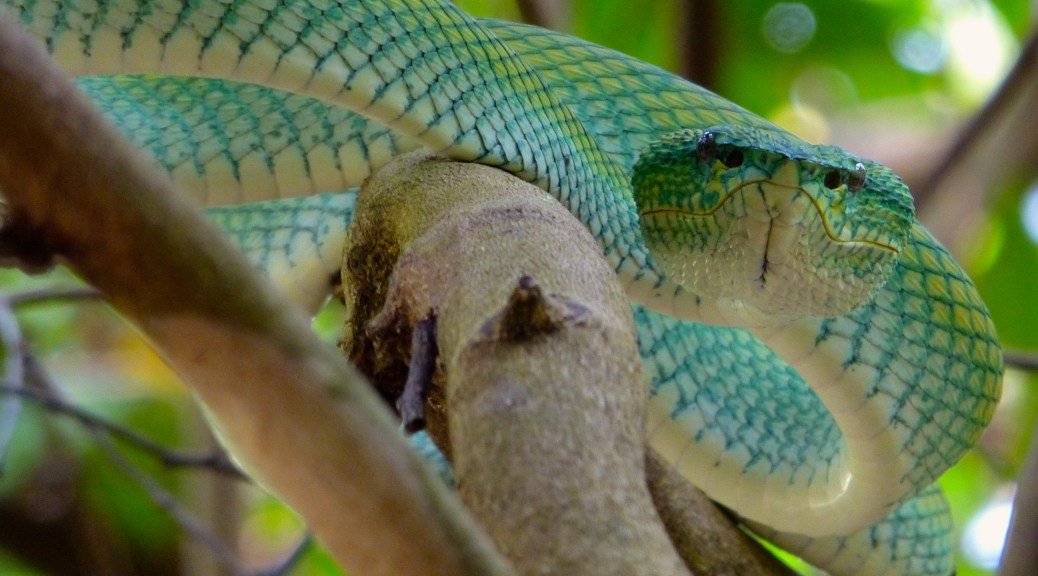
The most surprising of the big six was the Wagler’s pit viper. I never thought I’d describe a snake as beautiful, but these snakes are absolutely exquisite. They can stay still for days, unless provoked by another animal, the rain, or the need to eat. It makes sense then that the locals joke that if you pick them up and turn them over their stomachs will read “Made in China.” Don’t try it though, these statuesque creatures are venomous and will bite.

The last of the six we found just in the nick of time, as we were getting ready to board the boat and return to town. The flying lemurs are the most difficult to spot. These nocturnal creatures sleep all day so you’ll never see them moving, and to top it off they are masters of camouflage against the trees to which they cling while snoozing. We had to take pictures and zoom in before we even realized this was a mama lemur with a baby in tow!

The rest of the animal sightings were just icing on the cake. We saw tons of fiddler crabs with their lop-sided Popeye-sized claw, and some lovely cerulean colored crabs. We also saw small mudskippers (baby dragon type animals we saw earlier in Penang), and these snake-like sun lizards.

We saw very few birds in the park itself, which was somewhat surprising to us, though we did see some blue kingfishers on the drive in that were quite beautiful.

While the wildlife was clearly the highlight, it’s worth noting that the surrounding environs are quite impressive. The park is accessible only via boat, which picks you up by the Bako fishing village, takes you down the Bako River, and out into the South China Sea before arriving on a wide beach backed by lush rainforest. Don’t expect to swim here though, as the water is brown and muddy, not to mention there are crocodiles and jellyfish.

It is incredibly humid inside the forest. We did a bit of nature walking where we saw lots of jungly plant life. We were surprised how many plants here are spiked. There are more pointed plants here than in the desert! There is also a rare tree called the Bintangor, which is being studied currently as it may be able to cure HIV. Fascinating.

Mangrove trees are sprinkled around the coastline, and we discovered that what appear to be young plants growing around these trees are actually roots of the big mangrove trees that pop up out of the earth so the tree can breathe. Amazing.

Practical Info

Bako National Park is just 37 km from Kuching and occupies a mere 27 square km.  But it feels worlds apart and packs a lot into a small space.  Many of the animals congregate around the headquarters.  There are a handful of relatively short hiking trails and some longer ones.  Most trails are out and back with I think one loop trail.  We took the Telok Paku trail to a more secluded bay, which is where we saw the viper.  We also took the Ulu Assam trail, which ascends to a platform overlooking the main bay.  This latter trail is very steep near the top.

Transportation: We booked everything through our tour company, but you need to get to Kampung (village) Bako, which is about a 30-minute drive from Kuching.  I believe you register there and hire a motorboat for the 20-minute ride to the park.  Depending on the tide, you may have to disembark in shallow water.  If you have one, a small towel is handy.  As is insect repellant.  And your required departure time may be determined somewhat by the tides, as well.

The park is on the mainland but accessible only by boat.  On arrival, you check in at the park headquarters.

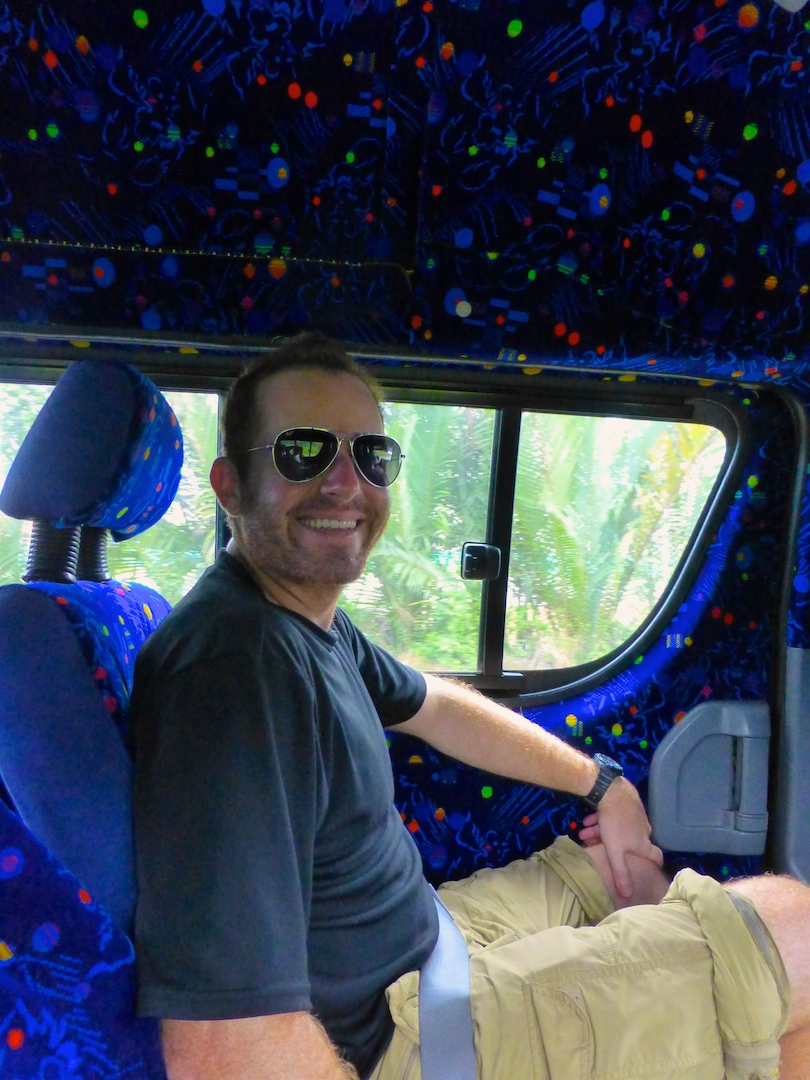
::just for fun, because this van was so tricked out::

Accommodation: Most people visit for a day, but right by park headquarters you can camp or stay in a “lodge” or a hostel.  I believe all accommodation is very rustic.  And be prepared to battle the macaques.

Food: We had a boxed lunch prepared for us that we ate at the canteen at park headquarters.  I’m pretty sure they sell food and beverages there, and toilets are available.

February 19, 2014 (Wednesday)

Welcome to Borneo

The island of Borneo holds legendary status among travelers.  The name conjures images and thoughts of dense rainforest, mysterious cultures and exotic wildlife.  It is the third largest island in the world, after Greenland and New Guinea (Australia, being a continent, doesn’t count).  Roughly 70% of the island (mainly the southern portion) consists of the Indonesian province of Kalimantan, with the remainder (mainly the northern portion) being the Malaysian states of Sarawak (in the west, where Kuching, our entry point, is located) and Sabah (in the east), plus the sovereignty of Brunei.

This is the first portion of our trip where we booked everything through a tour company (Audley).  Independent travel in Borneo seems quite doable, but we chose to spend less than two weeks on the island and felt it would be a smoother and more enjoyable destination if we had our plans laid out and the benefits of a private guide.

One of the biggest early surprises after doing research and arriving in Kuching is how developed the island is.  Kuching has a population of 650,000 and several buildings at least 15 stories tall.  For some reason, we kind of pictured Borneo as an undeveloped island with perhaps an airport or two and dirt roads and rivers.  I assume there are other landing strips for puddle jumpers, but Air Asia flies its Airbus A-320s to no fewer than eight different airports in Malaysian Borneo alone!

This city has a modern shopping mall with western chains and a Starbucks.  And a Maserati parked out front.  There is a large convention center outside town.  As if to confirm that we are not in the middle of nowhere, walking along the Kuching Waterfront we had our first chance encounter since California: we ran into Sheryl, my friend from Tufts.  Crazy small world.

For a city whose name literally translates to “cat” in the local language, you would think that it might appeal more to Jenni, but it somewhat underwhelmed. The cat thing is played up big time with cat statues all around the city (cheesy but cute) and souvenir and trinket shops selling I ❤ Kuching paraphernalia decorated with cats. There is clearly an effort underway to develop Kuching as a tourism hub for Borneo. It has the potential to become more Cancun than Cassis in class. Fingers crossed that this city can manage its growth well and preserve its character while adding facilities and benefitting locals.

Kuching is not a bad place at all.  It is pleasant enough and a fine place to spend a day or two to explore or while in transit.  The city is a bit weathered and our expectations were lofty. I think we envisioned a quaint, colonial-style riverfront village and that it is not. Perhaps though if we’d showed up here fresh from Los Angeles, and hadn’t just spent two and a half months gallivanting around other highlights of Asia we’d be more enticed by the Asian flair and the temples and all that. Are we becoming jaded!?

We definitely did enjoy the relief from Singapore prices and had a handful of tasty meals, including some fantastic laksa and teh tarik, a traditional spicy Malay noodle dish and tea drink, respectively. Walks along the Waterfront in the evenings were quite pleasant, with a handful of young musicians providing a soundtrack to the families and lovers walking about.  I really enjoyed my visit with Eric (while Jenni was sick) to the non-touristy Premier 101 Food Centre our last night in town. Tsingtao and chicken feet for the soul.

Our hotel was also a highlight, as it was the first place we stopped in Asia that had a bathtub. And not just any bathtub, a big lovely tub with a sliding door that opened to the balcony. Living large at The Ranee in Kuching.

Granted we are on a tropical island now, but it’s also the first place on our trip that we visited at the edge of its high season, and so we weren’t terribly surprised to experience our first rain on the trip since leaving the U.S.  But an impressive downpour and thunderstorm it was!  And very well-timed as it did not interfere with any of our scheduled activities.

There is much to see and do in Malaysian Borneo, and a comprehensive description is well beyond the scope of our blog.  But we will mention a couple places we skipped, in part because one area was a most difficult decision.  Some of the best places to see wildlife and I think the undisputed best places for tropical paradise islands in Borneo are in eastern Sabah.  This includes the Kinabatangan River and Tabin Wildlife Reserve, and world-famous SCUBA diving destinations like Sipadan and Mabul.  Unfortunately, there have been terrorist incidents on the offshore islands, with the most recent kidnap/murder occurring in November 2013.  The US State Department advises against travel to eastern Sabah.  We read the travel advice of the UK, Australia, Canada and New Zealand, too.  Each is cautious on the coastal regions, though only the US recommends avoiding such a large geography.  Australia’s website warns: “There are recent indications that extremists may be in the advanced stages of planning to kidnap foreigners from locations in this vicinity.”

Most seasoned travelers will tell you that the US State Department is alarmist, and often we agree.  Every single person we asked (meaning Borneo residents and those in the travel industry operating on Borneo) said they would not worry about the travel warnings, or at least would only worry with respect to the offshore islands but not the slightly inland destinations of eastern Sabah.  People said they feel entirely safe there.  We take more comfort in such statements when the primary concern is petty or violent crime, as opposed to terrorism.  There is no right answer, but that is the decision we made.  Plus, we are hopeful that the risk will diminish over time (especially with the recent Philippines peace accord) and now we have a great reason to return.

Another top attraction we are skipping is the Gunung Mulu National Park.  This area in eastern Sarawak (close to Brunei) is famous for its karst formations and enormous caves, including the largest known natural chamber in the world.  We hope to return to visit this area, too.

Practical Info

Kuching is the largest city on the island of Borneo, with a population around 650,000.  It is the typical base for exploration of Sarawak.  It sits on the Sarawak River, a little south of the ocean.  Tourist activity seems concentrated on the Kuching Waterfront.  There is a lot of commercial activity on Jalan Padungan with food, hardware stores, bars, restaurants, etc.

There is a cluster of three banks with ATMs next to the Riverside Majestic hotel, across the street from a 24-hour McDonald’s.

We purchased a DiGi SIM card, and it was less smooth than in some other places.  Nobody could give us a clear answer on rates to call the US.  It seems to work fine.  We found lots of shops selling SIM cards on Jalan Padungan.  You can top up DiGi cards at 7-11, and you can also purchase U Mobile cards there.

Transportation: Kuching has an international airport about 15-20 minutes from downtown.  There is a Starbucks and a Coffee Bean.  Air Asia flies here, and there are direct flights from several Asian cities.  Since we are using a tour company for Borneo, we did not arrange our own transport from/to the airport nor to Bako National Park, etc.  I would imagine it is not too difficult.  You can walk around most of the downtown area.

Accommodation: We stayed at The Ranee Boutique Suites located across from the Kuching Waterfront.  The room is large and well-decorated, with a sitting area and big, modern bath with separate tub.  The location is excellent.  The included breakfast leaves a bit to be desired.  There is a large Hilton and other high-rise hotels on the eastern end of the Waterfront.  I think you would want to stay around the Waterfront, but the central city area seems small enough that it probably doesn’t matter too much.

Food and Drink: Lunch at James Brooke Cafe on the Waterfront was great.  10 MYR for a large, delicious bowl of Sarawak Laksa.  We were a little disappointed by Top Spot food court, a collection of seafood and other stands atop a parking garage.  It is very popular with locals and tourists.  We ate at Ling Loong seafood, and my snapper was neither grilled nor filleted as requested and at 26 MYR the value is questionable.  Though in fairness I inquired at a food stall in town that seemed entirely local and was quoted a higher price per kilo.  We dined at The Junk, a supremely atmospheric restaurant with good food and mediocre service.  Pizza, risotto, a glass of house red and a pint of Guinness cost 113 MYR.  We had lunch at Little Lebanon by the Sarawak Tourism Complex, across from India Street.  The food was pretty good and they have hookahs, which they also call Hubbly-Bubbly.  There is another location on the Kuching Waterfront.

There are many vendors selling popcorn, chicken kebab, laksa and more along the Waterfront.  Waffle stands are all over and smell amazing. There are a couple popular stalls selling pork satay (0.60 MYR each, minimum five, limited hours) across from Hiang Thian Siang Ti Temple (aka Shang Ti Temple) and next to Backpacker’s Stay.  We saw some Chinese noodle shops, dim sum spots and pork leg rice places on Jalan Padungan. Near India Street and the Electra House shopping center are food stalls with laksa, mee goreng, bao etc. for ~4 MYR per plate.

Premier 101 Food Centre is a mainly Hokkien hawker market located 10-15 minutes outside downtown.  There are hardly any other tourists, and perhaps 20-30 vendor stalls.  The spot at one end of the alley serves BBQ chicken feet (among other items) with a great, spicy dry rub (4 MYR).  I tried kolo mee (3 MYR) and kong pia (1 MYR each) and each was tasty.  Char siu bao (2 MYR) was also good.  The highlight was the apam balik, a very thin and crispy pancake that had ground peanuts and butter and was superb.

There are loaf-shaped cakes (Jenni deemed these “Tetris cakes”) sold around town, especially along Main Bazaar.  I hear Secret Recipe is the spot for cheesecake.

Zeus Sports Bar looks like a place you could catch EPL games.  21 Bistro had a more sophisticated menu.  Jambu and the Dyak are higher end restaurants that come recommended.

Activities: Walk along the Kuching Waterfront, which offers views across to the Astana palace (the official residence of the state Governor) and impressive State Assembly Building.  We did not visit any of the Chinese or Hindu temples and skipped a museum or two, but we managed to squeeze in a quick visit to the very good Sarawak Museum.  It has informative displays on fauna, longhouses and headhunting (among more), and it is open every day with free admission.  Walk along India Street, Gambier Road and the Indian Mosque Lane that connects the two.  It didn’t seem like the India mosque was too exciting, but we weren’t dressed appropriately to enter so couldn’t tell for sure.  You can cross the river and we read there are some villages and an orchid garden.  There is a weekend market that I believe is now located outside the city.

Day trips are perhaps the premier activity of Kuching.  We visited Bako National Park, and it was awesome.  We stopped at the Semenggoh Orangutan Sanctuary on our way to overnight at an Iban longhouse, but many visit the Sanctuary on a day trip that includes a nearer Iban longhouse.  You can also visit the Sarawak Cultural Village near Damai Beach.

February 18-21 + 23, 2014 (Tuesday-Friday + Sunday)

Sim Singapore

Singapore is the anomaly of Southeast Asia: everything is expensive, high tech and functional, and clean. Even the legal tender is clean! Every single place that gave us change handed over crisp, unwrinkled new bills. But the clearest indication we aren’t in Southeast Asian Kansas anymore: there are no tuk-tuks! And as if we needed further proof that the western world has its influence on Singapore…we spotted a tanning salon!

From the get-go we were impressed with the competence level of just about everyone here. Immigration is seamless, incredibly fast and at one of the busiest airports in the world no less. They even provide mints and hard candies while you wait, which you don’t. And then after you make it through there is a machine with a five second survey on your immigration experience.

Cabs are efficient, with green “taxi” signs on top that change to a red “hired” when occupied. Even the chicken satay sticks at the mall are affixed to a machine that rotates and dips them in sauce for perfectly even distribution. You use a vending machine to pay for your haircut! And the WiFi works! We did in perhaps a few hours what it took us days to do elsewhere. Heaven sent because we’d been in the painstaking process of trying to upload photos to the cloud on slow third-world WiFi so that Jenni can use her computer which is now full to the brim.

Part of why everything is so efficient, orderly and highly functional: there are rules in Singapore. For instance, there is no gum sold in the entire country. Spitting is not allowed. Failure to flush a public toilet can result in a steep fine. There is not much traffic because the government limits the number of vehicle registrations that are available at any one time. It’s a nation run almost like a business. See the following examples:

And they are enforced strictly.

Our good friend (who shall not be named, only referred to by the pseudonym S. Goldberg), made the most perfect analogy of Singapore. Well, he made several. And we haven’t been able to come up with a better way to explain it. His words: Singapore is a real life SimCity, Disneyland (we even heard that buildings are required to emit insect repellant so this tropical former swamp stays mosquito-free!) or peaceful North Korea. This is about as accurate a comparison as we can imagine, though we did find ourselves trying to put our finger on what exactly Singapore reminded us of. The city is decidedly modern and westernized and it boasts a rather spectacular skyline. It’s very unlike pretty much all the rest of Southeast Asia, as noted above.  In ways it’s a lot like Miami, it’s hot and humid and a big city with tall buildings. But it definitely lacks that Miami flavor. In a lot of ways Singapore is similar to Los Angeles, with its clean, wide streets, new buildings and shiny happy people. But only if Los Angeles were the Grove or the 3rd Street Promenade (Los Angeles outdoor malls) everywhere. And if the Wilshire Corridor spanned the entirety of the Westside (hello, skyscrapers with rooftop pools!). It even had a little bit of a tropical answer to Savannah, what with its big beautiful trees lining the roads like live oaks.

I’m not going to lie, we had to do some googling on Singapore to figure out what the deal with a city-state is. There are about five million people living here, many of whom are expats, and it’s multi-cultural in a way that you don’t see too often outside the United States. Singapore has its own government, its own military. It is represented in the UN and competes in the Olympics (well I think just the summer Olympics, but according to Wikipedia they made a bid to compete in Sochi and can’t figure out if that panned out), but it covers a space of only about 275 square miles, there is no such thing as a “domestic” airport, and you have to use your passport to get out of the city for a weekend! Despite being the smallest country we’ve visited on this trip so far, it’s by far the most livable (if you like a western style of living). And it’s the first place we’re going on this trip with a higher GDP per capita than the US (per IMF). Not surprisingly, it’s the first place we’ve been in Southeast Asia where we drank tap water without fear.

There are a lot of expats here, but not so many Americans (probably because we are the only nation that taxes our citizens no matter where they’re residing and hence Americans can’t reap the full benefits of reduced taxation without renouncing citizenship). It’s easy to see how a Brit or Aussie could call this place home. It’s incredibly safe and you have the modern amenities of a western city, but with consistently warm weather (tropical, hot, humid weather, but it’s never cold), a diverse population and lots of green space.

Singapore is culturally mixed, primarily with Malay, Chinese and Indians. And not surprisingly all of these cultures are well represented architecturally and gastronomically throughout the city. There are several hawker stands dispersed throughout. These range in shininess – from the more typical Southeast Asian style stalls in Chinatown to what is essentially a mall food court in the basements along Orchard Road. We tried them both: decent Chinese food at the overwhelming and hectic Chinatown Complex, where we were the only non-Asians in sight, and nasi padang and a rather impressive Korean kimchi noodle soup in the polished basement of the Takashimaya mall. Something we discovered in Penang is also common around Singapore and we’re fast becoming big fans: barley drinks. So refreshing. The Asians like to chew their drinks huh? Boba tea, grass jelly tea, barley drink…we’re liking it.

There are also western-style restaurants everywhere, and we took advantage of this opportunity to enjoy cheeseburgers for the first time since leaving the US. Though be aware that coffee is absurdly overpriced here. $6+ iced coffees?! What’s up with that?

There are several neighborhoods throughout the city with good food, shopping and entertainment on offer.  And they are somewhat easily accessible via foot (if you don’t mind sweating in that hot hot humid heat) and the MTR. We walked much of what we saw in one day, so it’s quite manageable, and we only took the MTR once, mostly to say we did, and also because Jenni couldn’t stop complaining about the heat. It’s nice and clean and air-conditioned in there. On par with Hong Kong for transport, even matching the extra fast station escalators.

Robinson Quay by the river is a lovely spot to dine or imbibe alfresco. It reminded Jenni a bit of the waterfront restaurants in Melbourne. We ate a handful of meals here. Further down the river is Clarke Quay, which had a very Grove feel to it, albeit on the water.

Orchard Road is a shopper’s paradise with mall after eight-story mall. Don’t expect great deals though, my suspicions that absolutely everything costs more in Singapore were confirmed when I popped into Forever 21 and discovered even they charge prices two to three times what you’d see in the states.

Little India is definitely a toned-down version of the sub-continent, but there are still lots of colors, great Indian food, and a bit of Bollywood music. Memories of India flooded back, and we savored our first tastes of Indian food since leaving Varanasi more than a month ago. Oh how we missed that spicy goodness. India over-stimulates in just about every respect, but we aren’t complaining about the taste bud invigoration. Jenni eased her paratha withdrawal pains at Komala Vilas, a delicious veg food spot with superb parathas and other savory Indian dishes.

We meandered around this area for a while, checking out the shophouses on Decker Street (though to the untrained eye these did not seem all that different from the shophouses on the other streets?). There are also a lot of cheaper hotels and hostels in this area.  We were surprised by signs prohibiting the consumption of alcohol in Little India from Saturday morning until Monday morning.  Only later did we learn this stems from the riots that broke out in early December.  We were also surprised to learn that Singapore otherwise has a fairly lenient policy towards booze.  Walk around Robertson Quay and you might find groups of youngsters drinking on the sidewalk.

The Arab Street area (aka Kampong Glam?) has a nice collection of Middle Eastern restaurants (solid selection of Turkish, Iranian, Egyptian etc. If only we hadn’t just eaten, we would have ordered the borek at Derwish for sure) and shops, with a concentration on the pedestrian-only Bussorah Street that is anchored at one end by the Masjid Sultan. Nearby Haji Lane had some eclectic cafes and bars, as well. Informative plaques are displayed, and we learned that: “Up to the late 1970s, Singapore was where Muslim pilgrims in Southeast Asia would gather to prepare for their journey and board the ships to take them to Jeddah or back home after the haj.  Kampong Glam, in particular Bussorah Street, was where many of these pilgrims gathered.”

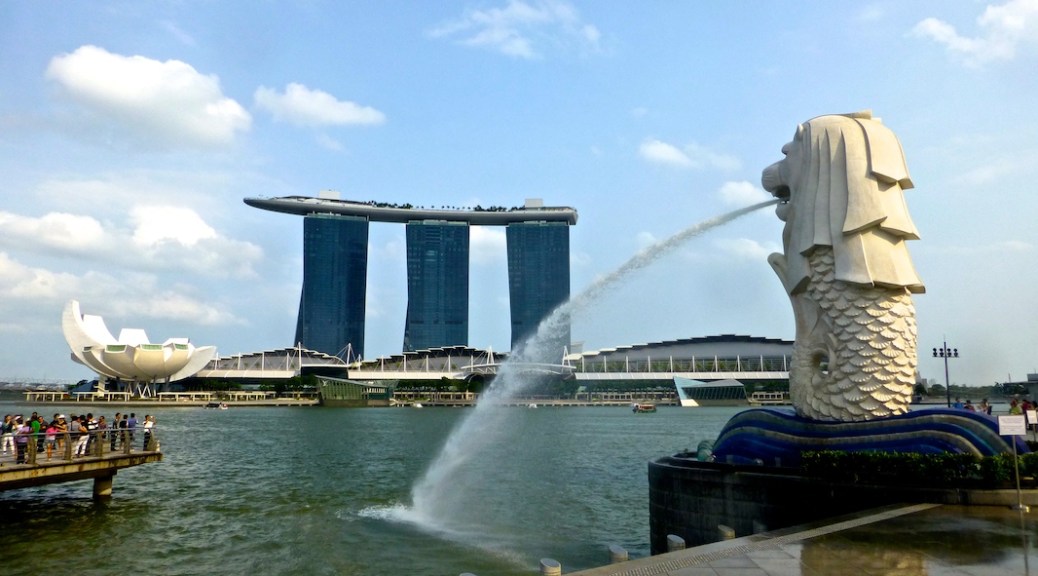
Marina Bay and its surrounding environs are full of nice hotels and pricy restaurants.  From Esplande Drive and One Fullerton there is a great view of the Marina Bay Sands hotel and casino and Singapore’s part mermaid/part lion mascot: the Merlion. Pause in the underpass near the War Memorial if you want to see a hodge-podge collection of Singapore’s youth breakdancing and performing traditional Indian dance.

We visited Marina Bay Sands one evening with our friend Swimmy. He was a fabulous host, and after stuffing our faces with some fantastic garlic bamboo clams and chili crab at No Signboard Seafood in Geylang, we partied like rockstars with some Singapore Slings (obvs) at the rooftop bar. Not a bad view from this spot I tell you.

Chinatown is quite the happening spot, despite that we were there on a Sunday when many of the brick and mortar bars and restaurants were closed. Still, we got to check out Ann Siang Hill (which was clove and nutmeg plantations not so long ago), meander down Club Street, and be super mature tourists stopping to take a photo of this place:
P1060489

There are a handful of impressive temples over in this part of town, including Thian Hock Keng (Hokkien) and a Hindu temple (Sri Mariamman) reminiscent of the Meenakshi temple in Madurai, albeit a fraction the size.

Valentine’s Day seems to be a really big deal here, with promotions everywhere. Jenni got a free rose with her morning latte and it totally made her day. After a day full of blogging we snuck in a little romance with a dinner and chocolate lava cake at Wine Connection at Robertson Quay.

Our last night in town we met one of Alan’s friends from his Latham NY days for drinks at eM By the River.  It was great to catch up and learn more about Singapore’s quirks from an expat.  Among many other interesting facts, Matt confirmed what we had heard from our Airbnb hosts: Singapore apartments are required to have bomb shelters, and some residents have Filipino maids that live in these tiny spaces.  He also mentioned a documentary that I think is called “Meet the Natives – England and USA.”  The idea is to take our traditional notion of anthropology and flip it, i.e. tribesmen from remote South Pacific villages travel to observe people in the US and England.  Sounds fascinating!

Practical Info

Though we did not purchase a SIM card, I read that the major carriers are SingTel, StarHub and M1.  WiFi is not quite as ubiquitous as expected (though it is generally fast and reliable where it’s available). Of course ATMs are widely available and credit cards are accepted most places, though some have a higher minimum than you might guess. If you plan to spend a lot of time here, check out NETS.

Look into whether you need your passport to enter a casino here, as Singapore limits the gambling of its own citizens.

The exchange rate was roughly 1 USD = 1.27 SGD.  We use simply “$” for Singapore Dollars throughout.

Transportation: Changi International Airport is quite the hub, with non-stop flights to almost everywhere.  Immigration was the smoothest we’ve ever experienced.  We took a taxi from the official queue to our Airbnb apartment on River Valley Grove.  In the early afternoon, it took 20-30 minutes and cost $21.

Depending on where you stay, this is a very walkable city.  Public buses and trains have a great reputation, especially the MRT. As with most non-US cities, train fares vary by distance and you need your ticket to exit.  There are several different train lines so you may need to change.  Little India, Orchard Road (at Dhoby Ghaut), Clarke Quay and Chinatown are popular areas all next to each other on the purple North-East line.  The only time we took the train was one-stop from Dhoby Ghaut to Little India.  Each ticket was $1.30, of which $0.10 was the card deposit.  And remember, no durians on the train!

Taxis are very inexpensive compared to most US cities for long distances, though this is less true for short distances due to high flag drops and extra fees.  Taxis are plentiful, though when we tried to hail one at 7:15 pm on Thursday to Geylang we were denied by at least three…I think it had to with shift-change time, but Jenni is a pretty intimidating passenger.

A taxi from our apartment to the airport at 9:10 am on Tuesday morning took half an hour and cost $22.  There is free WiFi at the airport though you may need the ability to receive a code via SMS.  If you don’t have a mobile for this, ask someone to help you.

Accommodation: Lodging is very expensive relative to the rest of Southeast Asia. We opted last minute to go with an Airbnb spot given the price hikes as a result of the Airshow coinciding with our visit. The quality of moderately priced hotels and hostels even over $100 a night (and their pathetic reviews online) made us very pleased to be able to stay at a modern condo with private bathroom, laundry, a gym and a rooftop pool with views of the Marina Bay Sands for about the same price. Our hosts were super friendly and even provided bath products, Evian water and chocolates on our bed! While there are hotels that are a little closer to the action, we enjoyed this opportunity to see what life might be like as an expat living in Singapore.

There are many luxury properties here.  While we did not see a room, the Marina Bay Sands certainly has an amazing rooftop pool and bar.  If you are looking for more budget accommodation, there are hostels and cheaper hotels in Little India, Bugis and Chinatown.  Gallery Hotel, where we had drinks at eM bar, enjoys a nice location.

Food and Drinks: There is very good and ethnically diverse food in Singapore.  Restaurants tend to be expensive (and note that 7% GST and 10% service may be added to the bill), with much cheaper meals available from food courts and hawker stalls.  Alcohol is costly due to high taxation.  Many places have happy hour deals, but this means something like $6-10 for beer or a glass of wine…don’t expect a shot and a Tecate for $3.  Starbucks and Coffee Bean are common.

We did not hear about Dempsey Hill until our last night when it was too late to visit, but this converted British army camp sounds worth checking out.  I think it is near the Botanic Gardens so combining the two sounds like a lovely afternoon/evening.

No Signboard Seafood is famous for its chili crab and bamboo clams with garlic.  We dined at the original in Geylang, a huge place and an experience. Order lots of fried bread to soak up the chili crab sauce. It is expensive.

Malls often have food courts in the basement levels.  We ate lunch at Takashimaya where options included Chinese, Malay, Indian, Indonesian, Vietnamese, Korean and more.  Meals were $4-8.  Chinatown has multiple food centers, most of which were closed on Sunday.  The Chinatown Complex was open, and it was overwhelming up on that second floor! So many different stalls, mainly Chinese but also Thai, Japanese, Malaysian, etc. Cendol and ice kacang (which we discussed in our Penang post) are here. Jenni’s katsu don cost $4.50 and my soya sauce chicken noodles cost $2.50. I actually ordered chicken claw and was relieved to hear they had run out.

Little India has some food stands and proper restaurants.  We ate at Komala Vilas (there appear to be multiple) on Race Course Road and it was very good and cost $16. The Arab Street area has lots of Middle Eastern food, including some 24-hour options. Check out the intersection of Bussorah Street and Baghdad Street, as well as Haji Lane.

There are tons of options around Marina Bay and Clarke Quay.  Closer to our temporary home, Killiney Road has a handful of spots. Freshly Baked’s $3.50 iced coffee was the cheapest I saw.  Artisan Boulangerie Compagnie has no WiFi but fairly good food and coffee. Killiney Kopitiam is popular for coffee and kaya toast.

We spent a lot of time in the Robertson Quay area as it was nearby and very pleasant.  Boomarang is an open-air Aussie bar that made a nice place to watch the US defeat Russia in Olympic hockey.  My wagyu burger with bacon and egg was $30, a steep price but it satisfied my craving.  Jenni’s spiced lamb pizza for $18 was very good, and a bucket (5) of San Miguel beers was $40.

Ginza Lion was fine, the portion of chicken wings was large for the price.  Wine Connection Tapas Bar & Bistro was happening on V-Day and pretty good.  eM at the Gallery Hotel is a great spot for relaxed after dinner drinks.

Raffles is a classic luxury hotel.  We tried to do high tea but it was fully booked, so be sure to reserve in advance.  The menu at the restaurant looked great but was mega-expensive…like $198 for the degustation plus $138 for four glasses of paired wines.

Activities: There is quite a bit to do here.  Visit the Singapore Zoo, which also has a bird park, river safari and night safari.  The Singapore Botanic Garden is free, though I think you have to pay a little for the Orchid Garden.  There is also Gardens by the Bay at Marina Bay, and Jenni’s friend suggested you can get in free to the flower dome if you have a drink at Pollen Bar.

Walk around Chinatown, Marina Bay, Little India, Arab Street, Clarke Quay, Robertson Quay, etc.  There is a War Memorial monument and little park across from Raffles, a destination in its own right whether for a drink, high tea or just to see the grounds.

We did not make it to Sentosa Island, but Resorts World Casino is there along with Universal Studios and a Hard Rock hotel.  It is said to be a party place.

Should you need a haircut in Singapore, QB House is on level B3 of the 313@Somerset shopping complex.  It costs only $12 (paid to a machine, exact change only).  Plus they have this vacuum contraption to remove those prickly cut hairs before you get up.

February 12-18, 2014 (Wednesday-Tuesday)

Vientiane

Sure it’s not the most exciting city we’ve visited, but we felt that Vientiane was rather excessively hated on by other travelers we met. We’re not advising anyone with limited time to spend a large chunk of their trip in Vientiane, but it’s a perfectly pleasant place to pass a day or so. That said, we didn’t do all that much here. Vientiane is just across the Mekong River from Thailand, but the view is less than inspiring. And there’s not really any one thing that you could label as the main attraction or reason to visit, but like much of Laos there are a handful of beautiful wats, good French eats, and lovely people.  As the capital and largest city by far, Vientiane also houses the Lao National Museum.

We checked out a few temples (it’s Southeast Asia, after all), and we discovered Wat Ong Teu: the wat for monks on mushrooms. Seriously, look at the psychedelic lights in there.

We also arrived at Wat Haysoke just in time to catch the monks sitting down for their final meal of the day (they shall not eat after noon).

Of course, we sought out some good eats of our own. We were pleased with the fruit shakes and Greek salad at Noy’s Fruit Heaven. Benoni Café offered a tasty brie sandwich and solid coffees. Still loving that French influence and the great baguettes. While the service was atrocious, the sushi at Tokyo Sushi Bar (at Mix) was good, and the live music was lovely. You can order from a handful of restaurants surrounding the outdoor seating area, including sushi, Indian, Lao and Thai food. Jazzy Brick’s happy hour underwhelmed with the wine selection, but the half-priced cocktails, agreeable soundtrack and mid-century modern furnishings made up for it. We also enjoyed a nice Italian meal at Lao Luna D’oro.

We were weirdly most excited by the grocery stores we popped into. Phon Phet grocery had lots of imported goods, and we even found Ziploc bags! We of course re-upped. Another market near our hotel had first-rate snacks, including Funfetti mix!  But it is remarkably difficult to find lotion or face wash or practically any beauty product that does not “whiten.” It’s a fascinating cultural difference (in most Asian countries, actually) from the West, where tall, dark and handsome rules. You can be sure there are no tanning salons in Laos.

Having now spent two weeks in Laos, we can share some parting thoughts.  It has the horrible distinction of being the most heavily bombed (by the US) country, per capita, in history.  Unexploded ordnance remain a problem, though not really for tourists.  Laos became independent in the mid 1950s, but not long after a lengthy civil war ended the monarchy and the communists took over in 1975.  Efforts began in the 1990s to normalize relations with other nations.  Laos remains a very poor country and is one of five worldwide still considered to be communist.

Despite its troubled past and present-day poverty, we observed a peaceful and seemingly happy population that displays no outward resentment whatsoever towards Americans.  We have not been to Cuba, but those who have tell us the communist ideology is palpable to say the least.  Not so in Laos.  Tourism is on the rise, and we read that Laos expects to join the ASEAN Economic Community by the end of 2014.

If we had more time here, these are a few places or activities that sounded interesting:

  • The Nam Ha National Protected Area
  • The Bolaven Plateau with its coffee plantations
  • Si Phan Don, aka the Four Thousand Islands (said to be a nice place to mellow out, with a chance to see the rare Irrawaddy dolphin)
  • The Gibbon Experience
  • Nong Khiaw and the surrounding mountains

As a final reminder of how awesome the people in Laos are, at the airport Alan forgot to check his Leatherman pocket knife.  Rather than making him throw it out, airport personnel at security, immigration and ticketing all helped us retrieve our checked bags and get the Leatherman on the plane. Everyone was so helpful and friendly. A great send off from this hospitable nation!

Practical Info

Vientiane is the capital of Laos and sits on the Mekong River, directly across from Thailand.  Most tourist wants and needs are found within a compact downtown area.  ATMs are everywhere.  We stumbled upon a couple grocery/multipurpose stores (Phon Phet, and Phimphone on the main drag) with many imported items in case you need something. It is not so easy to find Ziploc bags in developing countries, so…

Transportation: We took a “VIP” bus from Vang Vieng.  It cost 50k Kip each.  You are dropped at the north bus station from where a shared tuk tuk to city center costs 10k Kip each.  This bus was a bit less “VIP” feeling than the one from Luang Prabang to Vang Vieng, but it was fine.  The scheduled departure was 10 am with arrival around 2-2:30 pm.  We were picked up at our guesthouse in Vang Vieng by a mini-bus after 10 am, then we made some loops picking up other passengers, and the actual bus didn’t leave until 11 am.  Even with a toilet (1k Kip) and lunch (sandwiches 10-20k Kip) stop, we still arrived at the Vientiane bus station at 2:15 pm.

This bus ride was less hilly, windy and scenic than from Luang Prabang, but we passed more villages.

Note that one may kayak from Vang Vieng to Vientiane, but be sure to inquire about details.  We met someone who did this and it sounded like a few hours of kayaking came with a lot of driving in less comfortable vehicles…like more combined driving hours than the whole bus ride.

Vientiane is the main international air hub for Laos (which isn’t saying much) and we flew from here direct to Singapore on Lao Airlines.  We purchased air tickets from All Lao Travel Service on the main street in Luang Prabang.  Ms. Teep beat everyone else’s price, and was far cheaper than what we found on Kayak.

A taxi from downtown to the diminutive airport at 6:15 am took less than 15 minutes and cost 60k Kip.

Accommodation: We stayed at Ibis, which is an Accor hotel.  At ~$60/night, you can find cheaper, but the room is nice, the WiFi works well and the location is excellent.  Street names are confusing but it seems to be on Rue Setthathilath.  It is close to several well-reviewed bars and restaurants like Joma, Benino, Amphone, Jazz Bricks, etc.

While searching online we also considered Dhavara and Avilla Phasouk.  These are all very near each other, and I would try to stay in this zone.  The downtown is small and easily walkable so a couple blocks this way or that shouldn’t matter too much.

Food and Drinks: We dined at Tokyo Sushi Bar, which I guess is part of Mix at Nam Phou Fountain Square, next door to our hotel.  The food was good but pricy and the service was poor.  The atmosphere was lovely, many tables outdoors with a fountain and live music.  Our brie baguette at Benino Cafe was OK, the coffee was great.  Noy’s Fruit Heaven comes recommended.  A tasty Greek salad cost 40k Kip and you can choose any combo for your 10k Kip fruit shake.  Friendly service.  Dinner at Lao Luna d’Oro was great.  My lasagna was richly delectable and the crust on Jenni’s pizza was superb…thin and doughy yet crispy.  We did not eat there but the owner of Le cafe de Paris in Vang Vieng recommended Chokdee Cafe Belgian Beer Bar.

Our viognier at Wine ’95 was OK but could’ve been chilled more. The service was good, though, and they agreed to happy hour prices before the official 6 pm start. Jazzy Brick’s happy hour cocktails for 20k Kip were solid, and the inside space is cozy and well-decorated with classy and comfy mid-century modern chairs.

Activities: There isn’t so much to do in Vientiane.  There are some temples and museums, we mainly walked around and stopped briefly at Wat Ong Teu and Wat Haysoke.  I believe the night market takes place in or around Chao Anouvong Park by the Mekong, itself something of a sight.  Naturally, there are plentiful massage parlors.  Last but not least, I believe there is a bowling alley, though we did not hear tales of late-night debauchery as in Luang Prabang.

February 10-12, 2014 (Monday-Wednesday)

“In The Tubing Vang Vieng”

It’s easy to see why Vang Vieng went from an undiscovered paradise to a hedonistic party pit-stop on the Banana-Pancake Trail. Luckily, it’s been cleaned up quite a bit (including, for example, by removing the zip lines and rope swings that used to exist), and what you’ll find now is a nice mix of adventure tourism in a karst-studded landscape and (mostly) good-natured fun.

Vang Vieng is best known for its popular tubing activity, where tourists rent inner tubes and use them as transportation to bar hop among the aptly named Bar One, Bar Two and Bar Three along the Nam Song river. This is a backpacker rite of passage we are very glad not to have missed.

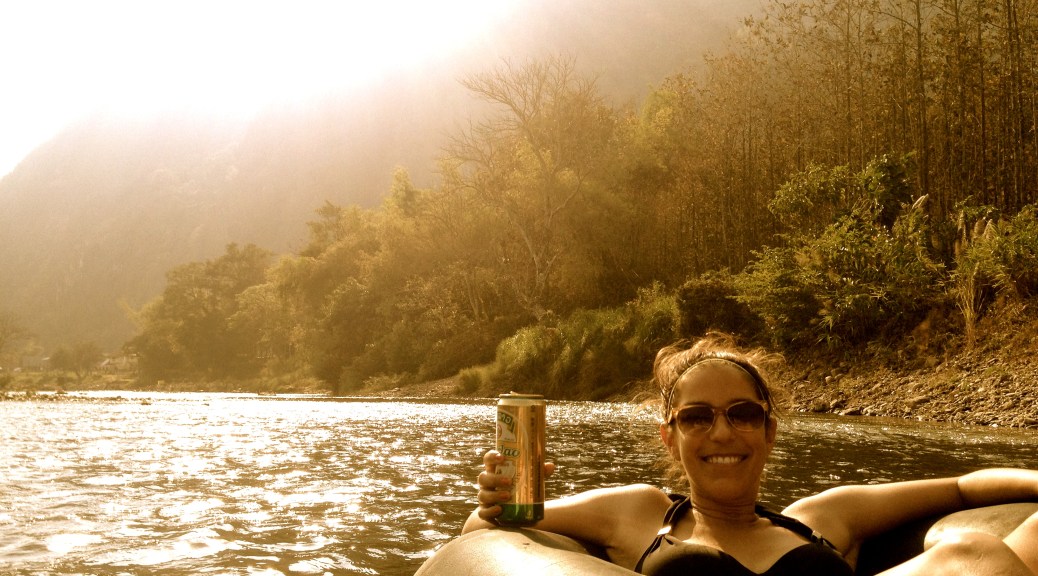
You rent your tube in town, and then a tuk-tuk takes you about three or four kilometers up the river. There is a bar set-up just beside the Organic Farm (which we had heard is good and has delicious mulberry shakes, but unfortunately we couldn’t peel ourselves away from the fun zone) where people hang out drinking alcoholic slushies, cheap whiskey shots (free at the door!) and Beerlao. There is a table set up for playing beerpong, blankets laid out on the ground, little cabanas with shaded seating and of course good tunes. This is technically Bar Zero, just getting you warmed up for the long ride down to Bar One. It takes about five minutes. If you’re noticing that the focus is on drinking rather than tubing, you’re very perceptive. Our only complaint with the tubing is there is not enough tubing!

Bar One had a little dirt soccer pitch where Alan played with a veritable United Colors of Benetton group: an American, two Brits, an Indian, a Spaniard and a guy from Brussels. OK, maybe it’s a highly European group but it’s still a diverse crowd. If you had any doubt that the alcohol imbibing was taking effect, know that Alan essentially dove into a brick sidewalk to try to save the ball and barely flinched. Not that he isn’t always this manly and macho 😉 There was also a spirited game of Polish Horseshoes taking place. We played this at Kenny’s birthday bash in Longmeadow years ago. Apparently it’s also known as Frisbeener or Beersbee, among other names.

Another five-minute tube ride takes you to Bar Two, where there is a volleyball court, lots of drunk men in mank tops with necklaces made of beer can tabs (when exactly did the mank top trend explode?), girls in neon bikinis, and some cheap eats.

There are guys standing at the water’s edge at each bar who throw out ropes with water bottles attached to the end to pull you in. They keep your tubes stacked by the river while you get your drink on.

The Vang Vieng locals are smart with their pricing policies, maximizing their chances of capitalizing on drunken tourists’ inability to return the tubes before the six o’clock cutoff when part of your deposit is forfeited (or all of it if you can’t manage to get back before eight). Not to mention it’s nearly impossible to make it back to town before sunset if (read: when) you lose track of time at Bar One, Two or Three. We’re told it takes about three hours without stopping to float from the drop-off point all the way back to town. We’ll never know. We didn’t even make it to Bar Three, as we wanted more tubing during our tubing. And we kicked with fervor trying to make it back from Bar Two via the river before six. We got picked up by a tuk-tuk driver with over a kilometer to go, and still didn’t make it back before six.

We’d heard rumors of how crazy this place used to be. While we can’t compare the present situation to what it used to be, we thought it a healthy mix of non-drinking kayakers and other adventure seekers and partiers who were more or less in control of themselves.

Our second day in town we checked out the next most popular tourist attraction around: the Blue Lagoon and Poukham Cave. It’s about thirty minutes away via tuk-tuk on a rough dirt road (including a stop to pick up a monk we passed along the way), though some people do bike or walk it (we got too late a start in the day for this). The Blue Lagoon is a really cool spot where you can swim and rope-swing or jump off a big tree into the water. There are ladders leading up to limbs about 8 and 20 feet above the water. We watched some impressive and far more brave people doing backflips and the like for a while. For those on the spectator side there are tables and shaded cabanas, a volleyball court, and a little restaurant where you can get beers and pretty cheap Asian noodle and rice dishes. All in all it’s a very chill scene and much more mellow (and sober) than the tubing, but if you have only one day in Vang Vieng we’d definitely say you should opt for the tubing.

The cave is also pretty impressive. It’s a steep, 5-10 minute hike up the hill. You can hire headlamps (torches) or bring your own, and we recommend doing this. For some foolish reason we brought only one and quickly discovered that one torch does not suffice for two people. There is a reclining Buddha near the entrance of the cave, and you can explore deep inside. We didn’t make it too far given the lighting issue, but what we did see was pretty impressive, this coming from two people who visited Carlsbad Caverns only a few months ago.

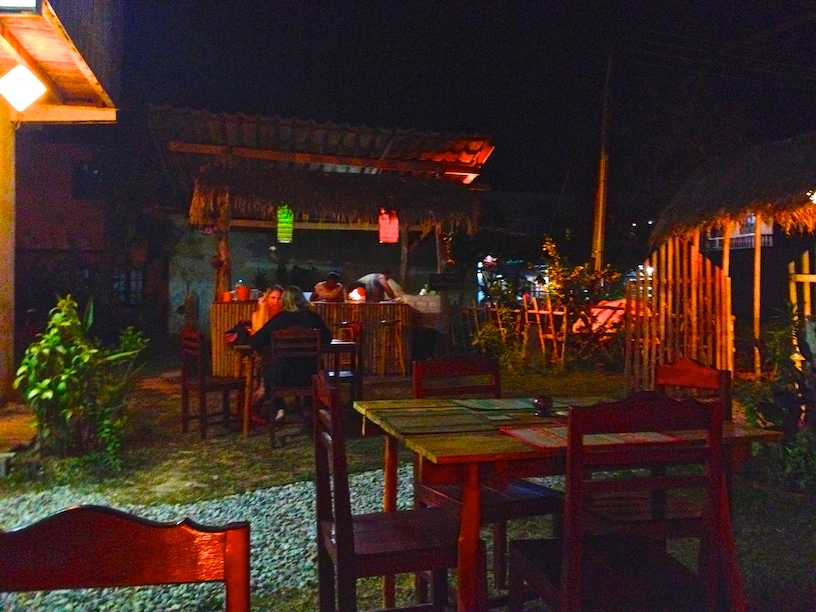
Lest you think every spot in Vang Vieng is filled with people wearing an “In the Tubing” tank top, we can confirm that there are again lovely French and other restaurants to dine in. Highlights for us were pizza at Luka (looks like a backyard, with a handmade clay pizza oven and a tiny bar. Order the eponymous pizza), and Le café de Paris (a fantastic bistro with jazz playing and a more mature crowd. The duck terrine is wonderful. And the French owner is quite friendly, lending Alan his bike to visit the ATM when we realized we didn’t have enough cash to pay).

IMG_1070

Of course, there are also solid cheaper eats around town. Our favorite find was Phonepadis’ breakfast. They take pride in their work. And Jenni ordered the mango with sticky rice, which came in a portion large enough to feed a small Lao family (Lao families have on average 3-7 children).

We felt that the locals were noticeably less friendly here, but you can’t exactly blame them when it’s necessary to have signs imploring tourists to respect the Lao people for their efforts to be properly dressed and follow their example and warning that your hosts can’t be blamed if some crazy farang comes and steals your shoes. Even the bus station had a sign requesting that people wear shirts. We were surprised that signage to this effect was necessary. We were even more surprised that it didn’t work. It’s easy to see how drunk and drugged tourists dressed immodestly and counter to local culture invading the Laotians’ slice of paradise could have a jading effect. That said, the meatheads on our bus ride to Vang Vieng and the girls wearing no pants in the center of town were among the minority, and in our experience we met a lot of really cool, friendly and interesting people while in Vang Vieng. And given what we’d heard about the town’s former reputation, it seems to have been cleaned up well. We didn’t notice any drug use on the tubing (and were very surprised by this), and the vibe was fun, not seedy or belligerent. This is part of a larger theme we’ve been noticing through Laos. It’s so backpacker and traveler friendly with the cheap and convenient transport, accommodation and food options. This was the first country on our trip where we’ve left our plans so open-ended and we’ve been really pleased with the ease with which we could get around and fill our time. And to top it off, we’ve met many great people during our time here.

We decided to see what all the fuss was about with the bargain hotels, and so we stayed at the deluxe room at BeeBee Guesthouse. For $15 a night we got this view from bed:

Best hotel room view for $15? We think so. Show us a better one. We had only a few complaints. One: it’s clear that someone punched through the panel in the door next to the handle to break into the room. They barely tried to disguise this, as the panel was actually taped to the door. So, not exactly an inviting place to store all of your valuables, but alas we had nothing stolen. Second: there’s no way to know if this is par for the course or an unfortunate coincidence, but we were staying just down from the main strip of the town where the loud, late-night parties are. In fact, we’d read that this hotel is a good option because it’s a bit quieter at this end. Well, our first night there happened to be what looked like a Lao high school graduation party with blaring cheesy Lao music and a DJ who could at best be described as abrasive. And our last night, there happened to be what looked like a Lao wedding across the street with blaring horrible karaoke style singing of, wait for it, cheesy Lao music. Actually, this might have just been drunken yelling. It’s hard to tell. I’m fairly certain you are required to be tone-deaf to obtain a job with a microphone in this country. It doesn’t help when the door is secured by masking tape. Alas, this is part of the experience, and we thoroughly enjoyed watching the sunset, drinking some Beerlao and listening to the world’s worst concert from our balcony.

That said, we’d probably recommend spending a few extra bucks to stay at one of the river view guesthouses like Elephant Crossing. Before arriving we’d thought the hotels on the opposite side of the river would be inconvenient, but there is a footbridge you can cross that makes them closer to some of the action than even our hotel was.

Practical Info

Transportation: We took a VIP bus from Luang Prabang that departed on time at 9:30 am and arrived at 3:30 pm, also on time.  It cost 130k Kip each and included transfer from our hotel at 8:40 am to the bus station.  We bought our tickets from Ms. Teep at All Lao Travel Service on the main road in Luang Prabang.  They accept credit cards with a 3% surcharge.  The road is hilly and windy but not in bad condition for a developing country.  The bus was pretty nice, the driver was unimpeachable and the scenery varied from good to excellent with stretches of dramatic jagged peaks.  We broke for toilets (2k Kip to use) and snacks at 11:15 am and then stopped at 2:15 pm for the included lunch of hot noodle soup.

On arrival at the north bus station in Vang Vieng, you can grab a tuk tuk for the 2 km ride into town or to your hotel for about 10-20k Kip each.

There are several options each day between Luang Prabang, Vang Vieng and Vientiane.  Mini-buses/vans sound nice but we hear they are crowded and less comfortable than the VIP buses.  There are also non-VIP buses and sleeper buses.  The sleeper bus from Luang Prabang to Vang Vieng sounds terrible as it arrives around 2 am, thus offering the chance to see none of the countryside, be on the road when it’s more dangerous and still need a hotel on arrival.  But the sleeper from Luang Prabang to Vientiane would be a time- and cost-effective option, albeit you would miss the scenery.  We inquired only once and did not try to bargain, and we were told a private car from Luang Prabang to Vang Vieng would cost 1MM Kip, which is surprisingly expensive.  It is even possible to arrange a kayak trip from Vang Vieng to Vientiane, but be sure to inquire about details.  We met someone who did this and it sounded like a few hours of kayaking came with a lot of driving in less comfortable vehicles…like more combined driving hours than the whole bus ride from Vang Vieng to Vientiane.

Accommodation: We stayed at BeeBee Guesthouse on the main street but a little south of the action.  Once we got past the blaring music the first night it wasn’t so bad.  Until the blaring music on the third night.  In fairness, the music seemed to be from specific Lao events and not from a touristy bar that would be loud every night.  There is WiFi downstairs but not in the rooms.  For $15/night it’s a decent choice.  We requested a front-facing room (got #12) and the view of the karsts out the window and from the shared balcony is superb.  We met backpackers staying at Pan’s Place and at Nana, both near BeeBee, and they had nothing bad to say.

I would recommend staying closer to the river or even across the footbridge that is near Roung Nakhon Vang Vieng Palace hotel because you can walk the whole town area easily.  Chez Mango across the river is well-reviewed.  Riverside Boutique Resort on the town side is #1 on TripAdvisor.  We did not see the interior but from a drive-by the location and pool area look great.  Elephant Crossing is well-reviewed and conveniently located, if unimpressive-looking from the road.  We met a couple who stayed there and they said the WiFi did not work well but otherwise the property was nice.

Food: There are street carts everywhere serving Thai-style pancakes, sandwiches and more.  Fresh baguettes are ubiquitous in Laos.  Pancakes from these carts cost ~10k Kip and sandwiches usually are 15-25k Kip.  Pizza Luka has a handful of outdoor tables and thin crust pies.  Jenni’s goat cheese pizza was OK while my Pizza Luka was great.  Proving yet again that it’s usually advisable to order the namesake item.  Each pizza cost 60k Kip.

Another night we dined at Le cafe de Paris, a bistro with an affable owner and jazz soundtrack.  The goat cheese salad was OK, the duck terrine was great, the duck breast was good but quite gamy, and the Philly cheesesteak was very good.  It is a classier joint with nary an “In the Tubing” tank-top in sight (practically the uniform of tubers), but that didn’t stop Jenni from plopping her Beerlao roadie on the table to avoid littering outside.  And the owner lent me his pink bicycle for an ATM run when I realized I didn’t have enough cash.

Bamboo Tree had pretty good WiFi but mediocre service.  Luang Prabang Bakery is popular though we were underwhelmed at breakfast, especially for the price.  Phonepadis has no sign yet but is on the main street just north of Molina Bungalows on the same/east side of the road…a few spots up from Pan’s Place.  It is basic but the breakfast was very good.  They take pride in their craft.

The Organic Farm and its mulberry shakes come recommended, but we couldn’t tell if the in-town cafe is permanently closed or not.  The farm itself seems to be a few km north, where tubing begins.

Drinks: Tubing without drinking is like Sasquatch. Allegedly it exists, but there is no documented evidence. We covered the tubing bars above.

In keeping with our M.O. of straddling both the backpack and champagne scenes, we never went out after dinner so cannot really comment from personal experience on the nightlife.  But a couple places that seemed popular based on conversation include Fat Monkey’s, Milan Pizza and Kangaroo Sunset.

Activities: Drinking and tubing clearly rank one and two.  There is only one place in town that rents tubes.  I’m pretty sure this stems from the recent clean-up of what had become a legendarily raucous and dangerous scene, and that now it is regulated and communally owned.  Tube rental costs 55k Kip and you must leave a 60k deposit, of which you lose 20k if you return the tube after 6 pm and you lose the full 60k after 8 pm.  I believe you can only commence rental of a tube between 9 am and 4 pm.  Dry bags can be rented for 15k.  With at least a couple other passengers (and in the high season I think that will always happen), the rental fee includes the 10-minute tuk tuk ride a few km up the river to the starting point.

There is also mountain biking, kayaking, caving, go-karting and more.  You could take a hot air balloon ride.  Sunset motorized dugout canoe rides are popular; it appeared these leave from just the other side of the driving bridge, and we could not tell whether the main appeal is viewing the karsts or the drunken tubers trying to return by 6 pm.

February 7-10, 2014 (Friday-Monday)

Two Falangs in Luang Prabang

After two weeks in the country, we are still unsure whether the proper pronunciation is Lao or Laos. We have confirmed, however, that this often-overlooked nation belongs on the itinerary of not only a Southeast Asia backpacker, but anyone looking to relax and savor Frasian (that’s French influenced Asian) culture and cuisine. It’s touted as the land of the friendliest people on earth, which in our opinion may be a slight stretch, but it sure does have some of the smiliest and happiest children on earth. And there seems to always be the sound of laughter in Laos. While this landlocked country is lacking in ocean-front views, there are green mountains and rivers running throughout, with the heart and soul of Luang Prabang existing on a tiny peninsula at the confluence of the Mekong and the Nam Kahn rivers. Sisavangvong Road is the main artery of the four-street-wide peninsula, and restaurants, guesthouses, wats and massage parlors are sprinkled throughout the city.

In Luang Prabang, especially, the vibe is decidedly mellow and laid-back (as is the case in much of the country, though Vientiane, the capital, is by comparison a bit busier). The population of Luang Prabang is around 50,000, or just a bit bigger than Walla Walla, so perhaps this is the ideal size for a chilled out but not too sleepy vacation spot with a strong food and wine scene. Expect very limited aggressiveness and bargaining from touts (if any at all), a welcome respite from the questionable sales tactics employed by many Southeast Asian street vendors. Instead, you can lazily meander the palm-tree dotted streets and mingle among the monks, who are plentiful! Probably because there are dozens of wats in Luang Prabang and every Lao man is expected to be a monk at some point in his life (we were told the minimum is seven days).

The wats are beautiful. One of the most famous sits atop Mount Phousi, about 300 steps above the street and popular among hoards of tourists at sunset. We enjoyed the views one evening for coucher de soleil, and also squeezed in a little workout walking up and down those steps another afternoon (gotta work off that French food somehow). Luang Prabang meets two of Alan’s requirements for a place to live: good food and wine and stairs or easy hiking for exercise. Is a life in Luang Prabang in our future?? It’s certainly far from a travel hub that lends itself to frequent and easy jaunts, so that’s unlikely.

We popped our heads into one or two other temples, and you’ll find them throughout the peninsula. You could spend the better part of a day exploring these, if wats are your thing (and if you aren’t quite as temple-d out as we were by this point). There is also a night market on Sisavangvong Road near the Royal Palace Museum where you can buy Lao souvenirs and partake of a street food buffet for just over $1.

Oh, and it’s the first place on our Asian tour in which they drive on the right. Of course due to the size and slow pace of this city you can cross the streets with ease regardless of which way you’re looking. In fact, there might actually be more people biking than driving.

Not for lack of a better word, Luang Prabang just is so nice. It’s one of the most pleasant places we’ve visited so far in all of Asia, and that’s part of the reason we ended up spending seven nights here. Not to mention the Beerlao – the beer of the wholehearted people – is tasty and copious.

The French influence in Luang Prabang (and much of Laos, for that matter) is palpable. This UNESCO World Heritage city was part of the French colony of Indochine, and you often hear people speaking French. Not surprisingly it seems to be a very popular destination among French tourists. In addition, a number of the older locals speak better French than English. In fact, Jenni had to reserve a room en français one night from the kindest Lao lady whose English was lacking. And oh, the food and wine. First, there is freshly baked crusty French bread served practically everywhere. Gone are the toast and cold butter breakfasts of most Southeast Asian hotels. Expect instead a warm, crunchy on the outside, airy on the inside mini-loaf with practically every meal. You can also find a number of “fancy” (though were you to lose consciousness, upon reawakening you would be unlikely to mistake your surroundings for Alain Ducasse au Plaza Athénée) French restaurants and some Frasian fusion menus. In Jenni’s humble opinion, the Asian spin on French food often just meant destroying perfectly delicious French foods with the addition of cilantro (coriander in these parts). (I’m looking at you, Tangor – your goat cheese salad and duck breast would be delicious if you just didn’t ruin them with that dreadful herb). You can also find decent cheese here. We had hardly seen a menu with goat cheese, feta, or brie anywhere on this now six-country tour, until Laos. And we were possibly happier than Liz Lemon with her night cheese to be reveling in these rich and indulgent treats.

Restaurants are everywhere, particularly on the river side of the road along the Mekong, where they also seem to be on the cheaper side (especially compared to the main street restaurants), albeit not as nice.

The accommodation options in Luang Prabang are abundant and we tried out quite a few. Due to a combination of extending our stay, returning to the city for a night after our hill tribe trek (more on that coming soon!), and leaving fully open our itinerary for the first time which coincided with the Chinese New Year in a popular Asian destination, we ended up staying in four hotels over the course of seven nights in Luang Prabang. While we met lots of people who told us they found nice accommodation for around $10 a night, we stayed in places ranging from $45 to $80. Our consensus is that $60 is the sweet spot.

And, lest we miss out on the long-term traveler’s quintessential experience of searching fruitlessly for a bed to lay one’s head for the night, we got our fill, jumping for joy when the 28th place we asked had one room left, for one night only. “We’ll take it!”

We arrived in Luang Prabang on Jenni’s birthday and so started the visit off with a delicious dinner at Apsara to celebrate (after a little bubbly and FaceTime with the family in the hotel room, of course). We highly recommend the starter taste plate with dried buffalo and the slow cooked buffalo cheeks entree. By the way, “buffalo” in Laos always refers to water buffalo, not bison as back home in the US. The chef and his wife who waitresses were very friendly and even created a special dessert concoction for us when we couldn’t decide between two options. Oh, and we had a Côtes du Rhône. How I missed you, delicious fine wine.

We actually ended up returning to Apsara on our last night, this time seated in the garden perched above the Nam Khan river, and shared a meal with a lovely couple from Australia whom we were put in touch with when researching our travel options for Papua New Guinea. They just happened to be on a holiday in Laos at the same time. Love the small world feelings when you travel! The buffalo cheeks were so good that both of us ordered it again on our second visit.

Other dining highlights included a small lunch at 3 Nagas (try the lemongrass iced tea and the spicy eggplant dip) and L’Elephant with its fantastic eggplant feta dish, wild boar pate, and pork and herb stuffed fish cooked in a banana leaf (though skip the buffalo steak here and head on over to Apsara). They also sell seasonings, including bee pollen, which they recommend you sprinkle over cereal or fruit salad. We had never seen that before, but it sounds like something people in Los Angeles would buy ☺. While we didn’t taste the food, the view at the Mekong Riverview Hotel restaurant is hard to beat. It’s situated at the tip of the peninsula where the Mekong and Nam Khan rivers meet, and marks a perfect spot to enjoy lime mint shakes.

You can also try your hand at cooking Lao dishes, and we did so by taking a class at Tamnak Lao.  We might have been better at watching the Lao chefs make the four dishes than we were at preparing them at our own workstation.  We whipped up the chicken and pork with coconut milk and cooked veggies with a spicy tomato dip. We also tasted jeow bong here for the first time – a spicy chili paste that’s used to add heat and flavor to many Lao dishes. Good stuff.

Some of our classmates amused us with a great illustration of how everything is relative.  They are Brits and Aussies living and teaching in Vietnam and half-jokingly spoke of fabricating alternate identities because teaching is so common and they want to seem exotic.  We think most of us would view moving to Vietnam to teach as a rather exciting and adventurous life and career path!  No matter what you are doing in life, someone will always be going bigger.

While out searching for a hotel one night the city had a short-lived but full on blackout. We pulled out the iPhone torch and made our way to the nearest stop selling Beerlao, where we got excited about the prospect of drinking in the candlelight all evening. The lights came back on, but it didn’t stop the fun. And just because we’re grown-ups now and we can, we ordered nutella-banana pancakes for dinner. Well, Alan ate his meat before his pudding, but Jenni couldn’t be stopped from pancakes and beer.

The backpacker scene is in full force in Luang Prabang (and much of Laos). We made many new friends here, and it seemed as if we bumped into someone we’d met at least once a day. To be sure, we were a bit taken back by how many tourists there are in town, but the city is so small you begin to recognize everyone and it feels more home-y than tourist-y. The bar scene is more than adequate considering that local laws require bars to close around 11:30 pm. Probably the most popular watering hole is Utopia, which true to its name, offers a really cool place to drink your Beerlao. Note: if it seems like we mention “Beerlao” a lot, don’t judge until you’ve been to Laos. Utopia is located down a side road, there is a large open-air room with seats on the floor and videos of what looks like Youtube’s best-of-random-shit-drunk-people-like-to-watch playing in the background. There is also a variety of seating in the riverside garden area, and a full beach volleyball court. It’s backpacker’s paradise. And it was here we met the crazy firefighter from New York who regaled us with some seriously impressive stories, including one in which he literally impaled himself on a metal rod while trying to catch a Frisbee. And then he bought us beers. Huge props to you, man. (See, we told you we’d mention you!). To Jenni’s delight, a group of backpackers we met also referred to Alan as ALAN! ALAN! ALAN!  And a Swiss couple said they used to call an Irish exit a French exit, but now they just call it an Alan exit in honor of their routinely disappearing friend.

There are a handful of other bars near Utopia, though none seemed quite as happening. We also popped into Icon Klub just up the peninsula, which had a very chill vibe and a slightly older, more wine-and-cocktails, less beer-and-well-drinks, crowd. For the true backpacker’s party experience, head to the bowling alley after the bars close. It’s the only place allowed to continue serving. We never did make it, but heard it’s quite the scene. Aussie Bar is supposed to be the place to watch sports, and we postponed our trek so that we could come at 6am local time to catch the Super Bowl here. Unfortunately, a combination of too much Beerlao and/or some bad street food meant we couldn’t force ourselves over there in the wee hours and completely missed the game. We heard from others it was packed and a great time, despite the game being a complete blowout.

While recovering from the party scene, we highly recommend you take advantage of the cheap massages on offer. We tried L’Hibiscus, which as one of the fancier places in town still cost less than $15 for a one-hour aromatherapy massage. Great. And Le Banneton, a café next door that we’d read is owned by the same Lao-Frenchman, offers lots of great pastries, quiche, salads and paninis. The food is good, the service lacking. Maybe they are serious about emulating the French? 😉

Practical Info

Luang Prabang is fairly condensed and easy to get around, though it is not easy to understand the names of streets, which at times change midway.  Most of the action for tourists is on the peninsula, and that is where we slept…in four different places over seven nights!  The northern end is quieter.  Sisavangvong (or Sakkaline) is the main road and much of it is jam-packed with restaurants, boutiques, travel agencies and massage parlors, plus the Royal Palace Museum and several temples.

Transportation: We flew on Lao Airlines from Chiang Mai.  Air connections with Laos are limited, and Vientiane has more options.  The airport is just north of town, a 5-10 minute van or tuk-tuk ride away.  A pre-paid shared van costs ~$6 total for 1-3 persons.  There are also international buses, and a somewhat popular option is the slow boat from Huay Xai at the Thai border.  The slow boat down the Mekong takes two days, with a night in Pak Beng.  Reviews are mixed.  There is at least one luxury boat option now.  There is also a one-day speedboat with a much maligned safety profile.

Walking all around the peninsula is very easy.  Tuk tuks are available for longer trips, as are bicycle and moped rentals.  Boats can take you to certain destinations up or down river.

For onward travel to Vang Vieng, we booked a VIP bus through Ms. Teep at All Lao Travel Service on Sisavangvong Road.  She came correct.  They accept credit cards with a 3% surcharge.  We also bought our air tickets from Vientiane to Singapore through Ms. Teep and she beat everyone else’s price.  The bus cost 130k Kip each (including transfer at 8:40 am from our hotel to the bus station) and took six hours (9:30 am to 3:30 pm).  The road is hilly and windy but not in bad condition for a developing country.  Ms. Teep got us seats 1&2, and our front-row view made it easier to avoid any motion sickness.  The bus was pretty nice, the driver was unimpeachable and the scenery varied from good to excellent with stretches of dramatic jagged peaks.  We broke for toilets (2k Kip to use) and snacks at 11:15 am and then stopped at 2:15 pm for the included lunch of hot noodle soup.

There are several options each day between Luang Prabang, Vang Vieng and Vientiane.  Mini-buses/vans sound nice but we hear they are crowded and less comfortable than the VIP buses.  There are also non-VIP buses and sleeper buses.  The sleeper bus from Luang Prabang to Vang Vieng sounds terrible as it arrives around 2 am, thus offering the chance to see none of the countryside, be on the road when it’s more dangerous and still need a hotel on arrival.  But the sleeper from Luang Prabang to Vientiane would be a time- and cost-effective option, albeit you would miss the scenery.  We inquired only once and did not try to bargain, and we were told a private car from Luang Prabang to Vang Vieng would cost 1MM Kip, which is surprisingly expensive.

Accommodation: There is an impressive array of lodging options, from $5 hostel rooms to $800+ at Amantaka.  We stayed our first three nights at Villa Somphong, across from the Nam Khan river on Kingkitsarath Road near the northern tip of the peninsula.  The room was nice enough and staff were very friendly.  It cost ~$45/night with good breakfast above the Nam Khan included and AC.  The WiFi was spotty.  Unfortunately, we cannot recommend Villa Somphong because the bathroom smelled so foul, so often.  We came to realize that wafts of sewage are all too common in this otherwise delightful town, but still the odor at Villa Somphong was next-level.

Our fourth night we stayed in the Issada building which is part of the Sala Prabang family.  Our room was good-sized, the shower was enclosed, AC and WiFi worked well and there was a huge balcony.  We liked the location, on a quieter street one block off the Mekong and near the Royal Palace Museum and main street action.  We can recommend this place at $65/night.

Our fifth and sixth nights we stayed at Villa Chitdara 2 Guesthouse on the Mekong.  It cost $45/night with a decent included breakfast and was perfectly fine if uninspiring.  Our seventh night we stayed at Villa Laodeum Nam Khan, pretty near Villa Somphong. If you stay here, beware the original Villa Laodeum is located across town and folks may try to direct you there. The WiFi was good, it had an enclosed shower and a nice large balcony (in the back with no view).  But at $80 there is better value elsewhere.

Though we did not see the interior of Mekong Riverview Hotel, the location is great at the tip of the peninsula, and the restaurant where we had shakes one day would be a splendid place for breakfast each morning.  It is also #1 on TripAdvisor.

We looked at a room at Burasari Heritage but passed due to budgetary constraints.  The room and lobby area were very well-decorated in the boutique style.  We walked into Amantaka to inquire about last-minute discounted rates.  While we did not see much of the property and there appeared to be an inviting pool, we were not blown away by what we did see.  The rooms would have to be extraordinary to justify a quoted price of $800++, considering there seem to be very stylish options on the peninsula for less than one-third that price.

I would probably opt to stay on the peninsula but there are also a couple places just across the Nam Khan river that could be nice.  And well-reviewed spots like La Residence Phou Vao that are off the peninsula. We preferred the Nam Khan river side to the Mekong side, but there are so many lodging options around Luang Prabang and the peninsula is so small that it’s nearly impossible to pick a place with a “bad” location.

Food: There is quite a bit of high quality food on offer here, plus good wine and omnipresent Beerlao.  As noted above, we really enjoyed Apsara and some of the dishes at L’Elephant were very good.  3 Nagas has a good reputation (and our lunch there was fine), as does Tamarind (which also offers a cooking class). Tangor has good food and an ideal location for people-watching on Sisavangvong Road.  We spent the better part of a day working at Le Cafe Ban Vat Sene, where the food is OK and the WiFi works well.

Drinks: Utopia is the spot, at least for the under-50 crowd.  We covered it above.  Hive Bar gets good press but it seemed a bit slow compared to neighboring options.  There are several bars in the small area around Hive, Aussie Bar, Utopia, etc.  Icon Klub is closer to Sisavangvong Road and featured a more mature crowd.

As noted, late-night bowling is a rite of passage for the backpacker crowd.  It is outside of town and requires transport.  We hear it goes very late and involves very large quantities of cheap whiskey and beer.

Activities: We found Luang Prabang a great place to relax and just walk around (aside from our two-night hill tribe trek), but there are plenty of things to do. Visiting wats (including Mount Phousi for sunrise or sunset) and the night market are popular in-town options. One of the most famous activities is early-morning alms giving to passing monks, though we did not partake. There are countless places to get a massage, and classes for massage and cooking are available. Re cooking classes, they seem to be unavailable on Sundays, and other days some offer a choice between a longer morning class that includes a visit to the market or a shorter afternoon/evening class.  And I believe Tamarind’s class takes place outside of town, but the price includes return transport.

We very briefly saw part of the Royal Palace Museum complex, which may have operatic performances on certain nights. It also houses the revered Buddha image for which the city is named. There is a bit of beach area on the Mekong near the tip of the peninsula, as well as a footbridge there that goes somewhere…we didn’t check it out, but you might.

We will cover hill tribe trekking in our next post.  Other activities outside town include the Pak Ou Caves and Kuang Si waterfalls. This visit to a nearby rice farm gets great reviews: livinglandlao.com.

January 29 – February 4, 2014 (Wednesday-Tuesday) and February 6-7, 2014 (Thursday-Friday)

Naked Pirates of the Nam Ou

Two nights and three days of trekking and kayaking among hill tribes in the Lao countryside was a highlight of our trip. There are many minority ethnic groups in Laos, including the Khmu (of the same origin as Khmer) and Hmong hill tribes we encountered on our trek.  Each speaks a distinct language, so even the handful of Lao words we had learned were not particularly useful.  Despite our inability to communicate with the locals, we got an inside glimpse into a very different lifestyle. Our guide, Mung, was fabulous, and tirelessly led us through the mountains all the while answering our thousands of questions about life in Laos. And he just about always had a smile on his face. That man was a laughing machine, and we truly enjoyed it. Our group was a great size too – we had two other trekkers join us (Matthias from Germany and Jolene from Quebec), which was perfect as we could share the experience and meet new and interesting people without having to stop every five minutes for someone to tie his shoelaces.

The trek began about an hour’s drive outside of Luang Prabang, and we hiked a very hot couple of hours before arriving at the first village for lunch. We were surprised to learn that tour companies do not necessarily plan in advance where we’ll go or stay, but simply show up and ask (and pay, of course, but Mung claims you will always find someone willing to host you and/or feed you). We adored this hospitable aspect of Lao culture.

While the food was not the most gourmet that we ate in Laos, it was probably the most authentic. And by authentic I mean we were served enough sticky rice for a small army with every meal. Every single meal. If there’s one thing we learned about Lao food, it’s sticky rice. Sticky rice with chicken. Sticky rice with pork. Sticky rice with fish, and salad. Sticky rice with cabbage. And sticky rice with your omelets in the morning, which actually functions quite well as a toast substitute. I’m pretty sure Mung claimed that Laotians eat on average a couple kilos of sticky rice a day. And these are not large people! The highlight of the food was probably the crispy, salty riverweed with sesame seeds and the buffalo meat with rice noodles (the Lao take on spaghetti Bolognese?). One cute anecdote that Mung shared with us – he claims Lao people are lazy, and this is why they eat with their fingers: one less utensil to wash! He added also that Lao PDR (People’s Democratic Republic) actually stands for People Don’t Rush and joked that one Lao worker is equivalent to three Vietnamese.

I have to say, it is a whole lot easier to eat Lao food with your fingers than Indian. The sticky rice makes all the difference, it’s practically a magnetic spoon.

The children were a major highlight of our trek. We remember thinking on our Cambodia trip a few years ago that Cambodian children seem like the happiest in the world. Well, the Lao kids might have them beat. There is constant, I mean literally constant, laughter. And not just little giggles, but riotous laughter, like they’re having the most fun they’ve ever had. And it looks like they are! We even witnessed a Lao food fight and Alan and Matthias joined in on their soccer/volleyball-esque juggling game (played with a bamboo ball a bit larger than a softball). Even bath/washing time was a cause for celebration. The kids run around and jump in and out of the water like gleeful little maniacs. They sure are cute.

After another strenuous stretch of hiking we arrived at our home for the night. We had been briefed on proper etiquette: no touching heads, wear clothes, do not hang underwear or bathing suits above head level. Easy enough.

This village is still fairly remote, but already signs of development are cropping up: there were a handful of homes built from concrete and satellite dishes were affixed to nearly all the bamboo homes. That said, you still feel pretty far removed from the Western world, watching the children, adults and farm animals buzz about, the scenery framed in the background by a beautiful rock mountain that reminded us of Sri Lanka’s Sigiriya.

We stayed in what is essentially a bamboo shed, with a raised bamboo platform on one side where there were mats and blankets laid out for us to sleep. While it wasn’t the most comfortable night of sleep we’d ever had, it was certainly an experience. The beds and pillow are so hard you have to roll over every twenty minutes when an ear, arm or leg falls asleep. We woke feeling like rotisserie chickens that’d been spinning all night. And don’t expect the peace and quiet you get on a camping trip – it’s almost as if the villages get louder at night. Kids laughing, kids crying (I swear they only cry at night here. Too busy having fun with their friends during the day I suppose!), roosters crowing (I thought they were only supposed to do this as the sun comes up!)…

We’re both very proud of Jenni’s minimal freak-out in response to a hairy, jointed spider spotted near the “shower.”

And this place is the clear winner of the award for strangest experience brushing our teeth. The running water comes from a spout out behind the house. If I had any plumbing skills I would have installed a knob for them so the water flow could be turned on or off by a method other than sticking a round, wooden stick into the opening. Anyway, while brushing our teeth here we were accompanied by a local village boy, a puppy, a pig, and a duck drinking the runoff water.

The villages are full of animals, as the locals farm the land and the livestock for subsistence. Cows, big fat pigs and cute little piglets. Jenni tried her hardest to touch a piglet, to no avail. But we did witness a rather impressive cow brawl. Allegedly there are monkeys in the hills, but you don’t see any in the villages. Mung says this is because in Laos they eat everything that moves, and if monkeys came to village they’d end up in the frying pan. Of course, Jenni spent a good amount of time cuddling with puppies. Lao puppies have the most adorable little folded ears. Can you even resist? Although the puppy that belonged to the family we stayed with the second night was definitely psycho. He liked to bite (playfully, but still), and he spent about 20 minutes hurling himself into our mosquito net again and again in an attempt to bite  – err, play with – Alan.

The house construction styles differ by tribe, but are all built primarily with bamboo, which requires rebuilding every so many years.

The trekking itself was a bit tougher than we’d anticipated (or is it just all that food we ate in Chiang Mai and Penang slowing us down 😉 ), including some areas with difficult footing, steep passes, and muddy areas that required the assistance of bamboo poles both underfoot to keep us from sinking and used as walking sticks. Not to mention it is HOT in the sun. It was impressively beautiful though. Up high you get fantastic views of the lush mountains continuing forever, and down through the valleys you pass through both a bamboo forest and a banana forest at one point.

After lunch on our second day, an older Lao villager joined up with our group and walked behind us, whistling and chanting a bit as we went. He spoke no English, but communicated with Mung at each of our rest stops. And then at one stop he pulled out a hand-fashioned bamboo bong from behind the tree and proceeded to rip bingers (tobacco, take it easy) out of it. We were intrigued to say the least. Apparently this is a communal bong, and there are several along the walking paths that villagers use at their leisure.

Our second night we stayed in a more traditional homestay, sleeping in the ground floor living area of a local family’s home while they slept upstairs. This brick structure was more substantial than many others we saw. The family had a television (on which they watched Thai soaps) and a refrigerator, but the kitchen is still basically a wood fire outside. And the bathroom is a stone hole in the ground enclosed in bamboo (with a door that neither locks nor shuts completely. Privacy was lacking here, and I still don’t understand how women “shower” as they aren’t allowed to be naked outside and the running water is not enclosed at all). The family did not sit outside to eat dinner with us, but Alan dropped in while they were eating their meal and tried some of the buffalo blood with peanuts and buffalo meat. They were very friendly. In fact, the father used to be the chief of the village, which is a government salaried position in which you are essentially the mayor of a small town, and must know the goings-on of all the folks in your village. Mung also brought out a water bottle filled with Lao-Lao (rice whiskey) that the men tried. It tasted like a mix of sake and jet fuel. Jenni and Jolene took their word for it.

While the first night’s village was in the mountains, this second one was along the road and next to the Nam Ou river. A refreshing dip and mild body washing was most welcome after the sweaty haul to get here.

The last day Alan and the others went kayaking. Jenni, upon hearing the words “Class II rapids” had flashbacks to this rafting trip, and decided to opt out.

Alan’s kayak experience: This was a delightful way to spend several hours, and one of the interactions with Lao kids was a real highlight of this whole journey.  The Nam Ou river is an attractive blue/green, unlike the brown Mekong.  The scenery was beautiful with green mountains and dense jungle.  There were multiple stretches of rapids, but none was more than Class I or II so it was barely exciting, let alone frightening.  Midway through we stopped for swimming and lunch on a beach on the non-road side of the river.

Each time we passed a village, several naked kids would run to the riverbank, wave frantically and shout out some combination of sabaidee (hello in Lao), goodbye and I love you.  Not to harp on it, but the kids here really are extraordinarily friendly and happy.  We also observed some men fishing by laying out a circular net and then slapping the water with a bamboo pole to scare the fish into the net where they get stuck.

The climax, for sure, was when Matthias and I decided to paddle closer to shore to interact a bit with a particularly energetic group of youngsters.  One kept doing back flips into a shallow water belly flop, it was hilarious.  As we approached, several swam out and decided to climb aboard our little ship…naked, of course.  A couple began walking along the edge of the kayak and pretty soon we capsized.  I will savor a long time these moments of pure, innocent joy.  Note that I am hoping to get some video from Mathias of the kids to embed here, but he hasn’t been able to send it yet as he is currently in Myanmar.

While Alan was off having adventures with the Nam Ou Naked Pirates, Jenni had an unexpected adventure of her own. When the rest of the group hit the river, I joined Phoo, a guide-in-training and student with very basic English skills, and Sing, our driver who spoke no English whatsoever, and we all hung out in a local villager’s house with a young married couple and their one and a half year old baby. Now remember what we said earlier about how happy the Lao kids are? Not this one, at least not with me. Her face turned angry every time she looked at me. Everyone laughed and talked in Lao about how the baby would giggle and then when she looked at me she stopped and got very stern-faced. With nothing else to do for the next several hours, Phoo stepped out and returned with a case of maybe 18 large Beerlaos, and a water bottle full of Lao-Lao. I was unable to communicate verbally with anyone but Phoo, and even communicating with him was a stretch, especially as his Beerlao consumption increased. People kept coming over to hang out and drink with us. They taught me how to open the bottles with another bottle, and to drink the “Lao” way – in a glass, with ice, and a big “sip” at a time (a small glass each time). In other words, you don’t sip, you guzzle shots. We taught each other how to say such important words as cheers (“tom” in Lao), papaya and sticky rice. And we clinked glasses, cheers-ed and tom-ed for a lot of rounds. The couple living there brought out tons of food and encouraged me continuously to eat everything again and again, regularly asking “is it delicious?” (in Lao, Phoo translated). The fried bamboo shoots, yes. Very delicious (and especially with sticky rice). The buffalo skin – I must have had more Beerlao than I realized, because I can’t believe I tried that. I wholeheartedly advise against ever trying buffalo skin. It was so chewy, I seriously gnawed on it for like 20 minutes, trying to smile and figure out if I could somehow discreetly spit it out (I couldn’t). They also provided rice crackers, beef with a spicy chive sauce, and papaya salad that was impressively spicy.

I got another glimpse into a couple of fascinating cultural differences in Laos. First, kids are trusted to be so independent from a young age. The little girl was literally one and a half years old and she would pick up sunflower seeds, crack the shell off herself and eat them. How many American parents can you imagine giving their children sunflower seeds that haven’t been de-shelled? But even though she could do it on her own, Sing started cracking them for her, which solidified our earlier observations that people tend to work like a team here. Though Sing had just met this family today, he was welcomed with open arms and reciprocated by contributing to the communal efforts.

We did not see a single other tourist during our three day trip, and it was fascinating to learn about Lao culture. While each tribe is culturally independent and speaks a different language, one might find a Khmu village just a few minutes’ walk from a Hmong village. It is now acceptable to marry between tribes, and the Khmu enclave where we ate lunch the first day shares a school with the nearby Hmong people.

Many of the villages have no mainline electricity and instead use generators or car batteries that charge by hydro rig. This appears to be rapidly changing as power lines and concrete buildings existed in both villages where we stayed. Still, it feels like remote village life for sure. I’d like to see an episode of Wife Swap where a New York or Los Angeles woman swaps places with a Lao villager. The ensuing culture shock (on both sides) is hard to fathom, as was reinforced when Mung told us his own story. He grew up in a small mountain village and was shocked and scared when he first saw Luang Prabang at 20 years old. Imagine how he would have felt dropped into midtown Manhattan.

We were impressed by the emphasis on hygiene, given the lack of convenient running water in each home. It felt like each time we looked we saw people washing themselves or something else, and kids even scrub their feet and sandals, no adult supervision required. We were also struck by the seemingly admirable distribution of workload among men and women. Everyone shares in the task of caring for children, including the older kids and the men. And above all, Laos is a happy, smiley nation. For this, it is impossible not to love.

Practical Info

Which Operator + Costs: We considered White Elephant, Tiger Travel and Green Discovery before settling on Green Discovery.  Each of these companies has an office within about a block on Sisavangvong Road in Luang Prabang, and each gets pretty good reviews.  White Elephant seemed a little less flexible in terms of departure dates so we ruled them out.  It was a tough choice between the remaining two, but Green Discovery’s operation/office presented as slightly more polished.  I believe the cost for a similar package (i.e. two nights, with two days of trekking and one kayaking) at White Elephant or Tiger Travel was ~$150/person.  When we signed up with Green Discovery, they said it would cost $161/person for just the two of us, but they would put up a sidewalk display advertising our trek and if others joined the price would drop.  Thankfully, Matthias and Jolene joined us, which meant great company and a greatly reduced price of $118/person.  Green Discovery takes credit cards with a 3.1% surcharge.

We found the operation to be quite professional.  Mung was a great guide, and for the kayaking they provided nice double Tri-Yaks, life jackets, helmets, dry bags and a brief lecture on safety/instructions.

Packing: Since of course you will not get a neatly presented packing list when you book your trek in this developing country, we figured some recommendations might be helpful.  Here is what we would bring:

Day pack, headlamp, toothbrush and paste, medication, bathing suit (not a bikini), sunglasses, sun block, insect repellant (though we were pleasantly surprised by the relative lack of bugs), hat, soap, towel of some sort, hiking shoes/boots and socks, flip flops, a dry bag if you have a lightweight one (better to double-protect, only necessary if kayaking), a fleece/jacket for late at night and early in the morning, zip-off pants would be ideal though all of us wore long pants the whole time despite the heat, maybe a rain jacket, hand sanitizer if you’re into that…

February 4-6, 2014 (Tuesday-Thursday)

Chiang Mai, Oh My We Ate a Lot

We are not experts on pregnant women, but the Chiang Mai night markets struck us as a place a woman with child might enjoy hanging out. You can eat for two (or three, if we’re being honest here) from the incredible array of delicious street foods, get a foot massage for less than $5 an hour, and eat lots more delicious street food during your massage (and then maybe eat again after). At least, that’s how we enjoyed spending time in Chiang Mai. Though a doctor might advise drinking fewer Singha’s when preggers, and perhaps less street food sushi.

We really enjoyed Chiang Mai. The natural scenery was a bit less impressive than we expected, but it is a most chill place to hang out for a few days. Chiang Mai offers the convenience and comfort of a real city.  There are movie theaters, international cuisine, shopping malls, bagels (!) and good WiFi.  But it doesn’t feel like a real city. The locals are friendly and nobody seems to be in a rush.  The crowd is young and international, the weather is good (at least this time of year) and it is easy to understand why so many expats now call Chiang Mai home.

We were excited to find a place with some not-terribly-sketchy sushi, and so our first night in town we tuk-tuked over to Tsunami Sushi. It was great, and reasonably priced, but when I found out later we could eat street sushi for literally 15-30 cents a piece, I maybe would have skipped it. (I don’t know if the irrational excitement I experience at being able to order a meal for $1 is as widespread as it is satisfying, but I do know that obtaining a $1 meal of sushi is the most rewarding.) Anyway, it was fun, and put us near Chiang Mai University at graduation time, so we bopped about the bars in that area with the young and newly free (or were they newly shackled?). This area (particularly Nimmanhaemin Road) is packed with coffee shops, spas, and bars, including one stop that is essentially a liquor store (Kamrai, on the west side of the street) with little tables outside, set up so that you can go in and buy a couple of beers and sit drinking them on the street. It was here that we discovered Banana Bread Beer and Sticky Toffee Pudding Ale (can you say delicious?).

We also made what was probably the best value purchase of our lives here: jackets for $1.50 a piece! We didn’t realize how cold it would get in the evenings, and as we shivered our way down the street we both did a double take at the sight of a row of jackets with a price tag of 50 Baht! Check out how sweet these are.

We may or may not have gotten into an argument over which one of ours actually was cool. They would have been worth it for the tuk-tuk ride home alone, and we wound up wearing them every night in Chiang Mai, though given our limited luggage we opted to leave them behind after those five days.

By the way, they’ve got real tricked out tuk-tuks here, which feel more like low-riders with reclining seats. We half expected them to start bouncing and blaring a little Warren G when we drove.

One of Chiang Mai’s highlights is its array of street markets.  The most famous are probably the Saturday and Sunday Walking Street markets and the nightly, um, night market.  There is also the Warorot Market, likely others we don’t know, and countless little agglomerations of food carts scattered throughout the area.

And the variety and amount of cheap street food on offer in this city is impressive. But maybe not quite as impressive as the amount of it we were able to consume. Let’s give you the breakdown, shall we? Because it’s so remarkable, nay, monumental even that it’s hard to believe it happened. (I promise, we worked out after this.)

Saturday Walking Street: Pork on a stick (10B), roast pork on rice (30B, fantastic), pad thai (40B), thai pancakes (25B insanely delicious), freshly fried quail eggs (7 for 20B). We had some kanom krok (coconut custard cups, 10B) on the walk there to wake our bellies.  The Walking Street has tons of food (beyond what we ate here, there are endless options for grass jelly, dumplings, sausages, shumai, ice cream, cupcakes and more), art, and souvenirs etc, including these awesome little hand-held sewing machines that look like staplers.

There is also a very substantial collection of food stalls just outside the Saturday Walking Street market by the south gate of the Old City wall. While dining at one of these, Alan tried to purchase beers at 7-11 but was denied due to pre-election regulations.  This happened a couple times during our stay, but was easily thwarted by patronizing smaller, local establishments that despite their lack of billions in revenue were sophisticated enough to understand the nuances of the situation: we would not be voting and so it didn’t really matter how much beer we drank.

Along the Walking Street we got half hour upper-body massages for 80B. Not the best massage I’ve ever had, but probably the cheapest. Did I say that exact same phrase when blogging about massages in Varanasi, India? Well this one was worse, and cheaper. But it’s really fun because you sit in your chair and people watch as market-goers pass by. Definitely not a zen environment as massages go, but a fun and unique one.

I tried to convince Alan to eat some fried crickets or worms. Do you see the size of this thing? His downfall was too many questions. How do you eat it? You eat the whole thing? What is it fried in? How long ago were these cooked? You know you’ve over-thought it by now, and it just ain’t happening.

Sunday Walking Street: Our mango sticky rice consumption had been gravely deficient so first thing we did upon entering the market zone was eat this dessert.  And then, bam, more street sushi!  Followed by half hour foot massages for 70B.  We ambled on to a wat’s courtyard loaded with food vendors where Alan had some grilled spicy sausage that was phenomenal and Jenni ordered lemon iced tea that turned out to be Thai iced tea, which may be more calorie-laden but is sweet and delicious.

P1050854

There are a lot of musicians (many disabled) that sit or stand in the middle of the walking street and play or sing.  We passed some girls playing Hava Nagila on the violin, but it was too crowded to fire up the circle.  After this we spent a while near the lively east gate at a courtyard bar cum ice cream shop with a talented singer playing acoustic guitar and covering popular Western songs.  I can’t figure out the name of this place, but maybe it is part of Turtle home made ice cream or next to it. Jenni got an early birthday present necklace on the street…for 200B.  Birthday presents are so much cheaper in Thailand than Brentwood!

Tempted by the 24-hour BK, instead we patronized another Turkish joint that is part of Zoe at the reggae/bar area.  Gotta show love for the peoples.  The doner kebab was so-so.

Monday night Alan ate some mystery pork or chicken on a skewer on the walk to Warorot Market followed by the night market.  Don’t worry, we’ll talk about something other than food and markets…just not yet.  We’re not sure if we exactly found Warorot Market or just the streets nearby, but here we had one of our favorite meals: spicy cold noodles with chicken.  These were outstanding, and the vendor was a young lady so on point.  Alan gets excited at jobs done right.  And while he was drinking a large Singha as we shared the noodles, this drunk older Thai lady kept trying to steal his beer.

IMG_1001

Do you know what’s best to wash down some spicy noodles and beer?  Fried chicken!  With all due respect to my southern relatives, this might have been the best fried chicken I’ve ever had.  Then Alan ate a Peter Luger size piece of grilled bacon (maybe even bigger), Jenni ate a donut, Alan ate a peanut caramel cake, and we both had these items that looked like tacos with sour cream but were really mini crepes with a fluff-like filling.  And then another kebab sandwich, where we concluded that Thais excel at most food but not Middle Eastern.

All that said, let’s talk a little about food.  Street food spots pop up everywhere. We stayed near a school and on weekdays there were side-by-side chicken skewer (10B each, get it covered in chili powder if you can stand the heat) and iced tea stands where students ordered from inside the fence and commoners lined up on the street. Solid. So for a person like Alan, whose biggest fear in life is probably where and when he might be able to get food next, Chiang Mai is a very safe bet.

There is also a big assemblage of food stalls outside the north gate where Alan tried some pork from the lady wearing a cowboy hat. She has managed her brand well and built a following, but there is definitely better pork elsewhere. It is less clear, however, if there is better dessert elsewhere than the fried dough bites dipped in green custard made with condensed milk and green something or other. Just watching the cook lay out and cut up strips and then his maybe eight-year-old assistant fry them up in a big wok, turning them with chopsticks, was entertaining.

P1050922

Next to the markets, the wats (temples) are probably Chiang Mai’s other biggest tourist draw. And wat a collection of wats they have! (See wat I did there?). Just wander around the city a bit and you’ll happen upon a number of them, each impressive in its own right. It is pretty neat to be bar- or food-hopping and stroll past centuries-old temples. We checked out Wat Chedi Luang with its gorgeous high ceilings and abundance of gold Buddhas. We also enjoyed the broken English signs which seem intended to warn tourists of the non-sanctioned guides who want to pickpocket you?

We also made the journey up to Wat Phra That Doi Suthep, which is a stunning temple set atop a hill a ways outside of the city. It’s a very windy road, so expect to get carsick. You get up there via a songthaew, which is a cross between a tuk-tuk, a pick-up truck and a bus. On a good day you supposedly get great views of Chiang Mai proper, but we were greeted with hazy skies. Alan also checked out Wat Pra Singh (20B) one day when Jenni was battling her stomach, which was battling the Chiang Mai street food (all I want for my birthday is to not get sick from food in Asia one more time. Pretty pretty please.). The main building was nice but he was more smitten with the rear annexes containing gorgeous murals and woodwork.

Our efforts to find the lady-boy cabaret at the night market were nearly thwarted when we were pointed in completely different directions by no fewer than ten people. We finally found it, luckily catching the last couple songs and getting a good feel for the Thai tranny scene (I don’t quite understand what it is about Thailand and trannies/cross-dressers, but there sure are a lot) and Alan was kissed by one very gregarious waiter/waitress who obliged a photo with Jenni in exchange for a photo and a kiss to Alan.

Our last night in town we opted for a slightly classier scene, and enjoyed a bit of live jazz at North Gate Jazz Co-op’s weekly Tuesday jam session. Jenni turned 28 at this pleasant spot with spirited musicians, and tourists, locals and ex-pats spilling out of the diminutive space over the sidewalk and into the streets, drinking cocktails and enjoying the tunes.

We were in Chiang Mai right before the elections that were causing some pretty serious protest-related violence down in Bangkok (part of the reason we skipped Bangkok, as you’ll remember reading in our Railay post). There were some smaller protests taking place in Chiang Mai, including one instance before we arrived where a Molotov cocktail was thrown, but the protests we passed by were so small you might not even notice them. And it definitely did not feel unsafe. It is alarming what is happening in Bangkok, though, and our thoughts are with the Thai people hoping that they can find a peaceful resolution.

Practical Info

Chiang Mai is the largest city in northwest Thailand and a popular base for hill tribe trekking and further exploration of the area.  Most tourist attractions are concentrated in and around the square Old City.

Transportation: Chiang Mai international airport is only a few kilometers southwest of the old city.  A pre-paid taxi from the airport into town costs 120B, and our hotel charged 150B from town to the airport.  Some recommend the day train from Bangkok as a good way to see more of the country.  Overland travel to/from Laos is possible.  We considered going from Chiang Mai to Luang Prabang by heading north, crossing to Huay Xai and then taking the two-day slow boat down the Mekong.  Some say it is a great journey, others that you might look back fondly but likely won’t enjoy the experience.  I saw a place that seemed to be advertising 1900B for this journey, though it wasn’t clear to me what that included and I doubt it includes your night of accommodation in Pak Beng.

It is easy enough to walk around the Old City.  To visit the markets, depending on your exact location and affinity for hoofing it, you might want to hire a tuk-tuk.  As a couple examples for local transport, a tuk-tuk from our hotel by north gate to Tsunami Sushi cost 120B, and from Nimmanhaemin Road back to our hotel cost 100B.

Our visit to Wat Phra That Doi Suthep involved a songthaew from near north gate to the zoo for 30B/each, followed by a shared songthaew up the hill for 40B/each.  On the return one shared songthaew took us from the temple back to north gate for 60B/each.

Accommodation: There are tons of options here.  We stayed at Sawasdee Chiang Mai House in the northeast part of the Old City.  Jenni was a little less enthusiastic, but I could recommend this place.  For ~$40/night, we had a huge room with a pretty comfy bed and a bathroom with a shower curtain!  Maybe it wasn’t the cleanest, but some division of shower and other space in a bathroom is now a cause for celebration.  The included breakfast was decent and filling and WiFi worked well.

Location-wise, I might rather stay a little closer to the Old City’s east gate where there is more action, but our spot was very convenient.  There are some high-end properties at varied distances outside the Old City that I’ve heard are wonderful, including the Four Seasons (not to be confused with the Four Seasons Golden Triangle) and Anantara.

Food and Drink: For sure our favorite part of Chiang Mai, in case you couldn’t tell.  Street food is everywhere.  The Saturday and Sunday walking streets are loaded, as is Warorot Market and the daily night market.  Plus there are small to large collections of stalls at several places throughout the city.  Street food averages 10-40B per meal.

Sushi is widely available.  Our meal at Tsunami with plenty of food, sake and beer cost 820B.

Chiang Mai has quite a coffee shop culture (I enjoyed my iced mocha at Akha Ama), and a nice cup of java was a welcome change from many places we’ve been on this leg.

One night we had a carafe of white wine at Brasserie near east gate.  It cost 390B and the space is nice, with live music later at night.

Nimmanhaemin Road is close to Chiang Mai University and has many boutiques, bars, restaurants and coffee shops. Kamrai Shop is a liquor store where you can drink your purchase at tables out front. There are also several spots along the Ping River, a handful of blocks east of the Old City.

The little backpacker / reggae bar complex is described as follows in http://www.1stopchiangmai.com: “Chiang Mai’s very own backpacker-cum-little Jamaica is a cluster of bars around a car park just off Ratvithi, down from the Irish Pub. Here you’ll find a lively collection of shacks or open air bars with several live bands, cheap beer and food. It’s downmarket but has character and is popular with beatnik locals and backpackers alike. Best bars include Zoe in Yellow (popular), Babylon Café (Irie), Roots, Rock, Reggae (live music) and Heaven’s Beach (pool tables).”

Activities: There are temples all over the Old City.  Cover your knees and shoulders to visit.  The weekend walking streets and night and other markets are entertaining and loaded with good food.  Cooking classes are popular.  Trekking (single and multi-day), elephant rides, climbing, rafting and more are offered by countless tour operators.  A couple hour visit to Wat Phra That Doi Suthep (30B) is worthwhile.  I believe there is a touristy hill tribe village further up the road. I have heard that Huay Tung Thao Lake can be fun, especially on a hot day.  And how about hour-long massages for $5-10!

January 24-29, 2014 (Friday-Wednesday)

Penang

What do you get when you mix trendy bars sporting mid-century modern furnishings with the unrivaled affable nature of Southeast Asians, some of the best and most unusual street foods in the world, and a veritable melee of cultures? The impossibly cool city of Penang. We adore Penang! Street art galore, funky coffee shops and bars to get all hipster in to your heart’s delight. It’s like what Portland, Oregon is trying to be, but cooler. It’s not so much hipster-ism as it is awesome-people-ism, because the pretentious element is completely missing, replaced instead by an enriching openness and sense of engagement. You like yourself more in Penang, because everyone is so nice and friendly and happy that you want to be nice and friendly and happy, too.

It’s a place where you can meander down Love Lane and pop into an art gallery where a small band coos over acoustic guitar, and then wander over to an open-air bar for cheap beers while you mingle with tourists and the nicest locals. You can stroll around stopping occasionally to admire the street art and tiled sidewalks abutting a great mix of Western and Asian architecture.

And to top it off, you can order drinks with ice, eat street food without a dose of Pepto-Bismol, and go home and brush your teeth with tap water! Can I get a “HELL YEAH” for (moderately) clean water?!

A highlight (for Jenni at least) might be the coolest new trend of 2014: a tea shop where you come in, drink tea, and – get this – play with cats! Cats, books, life is good. Funny enough, we read an article a day later pronouncing this is an up-and-coming trend in various Asian countries. I’m considering bringing a puppy and tea shop to America. New career? I think so. Purrfect Cat Café (yes that’s their name) hadn’t opened their doors to the public yet, but kindly invited us in to play with the main attractions. I was delighted to be photographed as their first kitten-petting guest.

Perhaps what Penang is best known for is its food. Penang is a foodies haven, particularly the cheap and delicious street eats on offer. And we tried our fair share of what we could squeeze in our bellies over the course of a day and a half. Below is a breakdown of some of the spots and (sometimes strange!) delicacies we enjoyed.

Tek Sen: we went here for dinner our first night. Highlights:

  • The homemade barley and lime drink – tastes kind of like Quaker Oh’s cereal (my absolute favorite cereal in the world, how is it not more popular?)
  • Double roast pork with chili padi – one of their signature items. Delicious. Sweet and fatty.
  • Less impressive were the braised duck with dried oyster and the stir fried bitter gourd with salted duck egg, minced pork and minced prawn. Though I think I may just not be a fan of bitter gourd. Note to self, avoid items with bitter in the name.

Red Bean Ice at the hawker stands near the corner of Lebuh Carnarvon and Lebuh Chulia: Despite Kenny regaling us with a story of how he ate so much of it one night that he literally made himself sick, we found this one a little unexciting. Not bad, but I definitely would never eat enough to make myself sick.

Kafe Mews: we tried the guava mojitos, good but quite sweet. Jenni was tempted to order scones with cream, but abstained, saving her calories for more unique Malay treats to come.

P1050614

Aik Hoe Dim Sum: we went here for breakfast. White coffee is superb, like a hot frappuccino. The dim sum is primarily self serve, you just go and pick up little plates of whatever calls your name from those steaming baskets of goodness. The water chestnut and prawn dumplings were DIVINE. I could have eaten seventeen of them. We tried a few others whose contents were a mystery, though a gingery dumpling was quite good as well. We ordered pork buns after seeing them on someone else’s table. They didn’t quite rival the BBQ pork buns we had in Hong Kong, but they were good nonetheless. We also ordered the fried noodles on our waitress’ suggestion, which were good, but arrived after we’d stuffed our faces with so many other items we could barely make a dent.

Food stalls outside Fort Cornwallis: Hainan chicken rice, meh. Mee goreng from Mee Sotonic. Real spicy, kind of like pad thai. The lime is key. Sadly, the coconut shake place was out of cendol so instead we tried ice kacang.  In addition to something you might hear on Hot 97 FM, ice kacang is a scrumptious and unusual conglomeration of flavors and textures.  Rather than spelling out each dish we will assume Google has that covered, but just as an example here’s a paraphrasing of how ice kacang is described in this foodie map we found: fill a bowl with finely shaved ice topped with sweetened red bean, creamed sweet corn, attap chee (palm fruit), strips of dried nutmeg as well as colorful jellies drenched in palm sugar syrup, sarsi and rose syrup.  For a finishing touch, drizzle liberal amounts of rich evaporated milk.  And add a generous scoop of ice cream.

The tea truck (Otea2u) outside Cheong Fatt Tze Mansion was awesome. Impressively detailed list of teas with various add-ons like tapioca pearls, grass jelly, coconut jelly, etc. Alan tried the peach green tea with coconut jelly and Jenni the strawberry pearl milk tea, both are recommended.

P1050758

At a warehouse-like store selling bulk candies, dried goods, jellies etc, we sampled some superb oat chocolates. The blue potato chocolates fell short.

China House is a funky, cool, mixed space with galleries, food and beverage.  There is live music at Canteen Bar on weekend nights. Vine & Single is a cozy bar that serves cocktails but specializes in wine and single malt whiskey.  Beach Street Bakery is best known for tiramisu but our coconut milk chocolate cake did not disappoint.  Not even a little. There is a tapas menu and also a courtyard where one can dine.

Hawker stands by Carnarvon (again):

  • Wan tan mee was Jenni’s favorite dish in Penang: ramen noodle with sliced pork, dumplings, bok choy, chili.
  • Lorbak: pork wrapped in red bean and deep fired. The accompanying sauce was phenomenal.
  • Alan ordered char kway teow and loved it.

Special thanks to Robyn Eckhardt, a prominent food writer, who was unavailable to give us a tour but provided great suggestions in a personal email.

For the non-foodies, Penang still has plenty on offer, perhaps most notable is the abounding and impressive street art. We went on a bit of a scavenger hunt to find a number of these bad boys. And more and more keep popping up. We even spotted one guy in the midst of painting a new one.

The art doesn’t stop at the streets; there are charming shops full of hand-made crafts and stunning photographs and paintings. The galleries on Armenian Street were particularly lovely. We hope one day to return to Studio Howard when we have a home to decorate, and our fingers will be crossed that the sweet grandmother who chatted us up will still be there.

There are a number of intricate and eccentric temples and clan houses dotting this city.  Penang has a rich history as a trading post and has attracted large communities of Indians, Chinese, ethnic Malays and Europeans.  Some of these settlers built small compounds or villages specific to their own clan.  Khoo Kongsi is perhaps the most famous clan house. We enjoyed lingering around this one, and the attached museum below, admiring the intricate stone carvings and delicate details painted inside.

In addition to clan houses, the waterfront is home to six remaining clan jetties.  These mini-villages built on stilts are still home to clan members but tourists are welcome to walk around the planks.  We checked out Chew Jetty where Jenni may have uttered “that’s the coolest thing I’ve ever seen in my life” for the first time on this trip. She tends to be less than discerning in her use of this platitude, but these amphibious creatures were like little dragons. Dragons, I tell you. They alternate between land and water by taking out their arm/leg/fin things. They’re like tadpoles on steroids (not yet urine-tested by the MLB). Their faces puff up into giant triangles, they stick out shark-like fins when they fight (mate?) with other dragons. They have two eyes bulging out of the top of their heads that face opposite directions but touch each other.

Cheong Fatt Tze Mansion, also known as Le Maison Bleu for its deep indigo-colored exterior, offers daily tours. It houses a heritage bed and breakfast and one may also rent out the entire property for weddings and events. The building is lovely, but we were not so impressed by the tour. That said, our guide is bringing back the balding woman’s rat tail trend like it’s nobody’s business.  And Cheong Fatt Tze was apparently quite a guy: when he died in 1916, Dutch and British authorities ordered flags be flown at half mast throughout their colonies.

For the SJP, SATC, and pure Jimmy Choo enthusiasts among us, we’re told you can go to the factory where Jimmy Choo made his first shoe at the age of 11.

Granted our standards have been somewhat lowered along the way, what with our champagne taste and backpack budget, but Chulia Heritage Hotel rocks. It’s clean, the lobby is pretty, you get FOUR pillows! And the icing on top: a blowdryer. I don’t think we’ve seen a blowdryer since we left America. Did we use it? No, but still. Downsides: rooms are not huge, a bit loud, and I guess if you’ve spent a significant amount of time in psychiatric wards the all-white design scheme might cause flashbacks. Also, a rather large cockroach did make an appearance in Alan’s shoe as we were headed out the door, so, there’s that.

Practical Info 

Penang is a state and actually covers some mainland territory in addition to the more famous island portion.  The island itself has some nice hills and supposedly good beaches on the north and west, though we limited ourselves to historic George Town, the main city on the northeast corner.

Transportation: We took a ferry from Langkawi, which cost $39 for two and took a bit over three hours.  Upon arrival at Kuah Jetty in Langkawi you can pay a small fee (10-20 MYR depending on bag size) to check your luggage, which is a good idea.  This ride was inside a proper boat and infinitely smoother than the ride from Koh Lipe to Langkawi.  They were even showing Dark Knight Rises on the TV screens, albeit without sound.

There is an international airport here, and I believe ferries from Malacca in addition to Langkawi.  There is a very long bridge connecting the island to the mainland.

While sightseeing we walked everywhere.  If you wanted to visit the beaches (or stay at the beach and visit George Town), you would need to take a car or motorbike.

A taxi from our hotel in George Town to the airport at 6 am took 20 minutes and cost MYR 60.  The front desk said it usually takes 30-40 minutes and costs MYR 40.

The airport at Penang is quite nice, but at least Air Asia’s terminal in Kuala Lumpur (where we stopped en route to Chiang Mai) was much grimier.  Three hours free WiFi is available at each airport.

Accommodation: We stayed at Chulia Heritage Hotel in George Town’s UNESCO heritage district.  It was cheap and nice for the price at $40/night.  Options are abundant.  Other names we came across for George Town include the classic Eastern & Oriental, the heritage B&B at the restored Cheong Fatt Tze Mansion, and Muntri Mews.  There are several beach resorts in other parts of the island.

Food: We covered this pretty well above.  After all, it is arguably the main attraction. Various food tours are available, and that would probably be a good idea. Prices were not dirt cheap, but far cheaper than in most developed countries.  I think our meal at Tek Sen cost less than $20, including a Guiness foreign extra stout.  Breakfast at Aik Hoe was ~$7.  Most food stall meals cost $1-1.50.

Activities: Eating.  Beaches on other parts of the island.  Visiting Fort Cornwallis, temples, Khoo Kongsi (admission is 10 MYR each), the clan jetties, Cheong Fatt Tze Mansions (the tour costs 12 MYR each), etc.  There is also a funicular to the top of Penang Hill which probably affords nice views on a clear day.  Alan’s mom’s friend recommended going to Cheong Fatt Tze Mansion and asking for Joanne who gives city tours.

January 22-24, 2014 (Wednesday-Friday)