Tag Archives: Central Asia

Chinastan

After our final border crossing of the trip – and our last border crossing until going home to America! – we began our tour of the last country on our six month Asian expedition: China! While China is technically not part of Central Asia, the city of Kashgar is still along the Silk Road, and it’s actually closer to Tehran than Beijing, ethnically more Uighur (with some Kyrgyz, Kazakh, etc.) and predominantly Muslim, so it felt a lot different from other Chinese cities like Beijing.

While there was obvious influence from China (including a giant Mao statue, some Mandarin speakers, and lots of proper Chinese food), the Uighur culture is definitely prevalent. We couldn’t decide if it felt more like a Chinese Central Asia, or a Central Asian China, finding instead that it fills some sort of nice hybrid space. The neon signs at the traffic lights would scroll right to left with Mandarin, and then switch direction for Uighur, which felt kind of like a metaphor for Kashgar itself. The city can’t even pick a side when it comes to the time zone. While all of mainland China is technically in the same time zone (kind of crazy when you realize that it’s thousands of miles wide), there are two times used in Kashgar (local time and Beijing. Meaning that if you follow Beijing time, it stays light out super super late).

While we came here almost exclusively for the animal market (so awesome it will be covered in its own separate post, coming right up), we were surprised by how much we enjoyed the rest of the city. It’s chock full of developing nation style markets, great old guys with crazy long white beards and our personal favorite attribute: super friendly people! As soon as we crossed over the border from Kyrgyzstan to China we noticed a marked increase in friendliness (no offense to the Kyrgyz). If you’ve been following our posts on Central Asia you know we’ve had some unpleasant experiences at the borders, but the Chinese border patrol employees were stellar. I legit got into a conversation with one sweet lady about pandas. I had to restrain myself from hugging her, lest it be construed as aggressive. So, we were off to a great start with China.

Once we hit the open Chinese road, the scenery changed from that in Kyrgyzstan, but it certainly did not decrease in splendor. We passed through a deep gorge, and the rocks were a beautiful red color. And the roads. Oh, the roads. We have never been so ecstatic to see a nicely paved, smooth, divided highway. (For those who haven’t followed our posts on the previous several weeks in Central Asia, know that we spent more time in cars on the most impressively poor roads than I ever thought I would in my life). But this was still Chinastan, so the division didn’t stop the occasional scooter driver from heading down the wrong side of the road.

The views from the plane on our way out were equally impressive.

We got our first taste of Chinese food while here, though it was surprisingly difficult to order given that our guide and the wait staff did not speak the same language. We basically got as far as “chicken” or “soup” on a menu with about 100 items listed. Nonetheless, it was pretty tasty.

Kashgar is a dusty place. In fact, I pulled up the weather on my iPhone one day and the forecast was literally “dust.” I had no idea that was one of the options. I guess that’s a result of the sandy deserts all around, but it results in one strange and eye irritating condition.
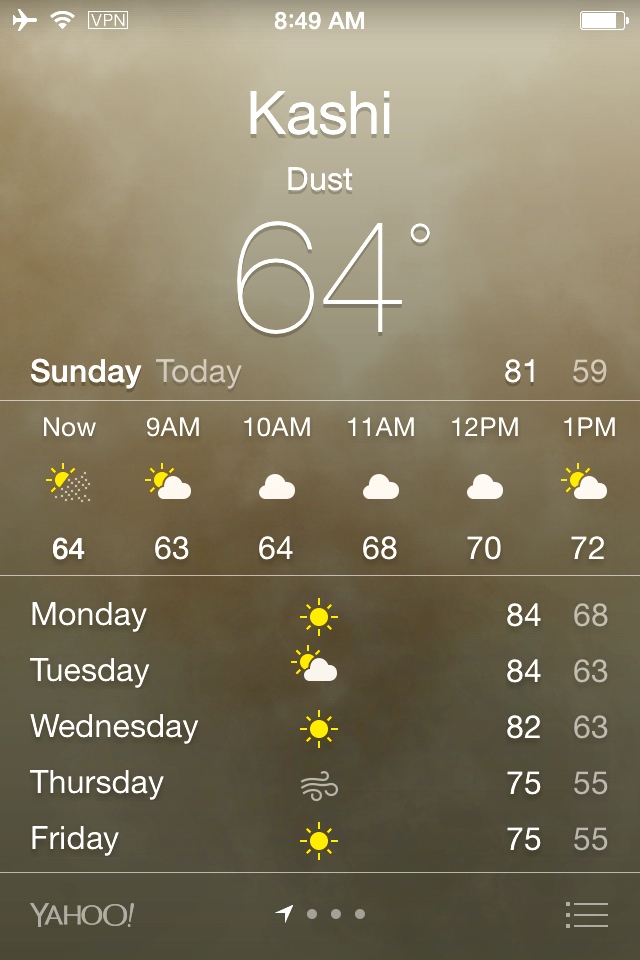
IMG_3067
::dusty with no chance of meatballs::

And here I thought the smog in Beijing would be suffocating, turns out Kashgar was the place we needed a gas mask. And, funny enough, they do place gas masks in the hotel rooms for purchase! China is crazy, man.

We had planned on a visit to Lake Karakol as a little day trip, but when we discovered that such a “little” day trip would entail about thirteen hours of driving and less than two hours of actually being at the lake (unfortunately there was some construction on the roads), we did some quick research to find an alternate option. Shipton’s Arch fit the bill, and we were quite pleased to be backed into the activity since it turned out to be really stunning. This arch is supposedly the largest freestanding arch in the world.

The drive in takes you through, basically, the middle of nowhere, though there is a nice brand new road leading up through the desert. And the drive affords some pretty neat views, scraggly camel sightings included.

We also saw this awesome lady prepping a giant pig’s head for what’s sure to be a feast.

Once at the parking lot for Shipton’s Arch, it’s a little hike to get to the base of the arch, and a pretty steep climb up a number of switchbacks to get the money shot. They’re busy building a staircase, and what appears to be the beginnings of a viewing deck, but for now it’s au naturel. The pictures barely convey the depth of this thing. It’s a spectacular view. I’ve not been to Arches National Park yet (seriously need to do that soon!), but I imagine this rivals it in scale if nothing else.

Sunday was obviously our day to check out the famed animal market, but since it was so great, and we have so many lovely photos (and video!) to share, we’ll be covering that in a separate post. We had the rest of the day to explore Kashgar’s other sights and so we did. The first, Abakh Hoja tomb, was definitely worth the visit, if only for the beautiful rose garden. The tomb itself was maybe not as impressive as others we’d seen in the ‘Stans, but the coloring was more green than blue and a lovely change of pace from the ones we’d been checking out over weeks past.

What we most adored about Kashgar was the old town. It really feels like you are stepping into the olden times. Where else can you see someone’s fat-tailed sheep tied up next to their Beemer?

We wandered into a blacksmiths’ shop and admired the men with remarkable aim and tolerance for heat. We meandered into a few other shops where locals sold their wares, ranging from lots of metal and copper products, to ceramics and woodwork.

The streets feel almost like India here, with crowds and activity buzzing everywhere.

We also checked out the Central Asian Bazaar, which was quite the market. It seemed to go on for miles, lined with stalls selling furs, carpets, shoes, spices, nuts, instruments, snake oils (literally)… you name it.

Also, how cute is this man?

We tried our best to get a photo of these hilarious assless pants the kids wear (I assume in lieu of diapers though it strikes me as an odd choice ripe for even less fortunate accidents), but there’s only so many attempts you can make to capture a shot of a baby’s ass without looking/feeling like a total creeper. Among other interesting baby accessories: they put their babes in these beds that are essentially long cradles with a hole. In the hole they place a ceramic pot, and the babies just go (as in using the toilet) into the pots. Fascinating, right? I’ve never heard of anything like that!

Craft street was lined with beautiful copper wares, and also some really good Turkish style ice cream. FYI, this is apparently where they filmed the Kite Runner.

Our last stop was the Id Kah Mosque. While the mosque itself wasn’t particularly mindblowing from an architectural point of view, it felt like a nice park inside with lots of trees. We also got a kick out of the propaganda on the signage.

And we started to see some of the awesome signage that proved to a be a theme throughout our stay in China. It seems like they have signs warning you about everything. I mean, there was a sign in the hotel shower warning that it could be wet, and hence slippery. Are there many people unfamiliar with the fact that showers get wet? Exhibit A (and do stay tuned for Xian and Beijing signs, because believe you me, they just keep getting better!):

Practical Info

Our Kashgar visit was coordinated through the same agency as our Central Asia travels. However, since this is our first post on China, I will cover the “can you travel in China independently” topic here. We went on to visit Xian and Beijing, and it was a tough decision whether to work with an agent or go it alone. We opted to go it alone.

I had received quotes from two agents for the Xian and Beijing portions, each of which included flights from Kashgar to Xian and the overnight train from Xian to Beijing (i.e. only five nights of hotels, not six as we chose in order to take the day train), plus transfers, hotels, and private guides. These quotes were both in the range of $1,900-2,500/person. This seemed shockingly high to me.

To make a long story short, we saved $2,000-3,000 by traveling independently. It was much easier than I expected. I will cover our flights from Kashgar to Xian and high speed train from Xian to Beijing in more detail in another post, but I purchased the air tickets on Ctrip’s English language site and the train tickets on the Travel China Guide website. We arranged a private full-day tour in Xian and a group Great Wall trip from Beijing. Locals were friendly. We took the subway in Xian and Beijing, and it was cheap and quite easy to figure out. Our hotel in Beijing had these neat little cards with top tourist sights written in English and Chinese, so you could hop in a cab and just point. Plus the hotel’s name and address were written in Chinese so you could get home, too!

Of course comparing a fully private guided tour with generally independent travel is apples to oranges. With the former you do not need to plan much nor worry about the details. But having just spent a few weeks with guides in Central Asia, we were really tired of all the history lessons and required interaction with relative strangers. So I would say we did not even want a fully guided tour in China, even leaving costs aside. Considering the thousands of dollars saved by going it alone, I am extremely happy we did China this way.

The exchange rate was 1 USD = 6.2 Chinese Yuan (CNY). Each place we stayed in China had electrical outlets that worked with US style plugs.

Transportation: We arrived from Kyrgyzstan via the Torugart Pass and covered that experience in more detail here. Since we worked with a travel agent, I never investigated the details of coordinating this. You can also cross the border from Kyrgyzstan to China via the Irkeshtam Pass. For onward travel, we flew to Xian via Urumqi. The airport was ~15 minutes from our hotel. There are some direct flights to a few cities, but most flights go through Urumqi.

Accommodation: We stayed at Tian Yuan Hotel. It seems pretty well-located, very near the Old Town and not too far from the Id Kah Mosque. Our room was spacious and nice. The WiFi did not really work, but it was great once they put a router in our room. The breakfast left a bit to be desired.

Food: At the markets and on the street there is quite a lot of food. We also ate at Karakoram Cafe, which serves a limited menu of Western food. The pizza was pretty good and the WiFi worked well. It cost ~120 CNY for a pizza to share (for two) plus a smoothie and soda. Dinner at the restaurant at the Chini (or Qini) Bagh Hotel was uninspiring (cost ~240 CNY for four of us). My dad and Linda ate at John’s Cafe and liked it.

Activities: The Sunday animal market is the biggest draw, and it is pretty impressive. Whether it is worth the effort required to visit Kashgar is another question. I would vote “yes,” because I rather liked Kashgar in general and the long journey here involved some wonderful scenery. For more information on the animal market, including a comparison vs. the Karakol (Kyrgyzstan) animal market, see our separate post here.

The Grand Bazaar (I think it’s also called the Central and West Asia International Trading Market, the Sunday Bazaar and other names, and it’s open every day but is most active on Sunday, when we visited) was fairly impressive. It is somewhat touristy, but mostly filled with Chinese tourists. There is a very large assortment of furs, shoes, spices (including exotics like dried snake, frog, lizard, etc.), nuts, carpets, instruments, toys, cloth, etc.

We didn’t see that much of Old Town and may have walked on a street restored for tourists. But it was pretty neat with blacksmiths, wood craftsmen, food carts, etc.

Abakh (or Apak) Hoja Tomb is a mausoleum along with a couple mosques. It cost 30 CNY each to enter. If you are coming from the ‘Stans and have seen glorious mosques and madrasas, you may be underwhelmed. Still, I thought it was nice and worth a visit.

Id Kah Mosque is in the center of town and any tour would probably visit here. It was OK but not terribly exciting or beautiful, at least compared to other things we’ve seen recently.

Our day trip to Shipton’s Arch was fun. The arch is a relatively unknown natural wonder, clocking in at 1,200 feet high by some measurements (it depends from which you side you view it and how you measure). It is very impressive. It took 1 hour 20 minutes driving from Kashgar, all on nice, paved roads. From there we walked on gravel plus some rocks and some metal staircases through slot canyons, culminating in a walk on dirt switchbacks up a steep hill to the arch. The round-trip hiking portion took us 2 hours 15 minutes, including some time at the top. They are doing a lot of work, so by the time you get here the path may be easier and there may be stairs all the way up to the arch. If you read about bad roads or rickety ladders, those articles are probably old…or possibly approaching from the other side??

We had intended to visit Lake Karakol but passed after our guide said it would take about six hours each way, partly on roads under construction. And this would have been the day after we spent nine hours in the car crossing the Torugart Pass. It is said to have wonderful mountain scenery, including multiple 7,000 meter peaks visible. There are options for multi-day treks in that area. We also considered a day trip to Davakul Lake, where I believe you can go camel trekking in the Taklamakan Desert.

May 16-19, 2014 (Friday-Monday)

Just Slip Out the Back, Jack. Make a New Plan, Stan. Seeya ‘Stans!

Ahh, our last few days in the ‘Stans. We checked out the yurts in Uzbekistan, but Kyrgyzstan’s nomadic culture just begged for some additional round accommodations. So, naturally, we drove out to the far side of Lake Issyk Kul to stay in a yurt for the night. This experience was much more rustic than our “fancy” yurt stay in Uzbekistan (as in no flushing toilets (though they weirdly had a Western style Porta Potty), no running water, no potable water, and certainly no showers). To be fair though, they provided lots of blankets and even a small space heater (much appreciated as it got COLD at night). It was also far quieter, as we were the only guests on the premises. So while we sadly missed out on the Russian serenading, we thoroughly enjoyed a little solitude among the peaks.

The best part, by far: the views! It was most certainly a yurt with a view. Though set back quite a ways from the lake, the yurts were nestled in a pretty phenomenal spot, with a view of the picturesque Lake Issyk Kul backed by snow capped mountains on one side, and more red stone mountains behind.

We walked down to the lake the first day and were pretty blown away. I’m definitely more of an ocean person than a lake person (speaking strictly for myself here, Alan goes both ways when it comes to bodies of water), but this lake was pretty awesome. It was a lovely turquoise color, had a sandy shoreline (with oddly reddish sand) and even had waves. While much too early in the season when we arrived, it’s rumored to be a very agreeable place to cool off from the hot summer heat.

After lunch at the yurt we explored Manjyly-Ata, a holy pilgrimage sight with sacred springs believed to cure a plethora of maladies. I think the Kyrgyz have been draining these dry though because we barely even saw trickles coming from them. Ah well, the views and the donkeys were worth it.

A few days later, on our drive out from the home stay, we stopped in a village to get an introduction to yurts (aka bozuy, in Kyrgyzstan) and how they’re made. We saw the intricacy and detail required to build the collapsible wooden frames, how they are hoisted together, and then covered in layers of felt and woven mats made from a tall grass called chiy. We even tried our hand at making some decorative chiy, and I’m disappointed to admit we were not as skilled as the masters (shocker, I know).

Our next stop was a village stay to get a feel for the rural Kyrgyz experience. While the accommodations were far from luxurious, we were really glad we got to witness this scene. The village we stayed in was tiny, maybe three or four blocks wide and a mile long (if that). You could see the whole place just by hiking up half an hour on the mountains nearby. And you’re more likely to see a horse than a car on the dirt road that runs through the center of “town.” Everything and everyone here comes from a radius of just a few miles. The family we stayed with are, like most of their neighbors, farmers. They farm potatoes, and at times carrots, beets, onions and garlic. They have their own horses, sheep, goats, chickens and cows. And these furry friends (mostly) live in the backyard.

Overall, the home had a fair number of modern comforts and conveniences (a television, DVD player, a dead fox on the wall… We got a kick out of the bedroom décor.), but the bathroom is rustic for sure. Getting there entails a foray through the animal pen to a small wooden outhouse with a tiny triangle cut out of the floor. I think it is uncommon to stay in homes like this, as most tourists visit later in the season and stay up the hillside in yurt camps (that were not yet set up for our visit). Clearly six months of travel through Asia has changed our standards a bit, as I was just excited that they had toilet paper.

We stopped in to visit the village school and were bombarded with cute kids. I mean, really.

We were even treated to a class rendition of the Kyrgyz national anthem (accompanied by the music teacher on accordion).

And a video for your listening pleasure…

The mother of our house cooked all our meals and we ate at the table pseudo-with her. (She speaks no English, so she kind of just watches you eat and then refills your teacup every few minutes). The food was actually pretty good, if you could get past the hairs in it (seriously, I think there was a hair in every item I touched. Woman needs some anti-hair-fall Pantene). But oh well, I suppose a few hairs are a necessary evil when all the food is so local it’s literally coming from the back yard. Lady made a mean chak chak (sticky sweet fried noodles). And as with many places we stayed in Kyrgyzstan, she provided some phenomenal jams, which we slathered on bread until the carb police had to pull us away.

To work off the lamb and jam we went on a really nice hike up the mountains behind the school. It was positively picturesque up there. Steep, rocky and craggy in parts, there were also wide valleys full of grazing sheep and their shepherd on horseback (who, by the way, was the only other person we passed on the trails). I loved that the local village has a carpool equivalent set up for their sheep: they take turns shepherding all the neighborhood sheep up the mountains to feed.

Up top (at perhaps 3,000 meters) we were afforded immense views of Lake Issyk Kul and behemoth mountains in seemingly every direction. Pretty incredible, especially once we realized some of these peaks were around 4,700 meters! That (almost) rivals the heights we reached trekking in the Himalayas!

I decided to hold down the home stay while Alan, Ron and Linda went horseback riding one morning. You know, my whole being afraid of everything, thing. Horses are such a prominent part of the Kyrgyz history and culture, and these were some well-trained steeds, so they enjoyed the outing.

In the hopes of finding a shower and a flushing toilet we moved to a different home stay the next night, this time in a town called Kochkor. The town was far more substantial, and the experience was more hotel-like than home stay, but trust me we were happy about the bathroom situation. And the dinner spread was impressive, complete with a tiered tray of desserts. No complaints here ☺

On the way out of Kyrgyzstan, we spent one uneventful night in the town of Naryn so that we could make the long drive across the Torugart Pass to China the following day. Naryn may have its charms, but I would not say they reveal themselves during a drive down the main drag. It’s in the mountains with a river running through it, but seems slightly more gritty than alpine cozy. We did little here other than get really excited at the thought of private flushing toilets in our room, only to be disappointed when the tank literally fell off the toilet and shattered in Ron and Linda’s room, which required shutting the water off in our adjoining room. To make matters worse, there was some confusion about whether our room bill was already paid or not. Yet another miscommunication by our tour operator, which fortunately we resolved without too much commotion. At least we got in a little excitement in Naryn, eh?

And, at long last, it was time to bid farewell to the ‘Stans. We (shocker) piled into the van for a long drive across the border, bracing ourselves for our old familiar and favorite (not) Central Asian pastime: overland border crossings. At first, the road was very smooth, and the scenery was quite beautiful. Then the road turned into dirt and while the ride was much less pleasant the view only increased in grandeur. It was remote, and beautiful, with nothing but pastures of sheep…

…stunning mountains…

…endless stretches of road surrounded by pastures of sheep and mountains…

…and a truck carrying a yurt. (Also lots of furry marmots running funnily. If you’ve never watched a marmot run, you’re missing out, man.)

It became impossible to hold out for toilets, so we used these lovely facilities:

And then we finally for once had a relatively smooth border crossing experience. I mean sort of…it still took hours, but this time mostly because checkpoints were as much as 70km apart. But by comparison, we had it good, since we picked up a poor stranded Dutch couple that had been waiting for their car from China for hours at the gate between Kyrgyzstan and China. And Torugart Pass is renowned as one of Asia’s most unpredictable borders, due to frequent logistically caused gridlock and weather related closures (it sits at an altitude of more than 12,300 feet!). Not to mention the lines of dozens of trucks sitting in a row on either side of the border. So I think we were pretty lucky.

Practical Info

Most of our time in Central Asia was arranged through a UK-based travel agent, but eco- and community based tourism are popular in Kyrgyzstan and thus we arranged a few nights of yurt and home stay lodging via Ecotour. This is the website: http://www.ecotour.kg. It is a good idea to bring drinking water or purification tools as potable water was not always available. And if you need your coffee, bring some instant grounds.

Kochkor is one of the centers for Kyrgyzstan’s budding community based tourism industry. Through outfits like CBT, Shepherd’s Life and others, you can arrange home stays, yurt stays, horse trekking, day trips to Song-Kul Lake, etc. When we altered some plans mid-trip, Ainura at Shepherd’s Life was very kind and helpful. To clarify here, we had arranged things through Ecotour, which has an office in Bishkek, and we were pleased with their services. But Shepherd’s Life got involved because they have an office in Kochkor, and so they coordinated the local changes.

A popular attraction in this region is Song-Kul Lake, which we might have visited had it been later in the season and/or we had more time. We also skipped Tash Rabat on the drive from Naryn to the border because we were worried about getting to the border early enough on a Friday to minimize the risk of missing the cut off and getting stuck until Monday!

Transportation: We arranged our own transport from Green Yard Hotel in Karakol to Bokonbayevo, where we met our Ecotour team. The drive from Green Yard was two hours. We paid 3,500 KGS for a (very) small minivan. The other options were 2,500 for a sedan or 5,000 for a luxury SUV. Green Yard helped us arrange this. We could have taken a public bus for much less money.

From Bokonbayevo our transport through Ecotour was a white Mercedes minibus, of the sort seen all over Kyrgyzstan. It took only 15 minutes to reach the yurt camp near the lake shore. The drive from the yurt camp to our first home stay was perhaps 30-45 minutes. From the first home stay to the second in Kochkor, the drive was longer but I don’t recall details. From Kochkor to Naryn, we crossed the Dolon Pass at nearly 10,000 feet elevation. The road was pretty rough much of the time, and this took 2.5 hours.

Our last day in Kyrgyzstan involved a very long and rough drive over the Torugart Pass. This border crossing was more pleasant than some of the Uzbek gems, but it was at least as bizarre. We left Naryn at 7:20 am and two hours later reached the first passport checkpoint. We said goodbye to pavement and bumped along for two more hours until we reached the Kyrgyz customs and immigration station. Three passport checks at this spot. Then we continued ascending to the high point of the pass, where we said goodbye to Kyrgyzstan and walked through a gate to our next van on the China side. Then we drove several km down the hill to the first Chinese checkpoint, where again passports were inspected, along with every item in my father’s bag since he had to empty it on the table after passing through the mobile x-ray truck. Continuing on, there was another checkpoint before we finally reached the actual Chinese immigration station. And we must say that these government workers were extraordinarily nice and friendly. It was such a welcome change, Jenni wanted to hug the lady!

A few minutes later, we were driving on a perfectly paved, divided highway…and we were ecstatic. There was a full nine hours of actual driving time from Naryn, Kyrgyzstan to Kashgar, China. You can also cross the border at the Irkeshtam Pass, but we were coming from a different part of Kyrgyzstan. Should you decide to cross the Kyrgyz/China border by land, be very diligent in your research and plans because there are many rules and pitfalls for the unwary. Things like you may need to arrive at the border by noon, and you may not be allowed to proceed unless the Kyrgyz officials confirm there is transport awaiting you on the China side.

Note that local time in China is two hours later, since that entire country uses one time zone. Be sure you understand whether people are talking about official Beijing time or local Kashgar time, because both may be used.

Accommodation: Three of the four nights covered in this post were spent in a yurt or home stay, all arranged by Ecotour. In Naryn we stayed at the Khan Tengri Hotel. There were some mishaps (noted above) and a lack of WiFi, though the property was fine and the onsite restaurant was quite good. It is far enough outside town that you could walk in but might not want to do so.

Food: Almost all our meals were covered by the Ecotour package, but I’m including this section to mention two things. (1) we had a yummy stuffed and rolled pasta type dish called oromo, and (2) it’s a good idea to carry water and ample snacks for these long drives, especially crossing the Torugart Pass.

May 12-16, 2014 (Monday-Friday)

Farm to Table: Kyrgyz Style

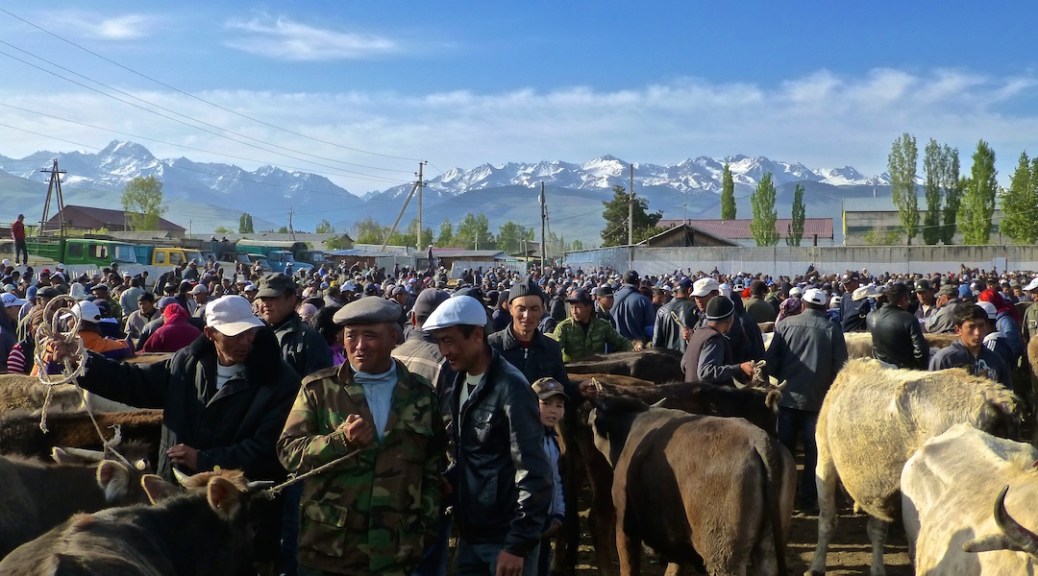
The Karakol Animal Market deserves its own post, because it was just that cool.

I mean, this is probably my favorite photo of all times. Doesn’t this sheep cuddle make you feel all warm and fuzzy inside and make you want to nuzzle someone or some thing!?

And how awesome is this photo-bombing Kyrgyz man?!

Only 15-20 minutes outside the town of Karakol, this craziness takes place once a week, every week.

What is it? A market where people bring their animals to sell, or come to buy them. Everything from fat-tailed sheep, to goats, to cows, to horses.

And it is madness. People and animals EVERYWHERE. Oh, and with animals comes animal poo. Be thankful you weren’t our shoes this day. Be very thankful. And remember to roll up your pants should you ever find yourself at the Karakol Sunday Animal Market.

I found the horse section particularly frightening given the instruction we received never to walk behind a horse, and the fact that this is physically impossible when the horses are packed into a field facing every which way. And they did not always look so happy to have people prodding them, checking out their teeth and feet.

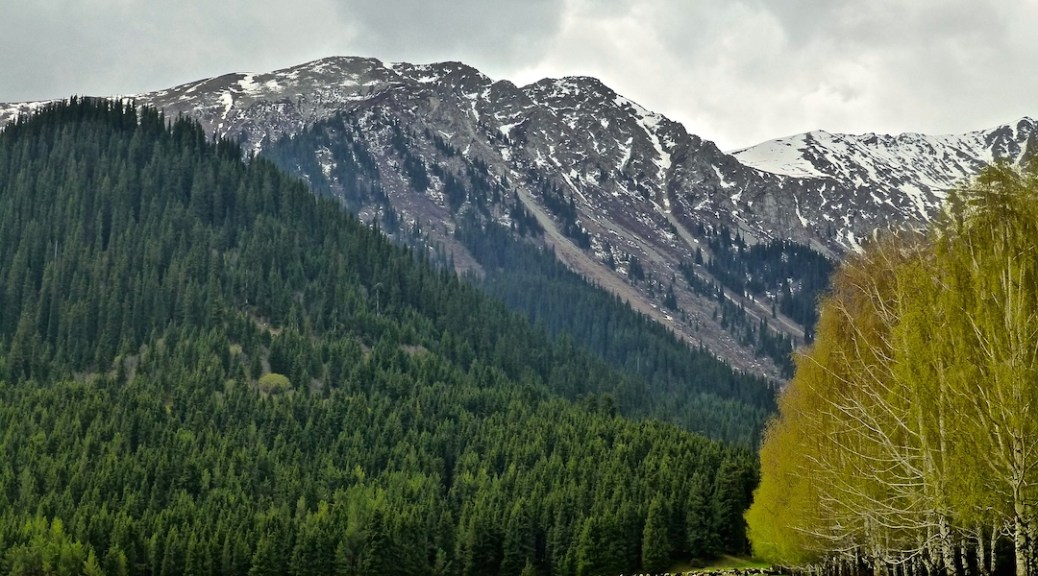
And because Kyrgyzstan is the vertically unchallenged beauty that she is, the whole scene is backed by this stunning snow-capped mountain view.

The parking lot alone was fascinating, as you get to see things like men napping with their calf tied to the car…

and people dragging their sheep by its front legs…

or people carrying piles of sheep…

If you’re wondering about the going rates for these animals, we were able to figure out that fat-tailed sheep go for about $100 to $150 a pop. The bigger the butt, the better. Or, as Aiperi put it, we appreciate these animals from behind. Here I am “appreciating” a sheep ass. Badunk…A-Dunk.

It’s not just animals here, but anything you could want for said animals, from grains to feed them, rocks for them to lick (I guess they like the salt?!), ropes to tie them up with and veggies to serve with them. Sorry vegetarians!

And since this is a Kyrgyz animal market, you can also get your vodka and cigarettes (at 7:30 am, and presumably for a while before we arrived). No former Soviet nation animal market is complete without a vodka and ciggie bar!

Almost as fun as the animals, was the people watching. We couldn’t get enough of the old men in the traditional Kyrygz hats. And their epic facial hair. While men were much more heavily represented, we did find some women in traditional garb checking out the goods.

This was undoubtedly one of the coolest experiences we had in Central Asia. Talk about a unique (and not super touristy) spectacle. We were lucky enough to witness not one, but two back to back Central Asian animal markets as we were in Kashgar, China the following Sunday. Stay tuned for that post, coming soon!

Practical Info

The animal market is held every Sunday. Timing is about your only decision here. I think the action starts in the wee hours of the morning. We left the Green Yard Hotel at 7 am and arrived at the market before 7:30 am. I think this timing was ideal, as it was late enough to be light out and not so cold, but early enough that we beat the tour bus which arrived as we departed. Allow 1-2 hours for your visit.

There were vendors selling liquor plus fresh fried dough, some grilled meats and roasted fava beans. We bought a satchel of the latter, and they were salty and yummy.

May 11, 2014 (Sunday)

You’re Like a Big Eagle, With Claws and Fangs, Mike

WARNING: THIS POST CONTAINS GRAPHIC PHOTOS. AWESOME, CRAZY COOL, GRAPHIC PHOTOS, BUT GRAPHIC NONETHELESS. Special heads up to animal lovers to proceed with caution (but hey, I’m an animal lover, too, and I thought this was amazing).

So, this is a story about the one time we met a Kyrgyz eagle hunter at a random spot on the side of the road to watch his eagle catch, kill and eat a rabbit. (Has anyone caught the Swingers reference by now? “And she’s just like a little bunny…”) And it was as cool as an eight-year-old boy thinks that sounds.

These birds are incredible. They can live to around 80 years old! This one is quite young actually (only four years old and already impressive in size), and older eagles can grow to be twice the size and are able to kill a wolf. A bird killing a wolf!

Hunters catch them by trap and train them. Once trained, the eagle works as a team with its owner, to catch prey. And this lucky bird at least gets to eat what he kills (or most of it). He also gets a sweet hat to cover his eyes.

Here’s how it went down. The eagle hunter’s assistant walked down a big hill with a rabbit in hand, and released it in the field. The poor little fluffy bunny rabbit made a futile attempt to run. Then our eagle hunter removed the hat from the eagle’s eyes, and within seconds he was flying on down, hovering over the rabbit for a moment before going in for the kill. He caught it without struggle, tearing its neck open with his claws to kill it.

The hunter went down to retrieve the eagle and the rabbit remains, and brought them up close for our viewing pleasure. The two men then severed the bunny’s head so as to save the body for the hunter’s bigger eagle back home, and we watched in amused and captivated horror/delight as the eagle devoured all but the very last bits of its skull.

For brave readers, check out this video (and be sure to note our freak out when the eagle swallows an ear whole):

Like, he pulled off and swallowed whole ears, eyeballs and brains at a time. According to the eagle hunter, the bird will vomit out the fur and bones tomorrow.

Our eagle hunter subsists solely on this eagle hunting business (and a Taigan puppy breeding business on the side. I’m going to need to get in touch with him once we’re no longer homeless, and see about importing a Kyrgyz hunting dog). Of course, he also breeds rabbits to maintain a big enough supply for his eagle hunting demonstrations.

This man loves his eagles. You could tell he wasn’t just saying it. He said the eagle is like a son to him, and by the way he looking lovingly into his eyes, and stroked his feathers while the bird shook rabbit blood onto him, I know it to be true. In fact, the eagle hunter’s wife and children take the backseat of the car. The front seat is reserved for the bird.

Practical Info

This eagle hunting demonstration was an add-on to the three-night itinerary we did with Ecotour. I think we paid 40 GBP. We did this on the drive from the yurt by Lake Issyk Kul to our home stay in Temir-Kanat village.

May 12, 2014 (Monday)

Balbals and Bulls

Bishkek was a shaky experience for us, so we were thrilled to get out and explore the Kyrgyz countryside. We set out for Lake Issyk Kul and for Karakol with high expectations and light spirits.

On the (long) drive out to Karakol we stopped to check out the Burana Tower. It’s an old tower, dating back to the prime Silk Road days, and now about 80 feet high having been shortened by earthquakes. We climbed to the top on a very narrow, dark, winding (but short) staircase. But what stole our attention were the balbal stones: ancient Turkic soldier stone markers. The stones depict the soldiers, and many are holding their swords and a cup full of the traditional Kyrygz drink: kumis, i.e. fermented mare’s milk. (P.S. we tried, despite our better judgment, to find and sample this treat, but apparently were there in the wrong season for alcoholic horse milk! Darn.)

The small museum onsite was densely packed with relics from the various religions that called the area home at one time or another. There were Buddhist figures and Arabic language carved stones, Zoroastrian ossuaries and plenty of bronze.

We also made a pit stop at the Petroglyphs at Cholpan-Ata. In this huge boulder field, you can wander around the stones, a handful of which have long-horned ibex, deer, hunters or other objects carved into their surface. The people who carved these believed in Shamanism and worshiped the sun, thus these carvings mostly face south towards Lake Issyk Kul.

From there, the long drive continued. Lest there be any doubt as to the quality of the roads, we got a flat tire. Luckily, the scenery was incredible, so we hung out and stared at the stunning view of Lake Issyk Kul and the abutting mountains while our driver changed the tire like a boss. Seriously, it’s like he has a background in the NASCAR pit crew or something.

Among the other weird things spotted on our drive: (1) We witnessed the end of a road race our guide believed to honor veterans. Each runner had a police car escort. What!? (2) We saw a group of men building a “billboard” of stones on the hillside. (3) We made a pit-stop on the side of the road and happened to have stopped under a huge collection of birds’ nests (and birds!). (4) We saw the Kyrgyz flag painted into the same hillside (their flag is red to symbolize blood, portrays a sun for a bright future, and utilizes the curved lines crossing of the yurt top). And (5) Caviar flavored Lays!

And finally we arrived in the town of Karakol. It’s a peaceful area near the lake but several kilometers from the shore. The neighborhoods are full of quaint white poplar-lined streets with gingerbread styled homes. It’s a popular trekking base and there is lift-served and heli-skiing nearby. One popular activity is the Sunday Animal Market (a highlight of the trip for sure, we’ll be covering it in a separate post because we have so many great pictures to share from that day!). The lake, in all its splendor, is probably the main appeal. It is the second biggest alpine lake in the world (behind Lake Titicaca) and the seventh deepest. It never freezes thanks to its extreme depth, salinity and some hot springs. The elevation is about a mile high and it has no outlet. It sits between the Kungey Ala-Too mountains to the north and the Terskey Ala-Too range to the south. The north side is more developed, with hordes of Russian and Kazakh visitors descending in the summer. We spent a night on the south shore of the lake after leaving Karakol and before arriving to our village home stay (to be covered in upcoming posts).

Our hotel was amazing (finally), and we gorged on the delicious breakfast spread of fried eggs, oatmeal, crepes, and pastries but mainly incredible fresh jams.

Outside the city is a lovely area called Djety Oguz, or Seven Bulls. This gorge got its name from the stunning row of red rocks that (don’t actually) look like a row of bulls, though we counted at least nine. Getting there requires a back and forth crossing of the river on narrow wooden bridges and a very primitive road, but the end result is well worth the effort. The green meadows are covered with cows, horses, sheep and goats, and then of course there are those gorgeous Kyrgyz mountains serving as the backdrop.

We especially enjoyed watching this young Kyrgyz boy come riding his donkey across the river and up to the meadow to tend to his sheep.

And then, in a perfectly random and awesome moment, a man came by on horseback with a PUPPY IN HIS BAG. Yes, man on horse + puppy in bag = awesome.

Back in town we hit up the religious Karakol sights. The Russian Orthodox church, built of intricately carved wood, is quite pretty. I stopped to pet a homeless dog before entering the church, and a woman, maybe deranged, offered me some food to feed the dog. When I exited the church a few minutes later, she handed me a flower and then, after I’d thanked her and headed back to the car, she yanked a branch of lilac off a tree and ran over to give that to me as well. She may be a mentally ill homeless Kyrgyz, but she’s a dog lover. So our souls are connected. Kindred spirits, if you will.

We also visited a Chinese styled mosque, which was not terribly exciting, given that we were not allowed to enter. Still, it was a colorful and eclectic building. We found it intriguing that there were signs at the Russian Orthodox church telling women to wear head scarves and no short clothes.

Practical Info

The small city of Karakol did not seem terribly exciting, but we loved the Sunday animal market and it makes a nice base for exploring the mountains. Note that Karakol is at the eastern end of Lake Issyk Kul, but several km from the lakeshore. There is lift-served and heli-skiing around here, I think the season is roughly December-February.

Accommodation: We stayed at Green Yard and loved it. It feels more like a guest house than a hotel. Our bed was enormous (two doubles joined together) and the furnishings were pretty nice. WiFi worked OK. The highlight for sure was breakfast.

Food: We picnicked or ate at Green Yard for all our meals. Dinner at Green Yard was good, but questionable value at 690/person. You order in advance and select a couple starters and entrees and everyone in your party then gets the same food. It did not measure up to the super high breakfast bar.

Activities: On the drive from Bishkek (which took maybe 5-6 hours of actual driving time) we stopped at Burana Tower and Cholpan-Ata, both covered above.

In Karakol, we had one full day and visited the Sunday animal market in the morning, then Djety Oguz later, and lastly a brief city tour of the Orthodox Church and mosque. It was a 15-20 minute drive from Green Yard to the animal market. We arrived around 7:30 am. I’m told the market starts like 3-5 am and ends at 10 am. I liked our time. It was fully light out and not so cold, there was still plenty of activity, and we were about the only tourists for most of our time there. By the time we left, a tour bus had arrived.

The drive to Djety Oguz from Green Yard took 1-1.5 hours (I think). Our van was 4WD with good clearance, which was important as the road to get up higher was rough. We stopped in a somewhat nondescript (but gorgeous) spot after crossing the river back and forth several times, and ambled up the road/meadow for a bit before turning around. I think there are real hikes, and maybe multi-day treks, around here.

There was no fee to enter the Orthodox Church, but a sign advised that women should have head-scarves and long clothing. The mosque seemed to indicate a fee, but I don’t think our guide paid anything, and we were not permitted to enter the building.

May 10-12, 2014 (Saturday-Monday)

Kyrgyzstan. It’s a Country.

True story: I visited a country that I didn’t know how to spell until after filling out my customs form. Whoa, that makes me sound ignorant. Did everyone else know there is a “z” in Kyrgyzstan?! I’m just gonna bank on the fact that probably half of Americans have never heard of Kyrgyzstan. 😉

By way of introduction for those that may have actually never heard of Kyrgyzstan, it is a Central Asian country comprised almost entirely of a “massive knot of colliding mountain ranges,” to quote Lonely Planet. These mountains and “their associated scraggy valleys, glaciers, gorges and ice-blue lakes dominate over 90% of the country.” In fact, the national hat is a big tall white thing that is designed to look like a glacier. The Kyrgyz people originated in Siberia though today they appear Asian given the Mongol influence and general assimilation and intermarriage. They are historically nomadic, and hence the yurt (and horse) plays a prominent role in the culture. There is a large Russian influence, what with the Lenin statues, Soviet style buildings, and Cyrillic script (we even learned some of the Cyrillic alphabet –enough to spell my name at least (Snowflake, E, H, H, backwards N…женни)). But the language is Turkic. Manas is the mythical national hero, and the epically long eponymous epic was composed entirely in oral form given the lack of written language among these nomadic folks.

Our welcome to Kyrgyzstan, as alluded to in prior posts, was less than pleasant. After a six and a half hour drive from Tashkent without food or bathroom break and a particularly infuriating and invasive bag check at the Uzbek border, we were in a rush to make our flight as a result of the failure of our Uzbek tour guides to comprehend time. Our true first taste of Kyrgyzstan was (very, very) briefly a pleasant change from our Uzbek farewell. After nearly an hour on the Uzbek side, we dragged our bags across the border. Sweating and incensed, we were greeted by a uniformed border patrolman. I looked at the man and asked, “Am I in Uzbekistan or Kyrgyzstan?” His response, “Kyrgyzstan. Welcome,” was the sweetest thing I’d ever heard. I gave him an exasperated thank you and quickly pushed forth my passport.

The warm fuzzy feelings dissipated quickly as we met our new local guides in Osh, realized the time had indeed changed, and then rushed off in a hurried manner to catch our flight to Bishkek. Having not eaten since an early breakfast, and grown more and more furious as the long day wore on, we realized after we were dropped at the airport that we had no local money and thus no way to obtain those delightful looking M&M’s and Sprites behind the counter. (And OH EM GEE, did those look like the most delicious thing I’ve ever seen after weeks of plov.) From here, it’s a little unclear what happened. What I do know is that I asked the cashier if I could pay her with either Uzbek Sum or US Dollars (which in no way proves that I’m American, but I suppose that could have been the hint). Her answer was no. A few minutes later Alan heard a man near us use the word “Ukraine,” but other than that we could not understand him as he was speaking in Russian (or Kyrgyz, who knows). And then he looked at us with eyes full of misplaced fury and proceeded to spew a diatribe smattered with “American” and angry fist motions. We stood quietly by indicating that we had no idea what he was saying and that we were not inclined to engage in a fight with him, and watched as he garnered the attention of the entire airport terminal to scream and point at us bad, bad Americans. To be the recipient of such undeserved and undiscerning hatred was scary enough. But what really scared me the most was the fact that not a single soul felt the need to provide us with comfort or try to calm this man down. No security guards, no brave passengers made a peep. No one came up to us then or throughout the half an hour we waited to board a flight with this crazy man. No. Instead, we saw a handful of young men walk over and basically high five the guy. Then we waited and got on an airplane with the whole lot of them. Still, no one would make eye contact with us, though they did stare at us. To say we were disgusted would be an understatement. I have no words to accurately describe the way I felt at this point in a long and trying day of travel (the worst I think I’ve ever experienced in my life), but I did feel myself having a newfound sense of compassion for people who’ve ever had to bear the brunt of that kind of senseless hatred.

By the way, what makes it even more scary is that after we’d landed in Bishkek, a sweet woman came up to Linda in the baggage claim area and began to chat with her, but no more than a few minutes went by before Anti-American man came over, said something in Kyrgyz or Russian to this lady and scared her away. She didn’t even say goodbye to Linda.

And I suppose this taught us that with everything going on in Ukraine, it was not an ideal time to travel in an area with lots of Soviets. The reality is we’ve no idea what spurred this man’s outburst, and even if it is related to Ukraine, we don’t know whether he was angry because the U.S. is pushing back against Russia or because the U.S. didn’t do enough to help Ukraine! Of course, there are narrow minded and aggressive people everywhere, and many in the U.S. But it is quite sad.

To state the obvious, we were a little uneasy after this. Top it off with the fact that Bishkek, the capital city and our first Kyrgyz destination, has a more extensive list of travel warnings than most places we choose to visit. It probably didn’t help that our hotel had metal detectors at the entrance and hotel staff checked the underside of our van for bombs before letting us pull in (though only some of the time, so that’s comforting…). I kind of feel like we spent the first three days trying to convince our guide that it only takes one person to ruin an experience and/or cause injury (be it emotional or physical) and that we do not believe that all Kyrgyz people are bad. She spent three days trying to convince us that Kyrgyz people are nice. Most of them are, really. And I’m the first to admit there are bad apples in every barrel, but I think we were justified in our decision to skip Victory Day celebrations, the nationalist holiday celebrating the Soviet Union’s WWII victory where lots of Russian-heritage Kyrgyz people might be drunk and hanging out in large crowds.

Bishkek was much more modern and Western than the cities we’d seen in both Uzbekistan and Turkmenistan. (Though as with most places, Kyrgyzstan is more traditional in the villages, and in the city people dress in skimpier, more Western styled clothing, etc.) While Kyrgyzstan is the poorest of the three (they have no oil or gas, and the main sources of income are hydro-power, some gold mining and some farming and cattle breeding), the streets were somehow filled with luxury cars (BMW, Lexus, we even spotted a Tesla). Fun fact: the Kyrgyz drive on the right, but many cars have steering wheels on the right, since they just import cars from wherever they are cheapest! (And if you’re wondering if this causes accidents, let’s just say that our van sideswiped a parked vehicle our first night in town). And the western influence was far more palpable here. For instance, we used our credit card!!! At multiple places! And there were grocery stores with bar code scanners. And they, too, accepted credit cards!

A large part of what attracts tourists to Kyrgyzstan is the natural beauty, and that allure is apparent right from the get go. Bishkek is dubbed a green city, and it does seem that way (I mean, check out the view from our hotel room) but one of the biggest selling points in our opinion is the access to nearby mountains like at Ala Archa National Park. You can even ski just a short drive from Bishkek!

A relatively short drive (maybe 45 minutes) took us to Ala Archa National Park for our first up-close enjoyment of Kyrgyzstan’s natural beauty. We were thrilled to stretch our legs for a bit and get in a little exercise (read: start walking off all that lamb!). The views were quite stunning from the start, as we began hiking up a trail through a canyon with views of a rushing and rocky river and rugged snow-capped mountains on either side. Alan and Ron felt the area reminded them a bit of the landscape in Switzerland or New Zealand.

It was remote feeling, and we bumped into fewer than five other people our entire time on the trails (though, to be fair, there were a number of young Kyrgyz people picnicking and drinking closer to the base of the trail).

The wildflowers were pretty beautiful, as well.

We stopped a little ways up for a picnic lunch, and enjoyed some bread, cheese, fruit and nuts (purchased on credit card!!!).

Alan, Aiperi and I carried on in search of the waterfall (which turned out to be more of a trickle), but we were treated with some awesome animal sightings. Marmots! Such fat and furry and awkward movers, I love these guys.

And later we came upon a large group of mountain goats. It is pretty spectacular to watch these things move. I startled one on the trail when I turned a bend, and we stood their, jaws agape, as it bounded down to the river, across, and back up the other side with such speed and agility it was hard to believe it really happened. Sadly, no snow leopard sightings.

Also a quick and easy day trip from Bishkek is the Issyk Ata Gorge and Sanitarium. This visit happened to coincide with Victory Day so we did have a quick police check on the way to confirm that our driver was sober (glad to see this care taken to prevent drunk driving, but a wee bit nervous that this is necessary at 9am). The area is lovely and we couldn’t even make it there without a few stops to admire the stunning poppy studded fields and green hills backed by Kyrgyzstan’s craggy mountainous landscape.

Issyk Ata is sort of like a wellness retreat. This is the closest thing I could compare it to in America. There is a “hospital” on site, but its services are more holistic than surgical. There are springs from which people drink the water, and from what we could tell the main attraction is one large hot spring in a concrete pool where locals come to swim. (In fact, it was almost all locals, I’m not sure we saw any other foreign tourists.) There are also some old Buddhist carvings, and as per usual, some really cute little kids.

Though we all came wearing our “special costumes,” as Aiperi called them, Linda and I opted to observe while Alan and Ron checked out the pool for themselves. I found it amusing that it was treated like a community pool, with kids running around and playing as if it was a regular, cool pool rather than a giant hot tub.

There were also hoards of Kyrgyz people picnicking and hanging out in yurt-like cabanas on the grassy hills nearby. We quickly learned how popular this pastime is for the locals. It seems that whenever there is a holiday, a birthday, a cause for celebration, or just free time, friends and families gather with food and drinks at the nearest outdoor space for a good old fashioned picnic. Now that’s a national pastime I can get behind. The horse slaughter wedding ritual? I’m still on the fence about that one.

We escaped any Victory Day related drama save for a drunk old man picnicking (on vodka) at Issyk Ata who asked Aiperi where we’re from in a tone we cautiously viewed as angry. Thankfully, by now we had instructed Aiperi to let anyone know we were from Canada. I don’t know if he was on to us, or had just never heard of Canada, because his response was, “America? [drunk Kyrgyz mumbling]…America?”And by skipping the festivities we actually made it back to our hotel in time to discover we had a perfect view of the fireworks from our balcony.

The food options were also more plentiful in Bishkek, and included more western style options (still no McDonald’s or Starbucks though). Our guide, Aiperi, impressed us with her restaurant selections and we feasted on some glorious non-meat-and-potato dishes (even sushi!) for a few days before heading to the more rural areas where we would again overdose on lamb. I even joined Aiperi on the dance floor at one of the restaurants that had a bit of a clubby vibe to it. Kyrgyz girls can move those hips!

Practical Info

Unlike its neighbors, Kyrgyzstan does not require a visa for US citizens. In fact, we didn’t even fill out a customs form to enter the country. And they never collected our passports at a hotel! You could travel independently here, but it would be fairly difficult. If you speak Russian then it’s probably not as hard, and Turkish would help a bit, too. 1 USD = 52 Kyrgystani Som (KGS).

We visited in mid-May, which is before the peak season. Combining Kyrgyzstan with Uzbekistan and Turkmenistan made it hard to time each perfectly, because later in the season those other countries will be scorching. The downside to visiting this early is that certain higher altitude yurt camps, treks, roads to lakes, etc. are either not accessible, or not reliably accessible such that you can make plans assuming access. The upside is it was never too hot, nor crowded. Perhaps you could do a Central Asia trip at the end of summer and time it to arrive after the sauna in certain places and before the snow in others…but I’m not sure.

Bishkek is somewhat more modern feeling than we expected. Credit cards are accepted at many establishments (generally only Visa, though). There are plenty of 24-hour supermarkets. We were still reeling somewhat from our Osh airport experience and the various travel advice warnings, so I wouldn’t say we relished our time here or saw that much of the city. Seems to us that a lot of the appeal anyway is the gorgeous surrounding mountains, which you can visit at places like Ala Archa National Park.

We bought our first SIM card in Central Asia, choosing Megacom. The purchase required a passport (one for the two of us) and the cards cost only 80 KGS each with I think 45 KGS of credit on them.

Transportation: We flew into Bishkek from Osh on a Pegasus (Turkish airline) flight. The drive from the airport to Ak Keme Hotel was maybe 20-30 minutes. We always had a car with driver. Our guide and many national travel advisory sites recommend against walking around much at night. They also recommend using only radio-dispatch taxis.

Accommodation: We stayed at Ak Keme Hotel. It was passable, at best. It is a large building and in the summer the pool would be open. The A/C did not work in either of our rooms. Breakfast was mediocre. In a city alleged to be not so safe, the rooms had no deadbolt or chain and no peephole. The security guy at the property entrance once used the long mirror to look for bombs under the car, and there is a metal detector at the building entrance. Another large, generally devoid of character hotel. Our guide pointed out the Jannat Regency (and called it five-star), which was near many nice-looking restaurants but maybe a little outside the city center?

Food: The food here was far more varied, and generally better, than what we found in Uzbekistan or Turkmenistan. We enjoyed each of our dinners at Tubeteika, Barashek, and Arzu. The menus were extensive and the alcohol generally cheap (like $4 for a JW Black). All accepted Visa.

Activities: We did not do that much in the city. We made two day trips. The first was to Ala Archa National Park. The park entrance is ~30km from Bishkek, and the road ends 12km beyond here. That is where you’ll find a lodge (seasonal?) and some well-marked hiking trails. The second was to Issyk Ata hot springs (farther from Bishkek, maybe a two hour drive) where we paid 60 KGS each for 45 minutes of access to the hot spring filled pool. Beware the scalding water pouring out of the pipe! The bare bones cafe served some tasty lagman.

May 7-10, 2014 (Wednesday-Saturday)

A Feisty Farewell

No trip to Central Asia is complete without some yurt action, so naturally we had to check it out and see what it’s like to spend a night in a yurt. If you’ve read any of our other posts on Central Asia, you will probably not be surprised to know that getting to said yurt involved a pretty rough, long drive. The landscape was all desert, not so much sand dunes, but lots of patches of about 6-inch high plants and nothing else. We stopped in this one area that seemed to pop up out of nowhere, with just a few trees and tons of locals picnicking, which was completely random and really fascinating.

While here, we climbed up the slate rocks to check out some very old petroglyphs. Up top, a local guy showed us a scorpion he caught and somehow maneuvered into a water bottle. It’s probably for the best that we declined to share this piece of information with Linda until after the yurt stay was over.

When we finally arrived, we were smack in the middle of the hot hot desert. There wasn’t much around except for a handful of yurts and a few camels, though our yurt accommodation was surprisingly fancy – we got thick mats to sleep on, there was even a light and a power outlet in the room, and get this…flushing toilets on the premises! Living large, my friends.

Alan and Ron went off to explore Lake Aidarkul for a quick and refreshing swim. Meanwhile, Linda and I stuck around at the yurts for a camel ride. Our camel guy seemed to be mildly infatuated with me, and I was hesitant to include this on here because it makes me all bashful, but I got a kick out of the fact that in Alan’s notes from this day it reads “J and Linda do camel ride, guess guy loves J. Natch.” Aw, honey.

Dinner was a multi course meal amongst the other tourists in a bigger tent. We drank a little vodka, busted out the cards and played a little dhumbal, and then everyone headed outside to the campfire where a Kazakh (the yurt camp was near Kazakhstan and thus many local residents are ethnic Kazakhs) singer and guitar player serenaded us. The Americans headed to bed afterwards, but the Russian tourists stayed up late very passionately (read: loudly) singing some patriotic songs.

As a telling example of the monitoring and control the government does and has, know that tourists must “register” at every hotel they stay at. These little stubs we receive when we hand over our passports at each stop must be presented upon exiting the country as proof of where we’ve been. So, even at this yurt in the middle of the desert, we had to use our passports to get documentation to serve as proof of our whereabouts. I’m starting to get the feeling that the government likes knowing where we are!

On the drive out to the yurt we had stopped in Gijduvan for a demonstration of the pottery workshop. You know this guy is legit, because he met Hillary.

We also stopped briefly to see a fortress built by Alexander the Great (holy oldness!) and to see the holy water spring and holy fish (so much holy in this sentence!) at the base of the fortress. While Ron and Alan climbed up top for the view, Linda and I stayed down and chatted with Mansur. A very curious Uzbek tourist was intrigued, and, speaking no English (or anything for that matter), stood about three inches from my face and watched me as I spoke and listened. I tried to be polite but my personal space bubble was just bursting and I finally had to run away from her in the awkward, shamed way that us space-bubble activists do. By now we were quite used to being among very few tourists (meaning foreigners, as we saw tons of Uzbek tourists) and used to people saying hello, wanting to know where we’re from, etc. We joked with our guide that we should just wear a big sign that says “AMERICA,” since he was constantly fielding the same question from curious Uzbeks as to our origins. Luckily, all the Uzbeks we encountered responded with enthusiasm, or – at the very least – tolerance (sadly, this was not the case for all of our Central Asian visit).

We left the yurt early in a best efforts attempt to escape the desert heat before it was at its most oppressive. It was Samarkand or bust! By now, by the way, the views on our drives were becoming more and more incredible. Beautiful pastures backed by stunning snow-capped mountains. Every so often a boy riding a donkey, or a shepherd tending his herd of cattle. Or sheep. And then these fields of poppies. I can’t even stand how beautiful it was. These photos are not even properly taken. They’re car shots. From a moving van. You can see the reflection of the camera in the window. And the blur from the speed. And it’s still the most amazing pastoral scene.

And then, the pent-up excitement was killing us. We’d been teased by these mosques, these madrasas, these caravanserais, these architecturally and historically significant buildings. One after another of impressive, amazing, intricate, beautifully tiled, older-than-old things. But we knew the icing on the cake would be Samarkand. Oh, Samarkand, the holy grail of Silk Road destinations. And here it was, at our fingertips and ready for our incessant photo taking and endless stories of ancient Islamic tall tales. And this is what we arrived to:

Wouldn’t it be our luck that our trip to Central Asia coincided with a period of construction and renovation on perhaps the most noteworthy historical sight among all of the Silk Road’s sights. I can’t lie, after all the history we’d soaked up like a (partially functioning) sponge, we were not quite in the right state of mind to truly appreciate the awesomeness that is Samarkand’s Registan Square, but this construction really did us in. We could hardly appreciate the grandeur of these buildings. Their scale puts the ones we saw in Tashkent, Khiva and Bukhara to shame, but it is very difficult to appreciate from the side, with jackhammers screaming (as evidenced by my face in that lovely video). I think part of what detracted from our experience here as well was that there were so many souvenir shops in, and modernization evident on, the buildings – for example, plastered walls and lights installed in the rooms to create better gift shops. Restoration is one thing, but some of this felt more like alteration and enhancement. We did not realize that all three enormous buildings on Registan Square were built after Tamerlane’s rule. By the way, Tamerlane is the same guy as Amir Temur.

Our first afternoon in town we were on our own, so we wandered around a bit independently. We meandered down the walking street, which used to be lined with stalls and covered. There is a bit more of a regular city vibe here (short shorts sighting included – though jeans are still a rarity). It’s not too surprising given that it’s the second most populous city in Uzbekistan at about a half million people. While the walking street is lined with souvenir shops and feels quite sanitized, it is a very pleasant place to kill an afternoon.

We ventured into the Jewish quarter in a search for the synagogue. By chance, McLovin happened to find us and show us the way. Not kidding. This kid had the lisp and everything…is this not the Uzbek twin of McLovin?!

We escaped the heat with a soft-serve in the shade. When in Samarkand do as the Uzbeks do?

There is also a nice little market off the walking street.

Aside from Registan Square, we also visited the first mausoleum of Amir Temur, where he is buried among others. It’s decorated with marble, papier-mâché over brick, gold leaf adorning everywhere, and the tomb is black jade.

What still managed to impress us mightily after all the sightseeing we’d done by this point was Shah-i-Zinda, a narrow street lined with mausoleums so densely packed and intricate it’s hard to fully absorb what’s surrounding you. This was by far the most impressive tile work we saw on the trip.

The tile-making process is incredibly intricate. Check out these pictures that give you a little sense of how much work goes into each one.

Our next stop in Central Asia was Kyrgyzstan, and getting there was quite the ordeal. After a change in schedule made the Tashkent to Bishkek flight less appealing, we decided to drive from Tashkent and cross the border at Osh, Krygyzstan, followed by a domestic flight from Osh to Bishkek. This was probably a mistake. We will cover the Osh airport incident in a separate post, but even getting to that scene was not an easy process.

The drive was much longer than our travel agents (both local and foreign) said it would be (how neither organization, whose functions entail solely guiding tourists through these countries, could figure this out is beyond me), and thus we spent 6.5 hours in the car without time even to stop for toilets or water. There was some beautiful scenery, and, this is still Uzbekistan, so there were also some checkpoints. I mean, why would anyone think you can move around freely within a country? One checkpoint involved getting out of the car and waiting while watching our passports get tossed onto the hood of someone else’s (moving) car. But anyway, after 6.5 hours we arrive at the border for our final Uzbek exit, already frazzled about the timing mistakes (plural. Aside from driving time, neither travel agent realized there was a time change at the border, despite our efforts to confirm this given the time change in Bishkek) and potentially missing our flight and being stuck in a Kyrgyz city that some State Department equivalents recommend avoiding. The border officials know we are in a rush, and this appears to inspire them to be extra slow and spend extra time talking and joking about us while we stand there. And there is certainly no right to privacy here, or at least the border control folks have no concern violating it. This is evident as the bag searches begin. The situation came to a head when one guy made me take out my laptop, open my photos (I guess because you are not supposed to take photos of certain things and places, the authorities feel entitled to search your photo files upon exit) and then started going through not only the photos from our time in Uzbekistan, but proceeded to peruse my older photos, including a photo album I’d made for Alan after our first year of dating. At which point I, in the middle of this border control building and surrounded by about six employees doing nothing but helping themselves to a tour of my photos and belongings, barely able to contain the rage bubbling up inside of me, slapped his hand away and grabbed my computer back saying something along the lines of “enough, this is ridiculous…[mumble lots of swears].” Though he certainly wasn’t able to decipher what I was rapid-fire shaming him with, I told him in no uncertain terms that he had absolutely no right to be going through those photos. As Alan points out, it was a bit of a ballsy and risky move, but it was a highly effective one, because a few minutes later we were walking across to Kyrgyzstan. And this guy clearly knew he was doing something wrong, as that was the end of all the bag checks. Alan’s was cursory at most. Hopefully I succeeded in shaming him to some extent, though this was not the end of the authorities prodding out of some perverted curiosity with further questions. Can I just say that it’s never given me greater pleasure to look a man in the eye and say, “I’m a lawyer.” This series of events filled me with a lot of rage. In retrospect, what was I to have done? Not opened the computer? Told him I had no photos? To be at a border crossing, confronted by these men is to be in a place of no power. They hold all the cards. Power does strange things to people, doesn’t it?

To summarize our time in Uzbekistan, we spent cumulatively about 10 days there. I think we all agree that we may have bitten off slightly more than we could chew in the history and sight-seeing departments, even with cutting out a number of the other Silk Road cities. We generally prefer more culture or interaction or activity on our trips (and definitely less time spent driving). But overall, we found the experience in Uzbekistan to be fascinating and worth the headaches (e.g. even despite the immigration and customs headaches). Aside from the gems hired to work its borders, the people we met in Uzbekistan were wonderfully pleasant and friendly. And it’s a tough balance to figure out because, while the security presence and red tape bullshit in Uzbekistan got very tiring, very fast, we really did feel safe here. Contrast this with Kyrgyzstan where we didn’t need a visa (in fact we did not even fill out an immigration form), didn’t have to register at our hotels, weren’t subjected to arduous border crossing processes, and didn’t get pulled over at numerous checkpoints. That was lovely, but Kyrgyzstan has a higher crime rate, and we actually felt the least safe in Krygyzstan of any country we visited (again, more on that later). Uzbekistan was unusual in many ways, and very much a different experience from most of our prior Asian travels (and really all of our travels, ever). From small, interesting nuances like the fact that drivers already in the rotary do not have the right of way, to the Soviet style checkpoints, form checking and border control, it was a place unlike any other we’ve been. There is so much of interest to see here, we feel it would benefit the country much to fix some of the issues that inhibit tourism here (e.g. making visas easier to obtain and fixing the currency issues we detailed in prior posts).

Practical Info

Transportation: We took a high-speed train back to Tashkent. There is a cafe and a couple stalls selling snacks at the station. We boarded at 4:20 pm (our guide said you should board early, he may have been just trying to go home) and the train departed (exactly on time) at 5 pm. It was incredibly nice with spacious seats that reclined. I guess we were in business class, not sure if they sell lower classed seats or what those would be like. They served complimentary tea and these tasty little burrito-like things, plus a wide selection for purchase. We arrived in Tashkent a little after 7 pm.

Accommodation: In Samarkand, we stayed at Hotel Malika Classic (not to be confused with Malika Prime). WiFi worked reasonably well, and it we paid 3k UZS for access for the whole family on unlimited devices. The hotel was quite nice and the staff was friendly and helpful, but it seemed a little removed from the action. That said, I’m not sure where the action is.

Food: My dad and I had dinner at Venezia where we got pizza, which was fine and a welcome change. With two beers and water and tip it cost 35k UZS. Lunches were at Sayor Cafe (right next to Karambek which gets good reviews, and I think the same owner), which was good, and at the Choyxona (aka tea house) by the bazaar near Bibi-Khanym Mosque, where we had manti and bread and yogurt and cucumber and tomato with dill and soup.

Activities: We covered most of this above, but I’ll add some more detail and/or repeat here. Our travel agent arranged the trip to Lake Aidarkul and the yurt stay, but we saw tourist offices advertising a similar overnight trip from Samarkand and likely other places. While I enjoyed the scenery and overall experience, it is pretty out of the way and thus if you have limited time then I would say this is skippable.

In Samarkand, while exploring on our own the first day, we walked through some back alleys and saw the Mubarak Mosque and nearby synagogue. On our full day tour, we visited the Amir Temur Mausoleum; Registan Square; Bibi-Khanym Mosque; Siab Bazaar; Shah-i-Zinda; and Ulugbek’s Observatory.

May 4-7, 2014 (Sunday-Wednesday)

Bukhara: The Living City

After another long Central Asian drive and even longer Central Asian border crossing we were back in Uzbekistan, this time bound for Bukhara. We freshened up quickly at our hotel (necessary after the mile-long walk through no man’s land in the desert heat between Turkmenistan and Uzbekistan) before heading out for a night of Uzbek food, fashion, dancing and music. This dinner, at the madrasa Nodir Devon Begi at Lyabi Khauz complex, was a lovely welcome back, and we thoroughly enjoyed our dinner (including a surprisingly not horrible Uzbek wine) while being entertained by a show alternating between fashion and traditional dance. (Very dorky) fun fact: the “madrasa” was built to be a caravanserai, but the king misidentified it as a madrasa at its unveiling, and the poor guy who built it couldn’t correct the king of course. So this is why it’s an atypical structure for a madrasa, and why you can walk straight into the courtyard (unlike other madrasas where you must go right or left upon entrance). Maybe it was that Uzbek wine, but I got inspired to shop. I’m kind of digging the Uzbek style. So much so, in fact, that I caved and bought my first “real” souvenir of the trip: a lovely Uzbek jacket.

Walking back through the old city after dinner it was immediately apparent that Bukhara is not the museum relic that Khiva is, but a living city. People are out and about everywhere, dining, drinking, shopping, laughing. It’s far more vibrant. Also more western and touristy, but overall a nice mix of activity. And we aren’t complaining about access to some of those “touristy” things we’d been missing, like ice (Alan loves his iced coffee). So enamored were we that we returned the following night to Lyabi Khauz, a plaza built around a pool shaded by some seriously old mulberry trees, for dinner at a nice restaurant on the water.

Bukhara is one of the seven holy cities of Islam because the religion developed so much here. Real religion or history buffs can have an absolute field day here, visiting as many of the 997 historic monuments as they can fit in. It’s all the more impressive when you realize that many of the buildings in Bukhara were destroyed when the Mongols invaded in 1220, and again when the (Russian) Red Army attacked and bombed the city in 1920. We had neither the time nor the attention span to see all of these, but we did get a good sampling, starting at the first building in Central Asia built of fired brick (the Ismail Samani Mausoleum) and which served as the prototype for India’s famed Taj Mahal.

The Bolo Khauz mosque, built in 1713, with an ayvan built in 1917, was particularly stunning, and we sat there on a Friday morning observing a group of old men waiting for the Friday services.

Alan and Ron got in touch with their roots for a change when we stumbled upon an old synagogue, which is home to the handful of remaining Bukhari Jews. (If you are interested in learning more, check out this New York Times article on the community in Queens.)

The gigantic fortress was impressive. It was here, of all places and all things, that bowling began when guards used to roll giant rock balls down the entrance to defend it! But what we enjoyed most was the impromptu flash mob of Uzbek ladies. (Funny enough, these are the same ladies from Fergana valley who we laughed with as the two groups of us stood around photographing each other).

Check out the video:

We executed our first black market money exchange here in Bukhara and you really feel like you’re doing something illicit when a guy your guide knows through a guy shows up with a black bag full of bills, crouches down all shady to count it out and then makes the exchange. I half expected to find a couple packets of smack in that bag. Just to be clear, this was the first black market exchange that we personally conducted. Earlier that same day, the driver who gathered us from the border crossing pulled over by what appeared to be a broken down car. Perhaps he was just a good Samaritan who received a five-gallon jug of petrol as a thank you, but the bag of cash suggested otherwise.

Perhaps the most impressive view is in the square surrounded by the Kalon Minaret, the huge Kalon Mosque and the prestigious Mir-i-Arab Madrassa. The minaret was likely the tallest building in Central Asia when it was built in the 12th Century. Genghis Khan was so impressed that he declined to destroy the minaret even as he razed everything else. By the way, I never knew that many spell Genghis as Chinggis or Jenghiz and pronounce it differently than we were taught.

This mosque (the oldest one, now home to a carpet museum) isn’t too shabby either.

Just outside the old city are even more historical sights. We checked out Chor Minor, which is a unique madrasa with four minarets. As Mansur drilled into our brains, building a madrasa kills two rabbits with one bullet 😉 : it satisfies the builder’s obligation to give charitably, while at the same time bringing him fame. This guy killed three rabbits, because the four minarets were a symbol to the world that his four daughters were, ahem, single.

Check out these doors with the double knockers – they each create a different sound so the people inside knew if a man or a woman was knocking and whether the woman answering the knock could show her face when she opened the door. Neat, eh?

Next stop was at a Sufi mausoleum. I learned that Sufism has something to do with silent meditation…something about all dervishes are Sufi but not all Sufi are dervishes…but mostly I kind of tuned out this stuff and thought about how we call my cat, Safari, Sufi for short. I know. Probably not the ideal candidate for this much historical immersion. I apologize to all our readers who were waiting patiently for my notes on Sufism.

Last stop on the tour was a visit to the Emir’s Summer Palace (the last emir, Alim Khan), an extremely pretty and intricately designed home with a lot of Russian influence. Our guide often asked us questions to keep us guessing and engaged in the course of our tours. At the summer palace he asked us to guess how the builders knew that this area would be cooler than the old city (hence the putting of the summer palace here). Our three or four guesses were dismissed before he finally gave us the answer. Linda smartly pointed out how hilarious it was that he let us keep guessing on this one like we might actually get there. The right answer? They cut a slaughtered sheep into four pieces and hung each on the four corners of the old city, waiting to see which direction spoiled the slowest, and then assumed that such direction was the coolest.

We learned a little bit, too, about Suzani embroidery. Apparently they are kind of like resumes of the girl making them, and she chooses figures that symbolize aspects of her personality. For example, the turtle symbolizes patience, the pomegranate means fertility, and the scorpion: tough. We opined on what we might sew on our own Suzanis to court each other, and we agreed neither of us would be needling any turtles. Dogs? Yes, definitely some of those. Loyal, cuddly, and super happy to see you at the end of every day. Sorry, total corn balls.

Mansur took us to his favorite spot for lamb, Chor Bakir, which was just outside of the city and certainly not touristy. The baked lamb was solid, if not incredible. But the special bread took the spotlight. It was like a super thick, flaky, buttery pie crust. Delicious.

For a little relaxation we decided to visit the Hammam. Now, being half Turkish and having visited Turkey several times you might think that I’d experienced a Turkish bath before, but no. I’d somehow avoided this experience until Uzbekistan. And it will most certainly be my last time. I’d say that it was one of the least comfortable experiences I’ve ever had. Not so much the vigorous scrubbing or the weird body contortions or the intense heat that was amplified by the ginger they rub on you, but the fact that it was a young man and I was, well, naked. Why couldn’t I get a fat old lady with a really big mole on her face? No, who am I kidding, I’d still be incredibly uncomfortable in that situation. The baths are not for me.

On the way out of town we happened upon a bird market and popped out of the van to explore. I’ve never seen so many birds in one place! My friend Jaimie has pretty severe ornithophobia, and I kept thinking this would be her nightmare.

Over on the prepared foods side of the market we picked up fixings for another picnic lunch. We ate so many dried fruits and nuts on this trip! I was able to fuel the fire that is my obsession with yellow raisins, and we even discovered a tasty new treat: apricot kernels.

Practical Info

You can walk to visit all the attractions in and around the old city, but you will need motorized transport to visit the Emir’s Summer Palace and/or the Bakhautdin Naqshband Mausoleum. If you like shopping, there are little domed bazaars at the crossroads of various streets and pedestrian paths. Today these seem pretty touristy, but markets have existed in this fashion for centuries. We saw many vendors with beautiful pottery near the Kalon Minaret and elsewhere.

Accommodation: We stayed at Karavan Hotel. The location seems pretty good, as it is right in between the different “old town” sites. There is free WiFi in the lobby, and they did our laundry for a reasonable price. That said, since Bukhara was the most lively and fun city we visited, I might prefer to stay closer to Lyabi Khauz. Which would put you further away from Bolo Khauz and the Mausoleum of Ismail Samani etc., but more in the middle of a fun little evening scene. A couple spots I noticed there were Hotel ASL and Hotel Asia.

Food: Our first night we went to the 6 pm dinner, folklore, music and fashion show at Madrasa Nodir Devon Begi (at Lyabi Khauz complex). It cost 230k UZS including a bottle of wine, i.e. not cheap but it was enjoyable and worth it. Another night we ate near the same place, right on the little water square at Lyabi Khauz. It was quite good and lively.

For lunches, we enjoyed Bolo Khauz Cafe (near the eponymous mosque), which had a nice mix of locals and some tourists. After our day trip to the Sufi shrine and Summer Palace, we had lunch at Chor Bakir, a non-touristy lamb spot outside the city. The baked lamb was solid if not incredible. The “special” bread we waited for out of the oven was incredible.

I finally got my iced coffee fix at Minor Coffee House. Well, actually it was a strange mix of espresso and Pepsi, but it had ice so I didn’t complain. Cafe Wishbone had a delicious iced coffee that was more like a frappuccino.

On our way out of town we stopped at the large market for picnic supplies. The variety and quantity of nuts and dried fruits are impressive (with combos like walnut-stuffed apricots). We bought outstanding apricot kernels…our guide said that Bukhara apricots are special which is why these kernels are better than most. They also sell chicken legs, apparently purchased from the US for their unnatural immensity. These are called Bush legs, no joke.

Activities: We covered most of this above, but I’ll list it out here. On our full day city tour we visited the Ismail Samani Mausoleum; the Chashma-Ayub Mausoleum; Bolo Khauz Mosque; the Ark Fortress (similar to Kunya Ark in Khiva, this was the royal town within a town), within which is the reception and coronation court, another mosque and some small museums; Kalon Minaret and Mosque; Mir-i-Arab Madrassa; an old Jewish synagogue near Lyabi Khauz; and the oldest mosque (I forget the name) which is now a carpet museum.

The hammam that Jenni so enjoyed is called Bozori Kord. I did not experience quite the discomfort that she did, but I would drop it in the category of an experience rather than a supremely enjoyable experience. My dad and I suffered in the uber hot room for about 15 minutes too long before being doused and roughly massaged with our faces pressed against a marble slab. All while I’m fearing that the man contorting me isn’t quite as focused on my herniated discs as I am. And that ginger scrub combined with lying down on hot stones honestly made me feel like my back was on fire. It was astoundingly hot, relieved only somewhat after they threw buckets of cold water on us. The fee for this hour of bliss is a mere 60k UZS.

On our day trip outside the city, we visited the Bakhautdin Naqshband Mausoleum (the memorial complex of the Sufi saint Naqshbandi) and the Emir’s Summer Palace.

May 1-4, 2014 (Thursday-Sunday)

And It Burns, Burns, Burns

You start to feel like you’re out there when your guide uses Afghanistan as a directional point of reference. “Afghanistan is just that a-way.” “See those mountains over there? That’s Iran.” But then you really feel out there when you drive hours into the Turkmen desert in search of a giant gas crater that has been burning non-stop for more than forty years, and then camp right by it. But I’ll get to that shortly. Any doubt that we were off the usual tourist circuit was obliterated when we realized that the entire time we were in the country we saw only one other person we were certain was a foreign tourist! (And she was a deaf-mute Japanese girl… is your mind blown yet? Again, I’ll get to that in a minute). Lest doubt linger on, know this: the former president of Turkmenistan proposed renaming the months of the year. After things like his mother.

Our entry to Turkmenistan was an “out there” experience in its own right. It was our first overland border crossing in Central Asia, from Uzbekistan. The process of getting from the edge of Uzbekistan (coming from Khiva) to the start of Turkmenistan (at Dashoguz) was an ordeal that took the better part of two hours, and included no less than nine (yes we counted them) passport checks. Mind you there were no lines. The process is just. that. slow.

Let’s break it down, shall we? First, there is a briefing by the guide who drives you to the border that you are under no circumstances to take pictures at the border. (We sneakily took our one photo from the car, but then, unfortunately, we had to halt the documentation of this epic process). After our car dropped us a solider checked our passports before we were able to enter the building. We filled out some forms and passed through customs. Of course, a few more people are checking our passports through this process. Occasionally, they are checking our bags. For what, I don’t exactly know. Then we walk a little bit further to immigration where our passports are stamped. Then, a solider on the other side checks our passports once more. Then you walk across to the Turkmen soil where another couple of soldiers checked our passports and looked for our visas (we only had an invitation letter at this point). Here, we were told to wait, and eventually up came a minivan to shuttle us the maybe half mile or so across no-man’s land to begin the process of entering Turkmenistan. Never mind that we had no choice in the matter of whether to walk, we were charged $1 each for the convenience. Again we wait for a soldier to check our passports and invitation letter while he sits in a little glass cube for several minutes hand writing down information from our documents. Our hearts sank a little when we thought he said “bad news,” but he was really saying something in Turkmen that we can only assume means “wait here while I very slowly cut through some red tape.” Finally, our passports retrieved, we walk to the main building and hand our passports over to the next lemming. Thankfully, our guide met us here, and explained that we should have a seat because it could be a half hour or more before we got anywhere. He also assisted in the customs procedure by asking about three different ways whether we were transporting any drugs or souvenirs as they checked our bags (apparently there are very strict rules governing the export of certain items, and if we had bought things like these items in Uzbekistan and failed to document that then we might face trouble when we tried to leave Turkmenistan. For this same reason, we were advised to buy items like jewelry or carpets only at official stores that can provide official papers).

Talk about a nation (or nations) in their post-communist era independent infancy. There’s a whole lot of bureaucracy and red tape and rules that don’t make a whole lot of sense in these parts. At least to an outsider. And we tried, oh we tried, to understand. We asked ourselves why five people need to look at your passport in the course of 100 yards. Is it because the state is large and needs to find employment for its citizens? Is it because the powers that be do not trust the workers and soldiers to check things correctly? And if so, is this a manifestation of a general lack of trust? Is it because they want to create an atmosphere of authority and ensure you get the message that the state is powerful and knows everything you are doing? All of the above?

As mind boggling as this experience was, quite possibly the most amazing part of it was the one other person we saw crossing: a deaf-mute young woman from Japan. Talk about balls! I can’t even imagine traveling alone in this part of the world, let alone as a woman (not that it can’t be done, and we’ve met women who travel the world independently, I’m just saying they are infinitely braver than I), but a deaf-mute single woman for whom English is her second language?! We observed one of the soldiers trying to communicate with her and she wrote down (in perfect English and very neat handwriting) “can you write, please?” The man clearly couldn’t read English, and I wouldn’t be surprised if very few people in this part of the world can read and write English well enough to communicate effectively. So, kudos to this massively impressive girl. We keep meaning to Google her and see if maybe she’s writing a book or something. Our other theory is that she is a spy and the whole deaf-mute thing is a cover. In this case, she is probably also a ninja.

Having finally succeeded in crossing the border (which in its own right felt like an accomplishment of sorts), we were greeted by our animated guide Rustam, and two SUV’s packed and ready for camping. Our driver, Aman, was the coolest grandpa I’ve ever met. He rocked Ray-Bans and had a look you might expect of a guy driving you across the Sahara from North Africa. Already we began to notice differences from Uzbekistan. First, while the landscape hadn’t much changed, it already looked and felt more wealthy. I suppose this is not terribly surprising given Turkmenistan’s comparative wealth (they have a robust gas supply, in addition to a healthy textile industry and agricultural crops. In fact, the state provides 120L of petrol free per month, and thereafter it costs about $0.25 per liter! Our guide said you could run the utilities in your home non-stop for a year and pay something like $50.) We passed some fairly basic looking villages but then began driving through a small city lined with big, modern buildings, and we started seeing the roads dotted with Beemers and Lexuses.

It perhaps goes without saying that when you have a guided tour in a country your experience is somewhat colored by the opinions and personality of that guide. Our guide in Turkmenistan was young, spirited and lively, and we felt that extended somewhat to the country as well. Despite that Turkmenistan bans Facebook and Uzbekistan does not, we felt a noticeable increase in cheeriness (albeit alongside an increase in aggressiveness). First of all, crossing the border we immediately began to see more variation in the color of the cars, in stark contrast with Uzbekistan’s white vehicles (our guide had told us this is because of the oppressive summer heat). Like Uzbekistan, Turkmenistan is primarily Muslim, but it is not an Islamic state, and again our guide felt inclined to point out that they are not fundamentalist Muslims (his words: they pray outside the mosque, like beer and pork and do not kill people). A rather blunt statement, but I guess they are sensitive to the fact that many ignorant people have a difficult time grasping the concept that there are Muslim-majority nations that are neither Islamic states nor infected by fundamentalism. The guides believe that many Americans fear this region and/or that we are told not to come here, which is at least partly true. But to make a long story short, we had only one very unpleasant and uncomfortable experience while in Central Asia (which we’ll mention when we cover Kyrgyzstan), and it did have to do with our being American but had nothing to do with religion.

On the way to the desert we stopped briefly to visit a produce market and picked up some local cognac and wine. Our guide raved about the cheap and delicious Turkmen cognac (20 Manat for a decent sized bottle), but I think we were mostly excited to pay for something without counting through a thick wad of cash (unlike Uzbekistan, here the exchange rate is closer to 3:1 and large bills are in circulation). We tried desperately to photograph some of these women with the epic teeth bling, but to no avail. They smile and flash these golden chompers, but the minute you hold the camera up the smiles turn tight lipped. We also tried to snap a shot of the adorable school girls in their green uniforms and long pigtail braids (which we learned were a required part of the uniform. If you haven’t got the hair you must get the extensions). The boys, somewhat less cute, wore little suits and taqiyahs (traditional Turkmen caps). This is the best shot we got:

Our final stop pre-crater awesomeness was our brief intro to Turkmenistan’s ancient Silk Road history (having gotten more than our fair share of old buildings and history in Uzbekistan we opted to skip most of the more prominent Silk Road attractions in Turkmenistan). Nonetheless we made the not-so-quick excursion to Konye-Urgench for a very quick tour. These sites were not as restored or excavated as the ones we viewed in Uzbekistan, but they were very much in the middle of nowhere, so you got to feel somewhat the experience of what it might have been like to pull up at one of these desert oases in your caravan (way) back in the day. We snapped the obligatory mausoleum photos and got accosted by a group of locals eager to photograph us. I was intrigued to learn that there is a hill (called Kyrk Molla) women roll down in the hopes it will make them more fertile (lots of Turkmen folks come here on pilgrimage). I just hope none of them are doing this while already pregnant.

And alas, onto the crater, which is essentially the reason we made this entire foray into the fascinating nation of Turkmenistan. After leaving Konye-Urgench and passing back through Dashoguz, we still had another four hours or so driving through the middle of nowhere. Literally. There was nothing for miles in any direction for large chunks of this drive. I would be lying if I told you the thought never crossed my mind that these guys could be taking us to some secret cult headquarters. The roads were in quite the state of disrepair, and this resulted in some serious swerving. It didn’t help that keeping right was more of a suggestion than a rule, and cars would occasionally just begin driving on the wrong side of the “highway” because there were fewer potholes. We were also intrigued by the sporadic arrangements of straw boxes placed roadside; these apparently help keep the sand from blowing across and clogging the roads.

The day turned into night and eventually we reached a turnoff, leaving the “highway” for what was essentially off-roading (which didn’t feel that different from highway driving), in the dark of night, in the middle of the Karakum Desert. All alone. Aside from our two vehicles, there was no source of light. Until, that is, we began to see this gigantic red glow ahead in the darkness. And then suddenly, there it was. A gigantic (70 meters across) hole in the middle of the desert, burning.

Both the crater and the fire were caused by man, which cheapens it in a way. I thought it was all natural. But nonetheless one of the most surreal things I’ve experienced. While the exact history of this phenomenon is uncertain, Wikipedia says the Soviets were drilling for natural gas here in 1971 and the ground collapsed beneath the drilling rig. To avoid poisonous gas discharge, geologists decided to light it on fire and thought it would burn a few days. It’s been burning ever since: more than 40 years! The whole thing is not one giant flame, however, but various areas (I assume pockets of gas) are alight while others just look like rock. For this reason, some spots are 200º Celsius while others are only 30º.

We stared in awe at this oversized campfire (I remarked at the time that I felt like I was in Honey I Shrunk The Kids: The Camping Edition). We were the only people there except for bumping into the deaf-mute girl and her guide. That guide saw us ogling the crater and noted there are three things capable of making people stand and stare: waterfalls, fire, and other people working.

I know it seems strange that we’re wearing winter jackets and hats beside Paul Bunyan’s camp fire, but it was actually quite cold and windy out here in the desert. When the wind blew one way, it was cold. When it blew the other you got blasted in the face with a serious heat wave. To escape this wind we camped behind a little hill.

Check out this little video clip to get a better sense of this thing:

Alan, Ron, Linda, Rustam and the drivers enjoyed a nice barbecued chicken dinner by our normal-person sized fire. Meanwhile, I ran in circles trying to escape the insane number of desert spiders creepy-crawling about. The cool grandpa taught us the trick of chilling a bottle of wine by wrapping it in a wet cloth.

In the morning we checked out the crater by daylight, which made us appreciate having arrived so late at night, so that we saw it for the first time in all its glowing glory. It’s still pretty incredible by day, but the night is the time to see it!

On the drive out we stopped to see two other craters of note: one with a bubbling mud base and another filled with a beautiful green water.

We also stopped for the obligatory desert sand jumping. Remind anyone of our visit to White Sand National Monument in New Mexico?

And then we had our first camel jam of our trip. (On the highway.) Too funny.

On our way to Ashgabat we stopped in the small village of Bokurdak for lunch and a little glimpse into Turkmen village life. I was of course enticed by the dogs (Turkmen dogs are typically shepherd dogs called Alabai, and large hounds called Tazy, which are often used in conjunction with a falcon for a Turkmen hunting tri-fecta). Their Alabai was only five months old and already quite large (and insanely energetic!). Apparently these things get enormous. I’m going to have to see about importing one of these guys. Our border crossing experiences tell me this is not going to be easy.

Lunch was preceded by a lovely introduction, including the reciting of a Turkmen poem by the homeowner’s youngest daughter, after which we sat down to a feast of lamb soup, lamb plov, these little “crackers” that are essentially small packets of dough fried in cottonseed oil, and our first taste of camel milk. (Yes, really.) Think soupy, salty yogurt. Though they put out a whole pitcher, we did not make a big dent (but propers to Ron for finishing his serving). We found it amusing too that the baby camel (which, by the way, how cute is he?!) is kept tethered away from it’s momma so he doesn’t hog all the camel milk. On our brief tour we learned that these villagers live on subsistence farming, felt-making and cattle breeding. They had an SUV and some kind of washing machine, but the toilet was still a wooden shed with a hole in the ground. After seeing the camel pen and being schooled on the useful properties of saxaul, we got a little demonstration of how she makes yarn from the camel’s wool and then we were on our way to the capital city.

We didn’t have much time in Turkmenistan’s capital city of Ashgabat, so we can’t opine all that much on the place. It is known for an abundance of white marble buildings and garish sights. I’m not sure what remains, but I know the former President Niyazov had erected a gold statue of himself, which revolved to follow the sun throughout the day. Anyway, black to Planet Earth. In the little time we did have, we went out to the Russian Bazaar via what I will call paid hitchhiking. Apparently illegal taxi-cab drivers abound in these parts, and we procured a ride from a non-English speaking older Turkmen guy smoking a cigarette and blasting “Barbie Girl.” Needless to say this brought me great pleasure. The Russian Bazaar/Altyn Asyr was a mix of a mall with cotton wares and an outdoor food market, which is organized and refrigerated. After a guy told Alan he was not allowed to take pictures (this is a market, not a military building?!), we bought provisions for a little picnic and ate dinner back at the hotel. Aside from this brief excursion, what I can tell you about Ashgabat is that there is a lovely, if smoggy, view of the mountains (on the other side of which lies Iran).

Practical Info

We booked most of our Silk Road trip through Jim O. at Tailor-made Adventures (somehow affiliated with Dragoman and Imaginative Traveller). For reasons we won’t get into here, we would not enthusiastically recommend his services. Though the team he organized in Turkmenistan was great. It would be extremely difficult, if not impossible, to visit Turkmenistan independently. I think the government pretty much requires you to travel with a licensed operator. Anyway, English is not widely spoken and there are many nuances and formalities that would be tough to negotiate on your own.

I do not recall whether my dad and Linda could have obtained visas in advance since they were coming from home, but in any event we all arrived with an invitation letter that the travel agency had obtained for us. At the border, we paid $66 each (comprised of something like $55 for the visa, $10 for immigration, and a $1 bank fee), and they were much less fussy about the bills than the class act at immigration in Uzbekistan. Though we may have just gotten a lucky teller that day.

We covered our land-entry in depth above. We departed by land, as well, at the Farab crossing from near Turkmenabat (Turkmenistan) towards Bukhara (Uzbekistan). Our experience was similar in terms of time commitment and absurdity. Except this time we took a short van ride for 1 Manat each, and then we had to walk about a mile through no-man’s land with all our bags. Fortunately it wasn’t the middle of the summer, when the temperature could be 120º+ (nor the freezing cold winter).

By the way, what’s the deal with the no-man’s land in between countries? Is it actually part of one country? What if Jenni just couldn’t take it any more and beat me silly? Would she have committed a crime? According to whose laws?

The exchange rate was 1USD = 2.85 Turkmenistan Manat. It was much easier to exchange money here than Uzbekistan…we did this at the market when we bought liquor, and we didn’t have to show our passport or fill out forms!

Transportation: Ashgabat is the capital city and where your international flight would likely (definitely?) land. We were met by SUVs at the border by Dashoguz and traveled in these the whole time, until we flew from Ashgabat to Turkmenabat. Domestic flights are only on Turkmenistan Airlines. We flew a new Boeing 717 and it was fine. Though we paid for almost everything as part of our tour package, we did see the receipt for our domestic flight: $26/ticket, including all fees etc. From the airport in Turkmenabat, we took two more SUVs for the ~1 hour drive to the border crossing at Farab.

As in Uzbekistan, it seems “illegal” taxis are ubiquitous. We took these both ways between our Ashgabat hotel and the Russian Bazaar, and paid 6 Manat total each way.

Accommodation: In Ashgabat we stayed at Ak Altyn. It was fine, though a bit dated and our room kind of smelled like cigarettes. WiFi was available for $5/hour, but we did not try it. There is a Sofitel that gets good reviews. And someone told us he prefers the location of the Grand Hotel, which is closer to some sights (while Ak Altyn is in a quieter area).

Our only other night in the country was camping at the Darvaza gas crater, which was awesome.

Food: We had lunch after the border crossing at Hotel Uzboy in Dashoguz. The lentil soup was outstanding. Our only other meal aside from our time camping and at the village in Bokurdak was a picnic dinner with supplies purchased at the Russian Bazaar in Ashgabat. There was a lot to choose from, and there is some prepared food there, too. Cognac is very inexpensive.

Activities: It was interesting to see Konye-Urgench, but the drive from Dashoguz was about 1.5 hours each way, and you could skip it if you’re visiting a lot of other Silk Road sites. Because we are not history buffs and we did so much of this in Uzbekistan, we skipped places like Merv, Nissa, Gonur, etc. Our guide was adamant about the party scene on the Caspian Sea, but I’m not sure it would be as fun for a (non-Russian speaking) visitor.

For activities in or closer to Ashgabat, another guide we met mentioned horse farms you can visit, the National Musuem, and Kow Ata Underground Lake.

April 29 – May 1, 2014 (Tuesday-Thursday)

Khiva

Leaving Tashkent we flew to Urgench and then traveled by car to the desert fortresses (covered in our prior post) before arriving in Khiva. This was the first of many long drives across the ‘Stans. Looking back I think we greatly underestimated the amount of time we would be spending in cars during these three weeks, and while it often got tiring and I occasionally suffered from some bad-road-induced car sickness, we really enjoyed these chances to observe the less-seen nooks and crannies of Uzbekistan and its neighbors. While there is a whole lot of nothing, there is also a whole lot that’s interesting. The box-like houses that sporadically line the streets are all connected by exposed pipes carrying natural gas (a major natural resource of Uzbekistan). In general, we were struck by how much more prevalent colors like brown and grey (in the landscape and man-made structures) are here compared to supremely colorful places we visited like India and Sri Lanka. But in spurts, the red and yellow government subsidized houses dot the landscape like Ronald McDonald outposts. In sparser areas there are miles and miles of cotton and wheat fields and lining the streets is often a row of the silk worms’ favorite: mulberry trees. And of course, there are those donkey-pulled carts.

Khiva was the first major Silk Road city we visited. Among the Silk Road destinations in Uzbekistan, Khiva has a reputation for feeling more like a museum than Bukhara or Samarkand. The old city has been beautifully restored, but some fret it is now so polished and touristic that it has lost some of its living vibrancy. We can understand this sentiment, for when you enter through one of the four gates into the walled inner city (Itchan-Kala), the ancient mosques, madrasas, and caravanserais are all full and buzzing with shopkeepers and souvenir sellers (including some folks selling these incredible traditional Uzbek hats for the men, and lovely fur hats for the ladies. Alan and Ron look like 80s rock stars, no?), but at night it seems more of a ghost town.

In addition to the beautiful restoration, the sense that you’re in a museum is perhaps because the tightly compacted inner city means all these architectural gems and amazing sights are conveniently located a quick walk around, as though you are passing through a large, outdoor exhibit.

Our first night in town we walked up to a great vantage point atop the city walls to watch the sunset and get spectacular views of the blue and white tiles with a stunning evening light.

After sunset we had another hearty meal (hearty is a good word to describe every Uzbek meal), preceded by a medicinal vodka shot. Our guide informed us that taking a shot of vodka pre-meal helps the stomach to deal with any pesky digestion issues. Fact or fiction? We’re not sure.

The area in which Khiva is located is called Khorezm. Back in the day, people were named after where they came from, and so one man from this area, known as Al-Khawrizmi went on to become a pretty great mathematician. And it is from his name that we got the word for algorithm, and his book titled Kitab al-Jebr is where the word algebra derived from. Crazy, huh?

Among the other fascinating facts about the way life was in Khiva’s heyday, men sentenced to death were killed by impaling. And the punishment for adulterous women? They were placed in a sack with wild, giant Uzbek hornets that would sting them to death. What a way to go, eh? We were skeptical at first too, until we saw Uzbek hornets with our own eyes. They are enormous!

Within the Itchan Kala, the Kunya Ark is the old palace and a smaller fortress within the fortress. It was neat to learn some of the engineering and architectural intricacies, necessitated in part by the region’s extreme weather. Temperatures in Uzbekistan often plummet well below zero in the winter, and summers are scorching with readings of 120º and higher. So, for example, the ayvan of the Khan’s court faces north and tops out above the city walls, so it stays cooler in the summer by avoiding the sun and catching the breeze. We also learned that Uzbekistan generally has a high water table and high salinity, so drainage and irrigation were and are a common theme in land use and planning.

Apart from the scientific-leaning tidbits of knowledge, we heard many a tall tale. Legends and mythical heroes are commonplace in Central Asia. Thus when we visited the Mausoleum of Pakhlavan Mahmoud, a fur maker and undefeated wrestler, our guide explained not only the various parts of the building but regaled us with a 10-minute story about how the wrestler was summoned to India because a rajah wanted to see him battle a local strongman and this local’s mother begged Pakhlavan Mahmoud to let her son win so he would not be punished in defeat and Pakhlavan Mahmoud did this but then got in trouble because the rajah knew he threw the fight but then in a dramatic turn of events…We must have heard 30 stories like this during our time in Central Asia.

Khiva was only stop number one of the Silk Road for us, and I have to be honest, we aren’t the biggest history buffs in the world, so there was definitely a bit of mosque/fact/history overload. Even this early on. One way to help us break up the long stretches and let us digest the information was to break for elevensies. Um, how had I never heard this term before?! Elevensies, tensies, twelvsies! You stop in the morning for a cuppa and a quick bite! Obsessed. I was told by Mansur that there is no such thing as threesies, but you can bet every time I snack break, be it ninesies or midnightsies I’m adding a “sies.” This also makes me terribly excited to go to London. Just so I can have elevensies (with scones and clotted cream!). And I can also try out the new expression we learned…Instead of saying, “kill two birds with one stone,” I can use the Uzbek twist on this phrase and say “kill two rabbits with one bullet.” Like, “Dear, we’re a bit knackered and hungry, aren’t we? Why don’t we break for foursies and we’ll kill two rabbits with one bullet? Right, then, cheerio.” Anyways, I digress.

A trip to the Silk Road would be incomplete without learning about the silk making process, and when we stopped at a small demonstration and educational facility it was practically impossible to pull Ron and Alan away from a book detailing the complexities of the silk dying and carpet weaving process. A very quick explanation: silkworms eat the leaves of the mulberry trees and grow tons and spin a cocoon maybe one-third the size of a chicken egg. When you unwind the cocoon they’ve spun you can have up to a kilometer of silk ready to be softened and died. The actual weaving process takes lots of time and is incredibly detailed. We were very impressed by these hard-working ladies.

On our last evening in Khiva and feeling a bit done with the touristy museum kinda thing, we requested Mansur help us find a non-touristy restaurant. He happily obliged, but even he had to say it as we sat practically alone in a big open room and were served a whole, cold chicken slathered in ketchup and mayonnaise, that maybe we picked the wrong city to try and get off the tourist track. I was also amused walking back to our hotel that night that despite the many very modern streetlamps, not a single light was on. When I asked Mansur why, he said “what for? They use them when officials are in town.”

Practical Info 

Accommodation: We stayed at Malika Khorezm Hotel. It is located outside the old city walls, but within easy walking distance. Our room was huge and spartan but nice. The WiFi worked only in the lobby. We saw several options located inside the old city which might be a little more atmospheric, though everywhere felt like a ghost town at night.

Food: We dined at Hotel Kheivak in the old city. The hearty soup with rice and beef plus dill, and the pasta with meat and yogurt etc., came with vodka shots. Our second night we asked for a non-touristy place. Perhaps we picked the wrong city for this. There was hardly anyone else in the large room. There was no menu. Our whole chicken arrived half cold and slathered in ketchup and mayo. Actually, it was not bad. The vodka came in a small water glass, and our guide calls it medicine.

Activities: Our first evening in town we entered the Itchan Kala (the walled inner town of the city of Khiva) through the gates of Ata Darvaza (there are four gates, this is the west gate), and we walked up some stairs inside the Kunya Ark (the palace) for a vantage point with great views (especially at sunset). We paid 4k UZS each to enter. I’m not sure exactly how to find this place, but maybe if you ask for the sunset view place inside Kunya Ark then someone could point it out.

We had a full day sightseeing inside the Itchan Kala. We saw the Kunya Ark, the Mausoleum of Pakhlavan Mahmoud, the Juma Masjid (with its 213 wooden columns), some minarets and madrasas, and a great little silk making place with a book describing the process. A silk worm’s cocoon might be one kilometer long when unwound! Our guide handled everything but I think you may need a ticket to enter the Itchan Kala and then also for specific buildings, though I’m not certain.

April 27-29, 2014 (Sunday-Tuesday)