Category Archives: Asia

Naked Pirates of the Nam Ou

Two nights and three days of trekking and kayaking among hill tribes in the Lao countryside was a highlight of our trip. There are many minority ethnic groups in Laos, including the Khmu (of the same origin as Khmer) and Hmong hill tribes we encountered on our trek.  Each speaks a distinct language, so even the handful of Lao words we had learned were not particularly useful.  Despite our inability to communicate with the locals, we got an inside glimpse into a very different lifestyle. Our guide, Mung, was fabulous, and tirelessly led us through the mountains all the while answering our thousands of questions about life in Laos. And he just about always had a smile on his face. That man was a laughing machine, and we truly enjoyed it. Our group was a great size too – we had two other trekkers join us (Matthias from Germany and Jolene from Quebec), which was perfect as we could share the experience and meet new and interesting people without having to stop every five minutes for someone to tie his shoelaces.

The trek began about an hour’s drive outside of Luang Prabang, and we hiked a very hot couple of hours before arriving at the first village for lunch. We were surprised to learn that tour companies do not necessarily plan in advance where we’ll go or stay, but simply show up and ask (and pay, of course, but Mung claims you will always find someone willing to host you and/or feed you). We adored this hospitable aspect of Lao culture.

While the food was not the most gourmet that we ate in Laos, it was probably the most authentic. And by authentic I mean we were served enough sticky rice for a small army with every meal. Every single meal. If there’s one thing we learned about Lao food, it’s sticky rice. Sticky rice with chicken. Sticky rice with pork. Sticky rice with fish, and salad. Sticky rice with cabbage. And sticky rice with your omelets in the morning, which actually functions quite well as a toast substitute. I’m pretty sure Mung claimed that Laotians eat on average a couple kilos of sticky rice a day. And these are not large people! The highlight of the food was probably the crispy, salty riverweed with sesame seeds and the buffalo meat with rice noodles (the Lao take on spaghetti Bolognese?). One cute anecdote that Mung shared with us – he claims Lao people are lazy, and this is why they eat with their fingers: one less utensil to wash! He added also that Lao PDR (People’s Democratic Republic) actually stands for People Don’t Rush and joked that one Lao worker is equivalent to three Vietnamese.

I have to say, it is a whole lot easier to eat Lao food with your fingers than Indian. The sticky rice makes all the difference, it’s practically a magnetic spoon.

The children were a major highlight of our trek. We remember thinking on our Cambodia trip a few years ago that Cambodian children seem like the happiest in the world. Well, the Lao kids might have them beat. There is constant, I mean literally constant, laughter. And not just little giggles, but riotous laughter, like they’re having the most fun they’ve ever had. And it looks like they are! We even witnessed a Lao food fight and Alan and Matthias joined in on their soccer/volleyball-esque juggling game (played with a bamboo ball a bit larger than a softball). Even bath/washing time was a cause for celebration. The kids run around and jump in and out of the water like gleeful little maniacs. They sure are cute.

After another strenuous stretch of hiking we arrived at our home for the night. We had been briefed on proper etiquette: no touching heads, wear clothes, do not hang underwear or bathing suits above head level. Easy enough.

This village is still fairly remote, but already signs of development are cropping up: there were a handful of homes built from concrete and satellite dishes were affixed to nearly all the bamboo homes. That said, you still feel pretty far removed from the Western world, watching the children, adults and farm animals buzz about, the scenery framed in the background by a beautiful rock mountain that reminded us of Sri Lanka’s Sigiriya.

We stayed in what is essentially a bamboo shed, with a raised bamboo platform on one side where there were mats and blankets laid out for us to sleep. While it wasn’t the most comfortable night of sleep we’d ever had, it was certainly an experience. The beds and pillow are so hard you have to roll over every twenty minutes when an ear, arm or leg falls asleep. We woke feeling like rotisserie chickens that’d been spinning all night. And don’t expect the peace and quiet you get on a camping trip – it’s almost as if the villages get louder at night. Kids laughing, kids crying (I swear they only cry at night here. Too busy having fun with their friends during the day I suppose!), roosters crowing (I thought they were only supposed to do this as the sun comes up!)…

We’re both very proud of Jenni’s minimal freak-out in response to a hairy, jointed spider spotted near the “shower.”

And this place is the clear winner of the award for strangest experience brushing our teeth. The running water comes from a spout out behind the house. If I had any plumbing skills I would have installed a knob for them so the water flow could be turned on or off by a method other than sticking a round, wooden stick into the opening. Anyway, while brushing our teeth here we were accompanied by a local village boy, a puppy, a pig, and a duck drinking the runoff water.

The villages are full of animals, as the locals farm the land and the livestock for subsistence. Cows, big fat pigs and cute little piglets. Jenni tried her hardest to touch a piglet, to no avail. But we did witness a rather impressive cow brawl. Allegedly there are monkeys in the hills, but you don’t see any in the villages. Mung says this is because in Laos they eat everything that moves, and if monkeys came to village they’d end up in the frying pan. Of course, Jenni spent a good amount of time cuddling with puppies. Lao puppies have the most adorable little folded ears. Can you even resist? Although the puppy that belonged to the family we stayed with the second night was definitely psycho. He liked to bite (playfully, but still), and he spent about 20 minutes hurling himself into our mosquito net again and again in an attempt to bite  – err, play with – Alan.

The house construction styles differ by tribe, but are all built primarily with bamboo, which requires rebuilding every so many years.

The trekking itself was a bit tougher than we’d anticipated (or is it just all that food we ate in Chiang Mai and Penang slowing us down 😉 ), including some areas with difficult footing, steep passes, and muddy areas that required the assistance of bamboo poles both underfoot to keep us from sinking and used as walking sticks. Not to mention it is HOT in the sun. It was impressively beautiful though. Up high you get fantastic views of the lush mountains continuing forever, and down through the valleys you pass through both a bamboo forest and a banana forest at one point.

After lunch on our second day, an older Lao villager joined up with our group and walked behind us, whistling and chanting a bit as we went. He spoke no English, but communicated with Mung at each of our rest stops. And then at one stop he pulled out a hand-fashioned bamboo bong from behind the tree and proceeded to rip bingers (tobacco, take it easy) out of it. We were intrigued to say the least. Apparently this is a communal bong, and there are several along the walking paths that villagers use at their leisure.

Our second night we stayed in a more traditional homestay, sleeping in the ground floor living area of a local family’s home while they slept upstairs. This brick structure was more substantial than many others we saw. The family had a television (on which they watched Thai soaps) and a refrigerator, but the kitchen is still basically a wood fire outside. And the bathroom is a stone hole in the ground enclosed in bamboo (with a door that neither locks nor shuts completely. Privacy was lacking here, and I still don’t understand how women “shower” as they aren’t allowed to be naked outside and the running water is not enclosed at all). The family did not sit outside to eat dinner with us, but Alan dropped in while they were eating their meal and tried some of the buffalo blood with peanuts and buffalo meat. They were very friendly. In fact, the father used to be the chief of the village, which is a government salaried position in which you are essentially the mayor of a small town, and must know the goings-on of all the folks in your village. Mung also brought out a water bottle filled with Lao-Lao (rice whiskey) that the men tried. It tasted like a mix of sake and jet fuel. Jenni and Jolene took their word for it.

While the first night’s village was in the mountains, this second one was along the road and next to the Nam Ou river. A refreshing dip and mild body washing was most welcome after the sweaty haul to get here.

The last day Alan and the others went kayaking. Jenni, upon hearing the words “Class II rapids” had flashbacks to this rafting trip, and decided to opt out.

Alan’s kayak experience: This was a delightful way to spend several hours, and one of the interactions with Lao kids was a real highlight of this whole journey.  The Nam Ou river is an attractive blue/green, unlike the brown Mekong.  The scenery was beautiful with green mountains and dense jungle.  There were multiple stretches of rapids, but none was more than Class I or II so it was barely exciting, let alone frightening.  Midway through we stopped for swimming and lunch on a beach on the non-road side of the river.

Each time we passed a village, several naked kids would run to the riverbank, wave frantically and shout out some combination of sabaidee (hello in Lao), goodbye and I love you.  Not to harp on it, but the kids here really are extraordinarily friendly and happy.  We also observed some men fishing by laying out a circular net and then slapping the water with a bamboo pole to scare the fish into the net where they get stuck.

The climax, for sure, was when Matthias and I decided to paddle closer to shore to interact a bit with a particularly energetic group of youngsters.  One kept doing back flips into a shallow water belly flop, it was hilarious.  As we approached, several swam out and decided to climb aboard our little ship…naked, of course.  A couple began walking along the edge of the kayak and pretty soon we capsized.  I will savor a long time these moments of pure, innocent joy.  Note that I am hoping to get some video from Mathias of the kids to embed here, but he hasn’t been able to send it yet as he is currently in Myanmar.

While Alan was off having adventures with the Nam Ou Naked Pirates, Jenni had an unexpected adventure of her own. When the rest of the group hit the river, I joined Phoo, a guide-in-training and student with very basic English skills, and Sing, our driver who spoke no English whatsoever, and we all hung out in a local villager’s house with a young married couple and their one and a half year old baby. Now remember what we said earlier about how happy the Lao kids are? Not this one, at least not with me. Her face turned angry every time she looked at me. Everyone laughed and talked in Lao about how the baby would giggle and then when she looked at me she stopped and got very stern-faced. With nothing else to do for the next several hours, Phoo stepped out and returned with a case of maybe 18 large Beerlaos, and a water bottle full of Lao-Lao. I was unable to communicate verbally with anyone but Phoo, and even communicating with him was a stretch, especially as his Beerlao consumption increased. People kept coming over to hang out and drink with us. They taught me how to open the bottles with another bottle, and to drink the “Lao” way – in a glass, with ice, and a big “sip” at a time (a small glass each time). In other words, you don’t sip, you guzzle shots. We taught each other how to say such important words as cheers (“tom” in Lao), papaya and sticky rice. And we clinked glasses, cheers-ed and tom-ed for a lot of rounds. The couple living there brought out tons of food and encouraged me continuously to eat everything again and again, regularly asking “is it delicious?” (in Lao, Phoo translated). The fried bamboo shoots, yes. Very delicious (and especially with sticky rice). The buffalo skin – I must have had more Beerlao than I realized, because I can’t believe I tried that. I wholeheartedly advise against ever trying buffalo skin. It was so chewy, I seriously gnawed on it for like 20 minutes, trying to smile and figure out if I could somehow discreetly spit it out (I couldn’t). They also provided rice crackers, beef with a spicy chive sauce, and papaya salad that was impressively spicy.

I got another glimpse into a couple of fascinating cultural differences in Laos. First, kids are trusted to be so independent from a young age. The little girl was literally one and a half years old and she would pick up sunflower seeds, crack the shell off herself and eat them. How many American parents can you imagine giving their children sunflower seeds that haven’t been de-shelled? But even though she could do it on her own, Sing started cracking them for her, which solidified our earlier observations that people tend to work like a team here. Though Sing had just met this family today, he was welcomed with open arms and reciprocated by contributing to the communal efforts.

We did not see a single other tourist during our three day trip, and it was fascinating to learn about Lao culture. While each tribe is culturally independent and speaks a different language, one might find a Khmu village just a few minutes’ walk from a Hmong village. It is now acceptable to marry between tribes, and the Khmu enclave where we ate lunch the first day shares a school with the nearby Hmong people.

Many of the villages have no mainline electricity and instead use generators or car batteries that charge by hydro rig. This appears to be rapidly changing as power lines and concrete buildings existed in both villages where we stayed. Still, it feels like remote village life for sure. I’d like to see an episode of Wife Swap where a New York or Los Angeles woman swaps places with a Lao villager. The ensuing culture shock (on both sides) is hard to fathom, as was reinforced when Mung told us his own story. He grew up in a small mountain village and was shocked and scared when he first saw Luang Prabang at 20 years old. Imagine how he would have felt dropped into midtown Manhattan.

We were impressed by the emphasis on hygiene, given the lack of convenient running water in each home. It felt like each time we looked we saw people washing themselves or something else, and kids even scrub their feet and sandals, no adult supervision required. We were also struck by the seemingly admirable distribution of workload among men and women. Everyone shares in the task of caring for children, including the older kids and the men. And above all, Laos is a happy, smiley nation. For this, it is impossible not to love.

Practical Info

Which Operator + Costs: We considered White Elephant, Tiger Travel and Green Discovery before settling on Green Discovery.  Each of these companies has an office within about a block on Sisavangvong Road in Luang Prabang, and each gets pretty good reviews.  White Elephant seemed a little less flexible in terms of departure dates so we ruled them out.  It was a tough choice between the remaining two, but Green Discovery’s operation/office presented as slightly more polished.  I believe the cost for a similar package (i.e. two nights, with two days of trekking and one kayaking) at White Elephant or Tiger Travel was ~$150/person.  When we signed up with Green Discovery, they said it would cost $161/person for just the two of us, but they would put up a sidewalk display advertising our trek and if others joined the price would drop.  Thankfully, Matthias and Jolene joined us, which meant great company and a greatly reduced price of $118/person.  Green Discovery takes credit cards with a 3.1% surcharge.

We found the operation to be quite professional.  Mung was a great guide, and for the kayaking they provided nice double Tri-Yaks, life jackets, helmets, dry bags and a brief lecture on safety/instructions.

Packing: Since of course you will not get a neatly presented packing list when you book your trek in this developing country, we figured some recommendations might be helpful.  Here is what we would bring:

Day pack, headlamp, toothbrush and paste, medication, bathing suit (not a bikini), sunglasses, sun block, insect repellant (though we were pleasantly surprised by the relative lack of bugs), hat, soap, towel of some sort, hiking shoes/boots and socks, flip flops, a dry bag if you have a lightweight one (better to double-protect, only necessary if kayaking), a fleece/jacket for late at night and early in the morning, zip-off pants would be ideal though all of us wore long pants the whole time despite the heat, maybe a rain jacket, hand sanitizer if you’re into that…

February 4-6, 2014 (Tuesday-Thursday)

Chiang Mai, Oh My We Ate a Lot

We are not experts on pregnant women, but the Chiang Mai night markets struck us as a place a woman with child might enjoy hanging out. You can eat for two (or three, if we’re being honest here) from the incredible array of delicious street foods, get a foot massage for less than $5 an hour, and eat lots more delicious street food during your massage (and then maybe eat again after). At least, that’s how we enjoyed spending time in Chiang Mai. Though a doctor might advise drinking fewer Singha’s when preggers, and perhaps less street food sushi.

We really enjoyed Chiang Mai. The natural scenery was a bit less impressive than we expected, but it is a most chill place to hang out for a few days. Chiang Mai offers the convenience and comfort of a real city.  There are movie theaters, international cuisine, shopping malls, bagels (!) and good WiFi.  But it doesn’t feel like a real city. The locals are friendly and nobody seems to be in a rush.  The crowd is young and international, the weather is good (at least this time of year) and it is easy to understand why so many expats now call Chiang Mai home.

We were excited to find a place with some not-terribly-sketchy sushi, and so our first night in town we tuk-tuked over to Tsunami Sushi. It was great, and reasonably priced, but when I found out later we could eat street sushi for literally 15-30 cents a piece, I maybe would have skipped it. (I don’t know if the irrational excitement I experience at being able to order a meal for $1 is as widespread as it is satisfying, but I do know that obtaining a $1 meal of sushi is the most rewarding.) Anyway, it was fun, and put us near Chiang Mai University at graduation time, so we bopped about the bars in that area with the young and newly free (or were they newly shackled?). This area (particularly Nimmanhaemin Road) is packed with coffee shops, spas, and bars, including one stop that is essentially a liquor store (Kamrai, on the west side of the street) with little tables outside, set up so that you can go in and buy a couple of beers and sit drinking them on the street. It was here that we discovered Banana Bread Beer and Sticky Toffee Pudding Ale (can you say delicious?).

We also made what was probably the best value purchase of our lives here: jackets for $1.50 a piece! We didn’t realize how cold it would get in the evenings, and as we shivered our way down the street we both did a double take at the sight of a row of jackets with a price tag of 50 Baht! Check out how sweet these are.

We may or may not have gotten into an argument over which one of ours actually was cool. They would have been worth it for the tuk-tuk ride home alone, and we wound up wearing them every night in Chiang Mai, though given our limited luggage we opted to leave them behind after those five days.

By the way, they’ve got real tricked out tuk-tuks here, which feel more like low-riders with reclining seats. We half expected them to start bouncing and blaring a little Warren G when we drove.

One of Chiang Mai’s highlights is its array of street markets.  The most famous are probably the Saturday and Sunday Walking Street markets and the nightly, um, night market.  There is also the Warorot Market, likely others we don’t know, and countless little agglomerations of food carts scattered throughout the area.

And the variety and amount of cheap street food on offer in this city is impressive. But maybe not quite as impressive as the amount of it we were able to consume. Let’s give you the breakdown, shall we? Because it’s so remarkable, nay, monumental even that it’s hard to believe it happened. (I promise, we worked out after this.)

Saturday Walking Street: Pork on a stick (10B), roast pork on rice (30B, fantastic), pad thai (40B), thai pancakes (25B insanely delicious), freshly fried quail eggs (7 for 20B). We had some kanom krok (coconut custard cups, 10B) on the walk there to wake our bellies.  The Walking Street has tons of food (beyond what we ate here, there are endless options for grass jelly, dumplings, sausages, shumai, ice cream, cupcakes and more), art, and souvenirs etc, including these awesome little hand-held sewing machines that look like staplers.

There is also a very substantial collection of food stalls just outside the Saturday Walking Street market by the south gate of the Old City wall. While dining at one of these, Alan tried to purchase beers at 7-11 but was denied due to pre-election regulations.  This happened a couple times during our stay, but was easily thwarted by patronizing smaller, local establishments that despite their lack of billions in revenue were sophisticated enough to understand the nuances of the situation: we would not be voting and so it didn’t really matter how much beer we drank.

Along the Walking Street we got half hour upper-body massages for 80B. Not the best massage I’ve ever had, but probably the cheapest. Did I say that exact same phrase when blogging about massages in Varanasi, India? Well this one was worse, and cheaper. But it’s really fun because you sit in your chair and people watch as market-goers pass by. Definitely not a zen environment as massages go, but a fun and unique one.

I tried to convince Alan to eat some fried crickets or worms. Do you see the size of this thing? His downfall was too many questions. How do you eat it? You eat the whole thing? What is it fried in? How long ago were these cooked? You know you’ve over-thought it by now, and it just ain’t happening.

Sunday Walking Street: Our mango sticky rice consumption had been gravely deficient so first thing we did upon entering the market zone was eat this dessert.  And then, bam, more street sushi!  Followed by half hour foot massages for 70B.  We ambled on to a wat’s courtyard loaded with food vendors where Alan had some grilled spicy sausage that was phenomenal and Jenni ordered lemon iced tea that turned out to be Thai iced tea, which may be more calorie-laden but is sweet and delicious.

P1050854

There are a lot of musicians (many disabled) that sit or stand in the middle of the walking street and play or sing.  We passed some girls playing Hava Nagila on the violin, but it was too crowded to fire up the circle.  After this we spent a while near the lively east gate at a courtyard bar cum ice cream shop with a talented singer playing acoustic guitar and covering popular Western songs.  I can’t figure out the name of this place, but maybe it is part of Turtle home made ice cream or next to it. Jenni got an early birthday present necklace on the street…for 200B.  Birthday presents are so much cheaper in Thailand than Brentwood!

Tempted by the 24-hour BK, instead we patronized another Turkish joint that is part of Zoe at the reggae/bar area.  Gotta show love for the peoples.  The doner kebab was so-so.

Monday night Alan ate some mystery pork or chicken on a skewer on the walk to Warorot Market followed by the night market.  Don’t worry, we’ll talk about something other than food and markets…just not yet.  We’re not sure if we exactly found Warorot Market or just the streets nearby, but here we had one of our favorite meals: spicy cold noodles with chicken.  These were outstanding, and the vendor was a young lady so on point.  Alan gets excited at jobs done right.  And while he was drinking a large Singha as we shared the noodles, this drunk older Thai lady kept trying to steal his beer.

IMG_1001

Do you know what’s best to wash down some spicy noodles and beer?  Fried chicken!  With all due respect to my southern relatives, this might have been the best fried chicken I’ve ever had.  Then Alan ate a Peter Luger size piece of grilled bacon (maybe even bigger), Jenni ate a donut, Alan ate a peanut caramel cake, and we both had these items that looked like tacos with sour cream but were really mini crepes with a fluff-like filling.  And then another kebab sandwich, where we concluded that Thais excel at most food but not Middle Eastern.

All that said, let’s talk a little about food.  Street food spots pop up everywhere. We stayed near a school and on weekdays there were side-by-side chicken skewer (10B each, get it covered in chili powder if you can stand the heat) and iced tea stands where students ordered from inside the fence and commoners lined up on the street. Solid. So for a person like Alan, whose biggest fear in life is probably where and when he might be able to get food next, Chiang Mai is a very safe bet.

There is also a big assemblage of food stalls outside the north gate where Alan tried some pork from the lady wearing a cowboy hat. She has managed her brand well and built a following, but there is definitely better pork elsewhere. It is less clear, however, if there is better dessert elsewhere than the fried dough bites dipped in green custard made with condensed milk and green something or other. Just watching the cook lay out and cut up strips and then his maybe eight-year-old assistant fry them up in a big wok, turning them with chopsticks, was entertaining.

P1050922

Next to the markets, the wats (temples) are probably Chiang Mai’s other biggest tourist draw. And wat a collection of wats they have! (See wat I did there?). Just wander around the city a bit and you’ll happen upon a number of them, each impressive in its own right. It is pretty neat to be bar- or food-hopping and stroll past centuries-old temples. We checked out Wat Chedi Luang with its gorgeous high ceilings and abundance of gold Buddhas. We also enjoyed the broken English signs which seem intended to warn tourists of the non-sanctioned guides who want to pickpocket you?

We also made the journey up to Wat Phra That Doi Suthep, which is a stunning temple set atop a hill a ways outside of the city. It’s a very windy road, so expect to get carsick. You get up there via a songthaew, which is a cross between a tuk-tuk, a pick-up truck and a bus. On a good day you supposedly get great views of Chiang Mai proper, but we were greeted with hazy skies. Alan also checked out Wat Pra Singh (20B) one day when Jenni was battling her stomach, which was battling the Chiang Mai street food (all I want for my birthday is to not get sick from food in Asia one more time. Pretty pretty please.). The main building was nice but he was more smitten with the rear annexes containing gorgeous murals and woodwork.

Our efforts to find the lady-boy cabaret at the night market were nearly thwarted when we were pointed in completely different directions by no fewer than ten people. We finally found it, luckily catching the last couple songs and getting a good feel for the Thai tranny scene (I don’t quite understand what it is about Thailand and trannies/cross-dressers, but there sure are a lot) and Alan was kissed by one very gregarious waiter/waitress who obliged a photo with Jenni in exchange for a photo and a kiss to Alan.

Our last night in town we opted for a slightly classier scene, and enjoyed a bit of live jazz at North Gate Jazz Co-op’s weekly Tuesday jam session. Jenni turned 28 at this pleasant spot with spirited musicians, and tourists, locals and ex-pats spilling out of the diminutive space over the sidewalk and into the streets, drinking cocktails and enjoying the tunes.

We were in Chiang Mai right before the elections that were causing some pretty serious protest-related violence down in Bangkok (part of the reason we skipped Bangkok, as you’ll remember reading in our Railay post). There were some smaller protests taking place in Chiang Mai, including one instance before we arrived where a Molotov cocktail was thrown, but the protests we passed by were so small you might not even notice them. And it definitely did not feel unsafe. It is alarming what is happening in Bangkok, though, and our thoughts are with the Thai people hoping that they can find a peaceful resolution.

Practical Info

Chiang Mai is the largest city in northwest Thailand and a popular base for hill tribe trekking and further exploration of the area.  Most tourist attractions are concentrated in and around the square Old City.

Transportation: Chiang Mai international airport is only a few kilometers southwest of the old city.  A pre-paid taxi from the airport into town costs 120B, and our hotel charged 150B from town to the airport.  Some recommend the day train from Bangkok as a good way to see more of the country.  Overland travel to/from Laos is possible.  We considered going from Chiang Mai to Luang Prabang by heading north, crossing to Huay Xai and then taking the two-day slow boat down the Mekong.  Some say it is a great journey, others that you might look back fondly but likely won’t enjoy the experience.  I saw a place that seemed to be advertising 1900B for this journey, though it wasn’t clear to me what that included and I doubt it includes your night of accommodation in Pak Beng.

It is easy enough to walk around the Old City.  To visit the markets, depending on your exact location and affinity for hoofing it, you might want to hire a tuk-tuk.  As a couple examples for local transport, a tuk-tuk from our hotel by north gate to Tsunami Sushi cost 120B, and from Nimmanhaemin Road back to our hotel cost 100B.

Our visit to Wat Phra That Doi Suthep involved a songthaew from near north gate to the zoo for 30B/each, followed by a shared songthaew up the hill for 40B/each.  On the return one shared songthaew took us from the temple back to north gate for 60B/each.

Accommodation: There are tons of options here.  We stayed at Sawasdee Chiang Mai House in the northeast part of the Old City.  Jenni was a little less enthusiastic, but I could recommend this place.  For ~$40/night, we had a huge room with a pretty comfy bed and a bathroom with a shower curtain!  Maybe it wasn’t the cleanest, but some division of shower and other space in a bathroom is now a cause for celebration.  The included breakfast was decent and filling and WiFi worked well.

Location-wise, I might rather stay a little closer to the Old City’s east gate where there is more action, but our spot was very convenient.  There are some high-end properties at varied distances outside the Old City that I’ve heard are wonderful, including the Four Seasons (not to be confused with the Four Seasons Golden Triangle) and Anantara.

Food and Drink: For sure our favorite part of Chiang Mai, in case you couldn’t tell.  Street food is everywhere.  The Saturday and Sunday walking streets are loaded, as is Warorot Market and the daily night market.  Plus there are small to large collections of stalls at several places throughout the city.  Street food averages 10-40B per meal.

Sushi is widely available.  Our meal at Tsunami with plenty of food, sake and beer cost 820B.

Chiang Mai has quite a coffee shop culture (I enjoyed my iced mocha at Akha Ama), and a nice cup of java was a welcome change from many places we’ve been on this leg.

One night we had a carafe of white wine at Brasserie near east gate.  It cost 390B and the space is nice, with live music later at night.

Nimmanhaemin Road is close to Chiang Mai University and has many boutiques, bars, restaurants and coffee shops. Kamrai Shop is a liquor store where you can drink your purchase at tables out front. There are also several spots along the Ping River, a handful of blocks east of the Old City.

The little backpacker / reggae bar complex is described as follows in http://www.1stopchiangmai.com: “Chiang Mai’s very own backpacker-cum-little Jamaica is a cluster of bars around a car park just off Ratvithi, down from the Irish Pub. Here you’ll find a lively collection of shacks or open air bars with several live bands, cheap beer and food. It’s downmarket but has character and is popular with beatnik locals and backpackers alike. Best bars include Zoe in Yellow (popular), Babylon Café (Irie), Roots, Rock, Reggae (live music) and Heaven’s Beach (pool tables).”

Activities: There are temples all over the Old City.  Cover your knees and shoulders to visit.  The weekend walking streets and night and other markets are entertaining and loaded with good food.  Cooking classes are popular.  Trekking (single and multi-day), elephant rides, climbing, rafting and more are offered by countless tour operators.  A couple hour visit to Wat Phra That Doi Suthep (30B) is worthwhile.  I believe there is a touristy hill tribe village further up the road. I have heard that Huay Tung Thao Lake can be fun, especially on a hot day.  And how about hour-long massages for $5-10!

January 24-29, 2014 (Friday-Wednesday)

Penang

What do you get when you mix trendy bars sporting mid-century modern furnishings with the unrivaled affable nature of Southeast Asians, some of the best and most unusual street foods in the world, and a veritable melee of cultures? The impossibly cool city of Penang. We adore Penang! Street art galore, funky coffee shops and bars to get all hipster in to your heart’s delight. It’s like what Portland, Oregon is trying to be, but cooler. It’s not so much hipster-ism as it is awesome-people-ism, because the pretentious element is completely missing, replaced instead by an enriching openness and sense of engagement. You like yourself more in Penang, because everyone is so nice and friendly and happy that you want to be nice and friendly and happy, too.

It’s a place where you can meander down Love Lane and pop into an art gallery where a small band coos over acoustic guitar, and then wander over to an open-air bar for cheap beers while you mingle with tourists and the nicest locals. You can stroll around stopping occasionally to admire the street art and tiled sidewalks abutting a great mix of Western and Asian architecture.

And to top it off, you can order drinks with ice, eat street food without a dose of Pepto-Bismol, and go home and brush your teeth with tap water! Can I get a “HELL YEAH” for (moderately) clean water?!

A highlight (for Jenni at least) might be the coolest new trend of 2014: a tea shop where you come in, drink tea, and – get this – play with cats! Cats, books, life is good. Funny enough, we read an article a day later pronouncing this is an up-and-coming trend in various Asian countries. I’m considering bringing a puppy and tea shop to America. New career? I think so. Purrfect Cat Café (yes that’s their name) hadn’t opened their doors to the public yet, but kindly invited us in to play with the main attractions. I was delighted to be photographed as their first kitten-petting guest.

Perhaps what Penang is best known for is its food. Penang is a foodies haven, particularly the cheap and delicious street eats on offer. And we tried our fair share of what we could squeeze in our bellies over the course of a day and a half. Below is a breakdown of some of the spots and (sometimes strange!) delicacies we enjoyed.

Tek Sen: we went here for dinner our first night. Highlights:

  • The homemade barley and lime drink – tastes kind of like Quaker Oh’s cereal (my absolute favorite cereal in the world, how is it not more popular?)
  • Double roast pork with chili padi – one of their signature items. Delicious. Sweet and fatty.
  • Less impressive were the braised duck with dried oyster and the stir fried bitter gourd with salted duck egg, minced pork and minced prawn. Though I think I may just not be a fan of bitter gourd. Note to self, avoid items with bitter in the name.

Red Bean Ice at the hawker stands near the corner of Lebuh Carnarvon and Lebuh Chulia: Despite Kenny regaling us with a story of how he ate so much of it one night that he literally made himself sick, we found this one a little unexciting. Not bad, but I definitely would never eat enough to make myself sick.

Kafe Mews: we tried the guava mojitos, good but quite sweet. Jenni was tempted to order scones with cream, but abstained, saving her calories for more unique Malay treats to come.

P1050614

Aik Hoe Dim Sum: we went here for breakfast. White coffee is superb, like a hot frappuccino. The dim sum is primarily self serve, you just go and pick up little plates of whatever calls your name from those steaming baskets of goodness. The water chestnut and prawn dumplings were DIVINE. I could have eaten seventeen of them. We tried a few others whose contents were a mystery, though a gingery dumpling was quite good as well. We ordered pork buns after seeing them on someone else’s table. They didn’t quite rival the BBQ pork buns we had in Hong Kong, but they were good nonetheless. We also ordered the fried noodles on our waitress’ suggestion, which were good, but arrived after we’d stuffed our faces with so many other items we could barely make a dent.

Food stalls outside Fort Cornwallis: Hainan chicken rice, meh. Mee goreng from Mee Sotonic. Real spicy, kind of like pad thai. The lime is key. Sadly, the coconut shake place was out of cendol so instead we tried ice kacang.  In addition to something you might hear on Hot 97 FM, ice kacang is a scrumptious and unusual conglomeration of flavors and textures.  Rather than spelling out each dish we will assume Google has that covered, but just as an example here’s a paraphrasing of how ice kacang is described in this foodie map we found: fill a bowl with finely shaved ice topped with sweetened red bean, creamed sweet corn, attap chee (palm fruit), strips of dried nutmeg as well as colorful jellies drenched in palm sugar syrup, sarsi and rose syrup.  For a finishing touch, drizzle liberal amounts of rich evaporated milk.  And add a generous scoop of ice cream.

The tea truck (Otea2u) outside Cheong Fatt Tze Mansion was awesome. Impressively detailed list of teas with various add-ons like tapioca pearls, grass jelly, coconut jelly, etc. Alan tried the peach green tea with coconut jelly and Jenni the strawberry pearl milk tea, both are recommended.

P1050758

At a warehouse-like store selling bulk candies, dried goods, jellies etc, we sampled some superb oat chocolates. The blue potato chocolates fell short.

China House is a funky, cool, mixed space with galleries, food and beverage.  There is live music at Canteen Bar on weekend nights. Vine & Single is a cozy bar that serves cocktails but specializes in wine and single malt whiskey.  Beach Street Bakery is best known for tiramisu but our coconut milk chocolate cake did not disappoint.  Not even a little. There is a tapas menu and also a courtyard where one can dine.

Hawker stands by Carnarvon (again):

  • Wan tan mee was Jenni’s favorite dish in Penang: ramen noodle with sliced pork, dumplings, bok choy, chili.
  • Lorbak: pork wrapped in red bean and deep fired. The accompanying sauce was phenomenal.
  • Alan ordered char kway teow and loved it.

Special thanks to Robyn Eckhardt, a prominent food writer, who was unavailable to give us a tour but provided great suggestions in a personal email.

For the non-foodies, Penang still has plenty on offer, perhaps most notable is the abounding and impressive street art. We went on a bit of a scavenger hunt to find a number of these bad boys. And more and more keep popping up. We even spotted one guy in the midst of painting a new one.

The art doesn’t stop at the streets; there are charming shops full of hand-made crafts and stunning photographs and paintings. The galleries on Armenian Street were particularly lovely. We hope one day to return to Studio Howard when we have a home to decorate, and our fingers will be crossed that the sweet grandmother who chatted us up will still be there.

There are a number of intricate and eccentric temples and clan houses dotting this city.  Penang has a rich history as a trading post and has attracted large communities of Indians, Chinese, ethnic Malays and Europeans.  Some of these settlers built small compounds or villages specific to their own clan.  Khoo Kongsi is perhaps the most famous clan house. We enjoyed lingering around this one, and the attached museum below, admiring the intricate stone carvings and delicate details painted inside.

In addition to clan houses, the waterfront is home to six remaining clan jetties.  These mini-villages built on stilts are still home to clan members but tourists are welcome to walk around the planks.  We checked out Chew Jetty where Jenni may have uttered “that’s the coolest thing I’ve ever seen in my life” for the first time on this trip. She tends to be less than discerning in her use of this platitude, but these amphibious creatures were like little dragons. Dragons, I tell you. They alternate between land and water by taking out their arm/leg/fin things. They’re like tadpoles on steroids (not yet urine-tested by the MLB). Their faces puff up into giant triangles, they stick out shark-like fins when they fight (mate?) with other dragons. They have two eyes bulging out of the top of their heads that face opposite directions but touch each other.

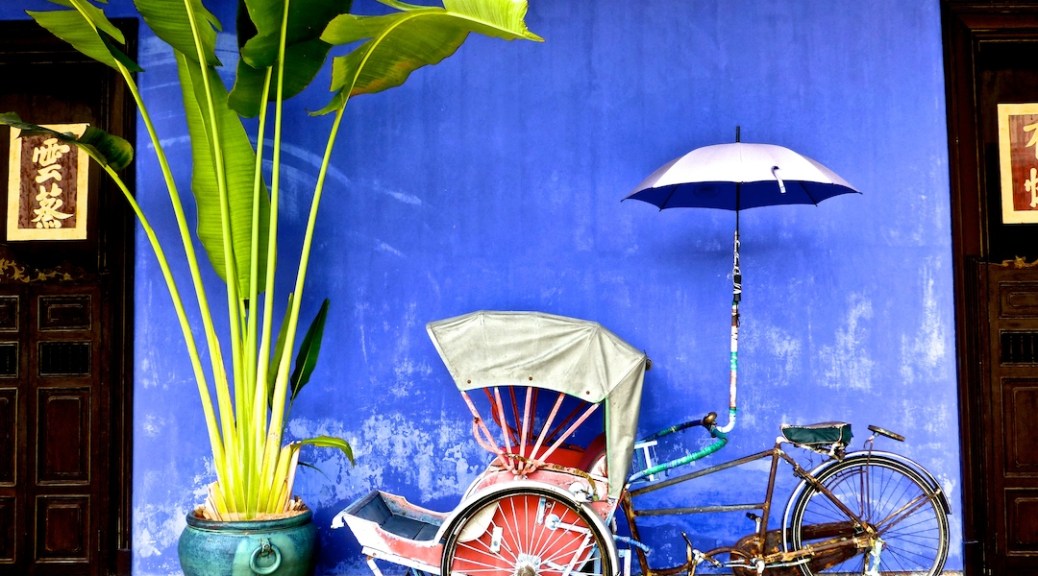
Cheong Fatt Tze Mansion, also known as Le Maison Bleu for its deep indigo-colored exterior, offers daily tours. It houses a heritage bed and breakfast and one may also rent out the entire property for weddings and events. The building is lovely, but we were not so impressed by the tour. That said, our guide is bringing back the balding woman’s rat tail trend like it’s nobody’s business.  And Cheong Fatt Tze was apparently quite a guy: when he died in 1916, Dutch and British authorities ordered flags be flown at half mast throughout their colonies.

For the SJP, SATC, and pure Jimmy Choo enthusiasts among us, we’re told you can go to the factory where Jimmy Choo made his first shoe at the age of 11.

Granted our standards have been somewhat lowered along the way, what with our champagne taste and backpack budget, but Chulia Heritage Hotel rocks. It’s clean, the lobby is pretty, you get FOUR pillows! And the icing on top: a blowdryer. I don’t think we’ve seen a blowdryer since we left America. Did we use it? No, but still. Downsides: rooms are not huge, a bit loud, and I guess if you’ve spent a significant amount of time in psychiatric wards the all-white design scheme might cause flashbacks. Also, a rather large cockroach did make an appearance in Alan’s shoe as we were headed out the door, so, there’s that.

Practical Info 

Penang is a state and actually covers some mainland territory in addition to the more famous island portion.  The island itself has some nice hills and supposedly good beaches on the north and west, though we limited ourselves to historic George Town, the main city on the northeast corner.

Transportation: We took a ferry from Langkawi, which cost $39 for two and took a bit over three hours.  Upon arrival at Kuah Jetty in Langkawi you can pay a small fee (10-20 MYR depending on bag size) to check your luggage, which is a good idea.  This ride was inside a proper boat and infinitely smoother than the ride from Koh Lipe to Langkawi.  They were even showing Dark Knight Rises on the TV screens, albeit without sound.

There is an international airport here, and I believe ferries from Malacca in addition to Langkawi.  There is a very long bridge connecting the island to the mainland.

While sightseeing we walked everywhere.  If you wanted to visit the beaches (or stay at the beach and visit George Town), you would need to take a car or motorbike.

A taxi from our hotel in George Town to the airport at 6 am took 20 minutes and cost MYR 60.  The front desk said it usually takes 30-40 minutes and costs MYR 40.

The airport at Penang is quite nice, but at least Air Asia’s terminal in Kuala Lumpur (where we stopped en route to Chiang Mai) was much grimier.  Three hours free WiFi is available at each airport.

Accommodation: We stayed at Chulia Heritage Hotel in George Town’s UNESCO heritage district.  It was cheap and nice for the price at $40/night.  Options are abundant.  Other names we came across for George Town include the classic Eastern & Oriental, the heritage B&B at the restored Cheong Fatt Tze Mansion, and Muntri Mews.  There are several beach resorts in other parts of the island.

Food: We covered this pretty well above.  After all, it is arguably the main attraction. Various food tours are available, and that would probably be a good idea. Prices were not dirt cheap, but far cheaper than in most developed countries.  I think our meal at Tek Sen cost less than $20, including a Guiness foreign extra stout.  Breakfast at Aik Hoe was ~$7.  Most food stall meals cost $1-1.50.

Activities: Eating.  Beaches on other parts of the island.  Visiting Fort Cornwallis, temples, Khoo Kongsi (admission is 10 MYR each), the clan jetties, Cheong Fatt Tze Mansions (the tour costs 12 MYR each), etc.  There is also a funicular to the top of Penang Hill which probably affords nice views on a clear day.  Alan’s mom’s friend recommended going to Cheong Fatt Tze Mansion and asking for Joanne who gives city tours.

January 22-24, 2014 (Wednesday-Friday)

Langkawi

Getting to Malaysia was among the least pleasant travel experiences of Jenni’s life. The journey began with moderate trepidation. The tide was super low when we left our little slice of paradise in Lipe, so we were unable to take the longtail boat. Instead, we had to call a “taxi” to take us by land over to the immigration stand at Bundhaya Resort on Pattaya Beach. A taxi on Koh Lipe is basically a moped with a sidekick module attached to the side. And by sidekick module I mean a little metal basket. The engine was apparently not powerful enough to carry the both of us and our luggage up the hill from our resort so the driver picked up our bags and told us to meet him at the top of the hill. Then we hopped on and I, being of course a person afraid of approximately 87% of things in the world, hopped in the front as we began zooming down the semi-paved road. I held on to the damn seat for dear life as I imagined which bone would be protruding from which part of my body when I went flying face first into the pavement.

Alas, we made it to immigration. As is now par for the course, we encountered obstacles. All the normal tourists have their itinerary/confirmation pages for their ferry tickets printed out and neatly presented in little laminate pockets. We had an email on an iPhone, which didn’t make the cut. So Alan walked around to the resorts, trying to find WiFi to e-mail the immigration/ferry lady a copy of the PDF so she could print our tickets. Of course, though, the one resort where WiFi had worked well before…now not so much. It’s becoming comical how often technology fails us.

By the way, one of the cardinal rules of international travel is to never let your passport out of your sight.  But it’s impossible to follow that rule.  So don’t be alarmed when they take your passport at the immigration office in Thailand and then call out names and hand out passports (already stamped) 45 minutes after you disembark in Langkawi.

The “ferry” from Lipe to Langkawi was horrid. Perhaps someone could have warned us that it is not, in fact, a ferry, like the ferry we took from Railay to Lipe, but rather a motorboat cum amusement park water ride. Expect to get absolutely drenched. Not a little “sea spray,” friends. Soaked. Like how wet you get when you shower, and not a shower in India or some place where the water pressure sucks. Like a shower with a rain shower overhead and those side sprayer things coming out of the wall from three sides. I normally wouldn’t mind the wetness, but for the fact that everything of technological value was stored in a non-water proof bag I desperately tried to keep dry by hoisting it above the ground between my legs and covering it with my lifejacket when I wasn’t holding on for dear life as the boat and my stomach dropped over harrowing waves that caused all the Asian women on the glorified “ferry” to scream like I do when I see spiders.

The rational man’s take: It was a tad scary, but mainly a rollicking, rough ride.  Four factors jump to mind that often lead to accidents with casualties: a vessel in bad condition; passengers beyond capacity; lack of life jackets; inclement weather.  None of the four was present.

First impressions on arrival, however, are quite positive. The harbor is attractive, feeling less industrial and more like where your wealthy Malaysian friend might keep his yacht.  The backdrop is comprised of steep, jungle-covered mountains and the Langkawi cable car.  Langkawi is actually an archipelago of 99 or 104 islands, depending on the tide.  But the name usually refers to the largest, main island.

Here does not feel remote as Lipe did, and it seems decidedly modern. There are high quality signs with (almost) perfect English. (To be fair, though, passed and past are at least both words, as opposed to “showa,” as some Thai ads boast. I’m from Boston, but I don’t think the rest of the wicked smaht English speakers of the world would agree it counts.) Our taxi driver, while naturally charging us a bit of a rip-off price, was friendly, spoke pretty good English, and engaged us in conversation about both his hometown of Langkawi and our experience in Lipe.

We stayed a little bit off the beaten bath. We decided an ocean view for a reasonable price (with some compromises of course: shared bathrooms and no actual beach) trumped an expensive beachfront resort or a cheap place off the water. So we opted to stay in a tube. Tubotel is a strange little spot with “rooms” built into what are essentially large concrete pipes. They’re just about big enough for a bed (with your bags stored underneath) and a lamp. It’s definitely a funky and unique place, with lounge music, abstract and somewhat hipster art, a fun common area complete with day beds, plunge pools (pretty much just a couple large concrete tubs of unheated water, but pleasant enough to cool off in), a pool table, homemade pizza and mini-kegs on offer from the fridge.  The airport is nearby, and we quickly learned that Air Asia here is like Southwest in Los Angeles.  You see their planes constantly, easily identified by color.

Perhaps what we appreciated most about Tubotel were the “eco-pirate” tours they offer on a daily basis, shuttling guests to and from the nearby islands for free provided they pick up trash while on the beach. Even though we weren’t able to participate, we loved this idea, especially after our inspiration in Railay where we made a small contribution to remove some garbage from the otherwise magnificent beach.

Tubotel is just across a little inlet from the very popular beach (Pantai Cenang), but it takes about 20 minutes to walk there because the bridge is inland a bit. Once you do reach Pantai Cenang, be sure to look both ways when crossing the sand to avoid being hit by an SUV (they drive along the beach, jet skis and banana boats in tow). The beach is deep and the water is calm, albeit not so pristine looking and the sand quality is mixed. Picky comments for sure, but we’re coming from Thailand, and Cenang, my friends, can’t hold a candle to Lipe or Railay’s beaches. Though the sunsets were consistently marvelous on our three nights here.

Casa del Mar, a pricier resort on the Cenang strip, seemed like a great place to post up. So much so that we spent the better part of a day at its beach-side restaurant using WiFi and drinking sangria. The sangria was necessary, because much of this day was spent trying to pay for our new and improved (and by improved I only mean more expensive. Except for that pediatric dental care. That will come in handy for all the children’s teeth we’ve hoarded) Affordable Care Act health plan (seriously, how has this been so hard), and dealing with getting our credit card replaced (and all of our automated bill-pays updated) because the first time we shopped at a Target in probably two years was the week before we left the country and coincided with hackers stealing the credit card information of all Target shoppers.

The street just behind the beach resorts is abuzz with restaurants and shops. We thoroughly enjoyed Yasmin’s chicken shawarma. So much that we considered getting it again the next night, changing our minds only when we found a Turkish restaurant, Istanbul, where we wolfed down a chicken doner kebab sandwich and spicy lamb iskender kebab with yogurt sauce.  Near Yasmin we bought some potent Carlsberg special brews (8.8%!) at the 7-11 and noticed a sign that alcohol sales are only for non-Muslims.  By the way there are so many 7-11’s in much of Asia.

Langkawi manages to strike a nice balance between action and relaxation.  The main strip is lively and the beach has jet skis, but you don’t see rowdy partiers or hear much untz-untzing.

We did something here that we hadn’t done since leaving the states almost two months before: we drove! We rented a car to explore more of the island. It was such an incredible feeling of freedom we’d forgotten, to be able to go as we please, wherever we wanted, with no haggling or ten minute conversations with a tuk-tuk driver to try to communicate a destination, and just throwing anything we might need for the day in the trunk. Alan was a pro with the steering-wheel-on-the-right, keep-left style driving, which was made very pleasant by the fact that there are super nice, rule-abiding, non-aggressive drivers here! It’s interesting that we have traveled exclusively in countries that drive on the left so far this trip (Hong Kong, Sri Lanka, India, Thailand and Malaysia). You’d think this means I know which way to look before crossing the road by now, but it still isn’t quite second nature. The roads are also well-labeled and well-maintained, which made the contrast of roadside monkey clusters and later a herd of water buffalo crossing all the more intriguing.

We first drove up to what had been described as the nicest beach on the island, on the north side, where some fancy schmance resorts are (Four Seasons and Tanjung Rhu). It’s a nice beach for sure, but still can’t really compare to Koh Lipe or Railay. That said, it was very interesting to see some women sporting bikinis next to Muslim women covered entirely head to toe. And we arrived at low tide to some really cool sandbars, one of which Jenni walked out to. It was a very long path and she lost her way on the return. A Malay man wanted to talk, know where we’re from, welcome us to his country, but Jenni was having a mild panic attack worrying that if she couldn’t find the sandbar to lead her back the way she came then would she step on those sea urchins with the crazy long needles? Asian sea urchins are far more destructive looking than the ones you see in the U.S. Which reminds me, I found it amusing and impressively resourceful when a kind European man we’d met in Thailand warned us to be careful to avoid stepping on the urchins in the direction we were headed by describing them as “sea porcupines.”

There are lots of women by the parking area at Tanjung Rhu offering one or two-hour boat rides to visit the mangroves and watch an eagle being fed.  We passed, but I did see some mysterious animal poking out of the ocean that may or may not have been a crocodile. Or do they have seals here?

We planned to check out Datai Bay but stopped for lunch at Scarborough’s fish and chips.  This nice little beachfront spot caught a hold of us with its free WiFi, and it was here over fried snow fish and spring rolls that we took the plunge into joint blogdom! (Only to run into…you guessed it…technical difficulties that were not resolved for weeks).

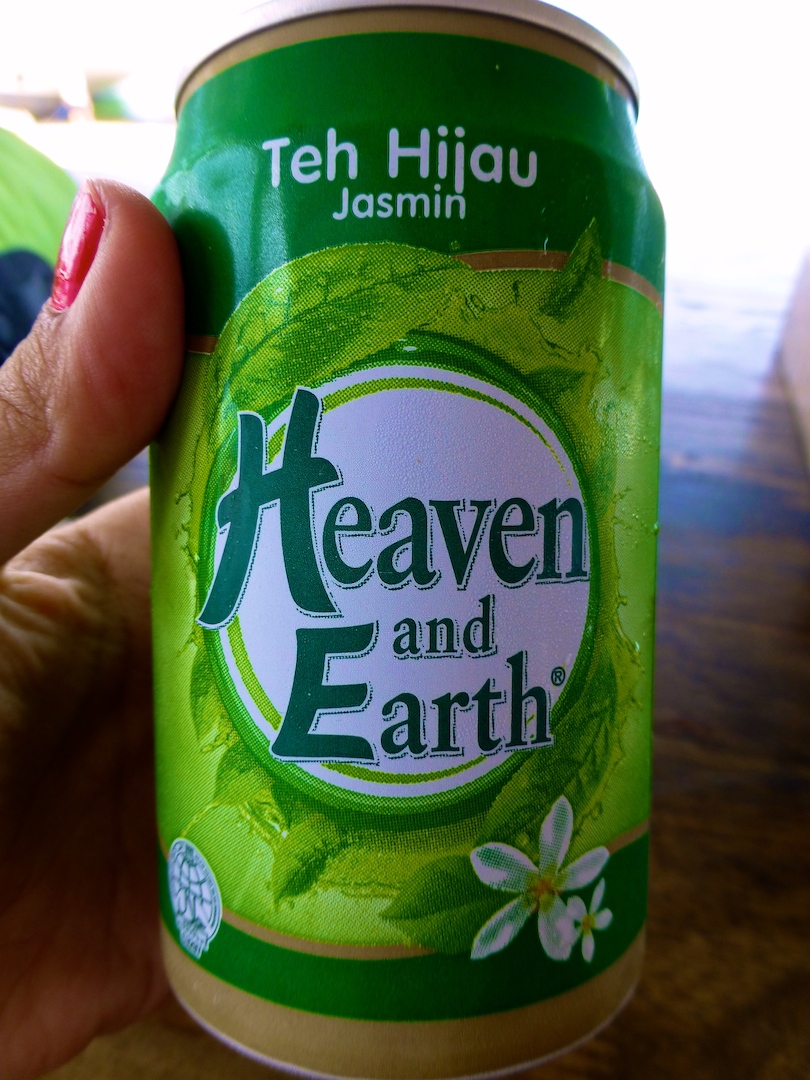
::why don't they sell this in the states?? jasmine iced tea. so good::
::why don’t they sell this in the states?? jasmine iced tea. so good::

Hours later, we drove over to the Langkawi cable car at Oriental Village hoping to catch the sunset. This is a great opportunity to get views of the island, and a very popular activity for visitors. It was absolutely terrifying. I’ve been on aerial trams before. I ski. I’ve been on those sky-bridge platform things in the Australian jungle. I’ve taken the tram to Sandia peak in New Mexico. This was by far the scariest one. I cried. Both ways. Going up I made it to the first “stop” and to my horror I realized Alan wasn’t kidding that the ride wasn’t over. That’s when I cried. On the way down I tried closing my eyes, but it didn’t help. Wow. If you’re afraid of heights, maybe this one is not for you.

Fortunately for Jenni, at least the sky bridge at the top was closed so she was spared the horror of walking across this suspension path spanning a deep chasm.  It was a bit hazy so the views weren’t great, but we could still see quite a bit and the jungle covering these mountains is impressively dense and verdant.

Overall we would say that Langkawi is quite a pleasant place and good for a Thai visa run or perhaps a quick beach escape with its international airport.  But we would not advise traveling a great distance to visit Langkawi alone.

Practical Info

The main commercial area on the island is Kuah.  The most popular beach area is at/around Pantai Cenang.  The north coast is quieter with some fancy resorts.  There are ATMs in Kuah and also at Telaga Harbour and Underwater World.  Langkawi is duty free which means alcohol and chocolate, among other less important things, are cheap.

The exchange rate was 1 USD = 3.3 MYR.

Transportation: We took a ferry from Koh Lipe, Thailand which lasted about 1.5 hours.  As noted above, it was a rough ride.  We bought the tickets on Telaga Terminal’s website and paid $74 for two but the boat said Bundhaya on it.  This ferry lands at Telaga Harbour, which is closer to the beaches and resorts on the west of the island than is the Kuah Jetty.  There is an ATM and mini mart here.  From Telaga it was about a 15 minute drive to Pantai Cenang (taxi cost 30 MYR).  There is an international airport (and this is Air Asia territory), and also ferries from Penang and the mainland.

Our ferry to Penang left from Kuah Jetty, and a taxi there from Tubotel cost only 30 MYR and took 30-40 minutes.  The Kuah Jetty area has a Starbucks with free WiFi, several other F&B options, ATMs, SIM card shops, etc.

Many visitors rent a moped or car, which is a good idea because it’s fairly cheap and the driving is very mellow compared to many Asian destinations.  We got a Nissan Sentra automatic for 24 hours, delivered to and picked up from our hotel, for 90 MYR.  A manual transmission would have cost 60 MYR.  Petrol is subsidized and inexpensive at ~2 MYR/liter, far less than we pay back in California.

Accommodation: We stayed at Tubotel, an interesting property just west of Pantai Cenang that we described above.  There are loads of properties on Pantai Cenang.  Casa del Mar is very well-reviewed, and Meritus Pelangi is a big resort on the western end of that beach.  Many fancier resorts are on the north side of the island, including Four Seasons and Tanjung Rhu at the eponymous beach, and The Datai on its namesake bay.  There are also some less expensive, well-reviewed places off the beach in the hills.

Food: There are abundant options on the main strip at Pantai Cenang.  Yasmin is a Syrian joint with a small, proper restaurant as well as a nearby sidewalk stand where we enjoyed chicken shawarma (10 MYR).  Palm View offers seafood plus meats like deer and ostrich and was crowded.  Orkid Ria was packed each night.  Tomato is popular.  There is Starbucks and a 24-hour McDonald’s.

Istanbul was closer to Pantai Tengah, the beach just southeast of Cenang.  If you are near Tanjung Rhu then Scarborough’s is a good option for fish and chips.

There are also Dunkin’ Donuts and Dairy Queens in abundance in Langkawi and Penang. How is it easier to find a Dunks in Malaysia than it is in California?

Activities: Perhaps the star attraction is the cable car, ascending ~700 meters in less than 15 minutes.  Tickets may be sold in combination with things like a 3-D movie, but we did just the cable car and it cost 30 MYR each.  Pantai Cenang is the most popular beach area and it’s loaded with jet ski rentals and parasailers.  Underwater World is located here.  There are also some crafts centers, Telaga Tujuh (aka Seven Wells) Waterfalls, a museum or two and duty free shopping.

January 19-22, 2014 (Sunday-Wednesday)

Paradise Found: Lipe

Sweet, untainted tropical bliss. Our home of five nights on Koh Lipe was pure, unbridled relaxation. We picked the very best hotel on the whole island, if I do say so myself. The island is quite small; you can easily walk around pretty much the whole place without exerting too much energy. The vast majority of the hotels are located on Pattaya Beach and Sunrise Beach, with a smattering also on Sunset Beach. Ours was set apart from all of them, on its own private little beach over the hill from Pattaya and a bit south of Sunset. And oh, was it paradise. We knew things were looking good when our longtail from Pattaya rounded the southern tip of the island and we saw some crab-eating macaques climbing up the rocks above the flawless turquoise sea. We had a little cove filled with lounge chairs and hammocks, a small beach, a slice of crystal clear water to wade in and a huge labyrinth of coral to snorkel through.

So if you go to Koh Lipe, we highly recommend you check out Pitiusas Resort. I believe it’s fairly new as it hasn’t got too many reviews on TripAdvisor or elsewhere, a fact that made us hesitate to book, but so happy we pulled the trigger. It’s a bargain for such a pristine and isolated corner of the Thai islands. Our bungalow was about $70/night. To be clear though, the rooms are not what make this place so special. Each room is its own bungalow set up on stilts up a hill. There’s a smidgen of an ocean view and the rooms are pretty bare bones. They are not overly spacious, large enough for a big (kind of hard) bed, a fan and a little armoire. That said, you do have your own private balcony complete with a hammock. There is no hot water, but as we are becoming accustomed to rarely showering this didn’t bother us. Also, it’s hot and you are in the ocean constantly, so it’s not really a big deal here. That said, we showered once in five nights. (Cue the “ewwws.” We joked that our average rate of showers per week is probably closer to two than our former seven. How will we ever adjust to the working world again? Oh, with a real shower, probably.) And since we’re getting it out with the negatives, the beach is not ideal for swimming when the tide is very low. And while there is a restaurant and a teensy-weensy bar, there is not a ton of variety, and the service is not the most impressive. And this is a plus or minus depending on the person: be prepared for lots of topless Europeans (this is not specific to Pitiusas, but it’s more common on these quieter more isolated beaches). Boobies big and small, perky and droopy. And bikinis are not limited to the svelte and sexy. Am I becoming weirdly modest, or are one pieces very much in vogue in the US? I don’t think we saw a single other person in a one piece in Thailand. We saw lots of larger than lifes in thong-esque bikinis though. When did I become such a prude?

The WiFi didn’t work, which put us a bit behind on the blogging, but it was such a nice place to unplug and unwind. I think we read a cumulative five books over the four and a half days there.

::not a bad office::

The landscape is slightly different here vs. e.g. Railay in that you don’t get the jaw-dropping limestone karsts or dramatic cliffs, but the trade off for remoteness balances out. Alan remarked that Lipe has a bit of a South Pacific feel. And this is what Jenni calls a “honeymoon place.” Railay is not a honeymoon destination, unless you want to be surrounded by hip Europeans and topless chubby Russian ladies and hoards of men in banana hammocks and worst: children. If I were to honeymoon in Thailand, I would do it somewhere like Pitiusas on Lipe.

Again, the animals were a highlight for me. I struck up an intense friendship with the semi-wild resort dog, whom I affectionately named Bug. With the manners of a well-trained house dog and the energy and joy of a convivial puppy, plus an affinity for holding paws he obliterated any ability I had not to fall in love. Given the romantic setting I suppose it’s not that surprising that I engaged in one or two make out seshes with this little guy, after I hand-fed him the carrots from my dinner. Carrots are his favorite. I would totally steal this little booger if I could. He’s the sweetest. And I know I say that about all dogs, but this one really stole a piece of my heart. Although the puppy at Bila Beach nearby who bore an uncanny resemblance to Ryder tugged at my heartstrings as well. Look at that face, just aching for some Thai noodles.

There’s also an impossibly sweet cat that likes to hang out near bungalow four and he’ll mew for you and wait outside your door for love, much to Alan’s displeasure.

Much of the action on Lipe is on and around Walking Street, which connects Pattaya and Sunrise beaches with a strip of mini-marts, restaurants, spas, souvenir and dive shops. We ambled through one day, though didn’t sample many of the goods. We did, however, purchase some very overpriced sunscreen.

And we leave you now with a million pictures of this divine and restorative view.

Practical Info

There are no ATMs on Koh Lipe.  This is surprising given the amount of development, but be prepared.  There are shops on Walking Street that will swipe your card and give you cash for a 5-10% fee.

About that development…most of you travelers are all too familiar with the pattern of paradise found then lost.  Such is the nature of the world.  A spectacular location is “discovered,” a wise developer sees its potential, word spreads, and pretty soon those who were there before it was well-known cry foul.  Lonely Planet describes Lipe as “this decade’s poster child for untamed development in the Thai Islands.”  We can’t offer a before/after comparison, and yes much of the island is quite commercial.  But there weren’t any true eyesores and it does not have the feel of e.g. Koh Phi Phi, probably in part because it is more remote.  And the western side with Sunset Beach is more laid back, and Pitiusas’ spot is peaceful as can be.

Transportation: We took the Tigerline Ferry from Railay, and actually getting to the ferry was not so smooth but I think that was the fault of the travel desk at Sunrise Tropical Resort on Railay (which we covered here and is otherwise very nice).  That aside, it cost 1100B/person which includes the longtail from Railay East to Ao Nammao, a shared van ride to the Hat Yao pier in Trang, a ferry to Koh Lipe where you disembark on a floating platform off Pattaya Beach, followed by a longtail for 70B/person which dropped us right on the beach in front of Pitiusas.

There is also a ferry to/from Langkawi, Malaysia which we took on departure…more details in our Langkawi post.  It was quite a rough ride.  Note that many use the Langkawi/Lipe ferry to make visa runs from Thailand.

On the island, walking is generally sufficient, though there are moto-taxis and we took one (for 100B) to get ourselves and our luggage to the Bundhaya immigration office when we left for Langkawi.

Accommodation: We stayed at Pitiusas and discussed it above.  If you want to be closer to the action, you should stay on Pattaya or Sunrise Beach.  If you want peace, relaxation and a beautiful setting, Pitiusas is hard to beat.  There is a spit of sand jutting into the ocean on the northeast part of the island.  This is very pretty, though with the prevailing northeast winds this time of year Pitiusas’ location was even more advantageous.

The WiFi at Bundhaya on Pattaya Beach worked fairly well.

Food: We ate many of our meals at Pitiusas.  Our lunch at Daya Resort was fine, and Lonely Planet claims Daya has the best bang for the buck beach BBQ on the island.  We also had lunch at Flower Power on Sunset Beach, which was pretty good, and Bila Beach, which was a cool spot in its own little alcove, complete with banana daiquiris, hammocks and menus painted on bamboo shoots.  There are lots of eating and drinking options on Pattaya and Sunrise beaches and Walking Street between the two.  Castaway Resort on Sunrise Beach looked cool, as did the bar in front of Z Resort on Pattaya.

Also, check out the Thai potato chip flavors.

This slideshow requires JavaScript.

Activities: Relaxing!  In addition, you can rent kayaks and there are lots of places offering day/snorkel trips and several dive shops.  The diving is rumored to be pretty good around here.  The going rate was about 2800B for two dives with equipment.  Some operators use longtails and others more proper dive boats.  There are day trips visiting the nearby islands of Ko Adang and others, which are far less developed.  I believe that Ko Adang has some bungalows and you can camp on Ko Rawi.

Massage spots are omnipresent, and the going rate is 300-350B/hour.

January 14-19, 2014 (Tuesday-Sunday)

Restorative Railay

Three planes, one van, one longtail boat and a beach tractor ride later we arrived in paradise. It was a bit of a tiring journey from Varanasi, taking nearly 24 hours in all, mind you the actual flight time was a total of perhaps 6-8 hours. Lesson learned on planning in advance. One of the big dilemmas for “round the world” travelers is whether to buy the so-called round the world airline tickets or a package of major flights in advance, or to buy one-way tickets as you go. We did a bit of a combination, buying a number of more “major” international flights before leaving, and then supplementing that with internal flights, ferries, buses, trains etc. as we go. One such major ticket was a flight from Varanasi to Bangkok that had a sub-optimal layover in Kolkata. We wound up skipping Bangkok altogether and taking a decidedly un-direct route down to Krabi. We are learning!

P1050219

By the way, a handful of people have asked why we’re skipping Bangkok. Alan has been already; Jenni had not, but figured we’d see lots of big hectic Asian cities on this tour and given the protests and craziness going on there, figured it might be an OK city to skip for now. We will eventually be making our way back up to Northern Thailand, but decided to work our way south down the islands and ferry it over to Malaysia for a bit before the journey back up to Chiang Mai. It kind of made sense, it kind of didn’t. We were kind of tired of changing our mind on itineraries and so this one stuck.

We also had some concern regarding the onward ticket rule and thought showing a confirmed Koh Lipe to Langkawi ferry ticket would be safer than arguing about our plans to cross from Thailand to Laos over land.  As it turns out, the onward ticket issue never came up on our flights to Thailand from India or Malaysia and in any event we chose to fly from Chiang Mai to Luang Prabang.

Anyway, on to the good stuff: a very much appreciated beach holiday!!! After 25 nights in India, some of which were more trying than pleasant, we were ecstatic to be on “vacation.” So much so that we bought a bottle of bubbly at the duty free in Bangkok and upon arriving in Railay popped that bad boy with a toast of “cheers to not being in India anymore!” We love us some India, but talk about a vacation from which you need a vacation!

P1050261

There is so much beauty to be found in Thailand, it’s incredible. Picking a couple of islands to visit was almost as difficult as picking out what to fill your plastic baggy with as a child at those bulk candy stores. Being optimizers, you know that this process involved Alan vigorously researching the virtues of each island and Jenni google image searching each one with a lot of comments like, “well, this one looks like the most perfect turquoise water, but did you see the way the longtails frame the karsts at that island?!” At some point we settled (smartly) on Railay. By the way, while we didn’t spend too much time in the town itself, Krabi was featured on the New York Times’ list of 52 places to go in 2014.

P1050172

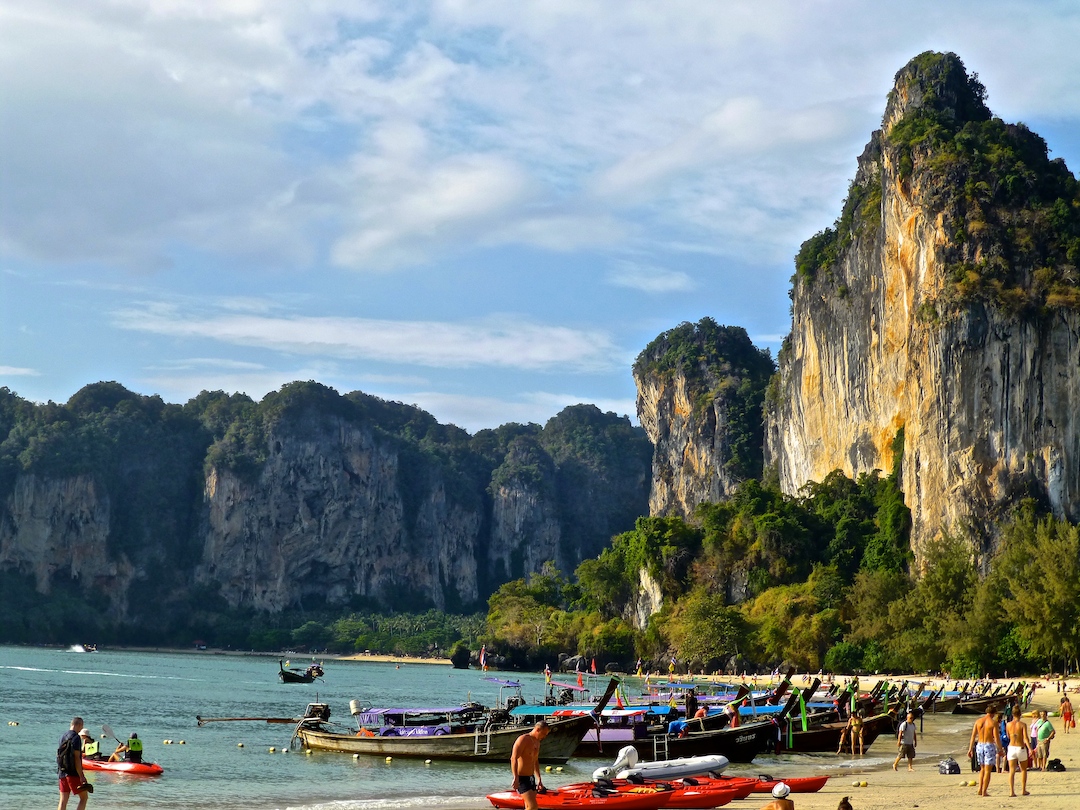
Perhaps a little orientation on Railay and the Thai islands is in order.  There are tons of islands!  Some are on the gulf side, like Koh Samui (very developed and often compared these days to Phuket) or Koh Phangan (home of the full-moon party), which Alan visited on his 2007 trip to Thailand.  More are on the Andaman side, and that is where we stayed on this trip.  Ko Phi Phi is probably the most famous of these.  And Railay is not actually an island.  It is part of the mainland, but huge limestone cliffs make it accessible only by boat so it has the feel of an island.  These same cliffs make it very popular with climbers.  This blog covers the various islands pretty comprehensively.

Railay itself has a few different sections.  The most popular area is Railay West, a beautiful crescent bay framed by huge cliffs with awesome sunsets.  Our hotel was on Railay East, which is the non-swimming mangrove-y side, but a mere five-minute walk across to West.  And being on the East side meant we were even closer to Phra Nang (about a 10 minute walk), which is the beach on the south of Railay and our favorite spot.  Then there is Ton Sai, reachable by longtail or a short walk over rocks (tide-dependent) from Railay West.

Unless you are there to climb, you can probably skip Ton Sai.  It has lower quality beaches and water than Phra Nang or Railay West. It’s more popular with the toking crowd who hang out walking on tight ropes and listening to music best described as heady. No wonder Alan remembers spending his time here when he came in ’07.

Funny enough we stayed at Sunrise Tropical Resort, the same hotel in Railay that Alan stayed at over six years ago when he traveled post-big law and pre-buy-side jobs. It was a bit of a splurge, at around $100 a night, and oh what a luxury it was. Air conditioning! Tons of space! Wood floors! Blankets! Pillows that are soft! A separate shower! A safe! A TV (that we never turned on but still)! A pool (that we never went in even, but who needs it when you have perfect oceans lapping at your feet)! A huge breakfast buffet! A mini-fridge! Towels for the shower! AND separate towels for the beach! We are living like gods among men here! Even though Sunrise Tropical is not on the “good” side of the island, we were only a few bungalows farther than the farthest back rooms of the hotels on the “good” side.  Plus there is that proximity to Phra Nang.

Phra Nang is wonderful.  It is home to one very nice resort (Rayavadee) and no other development. To walk there you pass caves full of crab-eating macaques (aka mustache monkeys) and arrive at a perfect bay of clear turquoise waters with jungle-covered karsts sticking out of the pristine sea. And the coolest part by far: there are longtail food boats. It’s the Thai answer to food trucks. Pad thai, fried rice, coconut shakes, beers, and more all on the cheap and available just a few steps into the water. Heaven.

Railay West is by far the most popular, lined with resorts and bars, including one awesome sunset viewing spot at the walking street entrance where they set up rattan mats along the sand, play chill music and serve drinks while the big pink ball in the sky sinks into the ocean. I’m trying not to insert too many sentences in here that say simply “sigh,” but it’s hard. How else can I describe that feeling? And in what was quite possibly the most perfectly set up question and response of Jenni’s lifetime, when Alan pointed at the white lanterns young lovers were buying from Thais on the beach and sending off into the sky by flame asking, “what are those?” Jenni was able to respond, “Oh Alan, you just don’t watch enough Bachelor to be cultured.” (On Ali’s season of the Bachelorette they attended the Lantern Festival in Taiwan, there is also a lantern festival in Chiang Mai.). Proof, watching the Bachelor does not suck the living soul out of me, but in fact makes me a more cultured person!

We had one other epic sunset while in Railay, this time while having a picnic back over at Phra Nang beach, eating pad thai, mango with sticky rice and a bottle of wine while being practically the only people there. Pretty incredible. So while it is quite touristy and crowded on Railay, there are still pockets where you can feel a bit removed from it all.  Which is pretty great considering how easy it is to get here.

It was quite sad to see how much trash people leave all over the beach. Jenni walked around and picked up a few pieces, but it’s really a bit soul-sucking to see the way people treat this natural treasure. And an aside, how come people don’t consider throwing their cigarettes on the ground to be littering?! Huge pet peeve. Also, tons of people smoke here. So, those are my main complaints: trash and smokers. Have some respect for the bounty this mother earth provided us, people! Come on!

Alan also indulged me one day with a boat tour out to see some of the more iconic Thai islands. He’d been before, and so had seen these beautiful, but preposterously touristy locations prior. But let’s be honest, it’s not exactly a big deposit in the favor bank to generously oblige your wife’s request to go to some of the most beautiful beaches in the world, again. We first hit Bamboo Island, where it appears you can camp! Pretty cool, although for an island with absolutely nothing else on it, it struck us as odd that the tents are set up right on top of one another. Oh and the highlight here was the water. Clear clear clear clear clear. Mmmmmmm.

We boated by Phi Phi Leh and the Viking Cave.  Next was arguably the most famed photo-op spot of the Thai islands: Maya Bay on Phi Phi Leh. This is where they filmed The Beach (apparently, though I don’t think I’ve ever seen it, a rather shitty movie starring Leonardo DiCaprio). We were in awe, not so much because of the breathtaking natural beauty (which was admittedly quite stunning, if you could see it), but the MASSES of tourists. It took probably 15 minutes to pull the boat onto the shore because they literally had to shove other boats aside and squish ours in between the dozens of others. Absurd. It’s an absolute joke. It’s like a caricature of itself, complete with at least four and a half tourists taking jumping photos or flashing a peace sign at any one time.  When Alan was here in 2007 he stayed on Phi Phi Don (the larger, main Phi Phi island with all the development) and hired a long longtail boat for a day, and with a very early start he saw Maya Bay with hardly anyone else there.  Perhaps this is still possible if you beat the day tour rush.

We stopped to snorkel just outside the cove at Maya Bay, which was fun as always. I love snorkeling. It’s one of those activities that’s so consuming you can’t really think about much else beyond the mesmerizing display of foreign creatures living quietly and unbeknownst to most of the world below you. An in-the-moment and awe inspiring thing, that ocean is.

The boat stopped quickly by monkey bay at Phi Phi Don, but there were no monkeys today. After an unexciting included buffet lunch,  we wandered over to the northern side of Phi Phi Don and hung out in the super shallow and even more beautiful bay. So much better on this side. It’s like a gigantic kiddie pool, but the water’s warmth comes not from gallons of human urine. And it’s surrounded by beautiful nature, not Dora the Explorer diapers bloated with chlorinated poo.

We snorkeled one more time at shark point, where we were not lucky enough to see any sharks, but did see some scary looking starfish cum spider like things that made Jenni rather uncomfortable. It’s funny how Thais use the word “maybe.” A language of perpetually hedged statements. While explaining the itinerary it was “maybe we leave now, maybe we go first to Bamboo Island, maybe after we go here… maybe then… maybe maybe maybe.”

Whenever I travel to tropical beaches I am reminded of my fascination with hermit crabs. I don’t know what it is. I’m obsessed. As those in attendance at our wedding might recall, Alan vowed “I promise to try to accept that nothing I am ever saying or doing will compete for your attention with a puppy.” This vow did not extend to hermit crabs, but Alan is trying to accept that no matter where we are in conversation when I spy a shell crawling across the sandscape I have to explode with “oh look at that one!” Then I inevitably pick it up and put it on my hand or Alan’s stomach, just to ensure he witnesses the awesomeness that is this little animal LIVING INSIDE OF A SHELL. And then I usually share with him (for the umpteenth time) the story of how when I was lonely in college I went on over to Ithaca’s Pyramid Mall and bought myself a pet hermit crab. Somehow, my obsession manages to reignite itself again and again. What is it about those guys?

Practical Info

If you are from the US or many other countries, you do not need a visa to enter Thailand.  Do not be confused by the space on the immigration card asking for your visa number, nor the signs at the airport directing you to the visa on arrival desk.  Proceed directly to immigration.  ATMs are widely available.  The exchange rate was ~33 Thai Baht per US$.

Communication: At the airport in Bangkok we purchased SIM cards from AIS.  DTAC is another popular telecom company.  We paid 299B for seven days of unlimited data and 100B worth of talk time.  Rates are 1B/min local and 3B/min to the US.  This card is valid for a few months.  There are lots of plan options, and you can top up at 7-11 stores.

Transportation: We flew from Bangkok to Krabi on Thai Airways.  There are airports all over Thailand and many flights are quite inexpensive and convenient.  Air Asia also flies here.  Having taken three flights and traveled overnight from Varanasi, we decided to have our hotel in Railay arrange transport.  For 1200B we got a private van from the airport to Ao Nammao from where we took a longtail straight to Sunrise Tropical Resort on Railay East.  It would have cost a little less to arrange this ourselves.  I think a taxi from the airport costs ~600B and a longtail ride ~60-80B/person.

Getting around the islands is often a mix of ferries and longtail boats.  Ferries cover the longer distances while longtails are great for short trips, and often a ferry will offload you to a longtail for the last couple hundred yards onto land.  You may have to disembark in knee-deep water.

Longtails to Railay West leave from Ao Nang on the mainland, and to Railay East they leave from Ao Nammao.  Once on Railay, it is easy to walk between East, West and Phra Nang, and you can also take longtails between Phra Nang and West and Ton Sai.

Thailand is very tourist friendly.  You can arrange day tours and island transportation at countless places, including likely your hotel.

Accommodation: We stayed at Sunrise Tropical Resort in a very spacious room with good AC and WiFi.  There is a pool that we never used.  Breakfast was included and good, with fresh omelets, fruit, etc.  It is probably preferable to stay on Railay West, but again the walk is so short that it doesn’t really matter.  If money is no issue then Rayavadee is where you want to stay.  It is on the most beautiful beach, and I believe the grounds are open only to guests.  So while the beach is public and you can easily walk there, it could be nice to step outside your room onto that beach.

Food: There are lots of food options, from proper restaurants at the resorts (which often have BBQ’s at night) to little stands on walking street, etc.  One of our favorite experiences here was dining from the longtail food boats on Phra Nang.  And Jenni proclaiming that her first Thai pancake hit a spot she didn’t know she had.

Activities: Many come to Railay to climb, and there are classes for beginners.  You can rent a kayak from various vendors.  On the walking path between Railay East and Phra Nang there is a side trail leading to a lagoon.  It is very steep and slippery, and we passed.  With better footwear and free hands we probably would have taken the challenge.

We did an all-day tour on a 30+ person speedboat to Phi Phi etc. which cost 1400B each including lunch and soft drinks and mask with snorkel.  There are also onshore excursions to local parks and mangrove kayaking and more.  Diving is easily arranged.

January 11-14, 2014 (Saturday-Tuesday)

A Fiery Finale to India

You know what makes Varanasi feel so refreshing? There are puppies and women. Puppies and women! What’s not to love? I knew something was amiss after all this time in India, and it was too many Y-chromosomes in the air. Finally, the ladies are back. And they brought with them puppies. Well no, I guess it’s just “puppy season,” as Ananya, the daughter of our Homestay owner Harish, told us. (Now that should be in the guidebooks under “when to visit.”) But seriously, there are women everywhere, which is not the case in all (most) other parts of India we visited. Especially at night. And here we saw lots of women out, young and old, day and night, in groups and alone. Which makes me feel safe, and happy. Also, Ananya took us out for an alley walking/food tour one day, and the company of another young woman all day was so welcome and refreshing to me. I forgot how comforting the presence of other ovaries can be.  (Alan says:  This is our first post together on the combined blog, and I bet you can guess who wrote this paragraph.  Though I do love me some ovaries.)

Varanasi is one of the world’s oldest living cities and one of the holiest places for Hindus.  It sits on the banks of the River Ganges and the stone ghats leading down to the water are the epicenter for both ritual ablutions and cremations atop wood-fueled pyres.

We expected Varanasi to be a highlight. When we began our trip we knew we were going to spend 25 nights in India, and the only places we knew for sure we had to see were Kerala and Varanasi. And so we booked flights into Kerala and out of Varanasi. The rest of the stuff in between was planned as we went. But Varanasi we’d known was a must-do. In fact, it’s the one place in India I’ve been talking about going since I started talking about going to India. The only reason we skipped it on our first trip was that the idea of watching people burn the bodies of their loved ones seemed even more antithetical to the idea of honeymooning than did the risk of Delhi Belly that everyone felt inclined to warn us about when we revealed our plans to spend our post-nuptials in such a locale.

Well, we came in prepared for intensity, for emotions to be tugged, eyes opened, cultures experienced. And that it was, but what was perhaps most intriguing was the experience of joyful emotions in Varanasi. It does not feel like a sad place.  The contrast of extreme happiness – people going on pilgrimage to one of the holiest places – and extreme grief – burning the bodies of their loved ones – is fascinating. We learned from Harish that death at a relatively normal age (e.g. not a child or young person whose children have not yet been married) is not so much a cause for mourning as it is for celebration of a life well-lived. After the friends and family of the loved one carry the body to the river and it’s been cremated, the family (if not poor) of the deceased provides food and sweets to thank those who came. Interestingly, the cremation is generally to happen immediately, but if family members need to travel to attend and see the body, the local members might keep the body warm (in winter, or cold in summer), as Harish did with his mother, by rubbing ghee on the body until the rest of the family can come pay their final respects. It was an emotionally powerful story and an experience difficult to imagine.

We saw the cremation ghats from a handful of different vantage points: the first time on a sunset boat trip up the river, seeing a few cremations from a distance, where the impact is somewhat diffused. (Though you do get a pretty up-front view of the nightly pooja ceremony, which to be honest felt like a show for the tourists). The next morning we woke early to see the ghats by sunrise, and while it was quite foggy, it was still a special experience, seeing all those people up at the crack of dawn to bathe in the freezing cold waters of the Ganges on a winter day. And let me tell you, it was cold. Alan was wearing long underwear! Most moving by far was witnessing the cremations on our last day when we walked to the main cremation ghat of Manikarnika. We went in expecting an intense experience, and intense it was, in some ways expected, others surprisingly so. Of course, it’s a moving experience to see the bodies carried to the river on bamboo stretchers, dipped in the water and then placed on a pile of logs to be burnt while dozens of people crowd around. I was somewhat surprised, though it makes perfect sense when you think about it, to see how many animals congregate by the main cremation ghat. They come seeking warmth, and next to the eight burning bodies are a mix of cows, dogs and goats, everywhere. It can be hard to watch, to see slowly the cloth wrapping the bodies consumed by flame and evaporating into ash to reveal the soft beige of a human skull, and to see the still intact feet poking out of a fire in which the legs and torso have all but disintegrated already.

While the cremations were impactful and emotional, they weren’t necessarily disturbing to us.  What was quite so, however, were a handful of young men and boys around the ghat. We’d been warned in advance, like so many tourist destinations in India, that unsanctioned “guides” will try to sell you tours for money. Here, of all places, seemed to us a disgraceful place to do such a thing, and to top it off, they lie about the money, claiming that they only request donations to provide firewood for the destitute, where in reality they are keeping it themselves. This is one of the holiest places in the world for Hindus, yet this disgusting dishonesty is taking place for personal benefit.

Armed with the knowledge of where this money actually goes, we refused any tours from these boys, one of which was quite pushy. When we told him we didn’t want a tour he stormed off saying, “fine, go away then.” We stayed on, observing quietly and respectfully (no photographs), for a while after. As we were walking away the boy called out after us “good, leave and don’t ever come back here.” In some bit of shock we turned around to confirm he was directing this towards us, and to our dismay he was. Trying to avoid confrontation Alan gave a pitied laugh at him, and this flared the boy up, trying to start a fight I suppose, yelling after us things like “don’t laugh at me, I don’t like your laugh. You stayed here a long time and did nothing.” As opposed to this boy? Who stands there while people return their loved one’s bodies to the earth and scams tourists so he can go buy himself some cigarettes? I am quite an emotional person, and had expected to be moved to tears at the sight of the cremations, but ultimately it wasn’t the cremation but these shameful boys that made me lose my emotions.

By the way – I read recently an article on NPR about how people can send in the ashes of their loved ones to companies that will compress them into diamonds that you can wear as keepsakes. Clearly Varanasi is not the market for these companies as the ashes are going into the Ganges, but I thought it fascinating. Apparently the diamonds usually come out blue, though some are yellow or black. Does that mean you have a dark soul?

Another highlight of our time in Varanasi was the walking tour we took with Ananya. We ate LOTS of food on this tour, starting with a plethora of pakoras. We learned that anything fried in graham flour can be a pakora. We tried tomato, eggplant, cauliflower and a few others.  And we had some terrific chai. I’ll miss Indian chai, I will. That sweet, spiced goodness. Here, Ananya threw in a Kit-Kat as well. Chocolate, as she says, is not a dessert in India. What is it then? A snack. Meandering through tight alleyways packed with people, mopeds, cows, dogs, goats and Bengali style houses with peaceful little courtyards, we stopped a man pushing a food cart full of peas to try “Indian peas.” These looked to us like regular old, get ‘em at your local grocery store snap peas and so we stuck them in our mouths, pod and all, and took a bite. Ananya turned around when she saw a man laughing at us and quickly informed us that you aren’t to eat the outsides, but just pull the peas out from inside. I don’t know, tasted fine to me. But she sure got a kick out of it. Next on the culinary tour was lassis at Spicy Bites. According to Ananya they are the best lassis in Varanasi. They definitely aren’t the best lassis in India, but they did have some of the most unusual flavors I’d seen. We went with a tried and true classic: chocolate banana coconut and chopped nuts, and a newbie: blueberry. Stick with the classics. That said, the best lassis we’ve had in all of India were probably the saffron lassis at Raas hotel in Jodphur. After “whetting” our appetites we went for a South Indian lunch at Dosa Café. We shared the masala dosa and veg uttapam, which is kind of like a pizza with a polenta crust. Both were heavy on the coriander for my taste, but Alan seemed to enjoy.

Onto dessert! Varanasi is well known for its desserts. And Malaiyo is one of its showcase sweets. It’s a special treat that’s only made in Varanasi and only during the coldest winter months (this, also, should be in the guidebooks under “when to visit”). It’s made from milk, which is boiled for a long time until it turns into an airy foam. It’s also got some cardamom in there, and I believe a bit of rose water. We’re told they place big pots of this on the roofs at night so that they chill.  Served in clay cups that are thrown away after a single use, they look like mounds of yellowy fluff. And they taste like an airy, lighter than mousse creamy cup of goodness. Make sure they pour a little condensed milk over top of it for the full effect. Ayo for Malaiyo.

Of course, this was only the teaser, and we went next to a sweet shop for a gulab jamun (basically fried dough soaked in honey and rose water, oh god), and a couple other sweet balls of rose water/cardamom/pistachio based goodness. They all taste similar, but vaguely different. Some of them have silver foil atop them, which you eat. It’s hard to fight the urge to peel off what looks like tin foil.

The alleyways range from fairly deserted and pleasant to walk around (albeit you always have to dodge the occasional pile o poop), to crazy and hectic.  The difficulty level of crossing the street doesn’t quite rival Mumbai but is made none the easier by mopeds driving on the wrong side of the divider. The environment feels ironically happier here than so many places we visited in India. It’s strange to find that in a place most strongly associated with death. Especially when you have to step aside on occasion as groups of men pass by with dead bodies hoisted on their shoulders.

Especially near the mosque where lines of locals wait eagerly for their turn inside, there is a large security presence. I never did quite adjust to the number of weapons that the officials carried here with such cavalier indifference to where they’re pointing.

We passed a number of music shops where the hippie variety tourists toted sitars around.

Ananya told us how from December 14 through January 14 it is not a time for weddings, but instead Hindus eat only bland food (rice with this daal type stuff) and grieve for ancestors lost. After the 14th there is a celebration with lots of kite flying. A friend I met while studying abroad also told me about the same festival, which is celebrated with more flair in Gujarat beginning January 14. We unfortunately missed it but it sounds worth checking out.

We usually cover accommodation in the “Practical Info” section below and we added some advice there, but we are including here our thoughts on TripAdvisor ratings and a lengthier discussion because in Varanasi our lodging was a more integral part of our experience than usual.  We stayed at a homestay, named, aptly, Homestay.  It’s the number one rated spot on TripAdvisor and people really rave about it. We’re coming to the realization that ratings on TripAdvisor can seem inflated, perhaps because people give ratings on different scales in different locations.  For instance, we’d rate our hotel in Cochin to be a “5,” for India and for the price. It was one of the best places we stayed, with a nice location, large room, functioning WiFi and A/C, but it’s no way a “5” compared to say, where we stayed on our honeymoon in the Maldives (for 28x the cost). You begin to notice in India especially people raving about things like “water actually got hot!” Also, a hostel might be a “5” for a hostel, but it can be difficult to know whether something is a “5 for a hostel cheaper than your morning latte in New York City for dirty backpackers with ridiculously lowered standards” or a “5 for a charming experience if less than luxurious spot” or the “5 for anything in the world at any budget.” So, take your “5” ratings with a grain of salt.

That said, Homestay was pleasant and we’re not trying to tear them down. It’s just not the BEST. The family who runs it is quite nice. You interact mainly with Harish, who is helpful and friendly, if also a bit long-winded. Our biggest complaint with Harish is that he spends so much time talking about how much his guests love him and how well he treats everyone that you never really get a chance to see it. Maybe it’s just that we spent four nights there and so heard his spiel to each new guest as they arrived. He also likes to opine on things on which he lacks personal knowledge, a bit of a pet peeve of ours. For example, he likes to explain why foreign tourists see certain local acts as irritating, because he apparently understands the psyche of Americans better than, say, the American tourists sitting across from him. And he’ll tell you how a sight in India is the second most impressive in the country, so beautiful, second only to the Taj Mahal. And fifteen minutes later he mentions he’s never actually been there. You can also expect to pay a bit more for transport and tours than you would otherwise. For the most part this is fine, because his guys aren’t going to try to take you around to shops and restaurants where they get a commission (much appreciated), but the tuk-tuk driver we’d hired didn’t speak any English, so if you’re looking for more of a guide, it’s definitely not a bargain (especially compared to what we got for less money in Cochin). Also, his airport shuttle fees are expensive and his argument that he’s saving you money because you aren’t dealing with commission schemes falls short here. Again, though, after a long 3.5 weeks in India we were just so over haggling.

Breakfast (included) and dinner (I can’t recall exactly but I believe dinner cost around Rs 250/person) are served communally. Harish’s wife, Malika, does the cooking. It’s pretty good. We loved her pakoras and the paneer curries. Weirdly, the dish I liked least was her paratha. Breakfasts are quite basic, pretty much toast (though with some fantastic homemade guava jam) and one hot Indian item that’s hit or miss. And when the power goes out (which happens pretty frequently), the toast switches to bread.

It is quite nice to share your meals with the other guests. We met several interesting people over the course of our breakfasts and dinners, including one couple that was also on a long-term round-the-world style trip including extensive travel in India. It was really fun to have people who could relate and discuss in detail with us such exciting matters as obtaining malaria pills and getting diarrhea (which for the record, was the woman’s opening line as we introduced ourselves at dinner. “Hello, we were supposed to arrive two days ago but I’ve had diarrhea for days.” Oh India and the things you learn about those you travel with).

The monkeys in Varanasi are scary little mothers. Our room was on the top floor, and we had to walk outside across the roof a bit to get to our door, which was something we avoided doing when the monkeys were out there. But the good news is that Jenni’s fight or flight instincts are intact. While dining on a rooftop in the old city, some monkeys snuck up there and in an impressively swift motion she jumped and ran inside the building before Alan could even grab the banana lassi and her sunglasses.  Which he sat valiantly protecting.

Other Varanasi Sites

We’d planned for four nights in Varanasi, expecting to have a work day and catch up on blogging/planning for the upcoming countries on our trip. Otherwise, we would not have spent so much time here. Given that we had plenty of time to spare, our first day we visited Sarnath. This was somewhat disappointing. Perhaps if you have a passion for history, Buddhism, or both, this would be more fascinating.  Deja vu to our commentary on Anuradhapura in Sri Lanka.  Or if you hired a knowledgeable guide. But as a sightseer with little understanding of the ruins you’re viewing, it’s a bit underwhelming.

However, I was more than pleased to discover an Indian zoo tucked away behind some of the temples. All you culture-ites, please avert your eyes. In lieu of checking out more of the temples… we went to the Indian zoo. And it was awesome. They had a collection of deer-related animals, a host of the most exotic looking birds, crocodiles and these strange-looking incestuous accident of a crocodile’s offspring: the cavial. It’s like a croc, but with a wicked fat tail and a long skinny nose.

After our outing to Sarnath we jetted over to the old city for ayurvedic massages on the uber-cheap. You get what you pay for. Not the best massages I’ve ever received, but possibly the cheapest. And definitely the most invasive. They really got up into the nooks and crannies there.  Alan said no man has touched him that way since his father last bathed him in the late 70’s.

Some final observations on India.

It can be overwhelming, which can be hard to admit. But it’s at times discouragingly difficult to get by, and I’ll tell you it was a great relief to arrive on the beaches of Thailand for a stretch of days with little to plan beyond “should I order a banana daiquiri next? Or a banana colada?” In fact, I write this post while in a lounge chair listening to the waves lapping a few meters below me, while the sweetest dog keeps us company over our mojitos. Sinfully good this bit can be.

Before India I’d mistakenly believed that the Air Hancock is a universal symbol for “check, please.” This one doesn’t translate to Hindi, unlike the universal language for “pot sold here”: Bob Marley music and/or posters.

Another interesting cultural difference that we noticed throughout India: the non-sexual touching of same sex friends. While it’s quite taboo for men and women to engage in PDA, men and men often, how do I say this, cuddle. No, but really. I’ve seen grown men spooning on the street. It strikes me as odd, that in a country so focused on sexual repression and where the rights of homosexuals are pitifully archaic (I read in the newspaper there that during 2013 they reinstated an old law banning “unnatural sex”), the men touch in ways you don’t see much in the western world.

Practical Info

Transportation: We flew to Varanasi from Delhi on Air India.  Our flight was delayed several hours and many were canceled due to fog, which apparently is common at this time of year.  There are flights from Agra at least a couple days each week.

A car to our accommodation (Homestay) was arranged by Homestay and cost Rs 850, which seemed quite expensive.  Since it can be even more difficult to find things in Varanasi than elsewhere in India, especially in the old city, folks often recommend arranging transport directly with your lodging.

The day we visited Sarnath we paid Rs 100/hour for a tuk-tuk.  This also was surprisingly expensive, and that was a theme of services arranged at Homestay.  For comparison, we paid Rs 60/hour in Cochin and that was for a driver who spoke English well and doubled as a guide.

Accommodation:

We stayed at Homestay and covered most of the experience above.  One of the key decisions here is whether to stay in the old city or not.  The old city is near/on the river, closer to most of the attractions and more atmospheric.  However, it is also more crowded and hectic.  Homestay is about 1 mile from the main ghat.  I believe that many of the higher end properties are away from the ghats.

I think I might prefer to stay closer to the ghats.  While this might be less peaceful in some respects, the ghats and surrounding alleys are fascinating and it would be nice to envelop yourself in this world for a couple days.  Unlike Agra, where the Taj Ganj area does not offer much to compensate for increased tout-presence and commotion.

We had lunch one day at Shiva Ganges View and the building and location were nice.

We heard that one or more heritage properties may be opening in the old palaces on the river in the coming years.

Food: We ate most of our meals at Homestay and the food was pretty good (covered above).  Lunch at Aum Cafe near Asi Ghat was quite good.  It is a crunchy place where we had our most Trader Joe’s-esque meal in a long time.  An open faced sandwich with homemade nut butter, honey and coconut, plus a much-needed salad and a rose lassi.  We also had lunches at Dosa Café (South Indian food) and Shiva Ganges View.  The former was good and its owner friendly; the latter was bland albeit with a roof deck perched way above the river offering nice views.

In the old city we had lassis at Spicy Bites.  The special with chocolate, coconut, banana and nuts was far better than the blueberry.

On our way to the airport we stopped at New Rajshree for sweets and samosas.  It appeared clean and orderly, was packed and tasty.  As mentioned above, malaiyo is a unique treat here, and of course street food is ubiquitous.  We ate a lot of tasty pakoras in the old city on our walking tour.

Activities: The most popular and unique activity is to spend time on the ghats by the river observing ritual bathing, cremations and more.  Dashashwamedh is the main ghat where the nightly pooja ceremony takes place.  Manikarnika is the main cremation ghat.  You can walk up and down the river, and a sunrise (and perhaps sunset) boat trip is de rigueur.  We arranged our sunrise and sunset boat trips through Homestay.  Each cost us Rs 300 and began and ended at Kedar Ghat.  Near the river you will be inundated with offers of boat trips, and I think the going rate is in the Rs 150-300 range.

The well-reputed Banaras Hindu University is southwest of the old city and home to the Bharat Kala Bhawan Museum.  The Monkey Temple and Ramnagar Fort are other popular attractions.

Many visitors make the ~10km trip up to Sarnath for half a day.  We found it missable, but if you do go there are ruins and Buddhist temples plus a neat little zoo.  It cost Rs 100 each to enter the ruins and Rs 20 each for the zoo.

January 6-10, 2014 (Monday-Friday)


The Real India?

We spent three nights in Delhi and filled our time with a walk around the old city and a great night out.  Plus one intended work day and one unintended sick/work day.  Driving in from Agra, I was amazed at the amount of construction south of Delhi.  I think this area is called NOIDA.  Less surprising by now was the half hour bathroom and car wash break our driver took at a highway rest stop after we replied “no” when he asked if we wanted to stop.

As we neared our hotel on Main Bazaar in Paharganj, our driver said “this is a very bad place.”  It is tourist central and the touts are quite unpleasant, but I think he exaggerated a bit.  Plus we had internal hallways and didn’t hear our neighbors shitting at all, so it was a marked improvement from Agra.

After dropping our bags, we got quoted many inflated auto-rickshaw fares to the old city but at last found an older gentlemen willing to charge us merely double what a local would probably pay.  Jokes were included free of charge.  He asked if we were married and then if I was happy (maybe it was Jenni’s Agra-induced scowl?), to which of course I replied “yes.”  Then he expressed skepticism and told the tale of an Indian arranged marriage and how the woman leaves her family which can be emotional.  So on the wedding day the groom asks the bride why she is crying, and she replies “I cry only today but you will cry the rest of your life.”

He dropped us a short walk from Karim’s, the legendary kebab etc. spot tucked away in an alley near Jama Masjid (which I think translates as great mosque, hence the same name here as in Agra and I presume elsewhere).  They were out of some items and we figured the leg of lamb might be a bit much for two, so we each got a Karim Roll.  It was pricey given how small it was, but maybe that’s because it’s made with lamb, and anyway it was delicious.

After our late lunch we walked around inside the walls of Jama Masjid which is the largest mosque in India.  It is lovely and affords nice views.  I’m told you can climb up one of the towers for really good views, but we got ushered out for the afternoon prayer time and decided not to stick around until it reopened.

The old city is crazy busy and lively and I would definitely spend at least half a day wandering around here.  We didn’t really do enough else in Delhi for me to opine, but my understanding is that New Delhi can be a tad plain and Old Delhi is where the action is.  The usual jumble of alleys and markets and fruit stands and tons of traffic.  We shared a tasty and jumbo pomegranate on the street.  There were more women and families here than many of the places we’ve been.

We walked a long way down Chandni Chowk and grabbed delicious sweets from Chaina Ram, which ended up being dinner.  It was dark and we weren’t quite sure how far the walk home would be, so after several attempts we settled on our first cycle-rickshaw of the trip.  He took us through the hardware section, and the metal back of the bike provides at least some protection from the madness around.

I’m glad we tried it, but the seat is so uncomfortable and you feel guilty watching the dude struggle mightily.  To ascend the hill over the train tracks he just got off and walked the bike.  I blame all the paratha.

Saturday we considered hitting a coffee shop but ended up doing work all day in the room.  When it was time to go we tried both online cab companies mentioned in my guidebook in hopes of avoiding haggling with a taxi in our touristy area.  Instead of a ride, we got a malfunctioning website, a 15 minute phone call and then a text saying sorry actually there is no car coming from you.  Not to worry, our hotel called a car.  Does the driver know exactly where we want to go?  Don’t worry, you’ll just tell him.  Oh he doesn’t speak English, but I’m sure you’ll sort it out.  I’d say perhaps 10% of the time we get in a car the driver actually takes us directly to where we want to go.  Good stuff.

Then the night got much, much better.  Jenni’s friend from Cornell, Aashica, lives in Delhi and we met her and Adi for dinner at Smokey’s in Greater Kailash II.  The food was great, but much more important the company was even better.  It was comforting to be with friends in the kind of place we’d probably frequent if we lived in Delhi.  The kind of place with a beet and goat cheese salad and a lamb and bacon burger.

It’s funny how I always think of the “real [country X, but I’ll just refer to India for this purpose]” as the part of the country that likely bears least semblance to my (former) life in the US.  I think most people have this tendency but I’ll take the bullet here.  I fully understand the notion that the way the overwhelming majority of the Indian population lives could be called the real India, and that generally it is more interesting to enjoy the contrasts when exploring another country.  But if you are a banker or lawyer or doctor or anyone else in a top income bracket in the US, you probably still feel like your life in the US reflects the real US.  Of course few in the US live the way most Indians do, so I appreciate it is a somewhat different concept.

But it does seem a bit silly for me to have the mindset that passing time in the manner I likely would if I lived here means I am forsaking the real India and substituting some misrepresentation of it.  One could even argue I’m doing just the opposite.  If you can afford a car, insurance and petrol, then you can hire a 24/7 driver for maybe $200-300/month.  So I bet most of you reading this would have a private driver if you lived in India.

Enough sounding off.  The night was awesome.  Aash and Adi hosted us through the hours of darkness and gave us an experience we never could have had on our own.  From Smokey’s we went to some hotel/bar complex (I don’t know the name but I think it was at/near Hotel Samrat in Chanakyapuri) and grabbed a scotch from a half-closed spot, and then went to another side of the area where the doorman ushered us in past multiple closed doors into some after hours back room with Russian girls dancing and further cocktails.  We were dropped back home around 4 am.

And then back to the real India :).  Jenni was sick all the next day (and more) so we never left our room.  At least our hotel had room service and the pizza and butter chicken were pretty good.  On Monday the situation nearly came to a head.  Our Air India flight to Varanasi was delayed 3 hours due to fog but we went to the airport on time anyway because who knows what might happen.  And as it happens the Delhi airport is super nice and is a much more pleasant place to hang out than our $35 hotel room.  We killed time and then I tried to withdraw cash from a Citibank ATM as we walked to our gate to board.  I went through all the steps, input the amount and hit enter, and then the power died and the whole machine went blank.  WTF?!?!?  So we didn’t know whether it was about to turn back on and dispense my cash to some lucky traveler or if Citibank would try to deduct the amount from my account regardless.  And of course we couldn’t sort this out with anyone so we just had to leave to board the flight.  Then we boarded but they had switched aircraft so we had a seat assignment that didn’t exist.  Things got tense and tempers were narrowly maintained, but alas we made it safely to Varanasi.

Practical Info

Transportation: Our drive from Agra took 3.5 hours on the toll road and with light traffic in Agra since it was a Friday and the Taj was closed, and it cost Rs 3,000.  Our auto-rickshaw from Paharganj to Karim’s cost Rs 100.  A car from our hotel to dinner in Greater Kailash II was Rs 500, same as our trip to the airport.

Delhi has a metro that is supposed to be reasonably good.

Accommodation: We stayed at Hotel Hari Piorko in Paharganj, fairly near the old city as well as Connaught Place.  Definitely a touristy area.  For $35/night in a big city, I thought it was pretty good.  Delhi has tons of lodging options.  A friend suggested staying somewhere in south Delhi, which is nicer and I think has more open space.  Several years back my family stayed at Master Guesthouse and thought it was great.  And as I write this from Varanasi, I wish we had stayed in more homestay-type properties while in India.  It is hard to overstate the value of an honest and knowledgeable local to assist you.

Food: Karim’s is legendary.  We visited the original location across from Jama Masjid, which actually occupies four spaces next to each other sharing a kitchen.  I think there are now other locations around Delhi.  Perhaps you should go for lunch at a more normal time, because around 3 pm they were out of several items.  The Karim Roll cost Rs 125.

Our one real night out in Delhi began at Smokey’s in Greater Kailash II.  This is a proper Western-style fun restaurant.  As I can’t think of a better comparison right now, I’ll say Houston’s look but a little hipper and a lot livelier.  You can get burgers and wings and cocktails and wine etc.  I thought it was very good.  But beware, we sat down to dinner upstairs at 9:40 pm and soon the music was so loud it was difficult to converse.  The bar area was lively and fun, and cocktail pours were legit.  They played Material Girl and Girls Just Wanna Have Fun.

Activities: My guidebook says foreigners have to pay Rs 300 to visit the Jama Masjid but we just walked in.  Note that it closes in the afternoon for about half an hour for prayer, and thus we got booted after about 15 minutes.  No shorts.  You can carry your shoes inside.  It has some nice views over the old city and Red Fort, which is one of the top attractions.

Had we done more, we might have visited Humayun’s Tomb, walked around the Rajpath, perhaps Connaught Place and more.  There are a number of museums in Delhi.  One thing I was bummed to miss is strolling around Hauz Khas, which Anish suggested (and Aash and Adi agreed).  This is a bohemian neighborhood with cafes, galleries and restaurants.

January 3-6, 2014 (Friday-Monday)

(the tiniest bit of) Delhi

It’s a good thing we paid up for 10-year multiple entry visas for India, because we didn’t get out and about to see nearly as much of Delhi as we’d like. We spent three nights in Delhi, though we basically didn’t go out during either of the two full days. Saturday day we spent in our hotel room doing research for our upcoming adventures in Thailand, Malaysia and Laos (we leave India so soon!). (But we did get out in the evening for a super fun night, see below!) And Sunday.. well, it was here that my streak of luck with avoiding a foodborne illness ended. At least I made it a cumulative four weeks in the country before it happened. And anyway, I think getting sick in India is a right of passage.

We had hired a driver in Agra to take us to Delhi, and much of the drive was actually incredibly pleasant. We paid extra to take the expressway (the tolls are over Rs 500), and it’s definitely worth it, as you travel on a nice modern highway with unbelievably little traffic. There is hardly anything around for much of the drive, which I found somewhat surprising as well.

I was amused by our driver (he is from Delhi) who asked our opinion on the people of Agra, saying that he thought they were not nice. Much nicer in Delhi we asked? No, he said. Only in the South. And when we pulled onto the street where our hotel was he made sure to tell us “this is a bad place.”

Despite that warm welcome, we really enjoyed (what we saw of) Delhi. Our hotel (Hari Piorko) was not amazing, but it was many many steps up from the accommodation we had in Madurai and Agra. I was pleasantly surprised that for about $30 a night in the capital city we could get a spacious, somewhat modern room with blankets, toilet paper and hot water. Each room also has a fish tank built into the wall. The water in them is practically black, and it’s a wonder the fish in there are still living, but it felt like this place might have been the bee’s knees back in, like, 1981. When the fish tanks were last cleaned. Anyway, I think it was the only place we’ve stayed in India that offered room service, and this came in quite handy since we spent so much time in that room.

After arriving Friday in the afternoon we stepped outside our hotel door and into the madness that is Paharganj (hawkers galore) and negotiated with a few tuk-tuk drivers before getting a ride over to famed Karim’s for some middle-eastern-ish Indian food. The place is absolutely packed, and I think there was even a security guard manning the entrance. Get there early, as they were sold out of a few things we’d contemplated trying. We ordered Karim rolls (lamb, and a delicious spice combo), which were fantastic, but quite small, especially at the price tag of Rs 125 each.

Our tuk-tuk driver was hilarious. Example: he asked, are we married? To Alan, are you happy? And then he tells us that when a woman cries on her wedding day (for arranged marriages it’s often emotional for the bride and her family since she is leaving her family to live with the husband’s etc.) and when the man asks why, she explains, I cry for only one day, you cry for every day after. Oh, ball and chain jokes. They translate everywhere.

After lunch/dinner/dunch we wandered over to Jama Masjid and explored the mosque for a few minutes before being kicked out for the afternoon prayers. It would have been nice to climb the tower for a better view of the city, but we kept on and bought a pomegranate from a street cart for our first dessert of the day. So good.

And then we ventured into the Chandni Chowk area. There are tons of shops selling textiles, clothes, food, everything. And there are tons of people and vehicles, of course. Holy mother of crowdedness. Each time I think I’ve experienced the on-top-of-eachother-ness of India, it’s one-upped. But I think Delhi truly takes the cake. At one point I literally had to crawl over a man’s push-cart to finish crossing a crowded road we were stuck in the middle of. That really is an awesome experience, if only when you reach a breaking point and confirm you are still in one piece.

We fought our way up to Chaina Ram, legendary for their desserts, and bought a nice big box of assorted sweets that we picked out based pretty much solely on how delicious they looked, though we had essentially no idea what was in any of them. And after eating them all I still couldn’t really tell you, except that I think pistachio, coconut, rose water, milk and cardamom(?) play big roles.

We hired a rickshaw driver to take us back to our hotel, and while he agreed to a price of Rs 80 we wound up giving him 100 because it looked like such hard work.

After a full day’s worth of trip-planning on Saturday we were rewarded with a fun night out with my college friend, Aash, who lives in Delhi. She and Adi took us to a happening spot (Smokey’s Bar and Grill) for dinner in Greater Kailash 2. I was very happy to have arrived at a place where we could drink the ice cubes and order salad. And even happier to reminisce on college days, share great conversation and get the locals’ perspective on all things India. They were fantastic and very generous hosts, and it was refreshing to see the “real” India as we might experience it if we were living in Delhi, rather than as tourists hopping from one sight seeing spot to another. We went big, closing down Smokey’s, venturing to another bar for a drink before last call, and last a sneaky, hidden bar that’s only allowed (I use that word loosely) open late because you can’t hear it from outside (it’s tucked far into the middle of a huge hotel). The crowd here was captivating. There were a handful of men being entertained by some Russian ladies, and one very drunk American who was super excited to see fellow Americans. When we arrived back at our hotel at around 3:30am I wasn’t sure if we were at the right place because I didn’t think it possible the packed street full of hawkers could ever be so barren.

After our experience trying to find the correct airport/terminal in Mumbai, we’d asked an Air India employee which airport we would go to in Delhi to fly to Varanasi. She assured us there was only one. Feeling smart, we hop in a car to take us to the airport on our way out and the first thing out of his mouth is “which airport?” Oh god, here we go again. Luckily, whichever one he took us to was the correct one.

Examples of things I by now find a comical part of the India experience: (1) We attempted to use an organized cab service that you call in advance so we could avoid haggling over price, though after 15 minutes on the phone trying to explain where we were and where we wanted to go all we ended up with was a text message saying “sorry, we can’t provide you a cab.” (2) Feeling not so hot myself, overheard in the Delhi airport bathroom: an American boy in the next stall puking up a storm and between sobs and retching crying to his mother, “I hate India.” (3) When we tried to use the airport ATM it shut off right after we entered the amount of cash to dispense. The helpful folks at the airport offered essentially no assistance, leaving us to figure out whether our cash came spewing out for a stranger once we’d boarded our flight. (4) Getting on the plane we discover that we were assigned seats that fail to exist. Mass confusion ensues while everyone stands around in the aisles until finally someone figures out that they switched the planes so our seat assignments don’t match, and tell us to sit wherever there’s an open spot.

Intoxicating, Infuriating, Inimical, Inimitable India

India holds well-earned legendary status among the world’s travelers.  It is an extraordinary place, but I am now going to commence a little public venting and a small call to action.  Nearly everything I have posted so far covers the details of our experience in each location and attempts to offer helpful information should you visit.  I want to write a little about our more personal experience and what life on the road has been like, at least in India.  I feel guilty complaining about anything when I know many think I am living a dream.  But since I am not yet a famous blogger with hordes of followers, there’s a good chance that if you’re reading this it’s because you know and care about me.  And thus you probably want to know how I’m really doing.  Which is: very well, but a little beaten down by this country!  So then I guess this post will be partly about India and partly about our life on the road…and I feel some run-on sentences coming.

There really is no place like India.  I heard that for so many years and always questioned the hype, but having now visited twice and spent a cumulative 25+ days here, I can opine with at least some degree of authority.

Some say India is more a continent than a country.  The diversity of landscapes may have peers, but I don’t think the energy and intensity do.  Or maybe there is a peer for India on a number of elements, but it’s the combination of all that is present in India that sets it so far apart.

For all its glory, India can be a truly maddening place.  I find myself thinking often about the distinction between an experience you are glad to have had and an experience that you actually enjoy.  My preliminary conclusion for this trip to India (and we still have four nights in Varanasi) is that it has been filled with specific experiences I have actually enjoyed, but the overall experience is one I will be glad to have had.

Let me be clear about a couple key points that might distinguish my current trip with one you may take.  First and foremost is budget and independence.  We have stayed in a few places for $20-30/night and only our hotel in Mumbai reached triple digits.  When we visited for our honeymoon, we had a private guide and driver and stayed in 5-star properties.  This was a very different experience.  Another extremely important point is that you will probably visit India on a stand alone vacation, which is an entirely different animal because you focus only on enjoying your brief time here.

We, on the other hand, are blogging, planning the next parts of our trip and dealing with the vagaries of life.  Like when you can’t keep your old insurance plan due to the Affordable Care Act and log on to find your premium has nearly doubled and you have no way of paying it without making a phone call to the US.  Which isn’t perfectly easy due to time changes, WiFi that works a small percentage of the time and SIM cards that apparently are roaming in every state other than where you bought them.  And you can’t just walk into a store and buy a new SIM card because you have to fill out forms and submit passport and visa copies then wait several hours or more.  And the higher roaming rates actually matter when you figure you’ll sit on hold for an hour trying to speak with someone at the insurance company.

So while “down time” in a country where it’s most needed should be filled with relaxation, for us it’s often filled with stress and frustration that nothing works as it should and WiFi cuts in and out.  In fact, just getting anything done is harder and takes more time.  Last week I had to add a “payee” to my online bank account, but I can’t receive a call or text on my US mobile which is how they always validate the action.  So that leads to an online chat session (which sometimes gets disconnected) and takes half an hour.  Most of this isn’t that big a deal on its own, but when over and over there are obstructions to accomplishing simple tasks, it becomes frustrating.  And at times infuriating.

Which leads me to a theme: it is hard for someone who usually feels very capable and in control to feel helpless.  When you can’t really communicate due to the language barrier and your taxi stops at Mumbai’s international airport and then you find out you’re at the wrong place but nobody is really sure and your taxi already left and the taxis and rickshaws pulling up refuse to turn on the meter and want to charge us the same amount to drive 15 minutes to the domestic “airport” as we paid for the hour+ drive from our hotel to the airport…then you finally get in a rickshaw with two backpacks and rolling duffels hoping your knee doesn’t stick out the side since there is zero margin for error and that driver doesn’t really know where he’s going and then the security guards at the domestic airport ask for tickets but we don’t have a printer so I only have e-tickets and then he takes my iPhone and walks away with it and tries to tell our driver that we actually are supposed to be at the international airport but fortunately our driver doesn’t go there and drops us at what eventually turns out to be the right place…and then it becomes clear that what they call two “airports” we would call two “terminals”, albeit really far apart, which explains some of the confusion I had when using airport codes to look into this before…anyway, while all that is happening you wonder if you’re going to make your flight and you can’t communicate and you feel helpless.  It kind of sucks.

Then there is the whole “just part of the experience” topic.  This tagline should be applied often, but I think it also can be overused to justify dishonest behavior that should be frowned upon and not tolerated.  I would say that the power going out when you’re in the middle of doing something is part of the experience.  Or having touts call to you when you walk past their storefront.  Or getting quoted obviously inflated prices constantly because you’re a tourist.  There is a market, and either someone will provide it cheaper or I don’t really need it, or I have to pay the market price at that time.  Fine, I get it.  That doesn’t mean I enjoy it, but I can accept it.

But I draw the line at blatant dishonesty and behavior that is simply rude.  Explaining this away as part of the culture or the experience perpetuates activities that do not help a country, tourism industry or culture in the long run.  It’s acceptable for a driver to take me to a restaurant that pays him a commission if I can’t specifically request a different restaurant of my choosing.  But it’s not OK to obviously collude with the restaurant to charge me more than what the menu says and bring me things I didn’t ask for, then use the language barrier to bullshit your way through why the bill is correct (which for the record happened in Sri Lanka, not India).  It’s not OK to grab me as I walk by, or to cut off my wife to better position yourself to continue to harass me.  And it’s not OK when I pay for transport to a sight for you to take me to a parking area with scamming guides who share commission with you instead of just taking me to the right place.

This behavior should be condemned, and frankly when fellow countrymen see it happening they should intervene.  I would like to think if I were in the US and heard somebody trying to scam a traveler that I would help them, either immediately or at least right after if I were concerned about the confrontation.  But in India this behavior seems so ingrained and such a part of the culture that the assistance almost never happens.  Obviously I don’t mean this is the case for Indians as a whole, but those in and around the tourism industry certainly seem to abide by it.

I keep thinking, as well, about the broken windows theory that Malcolm Gladwell discusses in The Tipping Point.  It’s been a while since I read it, but I believe he talks about William Bratton implementing this criminological philosophy as police commissioner in New York.  If you don’t know it you can read all about it elsewhere, but the basic concept is that removing the petty crime and indicia of lawlessness or vandalism etc. ends up having a major impact on reducing overall crime and improving well-being.

I understand how difficult it will be to implement this in India for countless reasons.  But the way you see people litter with such little apparent regard for its impact is sad.  And a thousand other things that might contribute to better quality of life.

India is endowed with truly phenomenal assets.  It has natural beauty and history that few countries can compare with.  The food is great.  The culture and accessibility and breadth of religions I believe are incomparable.  The US has religious diversity, but it’s not as though you witness it on a daily basis or feel like it’s a prominent part of your experience unless you make it so for yourself.  Here you see Jain and Hindu and other temples and mosques and constant prayers and processions and festivals.

Of course India is exceedingly diverse, so as I wrote in earlier posts the south was much more mellow and relaxing than the rest of our trip has been.  If I write that India is like life on speed, clearly it only seems that way in some areas.  Not on the backwaters, in fact just the opposite.  Not in Munnar, and probably not in many other areas.

India is often described as an assault on the senses, and I fully agree.  Jenni summarizes it nicely in her Madurai post: “sights (colors, people, animals, things everywhere), sounds (essentially continuous honking along with the myriad of other city noises you hear), smells (yeah, lots of those… by the time you realize you smell sweet flowers and think to inhale deeply, it’s been replaced by some other foul smell and you regret taking that deep breath), touch (lots of people and stuff, not so much space), and tastes (obviously you know by now from reading my blog that I love me some paratha, and India has a hell of a lot to offer in the culinary department).”

I’ve been baffled by the “market” and thought process of some of the drivers and others with whom we interact.  It seems hard to find the middle ground between a total rip-off and full fairness.  I expected negotiation to be more effective.  Like in the Mumbai airport example above, when the driver quotes Rs 350 and I counter at Rs 100, that ends it.  The guy who ends up taking us got paid Rs 75.  Is the first driver so confident that another tourist he can hoodwink will come by in the next 30 minutes that it’s not even worth it for him to take me for Rs 200?  It is a personality trait of mine that I get hugely upset at things that make no sense to me.  India is not gentle on my head that way.

It has distressed me that I’ve adjusted my habits in a way I didn’t aspire to.  I am so tired of the misleading info and touts that I sometimes refrain from asking a question, even if it might lead to interesting conversation or enhanced knowledge.  I do this because often I don’t trust the response any more, and because I strongly suspect it will just lead to a sales-push or other self-serving answer.  Me: What are your favorite places to go?  Him: Yes I can take you there what time should I pick you up do you have a pen so I can give you my number is that your friend or your wife…

Our honeymoon was fantastic, though at times I felt like I was missing out on the “real India” experience while we were cocooned in a fancy hotel and always accompanied by a guide.  On this trip I wish we had a bit more of that!  Perhaps the appealing middle ground to me would be staying at some nicer hotels (even if not top of the line and/or not every night), more assistance with the transport and some guided days, while still allowing some time for exploration and the sensation of uncertainty and wonder that is intoxicating in moderate doses but exhausting in excess.

Some assert that the more high-end trip is always better.  Others argue the point of travel is to immerse yourself in the culture and live like the majority of locals do, and that high-end travel can be antithetical to these goals.  There is no right answer.  And I think the relative merits and enhanced comfort that comes with spending more varies depending on location.  But after the amount and degree of frustration we’ve experienced so far in India (which I’ve obviously covered only a fraction of in detail), if you can afford it then I’d opt for more luxury and comfort!  And I don’t recall thinking this mattered much in Thailand or Cambodia, for example.  I’m eager to see how I feel about the budget/luxury/independent/guided balance in Thailand, Laos and elsewhere.

So, there, I said it.  I have prided myself always on my ability to adapt and my comfort with traveling.  It is hard to admit it has been challenging, but that’s the truth.  I am tired of nothing ever working right and constant harassment.  I am excited for Varanasi, and I fully expect to return to India many more times.  Just hopefully with some combo of a bigger budget, (more) local friends or an acceptance that I won’t try to complete any tasks like blog posts or bill paying.  Right now, I am so ready for 8 nights on the beaches of Thailand!